“Snapshot Saturday”
“…When the centurion who stood facing him saw how he breathed his last he said, “Truly this man was the Son of God!” Mark 15:40
“…When the centurion who stood facing him saw how he breathed his last he said, “Truly this man was the Son of God!” Mark 15:40
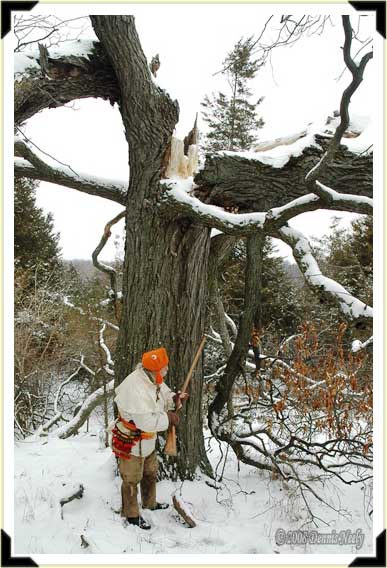
Gray fur bounded from beneath snow-packed twisted branches. The sear bar clicked. The Northwest gun’s tarnished brass buttplate swung higher. The Golden Hick’ry’s broad limbs sheltered underbrush before the fabled tree broke apart, but the calamity enhanced the cover. A cottontail or two made the area around the centuries-old monarch prime rabbit habitat… Old Northwest Territory, two hundred rods from the River Raisin, in the Year of our Lord, 1797.
Goose wings swished in the darkness. Moccasins crept along the earthen byway. At the oaks, the rolling hill took a sharp drop, falling to the edge of the swamp grasses with a steep slope. Moccasins slipped and scooted. Halfway down the west face, four red oaks, all about the size of a rum keg, clumped together. Msko-waagosh sat in the gap that faced north, his wife lurked in the one to the south.
The three trails that wandered across the swamp south of the watering hole converged at the tip of a cedar-tree-covered point that jutted westerly. That trail curved south along the mucky, sedge grass edge, some twenty-five paces distant, then angled uphill fifty paces to the south.
The well-used trail and its feeders were all upwind of the four red oaks. Night’s black abyss ebbed to a dull gray. The cool, crisp air smelled damp and foretold of snow on that November morning in 1796. Both backcountry hunters wore trade blankets, draped loose, not tight.
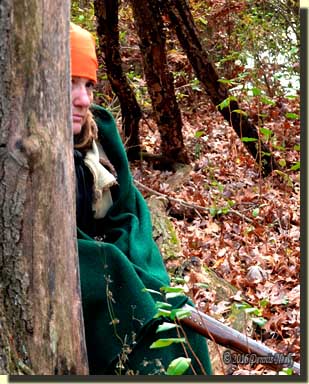 A doe and two yearlings meandered along the far side of the big swamp. The three wove in and out of red cedar trees that lined the bank. The last yearling kept looking back to the north side of the watering hole. In time, the trio melted into the forest.
Geese ke-honked over the oak clump, winging hard to the west with desires on the River Raisin flats. Unseen crows cawed in the distance. Two chipping sparrows flitted from branch to branch on autumn olive bushes dotted with yellowish-green leaves.
A red squirrel ran along the middle branch in the forked white oak to the south. The little critter took a mighty leap into a bushy cedar tree’s crown, scampered down the trunk some, then chased to the next cedar. In time the squirrel disappeared.
Two gray squirrels materialized midway up the white oak. Silver-gray fur and bushy tails spiraled about that tree. The scratching of tiny claws sounded more like a young bear marking a territorial tree. A solitary crow passed over in silence. Leaves rustled as the two squirrels took their frolicking to the forest floor.
Adding to the commotion, another gray leaped from a red oak, tumbled once, took two bounds, then stopped. This squirrel chattered away, then went about digging in the leaves. Dirt flew…a bound…more dirt…two hops…dirt…then a lone acorn. Watching for white-tailed deer seemed irrelevant. The forest jesters stole that 18th-century morning’s attention.
In time, the fracas transitioned to three gray squirrels sprawled on different branches in different trees. Crows flew over, as did geese. Blue jays swooped here and there. The one closest to the four-tree fortress uttered a contented, “Swip-it! Swip-it!” A crimson cardinal perched on a purple switch in the raspberry patch on the point; “Whit, whit, tsu, tsu, tsu, tsu, tsu,” was his song.
With a mutual nod, Msko-waagosh’s wife got to her feet, then stood quite. A few minutes later, the returned white captive who spent his youth among the Ojibwe also rose up. First one, then the other rolled their blankets, bound them with a portage collar and slung them over their shoulders. Single file, separated by a few trade gun lengths, the pair still-hunted to the north in search of fresh venison…
Back in January, I had the opportunity to have lunch with some good friends who share a common desire to preserve our muzzleloading heritage. This was a work session dedicated to focusing on ways to promote the black powder shooting sports here in Michigan. The discussions were frank, creative and insightful. But as always at such gatherings, good-natured kidding and a constant back-and-forth banter hyphenated serious conversations.
Joe sat to my right, and we exchanged jabs about those deep scratches that ruin a perfectly good smooth-bored barrel. He’s a flintlock bench shooter with an impeccable reputation and a bushel or two of medals. Our waitress placed a deluxe burger platter that looked scrumptious in front of him. I had a Cobb salad. Joe said, “My burger ate that green stuff!”
I put my finger to my lips and uttered a soft, “Shhhhhh… Be careful what you say, Joe, you might offend the smoothbore shooters.”
“What are you talking about? That’s just roughage to a fine chunk of beef.”
“It’s a necessity of life to a trade gun shooter. We call that green stuff ‘wadding,’” I said with a straight face.
Green roughage isn’t the preferred natural wadding material of choice, at least not for Msko-waagosh. Black powder is “hygroscopic,” which means the granules attract moisture from the air. If green leaves are used to wad a smoothbore’s load, the black powder starts extracting moisture from the leafy mass, and in a matter of hours, the load becomes “damped.” Damp black powder does not burn well.
Dry wadding material is available all year. Yes, it may take a bit of careful searching. Woodland experience helps in locating leaves and grasses with a low moisture content, but it is my contention that returned captives like John Tanner, Jonathan Alder and James Smith knew what to look for and where.
That morning, two Novembers ago, both “Old Turkey Feathers” and the “Silver Cross” harbored death spheres wadded with dry oak leaves: two rolled in a ball over the powder charge and one rolled leaf over the ball. Depending on weather conditions and humidity, I might keep the same load in Old Turkey Feathers for more than a day. Range testing and wilderness classroom experience have proven the dry leaves will not dampen the load.
When the time comes to change the load, the usual practice is to take aim on an old box elder tree on the east boundary of the North-Forty and discharge the load. This process confirms the flint is sharp, the touch hole is open and the powder still dry. A hang fire, klatch or weak-sounding “Kla-whoosh-BOOM!” sends chills up the returned captive’s spine and indicates a human error that needs attention.
From time to time, the best solution to changing a load is to pull it. I’ve had mixed success with this method. Tanner talks about pulling both shot and round ball loads:
“As I was one day going to look at my traps, I found some ducks in a pond, and taking the ball out of my gun, I put in some shot…” (Tanner, 60)
Here again, I try to accomplish either task with only a gun worm, which is what I believe Tanner possessed. Shot loads pull easy. The gun worm spirals into the wad and pulls it as a solid component. The same worm can dislodge packed shot, then pulls the wad over the powder charge. Removing a round ball tamped firm over a wad is more difficult. Getting the worm to grip the ball is the problem. Once it moves, it usually comes free.
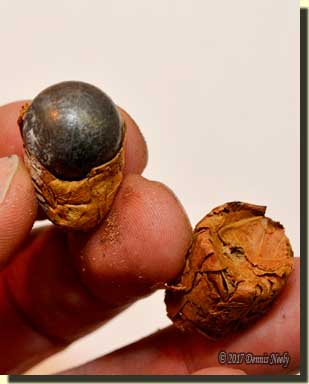 Every once in a while, a wad or wads will pull intact, showing no sign of being disturbed. When that happens, the over-the-ball wad shows a concave depression where it fit over the death sphere. Likewise, the over-the-powder wad shows the same indentation. In essence, the lead round ball is encased in a primitive shot cup of sorts. The only variable present is where the ball sits on the wad in relation to the center of the bore.
Studying how the ball rests within the wad column and observing the thickness of material around the ball, tends to indicate that the ball is centered or almost centered in the bore. I have not pulled any wads that show the ball off to one side. This goes a long way toward boosting confidence when using natural wadding materials.
At the range, the same holds true when using green grass for wadding. When pulling a load to see how well it is seated, the freshness of the material allows the wad to expand, and as a result the concave cup “fluffs up,” but the depression is visible, nonetheless.
Perhaps the end result of all of this experimentation in the wilderness classroom is more questions than answers. And then a little discovery happens along, like the concave impressions in a dry-leaf wad. Sufficed it to say, “Don’t make fun of a smoothbore shooter’s Cobb salad…”
Give traditional black powder hunting a try, be safe and may God bless you.
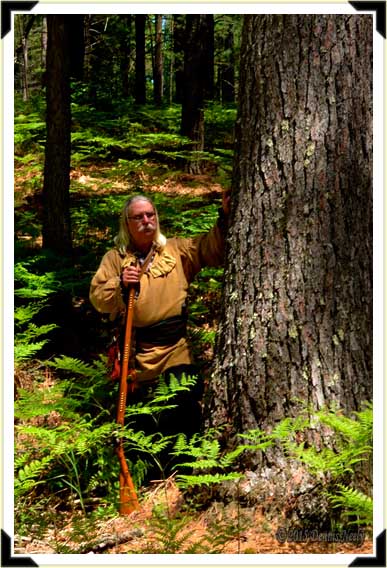
Msko-waagosh meandered through the tall pines that overlooked the Pigeon River in the heart of the Old Northwest Territory. The afternoon scout centered on finding elk sign for the upcoming fall. Several white-tailed deer, two with fawns, crossed the returned captive’s path on that pleasant June afternoon. In the Year of our Lord, 1796…
Damp elk moccasins scuffed away duff. Dew drops clung to the bushy cedar’s bough tips. Sweep by sweep, the nest took shape. Msko-waagosh, the returned white captive who spent his youth among the Ojibwe, sat cross-legged in the depression. A soft fog drifted about, pushed by a warm, humid breath, then an occasional chilly gust. The aroma of moldy cedar needles and disturbed earth surrounded the makeshift fortification. All was well that pleasant August morning in 1796, deep in the Old Northwest Territory.
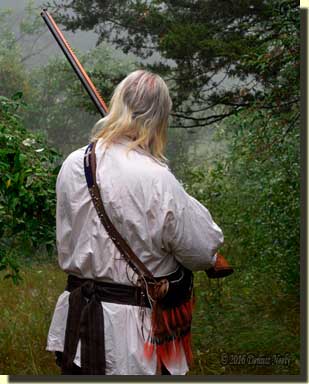 A vigorous scout preceded the welcomed respite. The worn-out moccasins held to the doe trails, but before reaching the meadow, they became damped through. The hand-dyed silk ribbons that bound the flaps of the woodsman’s blue wool leggins displayed a water line. Such discomfort was of little concern.
Forty paces to the north, clumped prairie grass hid a hen turkey. Now and again a gray head popped up, looked about, then disappeared. This bird inched east, circled back, then east again. Overhead, two pairs of Canada geese, separated by a few seconds, ke-honked toward the River Raisin. A fox squirrel navigated a distant maple. Two crimson cardinals bantered. “Tu-Tu-Tu-Tu,” one said. “Whit, whit, tsu, tsu, tsu, tsu, tsu,” the other answered.
About the time a dozen black, darting crows got into a fracas, the hen stepped from the prairie grass. She looked about, took maybe a dozen strides, then stopped as if reconsidering her choice. She uttered two faint clucks: “Ark, ark.” Her head stretched high; her beak turned to the east and in less than a minute her demeanor relaxed. Herky-jerking here and there, the plump wild turkey pecked the ground.
“Clikk, clikk.” A gray-skin head with a hint of red ducked and dodged in the deep prairie grass. The hen stood on the crest of the tiny knoll in the center of the meadow. She stopped pecking and gazed to the west, intent on the area that once sheltered her approach. The new arrival took two paces, then looked…two paces and a looksee…
Two trade gun lengths from the meadow’s short grass, big wings flapped twice. With a hop and long stride, a wild tom turkey sporting a stubbed-off beard appeared. The hen knelt down. The tom fluffed his feathers, then stood tall and stared at the knoll crest. The backcountry hunter’s inquisitive, 18th-century heartbeats marked time as the woodland drama unfolded.
The jake broke into a fast walk. The hen scrunched flatter. The distance between the two melted away. When the sprinting bronze bird got close, the hen stood and started walking east. Before long, the jake was running after the hen as they zig-zagged around the meadow. Their chase angled near the cedar fortress. The hen slowed, then stopped twenty paces distant. The jake stopped, fluffed up his feathers and fanned his tail.
The one-sided dancing, erratic spinning and false posturing lasted but a few minutes. The hen turned to walk away. The young tom folded his feathers and followed. She stopped, glared over her back and clucked once, stern and commanding. “Aarrkkkk!”
They leered at each other, then the tom glanced to the west. The hen took a couple of jerky steps, then went back to pecking the ground. The young gobbler watched and watched. Rejected, he walked to the northeast, up and over the knoll and out of sight…
Pressing farm work filled a recent Monday afternoon. A sticky note from last November made its way to the top of the “to-do” pile. Emails flew through cyberspace. A rendezvous to pick up a large tractor part took shape. The Dodge Ram was on the road by 1 p.m. Much to my delight, Tami felt up to riding along.
Light snow fell, enough to make the landscape beautiful, but not enough to make the driving miserable or unpleasant. We chatted along the way, then she got quiet. She said she felt up to it, and asked if we could stop on the way back at the big-box outdoor store. We usually make that store a day-trip on our anniversary, but she was too ill to travel then.
The paperwork took longer than it did to load the steel frame. Thirty minutes later we pulled into a handicapped parking spot right in front of the main doors. She found a fully-charged scooter and I tagged along for a few minutes as she motored to the clothing section. I then headed to the gun side of the store. Rack after rack of modern guns filled the wall behind the glass showcases. Eight mass-produced, reproduction muzzleloaders hid upright in a deserted corner. The “black powder accoutrements center” occupied eight feet of display space. I had to really hunt to find that section. I never did find the 18th-century clothing racks. Hmmm…
After all of two minutes, I started wandering about. The display of knock-down steel targets was interesting. A $99.00 spinner target with six three-inch paddles would last for six hits from “Old Turkey Feathers.” To be fair, I’ve been asked not to shoot the smoothbore at a couple of silhouette matches and woodswalks, because their steel clangors were not heavy enough for the trade gun’s death spheres. I can accept that.
The boxes and boxes of modern ammunition were mind boggling, at least for me. All I could think was, “What do you do if you buy the wrong ammunition? How do you know what’s safe to shoot?” Then I shifted to my own circumstance. “You have two packed-full muzzleloading cabinets that need cleaning,” I chided. “Where would you find room to store boxes of steel or plastic suppositories?”
With a deep sigh, I wondered how I managed to hunt an entire season with seven round balls and a half pound of black powder, stored in a buffalo horn and a flimsy deerskin pouch. Mind boggling, as well…
Now, I’m a people watcher, so I started observing the local wildlife. A clean-cut gentleman in a tailored suit and black wool overcoat (he had “middle executive” written all over him) stood at a showcase admiring a revolver on a black velvet pad. He and the sales clerk spoke a language foreign to me. Oh, I recognized the English words, but not the context or jargon. What happened to “flintlock,” “smooth-bored” and “grains of FFg black powder”?
That glass case alone displayed 45 pistols, multiplied by six or so cases. I’d have to figure that one long hand; my abacus is at the bead-makers for reconditioning. And scopes? There were six glass cases of those, with about 36 scopes per case (yup, I counted ‘em. Hey, I had time on my hands). The lenses on some of the scopes were bigger than the lens on my good Nikon camera. And $1,000.00 plus for a scope?
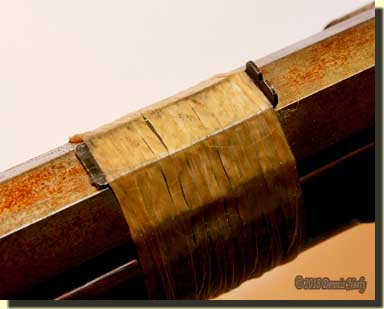 This last fall I made a rear sight for the “Silver Cross,” Tami’s chiefs-grade trade gun, so my grandson could use the smoothbore for hunting deer and turkeys. I didn’t want to dovetail the barrel, so I cut a strip of steel from an old joist hanger, bent it, then filed and shaped it to make the sight. I used artificial sinew to hold it in place. It took all of an hour, and I questioned spending that much time on a rear sight. With a chuckle, I remembered those misgivings as I gazed in amazement at the scopes. I could not help but think, “Five cents for the material and twenty-five dollars in labor (I always pay myself more than I can really earn)?”
Then a fellow strolled through the aisles with a blue plastic shopping basket slung on his right forearm. As he passed by, I counted eight point-of-purchase display cards, most with double-digit prices, before he started heaping items in the basket. Now let’s see, I need to finish making the strap for Mi-ki-naak’s powder horn, create a shot pouch, finish the sheath for the scalping knife… Am I missing something?
A young couple stopped a sales clerk and asked for something I had never heard of. I tried to write down what he said, but it made no sense: “Grandma Tofu mat?” I had to give up that quest. That’s when the thought struck me, “You don’t belong here.”
Not long after, I met up with Tami where the full-bodied elk browse on plastic flowers. I started laughing when she said, “This is disappointing. I feel like we don’t belong here.” Soul mates and kindred spirits…
I don’t know what to make of that visit. Maybe I dialed the wrong year into my time machine? In one respect it bothers me, then on the other hand, it reinforces why I do what I do. I realize this is all in fun, but I will need time to cogitate on the hidden meaning. My head hurts. In the meantime, I’m taking Msko-waagosh to the woods. I told him, “That’s where you belong…”
Give traditional black powder hunting a try, be safe and may God bless you.
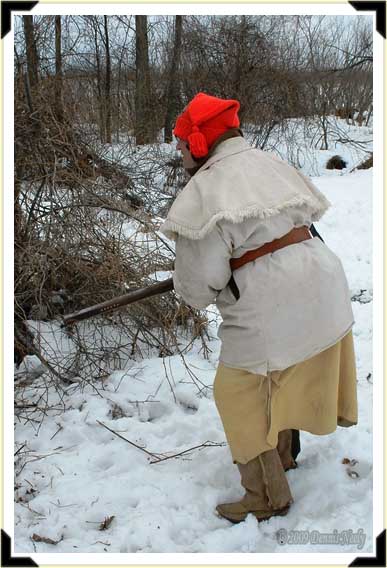
Two hounds bayed in the thicket. A cottontail rabbit bounded into the open, then circled away from the lady of the woods. She watched in great anticipation as the rabbit toyed with the beagles, hoping the furry lightning bolt would streak within range of the “Silver Cross,” her chiefs-grade trade gun. Old Northwest Territory, west of Lake Huron, in the Year of our Lord, 1797…
Trail-worn moccasins whispered in soggy snow. Up on the rise, a blue jay sang a contented morning song: “Swip-it! Swip-it! Swip-it! ”
Sunlight streamed through the hardwoods. The aroma of warm bark perfumed the fresh, cool air. Three steps and the barren glade returned to silence. Three more footfalls, then stiff fingers touched a shag-bark hickory at a pause. “Swip-it! Swip-it!” The blue jay’s melody resumed.
Keen eyes scanned the rise and the ridge crest beyond. The Northwest gun’s tarnished brass butt plate rested on a moccasin. The hollow silence returned as the trudge continued on that glorious morn in 1796.
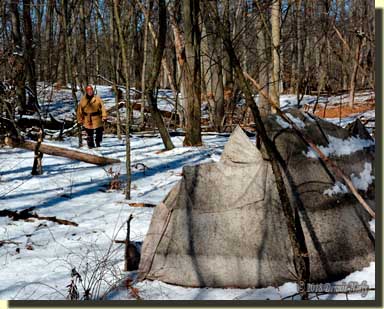 At the tipped sassafras, the next pause brought the little valley into full view. The wigwam’s domed crown appeared jagged and torn. A faster-paced course snaked around the red oak’s splintered trunk and toppled log. The calamity came into full view: grayed canvas, broken cherry saplings and globs of snow caked in shadows that should not be.
Wet snow covered the fleshing beam. Geese began ke-honking near the River Raisin’s sandy shallows. Msko-waagosh concentrated on the canvas shelter and not on where he walked. Barberry spines tore at bare flesh on the woodsman’s left inner thigh. The sharp pain brought a halt to the haphazard advance. The wigwam was gone; the damage from February’s heavy snowfall was too severe to repair.
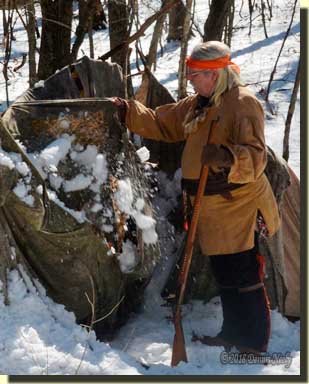 Red Fox circled the downed dome. It appeared that rain wet the covering, then the snow fell, freezing white clumps here and there and binding canvas pieces to the forest floor. The smoke flap hung straight up and down, limp like a fallen battle flag; the prop-pole leaned against the east upper rib the same as it did during the fall hunts.
That side still stood and would have provided an evening of comfort, were it not for the sunset side being frozen flat over the fire pit. A butcher knife cut a few threads that held a canvas panel to a horizontal rib. Pulling the stiff fabric back did little to uncover the cause of the collapse. Broken bents and ribs, some exposed and some hidden, held the remaining three or four canvas panels up.
A few minutes of quiet contemplation and rehashing melancholy memories gave way to the realization nothing could be done until the March thaw. Rebuilding would be left for another day, perhaps in a month or so. With geese ke-honking on the River Raisin, Msko-waagosh decided it was time to move on…
Late one November morning, Msko-waagosh wandered to his wigwam. Raindrops pitter-pattered on fallen leaves. The dome-shaped shelter in the little valley offered a quiet respite from the storm. My alter ego left the flap open, sat to one side and watched the ridge to the south and west for passing deer.
In the height of the rainstorm, I started looking around the wigwam. At the third horizontal rib, one of the bents had cracked and lost its curved shape. After careful examination, I found two other breaks. A few days later, after the shelter dried out, I returned and lashed the wild cherry saplings together.
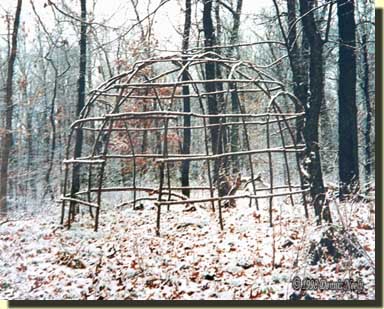 The degree of rot and the speed with which the bents and ribs deteriorated bothered me. The last wigwam saplings outlived the canvas. They survived for five seasons. I abandoned that structure when my persona changed. Unfortunately, the only pictures I have are of the bare frame after a December snowfall. I expected the same longevity with Msko-waagosh’s wigwam, but that is the way of the forest…
My alter egos like to hunt from a period-correct structure. A few years back, the trading post hunter built a simple lean-to patterned off one described by Meshach Browning. My hunter hero called his a “bush-camp,” because it was covered with pine boughs. He noted that the pine-bushes “were very dry…” (Browning, 110)
Cedar boughs covered the rafters of my bush-camp, and they became very dry. I felt a kinship with Browning when I noted that occurrence. The cedar branches also harbored a sizable herd of mosquitoes in the warm months. The smoke from a smudge fire did little to drive off those blood-thirsty beasties. Browning failed to mention that phenomenon, perhaps he did not experience that woodland joy?
“…I made the fire, then stood my rifle against the tree which formed the mainstay of the camp, hung my bullet-pouch, containing half a pound of powder and twenty or thirty balls, on the muzzle of the gun…While the girls were busily fishing, the fire had crept along in the dry grass, and got into the bush-camp, which was burned up, and thence the fire had communicated to my powder-horn. My gun was considerably injured, but not so much as to hinder me from using it…” (Ibid)
Many times the simple act of leaning “Old Turkey Feathers” against that oak’s trunk fostered a pristine moment shared with Browning. Little did I realize the danger I was in when I napped in the pleasant confines of that shelter.
Early in April of 1794, the trading post hunter passed by his bush-camp an hour before noon. The day was sunny and warm, too nice to spend in camp. An hour after noon, my alter ego circled south and again passed by the brush-covered lean-to. It was flat on the ground, crushed by a powder-keg-sized, living limb that tore free for no apparent reason and fell square across the ridge beam. Such is the way of the forest…
A couple of shelters have just rotted away, victims of historical neglect. The canoe-tarp lean-to station camps afforded one season in a chosen location. They were packed up in late December, relocated in the spring and moved again when the snow accumulated.
The “duck camp’s” rafters still stand, but God has reduced its cedar-bough skin to an ankle-high pile of twigs. If I’m not mistaken, a British ranger assigned to Joseph Hopkins Company spent time at that lean-to this past fall. Hopefully, with the help of three grandchildren, that camp will see new life later this spring.
The research surrounding the birth of Msko-waagosh brought with it similar stories of the abrupt end of hunting camps. Early on in his narrative, John Tanner, The Falcon, told of the demise of his own bush-camp:
“We used to hunt two or three days’ distant from home, and often returned with but little meat. We had, on one of our hunting paths, a camp built of cedar boughs in which we had kindled fire so often, that at length it became very dry and at last caught fire as we were lying in it…” (Tanner, 23)
Later in his journey through life, John Tanner lost another “lodge.” He does not describe this dwelling, and oh, how I wish he had!
“…When I returned late at night, after a long and unsuccessful hunt, I found these two children standing, shivering and crying by the side of the ashes of my lodge, which, owing to their carelessness, had been burned down, and everything we had consumed in it. My silver ornaments, one of my guns, several blankets, and much clothing, were lost. We had been rather wealthy among the Indians of that country; now we had nothing left but a medicine bag and a keg of rum…” (Ibid, 67)
But fire was not the only danger. Enter the devious creatures of the glade:
“One day, when I had killed a moose, and gone with all my family to bring in the meat, I found on my return, the wolves had pulled down my lodge, carried off many skins, carrying-straps, and in fine, whatever articles of skin, or leather they could come at. I killed great numbers, but they still continued to trouble me, particularly an old dog wolf, who had been so often at my door that I knew his appearance, and was perfectly acquainted with his habits…” (Ibid, 171)
Tanner tells of the ever-present wolves, as do many of my hunter heroes, and the impact they had on his life and survival. About fifteen years ago, while reading the early remembrances of settlers in this county, I was surprised to read of the commonality of wolves near the headwaters of the River Raisin up through the 1830s. And, until studying Tanner’s narrative, I had no idea of their threat to a woodsman’s lodge.
Like The Falcon, life must go on for Msko-waagosh. The humble wigwam in the little valley will rise up again, after a careful dissection and an appropriate amount of reflection. The loss of this lodge is, after all, another wilderness classroom lesson. Such is the way of the forest…
Give traditional black powder hunting a try, be safe and may God bless you.
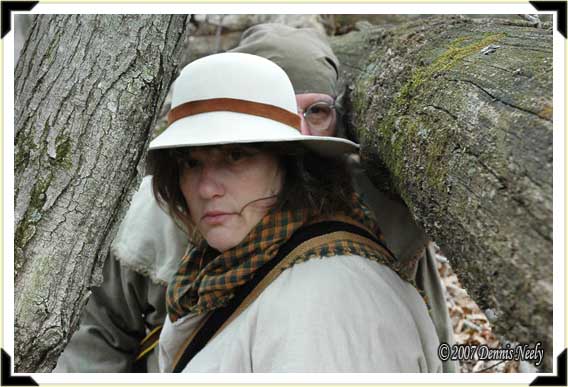
“Gob-obl-obl-obl-obl-obl!” A distant tom turkey answered a single cluck from a wing-bone call. Twenty agonizing minutes later, the gobbler strutted to the top of the knoll. The grizzled woodsman watched the bird’s approach over his frontier wife’s hat brim. Much to the couple’s dismay, a hen appeared… Old Northwest Territory, two ridges east of the River Raisin’s bottom lands, in the Year of our Lord, 1796.