“Snapshot Saturday”

Then the angel said to the women in reply, “Do not be afraid! I know that you are seeking Jesus the crucified. He is not here, for he has been raised just as he said…” Matt 28: 5-6
Then the angel said to the women in reply, “Do not be afraid! I know that you are seeking Jesus the crucified. He is not here, for he has been raised just as he said…” Matt 28: 5-6
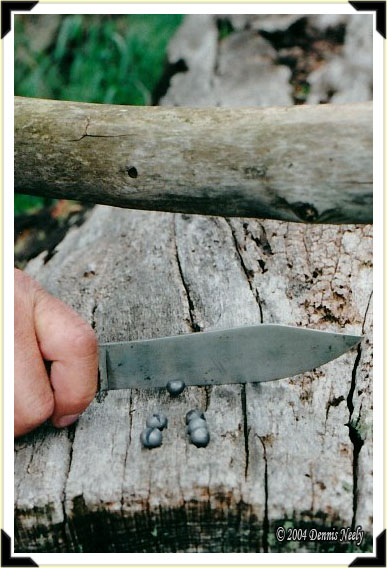
A stout branch taps the back of a trade knife, splitting buckshot for a traditional fishing adventure. Old Northwest Territory near the headwaters of the River Raisin, 1798.
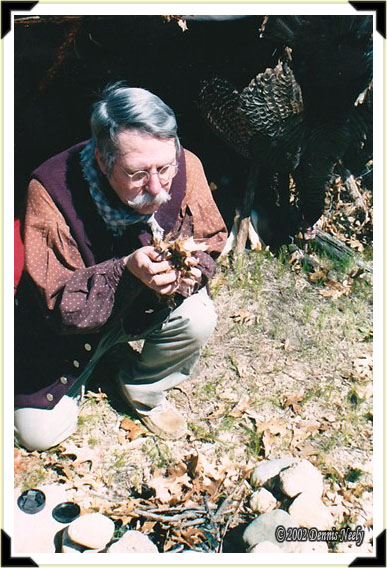
After a successful morning’s turkey hunt, the traditional woodsman brings a glowing ember to life in anticipation of a warm pot of tea. Old Northwest Territory, one hill east of the River Raisin, 1792.
Delicate ice skimmed the waterhole’s edge. A heavy hoar frost clung in the low ground. Faint stars still sparkled overhead. Chilled breaths hung like miniature clouds drifting in night’s last hurrah. Buffalo-hide moccasins whispered along the earthen trail, then ascended a rolling hill.
On the ridge crest a silver, dewy bead tipped each blade of grass. Looking down, the white frosty flakes that coated the hunt-stained buckskin leggins had melted.
When the path forked, the east leg offered the most promise. Cedar boughs clawed at the sleeves of the linen hunting shirt. An unseen twig caught between the frizzen cam and the browned spring, tugged the Northwest gun to the right, then pulled free with a noticeable “pop.” I stopped and stood up straight in a sequestered space between two large red cedar trees.
The English flint snapped to half-cock. I fiddled with the frizzen, making sure it operated as it should. A gentle smile crossed my face, for there was no need for the fuss. The bore held nary a death bee. The pan was devoid of gunpowder. Satisfied, I pushed the frizzen up, eased the hammer down and went on my way.
“Gob-obl-obl-obl! Obl-obl-obl-obl!”
The morning’s first tom called from far off, to the southeast, either atop Fox Hill or from the tall oaks to the north. A second wild turkey answered, farther north, but just as distant. I heard no hens as my moccasins pressed on, venturing deeper into the cedar grove. Despite the stand’s dark shadows, first light caused a noticeable stirring. Cardinals sang, crows cawed and geese ke-honked as they winged toward the River Raisin’s mud flats.
“Gob-obl-obl-obl!”
With little hesitation the other tom responded, “Gob-obl-obl-obl! Obl-obl-obl-obl! Obl-obl-obl-obl!”
Leggins swished as the moccasins circled a favorite haunt, an old cedar tree with broad boughs, encrusted with tangled grape vines. After entering the “vine tree’s” natural shelter, I tossed the blanket roll to the right, then sat cross-legged upon it. As the morning light grew brighter, what little gobbling and clucking the birds offered that second Friday of April, in the Year of our Lord, 1792, diminished to silence.
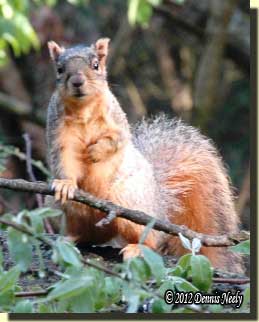 In due time, light beams caressed the upper branches of the oaks on the far hillside. The rising sun’s line edged lower and lower on the hardwoods. Then a plump fox squirrel bounded down the knoll to the north. It dug a bit, scattering dirt and grass, perhaps fifteen paces distant. From its actions, I thought it might come join me in the shadows, but it did not.
A few minutes later, another fox squirrel emerged from the cedar trees to my left. It sniffed around, then sat upright and chattered. The first squirrel approached, and as one might expect, a robust frolic ensued. At one point, the pair ran under the grape vines that touched the ground behind me, on the other side of the trunk. I turned to my right to watch.
When I turned back, greyish-brown fur caught my eye, not that far from where the first bushytail dug. After two lazy hops, I saw the cottontail rabbit full on. It bent forward and nipped a wide leaf of grass, then clutched it in its front paws as it nibbled away. With no wild turkeys to entertain this humble woodsman, rabbits seemed second best.
That morning’s delightful sojourn was a pre-season turkey scout. In my journal I scribbled that “I started a bit late,” and I judge that not by a timepiece, but by when the birds begin tree talk. Some mornings they remain silent and all that a woodland spectator can hope for is the sound of big wings thrashing as the birds fly down. Then sometimes at first light every bronze beauty has to be heard. That morning fell in between, and the memory that stuck in my mind was of the two squirrels and the rabbit’s soft little nose twitching up and down as it devoured that blade of grass.
The other day, a fellow traditional black powder hunter sent me a copy of a rather lengthy thread from the posting of a social-media question regarding taking squirrels and rabbits out of season while on a trek or engaged in a living history scenario. As I read the litany of disturbing posts, the memory of that particular morning played over and over in my mind.
It took me a while to sort out the comments, because some of the more boisterous proponents expressed their opinions multiple times. As one might expect, the responses covered all aspects of the original question from snarky innuendos to matter-of-fact refusal to break modern game laws.
Those who thought it was “acceptable” to take game out of season, less than a dozen individuals, outnumbered those who wouldn’t under any circumstances. Some of the posts didn’t express an answer, one way or the other, but their silence on the issue did nothing to condemn the practice. Regardless of the numbers, the impression their claims leave is that this is a common practice among traditional woodsmen, which it is not. Judging all traditional black powder hunters by the postings of a dozen people is neither fair nor representative.
I don’t know what there is about pounding keys and hiding behind a flat-screen monitor that pumps up peoples’ bravado to the point they want to spew out tales from the dark side, but that seems to be the nature of today’s social media frenzy. In my opinion, first, the question never should have been raised for discussion, and second, there is no room for this lawless attitude in living history or traditional black powder hunting.
The notion of “measured compromise” is a recurring theme woven throughout my traditional black powder hunting writings. Regardless of our chosen era, as living historians we all must engage in traveling back in time within the framework of 21st-century life. As much as we would like, we cannot physically return to the past.
Modern intrusions, be they game laws, jets flying overhead or a garbage truck’s squealing back-up alarm in the distant village, are a fact of each history-based simulation, to say nothing of those circumstances, both environmental and manmade, that pose an immediate threat to a time traveler’s safety.
A traditional hunter is left with two choices, let the intrusion destroy a living history scenario, or learn to evaluate the situation, measure the need for a response, and apply an appropriate compromise that minimizes a transgression’s adverse impact.
Although not calling it “measured compromise,” some respondents alluded to the concept when they spoke of taking sufficient food along to meet the needs of a given 18th-century woodland experience, be it a trek, scout, re-enactment or traditional hunt. And as one individual noted, “Being hungry is period correct…”
By embracing the principle of measured compromise, the choice of abiding by the game laws, as an example, never casts a shadow over an historical simulation, because the choice to conform is made prior to venturing back to yesteryear.
“Choice” is a key word here, because regardless of the specifics of re-creating a hunt from long ago there are always options along the path. As a re-enactor, I make a conscious, and serious, choice when I unleash the death sphere.
From the comments to the social media question, to a person, everyone knew they were violating modern game laws. In essence, each individual made a conscious choice to vacate the historical significance of the moment. To me, this shows a total lack of commitment to living history, to say nothing of being disrespectful to one’s fellow time travelers.
Instead of welcoming the squirrel or rabbit as a bit player in an historical simulation, these poachers willfully return to the 21st century and transform the creatures of the forest into modern intrusions as they ever so briefly weigh the legality of shooting. In a moment of weakness, they allow an intrusion in and destroy what might be a pristine living history memory—and then they gloat about their actions.
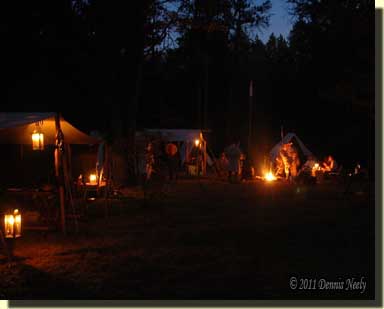 Over the years I have participated in a number of traditional black powder hunting camps. Authenticity and a true-to-life immersion in a meaningful impression are top priorities. The timing of these outings always centers on the open seasons for the game species the participants are most likely to encounter. At every camp, at least one person brings additional food, unless the premise of the camp is to “live off what you kill.”
And out of season, an integral part of any historical trek or scout usually includes provision for food, again, unless traveling hungry is a key element of the scenario. I have not been a part of, and will not be a part of, any activity that endorses “busting squirrels and rabbits for dinner…outta season.”
And what about the young people we are trying to recruit or introduce to living history and traditional black powder hunting? What a wonderful example this sets for them, to say nothing of the great light this shines on the hobby.
What of the lesson that it teaches? If one can pick and choose which game laws to abide by, then what about the other laws that bind a civil society together? If you want a new duck call, why not just walk out of the store with it? If you need to go to the state game area, why not just take your neighbor’s new pickup? Enough said.
Think before you post, be safe and may God bless you.
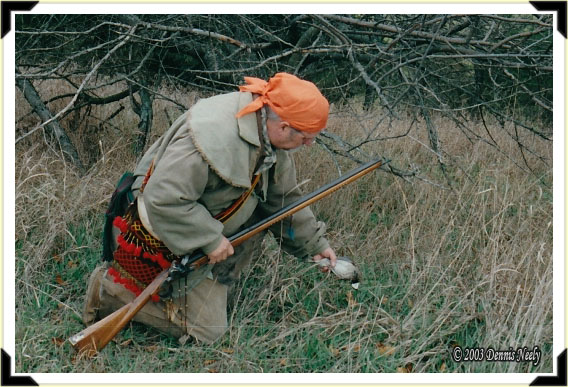
A frantic flush. A quick shot. A bobwhite quail tumbled. White, sulfurous smoke dissipated as the traditional woodsman picked up the downed quail. Old Northwest Territory, 1798.
Well, I did what I said I wasn’t going to do; I killed a few more paper coyotes. For me, a big part of the fun, and sometimes aggravating frustration, of traditional black powder hunting is thinking through a problem and then testing a hypothesis in the field. As so often happens, a set of results raises more questions, and if time permits, it is back to the glade for more wilderness classroom lessons.
The whole point of the “buck and ball lessons” was to see if the buckshot would kill a coyote if the round ball missed. Opportunities are few and far between, so every shot must count. Our purpose is not sport, but rather game management; I’m getting tired of finding piles of turkey feathers and dead fawn skins.
To complicate matters, when a coyote comes to the call it has to be dispatched; if it is missed or detects the hunter’s presence it is not likely to come to that call again. But with the growing popularity of varmint hunting, more hunters are trying to call in these wary animals. Unfortunately, like turkey hunting, calling mistakes or missed shots only serve to educate the coyotes.
So, rather than cut and paste answers to a number of emails the ball and buck postings have generated, I thought an additional post was in order.
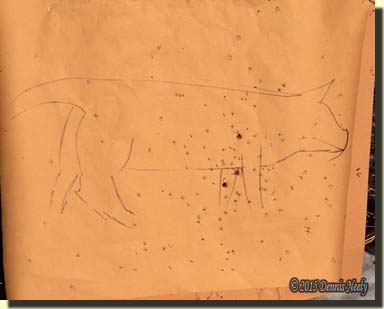
This target tested the “centering” of the death sphere in a birdshot load as described in the third test of this session.
Because the 45 pace (about 42 yards by my pace) results showed improvement with the patched “balanced load” (12-#3 buckshot under a patched .575 round ball) I felt I should try one more time. For these tests, I concentrated on improving the performance of the 45-pace loads.
The first two tests used a bare .610 round ball over eight #3 buckshot, but a patched .610 death sphere is a snug fit even in a wiped, “one-shot-dirty” bore. I started out not wiping between shots, because I was after a period-correct loading method using dry leaves for wadding. To maintain consistency, I continued this practice for the other targets.
But I did not want to deal with a stuck ball, so I broke a cardinal rule of range testing: “Only change one load component at a time.” I made two changes for the next test: I dropped back to a .600 round ball, which weighs 327 grains, and I added a lubed patch. The first change reduced the total load weight from 531 grains to 513 grains, or about 3.3 percent. The second change was made to get a tighter projectile/bore fit in hopes of improving accuracy.
As an aside, one email asked: “…did it hit your point of aim?” On the first 45-pace target (bare .610/8-#3), all three shots were low by 4 to 5 inches. That caught my attention, because I thought the second and third shots at 35-paces impacted a couple inches lower than my point of aim.
Before I started this last set of tests, I fired three shots with just the patched .600 round ball to check the point of impact against the point of aim. I was essentially “right on.” With the buckshot loads at 45-paces, I aimed at the animal’s spine area to compensate. So to answer that question, I am finding a difference: the point of impact is averaging 4 to 5 inches below the point of aim.
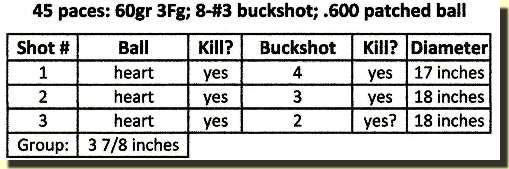 The patched .600 round ball tightened the group from roughly seven inches to four inches, registering three “kills.” The first test produced only one questionable hit in the chest area. Plus, the shots sounded better with more of a “bang” than a “thunk.” I saw no difference in recoil.
The diameter of the buckshot pattern improved over the first test and had more hits, nine as opposed to five, all resulting in potential kills. I did not expect the pattern to change, but it did, and I suspected that was due to increased breech pressure from a tighter fitting ball and the slightly lighter projectile package. I also noticed that the pattern was centered better around each round ball’s impact point.
After thinking about the target, I ran another test. This time I upped the powder charge by 5 grains to 65 grains of 3Fg Goex (equivalent to 81 grains of 2Fg). This powder charge is the most I ever use for hunting, and I use much less for target shooting.
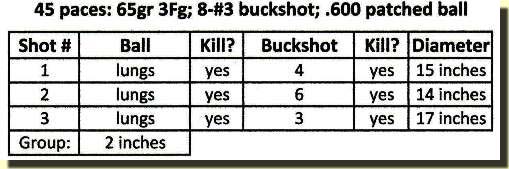 The round ball group tightened up to two inches, forming an almost perfect triangle. I noticed the recoil, but it didn’t seem to irritate my neck. This group maintained the three kills produced by the last test.
Again, the diameter of the eight buckshot improved; the pattern dropped from an average of 17.6 inches to 15.3 inches. The buckshot hits went from nine to thirteen, so patching the ball increased the hits by 80 per cent (5 to 9) and upping the powder charge increased the hits another 45 per cent (9 to 13). The round ball was close to the center of these patterns, too.
This is a small sample to draw conclusions from. I would like to evaluate the results from ten shots, before making any solid statements. But the results are heartening, and I feel well worth the extra range time.
From the previous tests, I had concerns about the location of the round ball in the pattern. After thinking through the problem, I decided to substitute an equal weight of #4 birdshot for the eight buckshot (186 grains). Even though the two targets showed significant improvement with respect to this issue, I went ahead with this test.
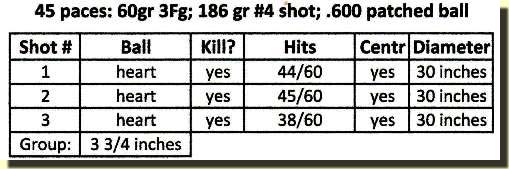 Without thinking, I compensated for the difference of point of aim versus impact point. The first shot hit square in the chest cavity. I marked each birdshot hit with a slash. For the second shot, I aimed at the first hit and the round ball struck 5 inches low. I circled the birdshot and repeated the test. The final death sphere hit about 3 1/2 inches low. In all three instances, the shot pattern spread in a uniform manner and centered around the round ball.
At the end of this wilderness classroom exercise, I have an acceptable buck and ball load that I believe will stop any coyote within 45 paces. This is a huge accomplishment, given the patterns produced by a cylinder-bored gun when loaded with buckshot only. In addition, I have a greater understanding of using a buck and ball in my Northwest gun.
The goal of the lessons was to create a tighter pattern for hunting, as opposed to a broader pattern for warfare. In the future, I would like to experiment with the round ball loaded first, then the death bees. Along these lines, I think it prudent to also test larger-sized buckshot, like that referred to in some of the old manuscripts.
Yes, I still come away with some unanswered questions, and I would like to perfect a period-correct loading method that matches these latest results. But that will have to wait for another time.
Although depleted some more, the bag of #3 buckshot still holds enough shot to disrupt the lives of several coyotes. Right now, I need to collect some furs so I can venture off to the trading post and secure more ammunition.
Give traditional black powder hunting a try, be safe and may God bless you.
A brilliant red cardinal hopped twice. The songster stopped. Its crimson top knot canted to its left. A potential morsel on the thawing earth held its full attention. It hopped twice more, then took flight for no apparent reason. Over the gulley, beyond the tall cedars, another cardinal began to sing: “Whit, whit, tsu, tsu, tsu, tsu, tsu…”
Several “ke-honks” from distant geese moved to the southeast. I wondered if the River Raisin’s channel was open. It wasn’t a couple of days before, but the bottoms were too far to walk just to investigate, at least not that morning.
A lone crow “caw, caw, cawed” overhead. Two others answered off in the direction of the meadow. Then I heard a robust “Cheeeri-leee, cheeeri-leee” at the edge of the hayfield, near the old golden hick’ry, but I couldn’t see the robin.
The rising sun felt warm and refreshing. The air smelled heavy with the scent of melting ice and snow. As I stood pouring out a charge of black powder, I felt the half-frozen dirt become squishy, soft and slippery.
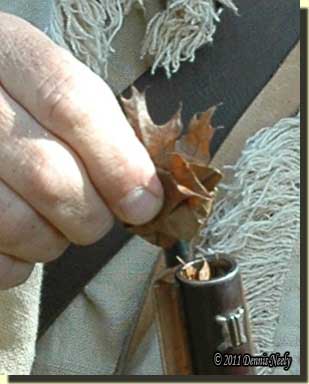 The brass measure clanked against the Northwest gun’s browned muzzle. The cardinals continued their melody. A rumpled oak leaf followed, tamped firm by the hickory wiping stick. Two at a time, I picked lead buckshot from the palm of my left hand and dropped them down the bore. The first four thudded, but after that I heard nothing. I counted to myself in a low whisper: “…nine, ten…eleven, twelve.”
The Canada geese angled southeast, then it sounded like they were circling more north than east. Another leaf wad squeaked a bit as it slid down the fouled bore; the wiping stick thumped three times. I dabbed my right finger in the little brass container, then smeared a bit of lube on a thick square patch. Three fingers on my left hand held the trade gun’s muzzle; my thumb and forefinger positioned the patch over the bore. I centered a death sphere and pushed hard with my right thumb. The wiping stick did the rest.
The robin sounded closer, but I still could not see it. I watched the big white oak longer than I should have, but it was a glorious morning. Black granules glistened in the sun as powder half-filled the pan. The frizzen snapped as it closed. In due time the back of my left hand rested firm as I steadied the Northwest gun’s forestock. The turtle sight found the critter’s shoulder, just behind the right front leg. I exhaled. There was no need for the hunter’s prayer.
“Kla-whoosh-BOOM!
White smoke roiled, then hung in the morning calm. The joyous stench of spent gunpowder bit my nose and left me wanting more. I eased the smoothbore down and canted my head to the right. “Looks like I killed another paper coyote,” I said with a chuckle.
A light frost firmed up the mud overnight, at least enough so I could drive back into the North-Forty and do some shooting. I’ve been trying to thin down my “to-do” list the past few weeks, but it has been hard. I forced myself to take a little time that morning and just get into the woods. I came home feeling I had been on vacation for a week!
The point of the morning’s short sojourn was to continue testing the buck and ball loads in the Northwest gun. I started this series of wilderness classroom lessons back in mid-February, but I was hesitant to continue while the power line crews were still working. Plus, it is amazing how a week slips by, even with the best intentions.
This all came about because I wanted to hunt coyotes, and I felt that my eyesight and the size of the critter’s vital area limited a round ball in “Old Turkey Feathers” to about 45 paces at best. From prior tests, a buckshot-only load was effective to 35 paces. I started experimenting with the buck and ball load in hopes of still killing the coyote at 45 paces if the round ball missed.
I started the second series of tests with a new craft-paper target, stapled over the original cardboard target. In the days that followed the first test, I wondered more and more if a “balanced load” by weight would perform better than the first test results.
From the outset, I would like to make it clear that I am not making loading recommendations here. Every smoothbore is different and the shooter must know and understand what loads are safe in his or her muzzleloader. All I am doing is reporting what process I followed and the results of the tests in my trade gun.
In the first test, I used a charge of 60 grains of 3Fg Goex (equivalent to 75 grains of 2Fg) black powder. I added an oak-leaf wad the size of the round ball (about 5/8-inch in diameter), tamped it firm over the powder and counted out eight #3 buckshot pellets.
From a previous classroom session with buckshot, I learned that four pellets would lay flat against the wad, so I used eight to give two layers. Another leaf wad of the same size held the buckshot in place. I then dropped a .610 round ball down the bore and used the equivalent of a half wad to secure the ball tight. I paid particular attention to making sure all load components were seated tight against the powder to avoid a “short-started projectile package” that might rupture the barrel.
Using a hand-drawn coyote target, I stepped off 35 paces and fired three shots. I numbered each hit with a felt pen and recorded the results. I repeated the test at 45 paces, and followed the same procedure.
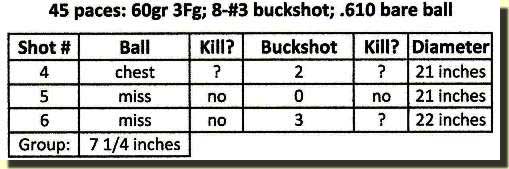 At the time I made some generalizations about each set of results. I did not move much past “what if” speculations, in part due to my disappointment with the 45-pace target. But like always, a few answers led to more questions.
The total load in the first test weighed about 530 grains. My normal turkey load of #4 shot weighs 570 grains, so I used that as a maximum load. I started looking for ways to increase the number of buckshot pellets to twelve, about 280 grains. I had some .575 round balls, which weigh 285 grains, bringing the total payload to 565 grains, just within my limit. I knew a heavy patch would improve the accuracy of the smaller death sphere, the question was “how will the ‘balanced’ load perform?”
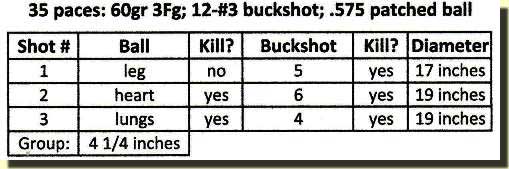
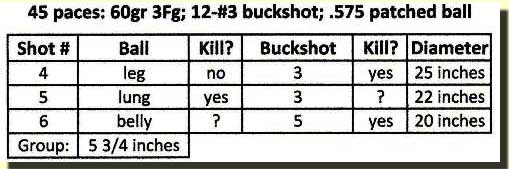
I started down the road of making generalizations, but I knew better. I took the results and plugged them into the four tables above, then began making comparisons. As a traditional black powder hunter, my goal is a clean and humane kill, so why not evaluate each shot on whether it was reasonable to assume the coyote pushed up daisies?
By breaking each load into the two components, a round ball and buckshot, I was able to assess the effectiveness of each “chance” I had to take the varmint. At 35 paces, both loads tallied five kills out of a possible six chances. Looking at the bigger picture, one or more of the components killed all six coyotes.
At 45 paces, the bare-ball load was ineffective, and what really bothered me was the three possible woundings without a kill by the other load component. The balanced load was better with three out of six chances being positive, and all three coyotes taken. Keep in mind that with the Northwest gun, there are no “quick” second shots.
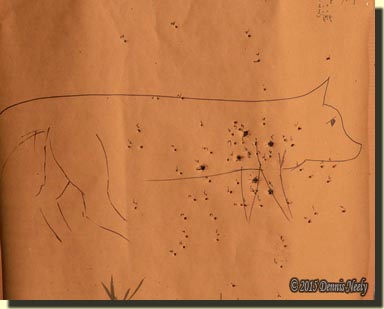 The tighter groups with the patched ball caught my attention. Changing the first load by patching the ball is not a big change, other than the actual load will no longer be “period-correct.” I haven’t addressed that issue, because this whole classroom lesson is about finding the most efficient load for affecting a clean kill on a coyote.
From past experience with my smoothbore, I know patching the .610 ball will tighten the groups and most likely result in at least two additional kills. In the first round, the fifth and sixth shots missed the animal and the accompanying buckshot hits were low. Perhaps this was hunter point-of-aim error? Likewise, a tighter patch on the .575 death sphere might improve the hits with the balanced load.
After studying the targets, two other issues appear. First, if the patterns moved up a few inches with the ball, there would be more lethal buckshot hits and a general improvement in effectiveness. Tightening the round ball group might affect this change and improve the killing potential of both loads.
Second, the greatest percentage of buckshot hits is at or below the impact point of the round ball. This is true on both targets at both distances. This may be a function of the amount of wadding or it might be due to the powder charge, in which case the buckshot load is losing velocity faster than the round ball. A lighter load consisting of a patched .575 ball over eight #3 buckshot might add some insight. Ideally, one would expect the round ball to impact in the center of the buckshot pattern, but that may not be the case with a buck and ball load.
So now I am left with a dilemma. Curiosity is pushing me to test further, but my time is limited and my bag of #3 buckshot is dwindling. The big question is do I spend that time and shot killing real coyotes or paper ones?
Give traditional black powder hunting a try, be safe and may God bless you.
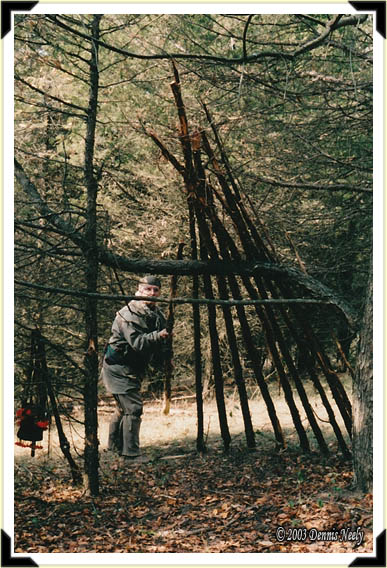
Taking advantage of a low, horizontal limb, a traditional woodsman places another rafter for a half-round, brush-covered shelter. Duck camp, Old Northwest Territory, 1795.