“Snapshot Saturday”
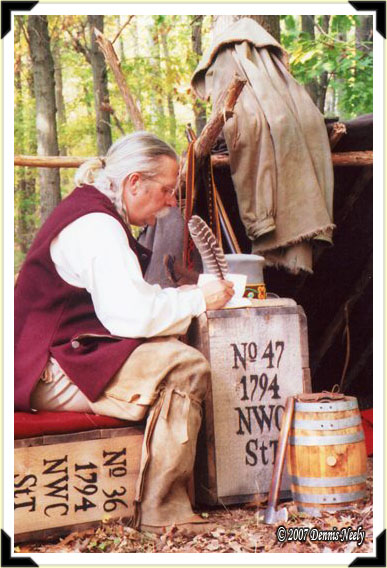
With the River Raisin flowing just beyond the tree line, the turkey quill scratched across a folded page as the morning’s memories found their way into the traditional woodsman’s journal. Old Northwest Territory, 1790s.
With the River Raisin flowing just beyond the tree line, the turkey quill scratched across a folded page as the morning’s memories found their way into the traditional woodsman’s journal. Old Northwest Territory, 1790s.
Anticipation danced about the glade. The still-hunt progressed tree to tree, bush to bush. Trail-worn buffalo hide moccasins depressed damp, winter-weathered oak leaves. Not too distant, a blue jay paid little mind. Autumn olive branches, bedecked with mouse-ear-sized greenery tugged at linen shirt sleeves or tussled with grayed hair strands.
The morning ramble hesitated at two crossed deer trails. In due time, faint moccasin prints marked the westerly earthen byway: up the grade, around the spreading red oak, then along the ridge crest. At a slight dip, an inner voice urged a halt to the scout. I pulled the trade blanket around my bare thighs, scuffed away moldy cedar needles and sat with my back to a forked red cedar tree. The smell of fresh turned earth tickled my nose.
The Northwest gun laid across my lap, unloaded, useless, a mere time-traveling prop. A gray squirrel frolicked to my left, and after a few minutes, two fox squirrels chased about down in the valley at the base of the ridge’s steep west-facing slope. The brass lead holder scribbled on a fresh journal page, recording the overcast clouds, the agitated crows hollering to the south, the geese honking on the River Raisin and the crimson-red cardinal that perched on a bobbing twig, halfway down the hill.
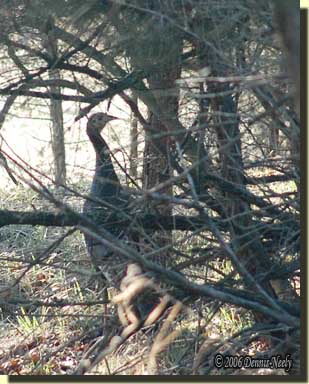 Minutes passed, perhaps ten. My eyes glimpsed a bronze body with a bluish head weaving amongst the impenetrable tangle of autumn olive, barberry bushes and razor-sharp raspberry switches that grew from the valley’s floor. The wild turkey moved with an air of determined diligence.
I lost sight of the bird where the trail begins to rise up into the cedar trees that border the hardwoods. But in a few moments, I heard a soft, crisp cluck, uttered about at the wagon ruts. Ten more minutes passed before I heard a second cluck. The hen’s location had not changed; she was waiting for a gobbler, I presumed.
Quite some time later, after the squirrels had treed, I again glimpsed the wild turkey, returning along the same path. About where I had first seen her, the bird veered away, vanishing into the understory close to a doe trail that leads to the east side of a prominent knoll, a location frequented last year by a nesting hen.
Immersed in the midst of an 18th-century adventure, it is sometimes difficult to heed an inner urge to “sit and stay.” Such inklings come and go at the oddest times in the heat of a simple pursuit. More often than not, if they slip by too fast and/or go unheeded a calamity awaits, sometimes significant, sometimes minor. I view such intuitions as a form of earned kinship with the tenants of the wild.
On that particular pre-season turkey scout, I felt relaxed, excited, in tune with the forest and my alter ego’s inner being. When I minded those inner whisperings and took a seat against the forked cedar, I found myself rewarded with an outstanding performance by the woodland creatures. As a bonus, I gained greater insight into the habits of a nesting wild turkey hen and her tending gobbler. I stored that knowledge away for future exploitation.
After the hen wandered back to the nest, I struck off to the west, following the ridge. When I emerged from the cedars at the wagon trail, that same inner voice suggested I check on the brush shelter, not too distant. I thought it strange at the time, because that shelter does not “fit” the new persona I have been developing. But, that morning’s circuitous route could meander that way, so I once again heeded the inner voice. I found the shelter in fine shape. On the way back to the truck, I kept wondering why I needed to check the shelter.
Later that morning the telephone rang. At the time, I was engrossed in editing an upcoming traditional black powder hunting feature story for Woods-N-Water News that included mention of the shelter. A subcontractor for the power company wanted to do some preliminary work for a pole replacement project to the high-line that runs diagonally through the North-Forty. We agreed to meet in an hour, back in the woods.
In 21st-century terms, the two-track that I refer to as “the wagon trail” in my 18th-century journal leads to the work area and passes within viewing distance of the brush shelter. When I drove by, I glanced at the shelter. In my mind, I thought something was amiss, but my overriding concern was meeting up with the line crew.
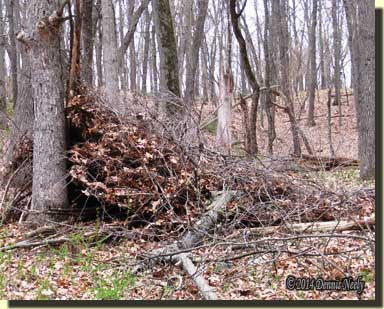 On the return trip, I stopped at the fork in the road and walked back into the woods. The shelter was half flattened, and the closer I got, it became obvious a sizeable oak limb had dropped across the ridge pole.
Earlier in the morning, not four hours before, the wind began to pick up as the historical me circled back and crossed time’s threshold. It blew hard enough to garner my attention about the time I was talking to Mike on the telephone. As I stood looking at the damage, I surmised the gusts were just too much for the limb, given the limb’s rotted heartwood. To say the least, I was a bit unnerved.
When I built the brush shelter, I tried to follow the scanty instructions Meshach Browning left in his journal for what he called “a little shelter, made of pine bushes.” (Browning, 110) One of my first chores was to select a location. As a part of that process, I walked around the area and looked up at all of the trees, searching for “widow-makers,” or damaged branches that might come down with dire consequences.
I thank God I was not sitting in that shelter at the time or worse yet, a traditional hunting guest, Tami or the grandchildren. Over five-plus decades of woodland adventures (not all as a traditional black powder hunter) I have witnessed a number of trees or limbs fall unexpectedly. On more than one occasion, I have leaned against a tree and had it topple, and I have pushed some over, too. But this is the first time a forest abode has borne the brunt of the catastrophe.
I had hoped the trading post hunter persona could continue to use the shelter, but that remains to be seen. Perhaps the message is it is time to move on and leave an unfortunate disaster behind?
Give traditional black powder hunting a try, be safe and may God bless.
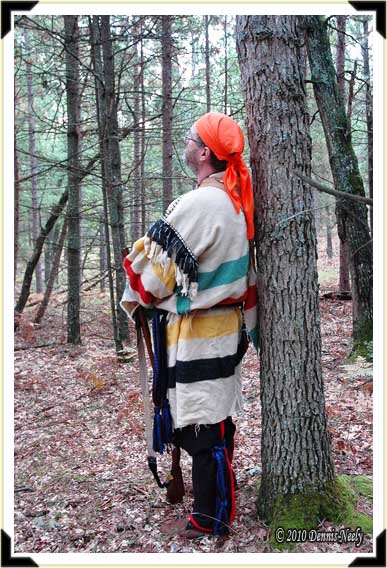
A black squirrel hugged a thin branch. Traditional woodsman Joe Brown watched and waited for the squirrel to move. Swamp Hollow, Old Northwest Territory, 1780.
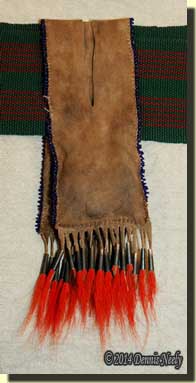 The split pouch project has been added to the “How-to” pages. Again, the introduction page gives the background and considerations that went into the design of this particular split pouch. The style is simple and utilitarian.
The number of existing split pouches from the 18th-century is very limited, and this pouch is not an exact reproduction of a known artifact. However, it does display the basics of the accoutrement type and size with a specific emphasis on similar work attributed to the Odawa and Ojibwe in the Great Lakes region from about 1785 to 1800. As promised, the aging techniques used on the pouch are included, and from the responses I received with the last posting, future posts will deal with other methods of aging.
Be safe and may God bless you,

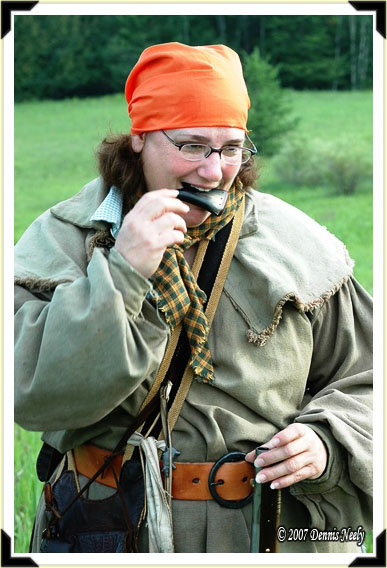
With her Chief’s grade trade gun loaded, Tami Neely reached for the flat priming horn she gripped in her teeth. Tennessee red quail hunt, Michigan Outdoor Writers Association Rogers City Conference, Old Northwest Territory, 1790s.
 This week’s blog post comes in the form of an addition to “The Basics” section of the web site, and is entitled “A Progression of Age and Use.”
As sometimes happens, a simple essay veers in an unexpected direction. In this case, a few paragraphs about artificially aging a new split pouch seemed inadequate and possibly confusing for the reader. The best alternative to expanding on the thoughts was to dedicate a separate essay and do better justice to the topic. Enjoy…
Give traditional black powder hunting a try, be safe and may God bless you,
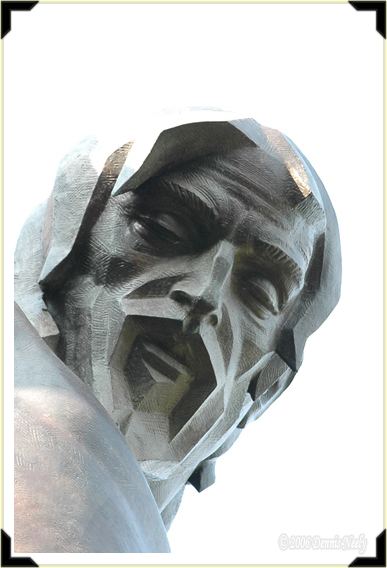
After the sabbath, as the first day of the week was dawning, Mary Magdalene and the other Mary came to see the tomb. And behold, there was a great earthquake; for an angel of the Lord descended from heaven, approached, rolled back the stone, and sat upon it. His appearance was like lightning and his clothing was white as snow. The guards were shaken with fear of him and became like dead men. Then the angel said to the women in reply, “Do not be afraid! I know that you are seeking Jesus the crucified. He is not here for he has been raised just as he said… Matt 28: 1-6. Marshall Frederick’s bronze sculpture of the “Man on the Cross,” The National Shrine of the Cross in the Woods, Indian River, Michigan.
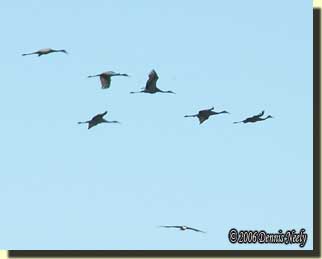 Thirty two Sandhill cranes winged overhead. Each day the groupings grew bigger, and the chortling and gurgling increased. The cranes spent more time in the air and less in the fields, presenting a clear sign winter was not far off. The sky was bland and ordinary that morning, the air calm and chilly, smelling of dry oak leaves. It was late-November, in the Year of our Lord, 1797.
My back rested against the three-trunked maple, where the tall forest trees meet the shorter, thinner saplings of the river bottom. The River Raisin beckoned, as it so often does, but I sat still and fought the urge to get up and wander about in the bottoms. If they came through, the deer would arrive soon. Dawn broke late. Still-hunting could wait.
The deer never ventured into that part of the woods. I sat stone-faced, not moving a muscle. I breathed slow, imagining dozens of whitetails, all with large antlers, wandering along the trail that angled to the west and into the impenetrable cattails, but to no avail. Six blue jays came and went along with several cardinals and a host of flitting sparrows, all silent, all seemingly unaware of my presence. A plump fox squirrel captured my attention for a good long while before I drifted into prayer.
Some days the trials and tribulations of 21st-century life burden a weary time traveler, interrupting any and all attempts to journey back to yesteryear. At other times, the gentle slide into the 1790s becomes an abrupt, unexpected free fall, as if a moccasin lost its footing on a mossy rock, sending its wearer over the precipice.
That particular morning I crossed into 1797 in a peaceful manner and frolicked for a while. I became caught up in the signs of winter. I counted the Sandhill cranes and the blue jays to pass the time. The mental exercise washed away what little remained of the present and secured a magnificent aura of the past. Yes, putting fresh venison in the freezer was the main objective, but, as happens once in a great while, the morning turned into a soul cleansing walk before the Creator.
With little forethought, I got to my feet, slung the bound bedroll over my shoulder and struck off into the Raisin’s bottomland. I never checked the Northwest gun’s prime; it hung at arm’s length like a tag-along afterthought. The prayer continued in the midst of the usual two-steps-and-a-pause still-hunt. At times, the words were whispered and at others they simply passed through as conscious thoughts. An hour or so later, I left my forest Paradise calm and refreshed, at peace with life.
Last week I had occasion to pull out my file on Madame La Framboise. I was researching the date of her husband Joseph’s death in preparation for an early-summer trip to Mackinac Island.
I first encountered Mme. La Framboise in the cardiac intensive care family waiting room of St. Joseph Mercy Hospital in the fall of 1995 (Johnson, 108). That first introduction resulted in an ongoing discussion that eventually led to awareness of the portage between the River Raisin and the Grand River. From my readings, I believe it is likely Mme. La Framboise and her canoe men journeyed along the River Raisin, passing through the North-Forty in the early 19th-century.
Marguerite-Magdelaine Marcot was born in 1780 to a French-Canadian fur trader, Jean Baptiste Marcot and Marie Neskech, the daughter of Kewinaquot (Returning Cloud), a celebrated Odawa chief. She married Joseph La Framboise, another French-Canadian fur trader about 1795 in the “custom of the country.” The marriage was formalized in July of 1804 by Father Jean Dilhet at St. Anne’s Church on Mackinac Island. The La Framboises’ fur trading business prospered, and Magdelaine became known as “Madame” prior to Joseph’s untimely death in 1806.
Accounts of Joseph’s death vary, but in the fall of 1806 Joseph, Magdelaine, their young son Joseph and their voyageurs began the return trip from Mackinac Island to their fur-trading post on the Grand River near Lowell, Michigan. About a day out of Grand Haven, at an evening campsite near a Potawatomi village, Joseph knelt for his nightly prayers. While praying he was stabbed to death by Nequat, a villager who was upset at Joseph’s refusal to trade liquor. After burying Joseph near Grand Haven, the courageous Mme. La Framboise continued on to the winter trading post and became one of the most successful traders in the Upper Great Lakes region.
My Mme. La Framboise file contains copies of every account I have found on her life. But, when I rummaged through them last week, I noticed a detail that had eluded me: they were devout in praying the “Angelus,” a devotional prayer. Some observers noted that they stopped at the appropriate hour to offer the prayer three times a day.
I knew both Joseph and Magdelaine La Framboise were Roman Catholic, Joseph by birth. About age nine, Magdelaine’s mother, Marie (I find no documentation as to whether she was a convert), allowed her to receive religious instruction from the Jesuit Fathers who were missionaries in the Old Northwest Territory. One account says her religious education included tutelage at a convent in Montreal. As her prominence in the fur trade grew, Mme. La Framboise became a benefactor for St. Anne’s Church on Mackinac Island.
So often when I reread a narrative, or as in this case, a series of biographies, I discover a hidden story that slipped by on the first or even second reading. The notation of praying the Angelus is such an occurrence, yet it appears in several of the accounts—perhaps stemming from different writers citing the same document.
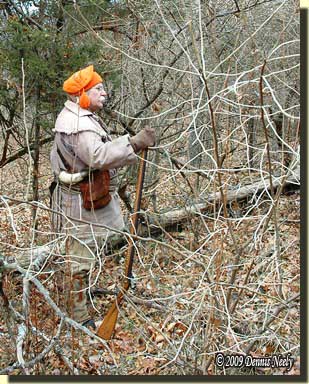 As I cogitated about the La Framboises’ religious piety, I recalled that late-November morning when I prayed through a still-hunt in the river bottom. That has happened a few notable occasions over the last three-plus decades. Such circumstances are as important to me as downing a fine stag or besting a wary gobbler.
For me, the Lenten season is a time for reflection, repentance and rededication. On that day, the 18th-century post hunter carried a copy of the New Testament in his hunting bag and engaged in a long wilderness prayer. The historical me’s religious thoughts, prayers and practices mirrored those of the modern me—adjusted slightly in verbiage to reflect my best understanding of 1790 religious practices.
As one might expect, my Lenten reflections have centered on the modern me, not the historical me. As Holy Week progresses that has changed, due in part to the devotion of Joseph and Madame La Framboise. The light of their example, reduced to a sentence or two in modern times, has traveled across eternity’s abyss and impacted the life of at least one traditional woodsman, and maybe more.
In particular, as the returned native captive persona takes shape, I realize that I must address the religious beliefs of this new alter ego. To some degree that has happened, because I am still trying to include a copy of the New Testament somewhere among his material possessions. All along, I have been aware that this character’s world view spans two distinct cultures and that a meaningful portrayal must account for that fact. But for now, at least during Holy Week, the emphasis has switched to religious beliefs and practices. What a glorious,daunting and uplifting challenge…
In this Easter season, be safe and may Christ’s light shine upon you.