Cavorting About the Section Oak

Life’s burdens weighed heavy. Snowy flecks drifted to and fro from soft, gray clouds. Through the window’s frosty pane, a distant oak, bare of fall’s splendor, offered a brief respite. Resistance proved futile, and after a flurry of haphazard dressing for November’s chill, my moccasins whisked away from the homestead’s warm fire. My being crossed time’s threshold before the bottom of the first big hill, plunging my alter ego into the Year of our Lord, 1796.
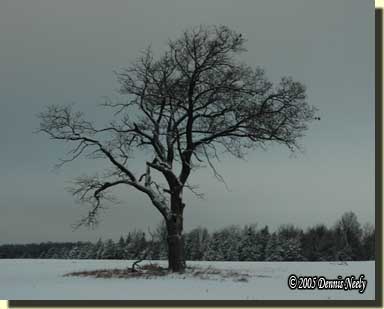
The old red oak tree standing bare on a gray winter's day.The sojourn’s pace slowed partway up the next rise. The goal was the old section oak that stood guard over the corn stubble. The closer I came to the hill’s crest, the more I crouched forward, until the hill’s curve forced me to pause and place a knee in the sparse, dust-encrusted snow.  To the north, six or eight antlerless whitetails of varying ages meandered about the meadow’s southwest corner. Half crawling, half waddling, my course turned due west until the prairie grass that encircled the monarch’s broad trunk blocked the deer from view. I hastened to the section oak, holding the Northwest gun tight across my chest, watching the meadow and the adjacent cedar grove.

Kneeling at the tree’s base, I slipped the portage collar from my shoulders and placed the blanket roll between two roots spaced about the same as a fine Windsor chair’s arms. The smaller of the two seven-point bucks that crossed this field each night walked around the tip of the gully at the meadow’s west side, the gully I so dearly love to hide in when calling wild turkey toms. To my delight, the gentle breeze began shifting to the northeast as I watched the young buck paw for lost cobs.

With a twitch of his tail, the buck jerked his head up and began plodding toward the browsing does. Two fast puffs of steam blew from the largest doe’s nose. The buck stopped; the pair stared, not friendly, rather cold and icy. Two more puffs followed, but I could hear no snort. The buck looked down and pawed at the ground like a pensive farmer at an auction, deciding whether to nod ‘yes’ or shake his head. The buck chose the latter and turned away.

A few steps to the south, the buck glanced back, then made a quick hop and a bound before striking the trail that angled upwind of the section oak. With the tree at my back, I scooched to my left, eased the trade gun around the trunk and adjusted my rump until my left elbow rested firm on my left knee. Quartering right, 80 or so paces out, the seven-pointer stopped, and it was then that I realized nightfall loomed close. It appeared that the buck was waiting for the security of the darkness I dreaded.

My back ached and my muscles throbbed by the time the young buck decided it was safe to venture through the old cornfield. At 70 paces, just inside “Old Turkey Feathers’” effective distance, I consider taking a shot. I prayed for a “clean kill or a clean miss,” as I most always do. With the trail passing within 20 paces of my lair, I pondered the situation and chose to wait for a better shot.

Out of the corner of my eye I caught the movement of three deer running on the hill two hills to the east. The buck saw them at the same time I did. He stopped walking, and stood stiff-legged, chest on, one of the hardest shots to take and one I had no interest in. The three whitetails hesitated just as the hill rolled into a gentle valley. What looked to be the other seven-pointer pranced not far behind. At that instant I feared the evening hunt was over.

The two young bucks cut the older doe from her summer fawns and proceeded to chase her all about the corn stubble. She seemed to have no interest, but never left the field nor ventured too far distant. The frolic reminded me of hunting bobcats and how the older cats toy with the baying hounds, pulling up until the dogs get close enough for a nose-full of hot scent. Well after dark, when the three cavorted off into the cedar grove, I retraced my early evening steps and passed through time’s portal once again.

Pleasant Relief

For a traditional black powder hunter, reminiscing about a joyous November evening offers pleasant relief from July’s sweltering heat wave. Rare does a day pass that I don’t wish for a romp in my 18th-century wilderness Paradise. Of late, the sweltering heat of early morning has dissuaded me from that endeavor. A full docket of 21st-century responsibilities doesn’t help matters, either.

In rummaging through the Falcon’s (John Tanner) journal in search of a specific passage for another writing project, I happened upon a brief entry that sums up my feelings of late:

“…I remained for some time entirely alone about the trading house. The trader, whose name was M’Glees, at length took notice of me, and invited me to live with him. He said so much to induce me to leave the Indians, that I felt sometimes inclined to follow his advice, but whenever I thought of remaining long at the trading house, I found an intolerable irksomeness attending it. I felt an inclination to spend all my time hunting, and a strong dislike to the less exciting employments of the men about a trading house.” (Tanner, 80)
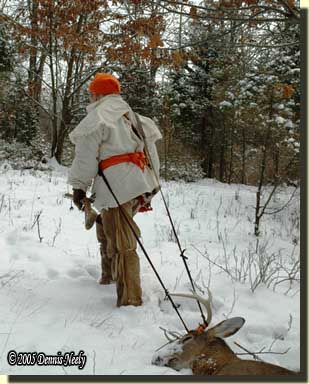
Dragging a deer on the snow using a portage collar.Now I don’t feel “an intolerable irksomeness” for my responsibilities, and I love my work, but what struck me was the Falcon’s “inclination to spend all my time hunting.” So many days I find myself forced to stifle the woodland wanderlust that burns within my being. I don’t like doing that, but controlling that pesky little angel that sits on my shoulder and whispers “go to the woods” is part of being a responsible adult and family man. I am just thankful that I can still get afield when time allows—many folks can’t.

That November evening hunt was not that long, an hour and a half at most. But in that short time I witnessed many wonderful forest happenings and each helped cleanse my soul of the day’s stresses. In an 18th-century context, that was a workday environment, and when the buck loped off to the east without a chance for a shot that would have been a period-correct stressor.

I suppose not feeling the pressure of “a bad day at the wilderness office” is an indication of 21st-century life intruding on the true-to-life hunting scenarios that we all pursue. At any rate, an hour or so just came free tomorrow morning, and rain or shine, I plan to wander through time’s portal and seek my fortune in the Old Northwest Territory.

Take an hour and step back in time, be safe and may God bless you.
Posted in Deer Hunts, General, Scenarios | Tagged , , , , , | Comments Off on Cavorting About the Section Oak

Oh, the Folly of Slackers!

A mature doe standing behind a red cedar tree.A shadow darkened a sunlit cedar trunk. Elk moccasins paused, just before a sleek doe stepped into view. With ears twitching, the cinnamon-colored deer looked left, down the hill, then up the trail that ran beside the cornfield. She sniffed, then in aggravation swung her head around and chewed at the flies swarming around her shoulders. She took another step, still sequestered in the morning’s long shadows. The air smelled plain, like it does some days in late March, but this was early July, in the year of our Lord, 1795.

I felt the ax handle press against my own collar bone, just as the Northwest gun does when the leaves change and I spy a whitetail before it discerns my human form. A young cedar tree, barely head high, stood between us. I sensed the casual breeze and knew I was safe from detection and free to watch. I anticipated seeing a spotted fawn, maybe two, but such was not the case.

The green blades of prairie grass shimmered with a thin, silvery coating of fresh dew. A red cardinal winged across the trail, then disappeared in a tall, full-boughed cedar. The wind rustled leaves on the corn’s drought-stunted stalks. Without thinking, I rolled the ax handle in my hand to ease the throbbing. I suppose that, too, is not unlike my penchant for tracing circles on the trade gun’s hammer screw while I await a deer’s next move. The doe never saw, but instead strolled off into the cedar grove.

A few footfalls down the trail I paused again, this time to marvel at the orange blossoms on a bushy butterfly weed. I wondered where the yellow and brown butterflies were, but a woodcutter’s lot is not to dally, but rather proceed on to the day’s work. I straightened and looked about. A wild turkey’s head popped up some distance to the south, next to a patch of milkweed yellowed by scorching days and rainless nights. Again I waited until the gray-headed hen turned her attention back pecking.

Deer flies buzzed about my headscarf, but the salt-stained cloth kept the little beasties from burrowing into my long, gray hair. I glimpsed the top of the next tree to fall, down the hill and around to the left, and in that instant I envisioned the morning sun sparkling off the River Raisin, not that far distant. In my mind I saw geese and swans and wood ducks paddling amongst the lily pads and cattails. I heard the ash paddle slip quiet into the river’s tepid water and saw the ripples stream from the canoe’s bow. Oh, the folly of slackers!

The evening before, with arms weary from wielding the ax, I cleaved the lower branches from the next tree in preparation for that morning’s task. The felling ax struck hard. The trunk shook. Yellow sapwood chunks flew. With each blow, dead “needles” cascaded earthward like a heavy, prickly snow. As the felling notch took shape, sweat beaded on my brow; droplets began dripping down the nape of my neck.

Before starting the first side cut, I stepped back, leaned the ax against the trunk and pulled the drab-green cloth from my head. Sweat moistened the lower edge, a ways from the telltale white salt line that marked the intensity of past work sessions. I shook free the brown needles that stuck to the crown and hid within the folds. Without thinking I wiped the perspiration from my forehead with the cloth. I thought about hanging it on a nearby branch, but persistent deer flies changed my mind, as did a conscious consideration of the blizzard of needles yet to fall. I sipped water from a pewter flask, the one my father gave me, poured a few precious swigs into the cloth and rubbed the water into the fabric, knowing it would cool my head. I then set about cutting the next notch.

“I see you prefer a head scarf…”

About two years ago an evening campfire conversation turned to period-correct hats. Each traditional hunter shared why he chose his hat; most cited solid historical documentation for his persona’s choice. One of the traditional hunters looked at me and said, “I see you prefer a head scarf?”

As we sat, I was bare headed, as were the others around the crackling yellow flames. The comment took me a little by surprise, not that the statement was offensive, but rather that I had not thought about it in a long time. He went on to say that he based his opinion on his careful scrutiny of the photos that accompany my scribblings and those in the albums that I have available for guests to browse at the outdoor shows.

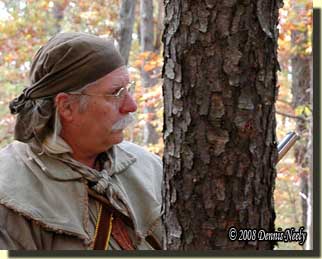
The cloth scarf covers the hunter's head.I started wearing a head scarf to comply with hunter orange regulations, because it was the least intrusive solution for my 18th-century hunting scenarios. Plus, my orange knit cap was too warm for the fall hunts. The choice was also driven by financial considerations. At the time, my best understanding of a common Great Lakes hunter in the 1790s suggested any number of felt hats, but the documented varieties all sold for way more than I could afford.

The head scarf option came with the right price tag, but not without some concerns. From the documentation that I had, the use of head scarves seemed to be indicative of a strong Native American influence. Portraying a hunter providing meat for a somewhat remote trading post, my persona would have been in constant contact with the Potawatomi, Ojibwa and Ottawa peoples, but there was a concern in my mind about the commonality of the use among hunters of English descent.

For example, in 1763, the former Indian captive, James Smith, was appointed captain of a company of rangers charged with defending the settlement in the Conococheague Valley. This passage from his narrative is often cited to document the use, but the reference is steeped with Native American overtones and intended deceit:

“As we enlisted our men, we dressed them uniformly in  the Indian manner, with breech-clouts, leggins, mockesons, and green shrouds, which we wore in the same manner that the Indians do, and nearly as the Highlanders wear their plaids. In place of hats we wore red handkerchiefs, and painted our faces red and black, like Indian warriors…” (Smith, 121)

And describing his adoption ceremony into his captor’s family, Jonathan Alder included a brief statement about the clothes his new Shawnee mother provided:

“…she brought out a new suit of clothes that I suppose she had been preparing for a week before. I was dressed all up from head to foot with the finest of goods in perfect Indian style: brand new moccasins very ingeniously made and covered with beads and silver buckles, and a silk handkerchief tied on my head.” (Alder, 45)

Other references exist, but all possess these same Native American connections and I have not found any that state otherwise. In addition, there seems to be a sinister perception, a sort of “bad boy” image, associated with the head scarf, perhaps attributable to Simon Girty? I do not wish my portrayal to cross that line, but the association appears to be contained within the living history community, so I let it go, for now. In any case, the captive narrative of Oliver M. Spencer tells of his meeting Girty and notes that he wore a head scarf:

“…he wore the Indian costume, but without any ornament; and his silk handkerchief, while it supplied the place of a hat, hid an unsightly wound in his forehead…He boasted of his exploits, of the number of his victories, and of his personal prowess; then, raising his handkerchief and exhibiting the deep wound in his forehead (which I was afterwards told was inflicted by the tomahawk of the celebrated Indian chief, Brant, in a drunken frolic) said it was a saber cut which he received in battle at St. Clair’s defeat; adding with an oath that he had ‘sent the damned Yankee officer’ that gave it ‘to hell.’ He ended by telling me that I would never see home: but if I should ‘turn out to be a good hunter and a brave warrior I might one day be a chief.’” (Quaife, 92-93)

A head scarf is lightweight, easy to fold, easy to stow when not needed and cost effective. It does not shade the sun like a broad-brimmed felt hat does, but my alter ego prefers to traverse the glade in the shadows, rather than in the open prairie for all to see. It keeps my hair clean and dry, and in warm weather, a wet head cloth cools and refreshes. A workman’s cap might serve the same purpose, but after years of satisfactory use, I find a head scarf hard to give up.

I usually wear the scarf folded in a triangular shape with the tails tied in the back (“pirate-style” seems to be the current derogatory term for this practice), but I have also experimented with wearing it “turban style:” rolled tight, wrapped around the forehead and tied in the front. Both styles, along with other variations, appear in the sketches of Potawatomi chiefs, warriors and hunters done by George Winter (early 19th-century). The illustrations seem to show scarves of greater size than the common 36-inch by 36-inch square, but are consistent with a description of the appearance of “Ravening Wolf” contained in Captain Johann Ewald’s Diary of the American War: A Hessian Journal:

“…With great skill, he had wound around his head a silk scarf, which was fastened with silver clasps…” (O’Neil II, Vol. I, 56)

But in the true nature of this fantastic hobby, my thoughts and understanding are constantly changing, constantly moving forward.

Give traditional black powder hunting a try, be safe and may God bless you.

Posted in Clothing & Accoutrements, Persona | Tagged , , , , , , , | Comments Off on Oh, the Folly of Slackers!

The Meadow Fawn

Deer flies swarmed about. A dead cedar branch clawed at a hunt-stained buckskin leggin, then swished the air in its vain attempt to belay an interloper. Silvery dew drops splattered linen sleeves as elk moccasins stalked uphill in that morning’s cool humidity. A red squirrel hopped across the winding doe trail, abandoned for summer travel. A wild turkey hen putted at wayward poults, somewhere close to the ancient red oak where a red-tailed hawk once swooped at a dashing fox squirrel.

That doe trail parallels a deep gulley on the south side. Near the point where the ravine’s crooked fingers join, the earthen path veers around the southernmost wash and emerges from the tight-packed cedars at the meadow’s edge. As I looked up ahead, light spears from a rising sun flooded through the cedar boughs. Even with the jaunt’s slow pace, sweat drizzled down the back of my neck.

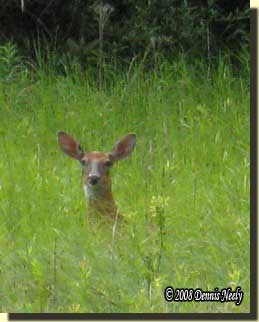
A fine doe standing neck deep in prairie grass.There was no definitive purpose for that 1795 ramble in the Old Northwest Territory, other than time travel, but that does not absolve a woodsman from exercising due care and caution. The only objective was a simple circular hunt, perhaps an hour or so in duration. Happenstance eased my course to the meadow, and as the sun’s growing warmth burned through the underbrush, I entertained thoughts of sitting for a spell in the shade of large Rose of Sharon.

My moccasins paused between the last two bushy cedars that grew beside the wild cherry. The tips of the cedar boughs interlocked, hiding my human form, but they obstructed my view, too. I stood for a while, watching a fine doe’s ears move north behind the hill’s crest. Dew glistened on the prairie grass. Now and again a blue jay swooped from oak to oak in the far tree line.

The doe’s ears disappeared within the thick boughs of the cedar tree to the left, and it was then that I stepped forward to study her progress. The improved view of the meadow also included two turkey vultures standing face to face in a flattened-down patch of green grass, 80 paces distant. One stood higher than the other, and it was that bird that reached down, grasped the unfortunate creature held firm between its gray toes and tugged with its ivory-colored beak. A fawn’s lifeless foreleg rose up, then flopped to the ground as a scrap of flesh pulled free.

I retreated to the shadows and backtracked to the gulley’s first grotesque finger. I hurried down, then up the wash’s bank, across the flat, then down and up again until I arrived at the last cedar before the Rose of Sharon. The far doe must have caught my movement, because she stamped. The one vulture looked at her, then in my direction. I glimpsed the little red rib cage, and my heart sank. Unconcerned with the doe or the two vultures, I struck off with a stern step. The one standing on earth flew first, the other was reluctant, but soon took flight.

A cloud of grief engulfed my being, the antithesis of the elation felt but a few weeks before at the discovery of a new fawn resting beside “Station #3” at the Traditional Muzzleloading Association’s Old Northwest Frolic. From the looks, the fawns were about the same age, no more than a few days old. There was no evidence of a struggle, no sign of a violent end, but even in death the fawn’s frail body did not look healthy.

The remains of the young fawn.Without thinking, I knelt and offered a silent prayer. As I asked for God’s care, the back of my fingers stroked the tiny whitetail’s soft, spotted fur. The prayer’s somber tone turned to one of thanksgiving, for in all its harshness, this is the forest reality the woodsmen of November never see. Not far off, the young doe stood in the long shadows cast by the box elders that grow in the point that protrudes from Fred’s woods, causing me to wonder…

A scarlet cardinal whit-tsued from the Rose of Sharon and another answered, or maybe challenged, from the leafless, gray branches of the broken wild apple tree. At the east tree line, the second vulture limb-walked, half-concealed by the fluttering leaves of the tallest oak; I lost track of the first vulture, but knew it wasn’t far off. Three crows flew up from the blind side of the meadow and perched below the vulture. The doe just watched.

In the glade, finding dead fawns, or deer of all ages, for that matter, is as common as stumbling upon sleeping ones. Each occurrence represents a point in the circle of life, some at the beginning and some at the end. The joy of encountering the fawn at Station #3 stayed with me for days, and the sorrow of discovering the meadow fawn did likewise. Both incidents became pristine moments, mystical points in time when the living historian experiences a deep feeling of kinship and oneness with the hunters of the past, yet each in a different way.

The Haunting Death of a Native American Child

Who knows why, but in the days that followed my thoughts kept returning to Alexander Henry and his description of the death and burial of Native American child. It was sugar making season and Henry briefly touched on the process of boiling down maple sap to make the sugar when tragedy struck:

“…a little child belonging to one of our neighbors fell into a kettle of boiling syrup. It was instantly snatched out, but with little hope of its recovery.” (Armour, Attack, 93)

Alexander Henry tells of the efforts to save the child, but she eventually died. The child’s body was placed on a scaffold to keep the wolves away until it could be transported to the family burial ground.

“On our arrival there…the grave was made of a large size, and the whole of the inside lined with birch bark. On the bark was laid the body of the child, accompanied with an axe, a pair of snowshoes, a small kettle, several pairs of common shoes, its own strings of beads, and—because it was a girl—a carrying belt and a paddle. The kettle was filled with meat.

“All this was again covered with bark; and at about two feet nearer the surface logs were laid across, and these again covered with bark, so that the earth might by no means fall upon the corpse.

“The last act before the burial, performed by the mother crying over the dead body of her child, was that of taking from it a lock of hair for a memorial. While she did this, I endeavored to console her by offering the usual arguments, that the child was happy in being released from the miseries of this present life, and that she should forbear to grieve, because it would be restored to her in another world, happy and everlasting. She answered that she knew it, and that by the lock of hair she should discover her daughter; for she would take it with her. In this she alluded to the day when some pious hand would place in her own grave, along with the carrying-belt and paddle, this little relic, hallowed by maternal tear.” (Ibid, 94)

There is little doubt in my mind that this incident had a profound impact on Alexander Henry’s life, enough so that he wrote about it. The same holds true with the meadow fawn. Such is the way of the forest.

Give traditional black powder hunting a try, be safe and may God bless you.

Posted in General, Scouts, Worth thinking about... | Tagged , , , , , , , | Comments Off on The Meadow Fawn