“Snapshot Saturday”
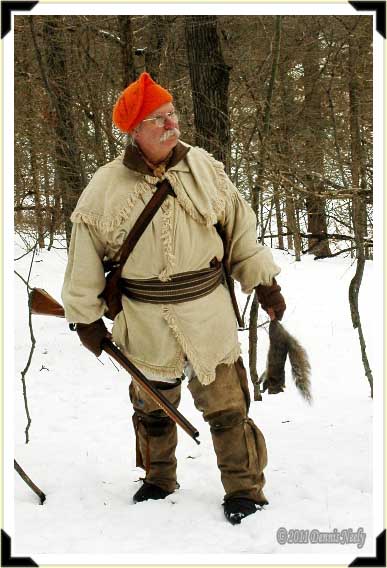
A fox squirrel’s bark attracted a trading post hunter’s attention. A single grey squirrel makes for a thin thin soup. Old Northwest Territory, 1793.
A fox squirrel’s bark attracted a trading post hunter’s attention. A single grey squirrel makes for a thin thin soup. Old Northwest Territory, 1793.
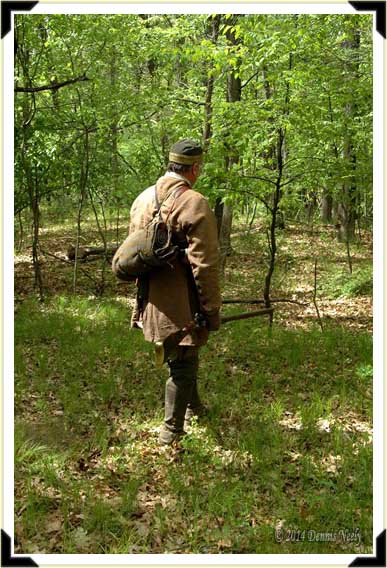
A British ranger from Fort Detroit, Lt. Darrel Lang, crosses a tiny forest clearing in pursuit of wild turkeys. Headwaters of the River Raisin, 1760.
Geese swooshed westward, tree-top high. Over the next few minutes, occasional kehonks told of a big swing out over the River Raisin’s bottomlands, then to the south, then back east and off into oblivion. The calm air felt cool and damp and smelled thick with the wormy aroma of wet, rotting leaves.
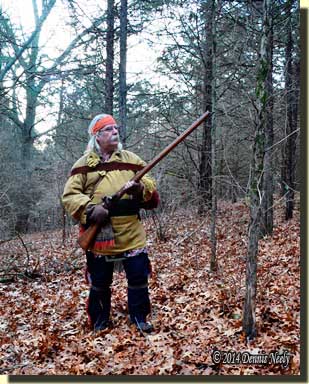 Slow and deliberate, buffalo-hide moccasins whispered over crunchy oak leaves—up onto the ridge crest then north on an old doe trail that saw little use that fall. The trail dipped, offering a brief downhill advantage over a spacious raspberry thicket. Impaled oak leaves created a thin roof over the tangled purple switches. Looking away with head half-drooped, a small, solitary deer lay just inside the south edge, shadowed under the oak-leaf blanket.
That late-afternoon still-hunt progressed up the rise, across a tiny clearing and on to the down-wind side of an early-winter path that meandered through the storm-twisted remnants of a poplar stand. Fourteen paces downhill the carrying-strap-bound blanket roll thumped between two close-growing red cedar trees.
I sat cross-legged on the blanket roll, and in less than a minute, three deer appeared, well to the west, plodding single file, displaying little concern. The trio angled south, then disappeared behind a small knob in the hardwoods. I struggled to gain another sighting where the knob melted into the hillside, but to no avail.
A wild turkey hen uttered a soft “putt,” up over the ridge to the northeast. A faint “arrkk” came from the south, farther down the east slope. Intermittent gathering sounds from wild turkeys on their way to the night roost frittered away another twenty or so minutes. Then a big doe and a scrawny, late-summer fawn walked in from the west. They, too, slipped behind the knoll, but reappeared, circling around the knob while angling uphill, a good 40 paces distant.
Darkness rolled over the hardwoods with a cold, chilling vengeance. A single, four-legged greyish mass, thick-necked and walking fast with its nose to the ground, materialized at the base of the knoll. The deer might have looked south, then north; I struggled to keep sight as its fading silhouette evaporated into night’s inevitable abyss. Such was a humble woodsman’s circumstance on the 15th of December in the Year of our Lord, 1798.
Three days before, I sat against a fair-sized red oak on the north end of that same ridge. Back to the right, down the hill and across an open, sweeping valley, neighbor Jeff, also a traditional woodsman, stalked south following the river bottom’s irregular, swampy edge. He paused, looked in my direction, then offered a modest wave, acknowledging my presence.
I waved back, but then expended a hearty, discouraged sigh as the gravity of the situation became apparent. Later that morning Jeff confirmed my suspicions. “It was easy to see you in that yellow shirt,” he said, which was not what I wanted to hear. I had over-dyed the linen outer shirt to tone down the brilliant yellow color, but the treatment was not enough.
To start at the beginning, two weeks earlier my first attempt at dyeing the hand-sewn linen shirt ended in failure. A boiling pot of stinging nettles added no color to a test swatch; disappointed, I never immersed the whole shirt. After further study, I think the nettles were gathered at the wrong time of year, but that didn’t lessen the frustration.
However, while seeking an historical explanation for the nettles debacle, I happened upon a brief mention of professional dyers in the 18th and 19th centuries using turmeric, an organic dye from India, to produce a bright yellow (Adrosko, 37).
After spending hours hand-sewing the trade shirt, I wanted to use an authentic dye. A green or grey were my first choices, browns as a last resort, but I never considered a yellow tone, much less bright yellow. It took a while to warm up to that idea, but after all, given my past failures with wild grapes, mint leaves and pokeberries, to name just a few, the ominous specter of resorting to “Rit-berries” acted as a powerful motivator.
As I so often do in the wilderness classroom, I sat down and evaluated the methodology used. In each of the failed attempts, I assumed the old recipes worked as written, and I set about concocting a “full batch,” sufficient to dye more than one shirt, which consumed hours of effort and compounded the end-result frustration.
Not wishing to repeat past mistakes and waste a lot of time, I chose to change my process for the turmeric. Instead of using a large kettle, I peeled the paper labels off two commercial-sized bean cans. After filling each can with four cups of water, one quart, I set them to boiling, along with a tea kettle.
Next I picked a recipe from those I had found and multiplied the gallons listed by four to convert from gallons to quarts. I multiplied the ounces of powdered turmeric by six to convert to teaspoons and divided the teaspoons by the number of quarts, producing the correct ratio of turmeric to water. Then I halved the calculated powder amount, measured it and added it to one can of boiling water, thinking I would test the dye at half-strength, full-strength and if necessary, one-and-a-half times the stated amount.
After writing all of these measurements down, I converted the first mordant, or dye fixative mixture, that I intended to experiment with to the quart basis. One recipe left the impression that a mordant wasn’t necessary, and none of the others listed a recommended choice so I thought I would try alum, alum and cream of tartar, baking soda and salt. I added the calculated amount of alum to the second can.
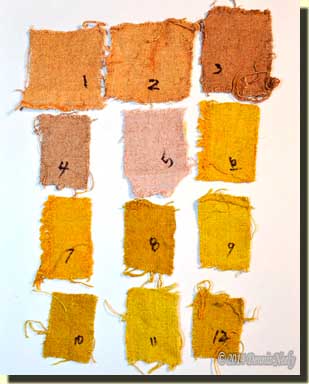 Next I cut small linen rectangles from the fabric left over from the shirt, divided them into two equal piles and clipped a corner of those in one pile. I placed three un-clipped-corner swatches in the mordant bath and three clipped-corner swatches in a Pyrex dish filled with boiling water from the tea kettle. I allowed the swatches to soak in the mordant bath for 30 minutes.
I selected a sample from each group and immersed them in the turmeric dye bath for 30 minutes, retrieved them with duck-billed pliers, and placed them on folded paper towels next to a penned number that matched the information recorded on the paper. I added another half-teaspoon of turmeric to the dye bath, and when the orangish-yellow powder had dissolved, I repeated the process. As the swatches dried, I marked the “batch number” on each with a Sharpie® marker.
By setting a timer, I was able to work in my office between batches, instead of watching the pots boil. About two batches into the experiment, a revelation hit me that I should add a bean can for logwood—all I needed was more test swatches. Then I started mixing equal amounts of the logwood and turmeric dye in a smaller bean can, just out of curiosity. At the end of the “laboratory session” I had a modest assortment of swatches, some about the same color and some quite different in tone, depending on the mordant (or absence of a mordant) used.
Instead of dealing with an 18th-century recipe and a vague description of the end result, I came away from that afternoon’s classroom lesson with a list of specific formulas and an in-hand example of what each dye lot produced.
In the past, I saw success with staghorn sumac and walnut hull dyes, but as with the stinging nettles, I bulled into the process and got lucky. The failure of the nettle dye pushed me into re-thinking how I was approaching the 18th-century learning experience. By undertaking a methodical approach, I achieved success with turmeric and logwood and combinations thereof. Sometimes, as living historians, we need repeated failures to bring us back to the reality that every sojourn, no matter how large or small, is an experiment in re-creating the past.
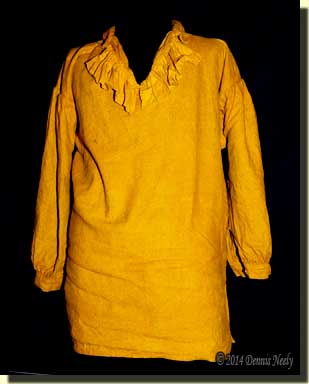 The turmeric/logwood mixes produced a drab green, which is what I was originally after, but I was so intrigued with the yellows the turmeric produced that I picked a sample that I thought looked good and set about dyeing the linen outer shirt.
“Neon Yellow” best describes the bright, vibrant end result. It was gorgeous, but I knew that yellow would not work on the 18th-century woodland stage. Despite the misgivings, I wore the shirt on a deer hunt, which only confirmed my beliefs. I over-dyed it in a diluted walnut hull bath to tone it down, but Jeff’s comment proved it was not enough. After much thought I “aged” the shirt a bit, but that is another story…
Think about your traditional hunting methodology, be safe and may God bless you.
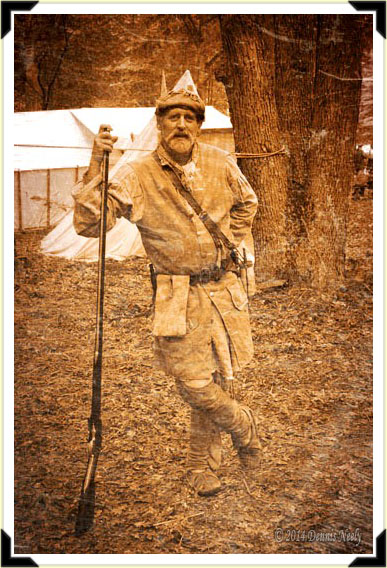
A French woodsman (Larry Horrigan) from the early 1700s pauses among the white canvas of a large encampment.
2014 Midwest Primitive Rendezvous near the Rabbit River.
“Old Turkey Feathers,” a flintlock Northwest gun, leaned against a cedar tree, an arm’s reach behind me. A bare patch on that tree, stripped away by an unknown buck, faced us. Three other rub trees lined the swamp’s edge to the south. The rub-line began in the little poplar grove, twenty paces out in the big swamp, upwind of the cedar trees. The crossing trail through the grove exited the swamp at the farthest rub, thirty paces distant.
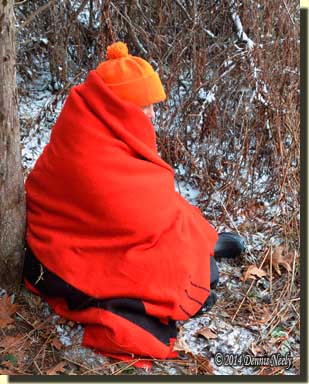 My daughter pulled a scarlet trade blanket tight about her body, then sat down on the snowy ground with her back to a different cedar. With a minimum amount of motion, I tucked the blanket under her crossed legs. All that showed were her eyes, nose and a black rubber boot tip.
Easing back on my haunches, I scanned the hillside and checked the trail to the north and to the south. Satisfied, I pivoted, adjusted my own four-point blanket, grasped the Northwest gun and sat against a third arm-sized cedar to the right of my daughter. “There’s a coyote,” she whispered. “It’s coming down the far hill at 10 o’clock, under the roosted turkeys.”
Eyes on full alert, she leaned forward. Her angle was much better than mine: she could see past the buck-rub cedar. I never saw the coyote, but as she whispered what she saw, I knew it would cross at the south island. The deep swamp grasses that hid the coyote also hid me. I shed the blanked, rolled up to my knees and rested Old Turkey Feathers’ forestock on the barkless trunk.
The sear clicked. The razor-sharp English flint snapped to attention. The turtle sight hovered on the first clear opening on the southeast trail. “A clean kill, or a clean miss. Your will, O Lord,” I prayed in silence.
The coyote crossed the first narrow opening at a fast walk. It was big and a dark charcoal grey in color. Much to my frustration, the underbrush was too thick for a clean shot. The turtle sight slid to the left, to a bigger clearing, just over the wooded mound’s crest. In the shadows I saw the canine veer to the north, choosing the trail that led to the thicket rather than continue on. I let out a deep breath. My daughter knew what that meant.
It wasn’t ten minutes before skittish deer began milling at the west side of the cattails, due east of the island. One-by-one they left the swamp and returned to the far hillside. The wild turkeys putted their disapproval. “There it is, on the hillside again, by the fallen oak,” Kate whispered, referring to the coyote.
Another wave of frustration washed over me, and I could tell it was bothering my daughter, too. “It’s just too far for the smoothbore,” I whispered. “All I’m going to do is educate the coyote. This is one of the few times I wish Old Turkey Feathers had a rifled barrel.”
The explosion of the coyote population is a real problem in this area, enough so that one of the few hunting rules on the North-Forty is: “if you have a good shot at a coyote, you take it. Even if it means you lose a chance at a buck.” That might seem a bit harsh, but chances to take out a primary predator like that mature coyote don’t come along very often.
But traditional hunters have a responsibility to know their own limitations and the limitations of the black powder arm they choose to hunt with. Every time a woodsman decides to unleash a death messenger, he or she must consider the circumstance and weigh the percentages of making a clean and humane harvest.
With Old Turkey Feathers the death sphere starts to “tail off” at 85 yards—taking a shot twice that distance is foolhardy and not respectful of the coyote. The island shot was maybe 60 paces, more than doable with the Northwest gun, but it just didn’t materialize like I hoped it would. And as frustrating as it is, waiting on a “best shot” that doesn’t happen is an integral part any hunting exploit, modern or traditional.
Around Christmas a fellow traditional hunter hinted that he had a Civil War reproduction rifle sitting in his gun safe, and that it was for sale. He said it was a 2-band Enfield Musketoon. Any other Civil War rifle would not have attracted my attention, but the musketoon was a different story, and he knew it.
Now, I started down the path to yesteryear in the late 1970s with a borrowed Model 1863 Remington Zouave reproduction. Over the years, I’ve looked at a number of Zouave rifles on trade blankets or at gun shows. I’ve always fought the urge and walked away. They just aren’t Northwest guns, you know…
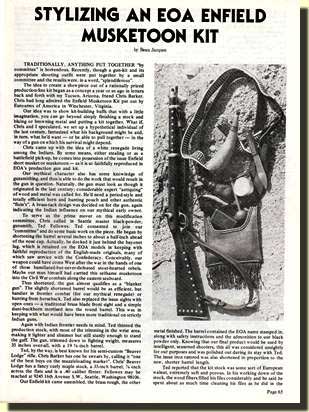 In the mid-1980s, MUZZLELOADER magazine published a story entitled “Stylizing an EOA Enfield Musketoon Kit” (May/June 1984, pg. 65 – 67). That article always intrigued me, and I never forgot about it. The article’s premise was not just completing a mass-produced kit, kit-guns were real popular in that era, but doing so based on an imaginative scenario: a white renegade living among the Indians out West who somehow came to own one of the short, 2-band Enfield muskets.
A “committee of experts” worked on that project, cutting down the barrel, reshaping the stock, finishing it, adding brass tacks and making a bag and horn that went along with the story. My retelling of the article and expressing a desire to distress this twice-shot rifle so it looks like “something found in a ditch” has met with a few, shall we be polite, “stern threats.” So for my Civil War re-enacting friends, relax. I’m now thinking perhaps the antiquing will be more acceptable on a Northwest gun?
This raises a good point for all living historians: spend a lot of time researching primary sources and applying that knowledge to the creation of a persona. With that in mind, I have begun looking for “after war” images of Civil War rifles, especially the 2-band Enfield Mustketoons. Ideally, I’d like to locate and actual example for study.
Right now, the gun looks “just out of the armory” new. Hard brush hunting will tone down that look and add “honest wear and tear.” And as I am learning, there are some authenticity issues with the reproduction itself, but that is to be expected. The question will be how far do I want to go with correcting the errors?
 In the meantime, I can’t wait to shoot the Enfield, to work up an efficient load and maybe compete with it at the Michigan State Muzzle Loading Association’s State Championship Shoot or at one of the National Muzzle Loading Rifle Association’s shoots at Friendship. I see a white-tailed buck in this gun’s future. In the 1970s I killed a running rabbit with a 500-grain, hollow-based Minie ball. I’ve got to try to duplicate that again, too.
At the very least, the 2-band Enfield Musketoon will serve as an example of a good “settler’s gun” for someone just starting out in this hobby. In doing some preliminary research, I found mention of the Civil War muskets selling for $1.50 in the 1870s as “war surplus.” Although the reference is far from primary, it said many settlers, many of whom were war veterans, took these guns “west.” And right there is the start of a localized persona—relax, Bob, I’m not talking ditch gun here.
I’m looking forward to resurrecting an idea from the past and expanding further my education in the wilderness classroom. At the very least, I see a lot of range time just over the horizon, when Michigan’s temperatures moderate. And if my eyes are good and I can muster a proper load, that coyote, or maybe some of his pals, might run into a death messenger slung from a stubby-barreled Civil War rifle.
Give traditional black powder hunting a try, be safe and may God bless you.
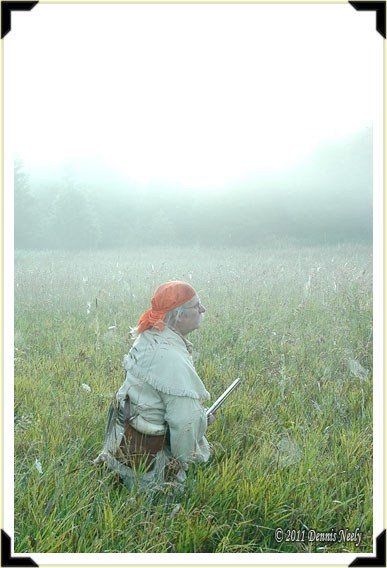
On a foggy fall morning, heavy dew clung to spider webs spun on the prairie grass. Old Northwest Territory near the headwaters of the River Raisin, 1792.
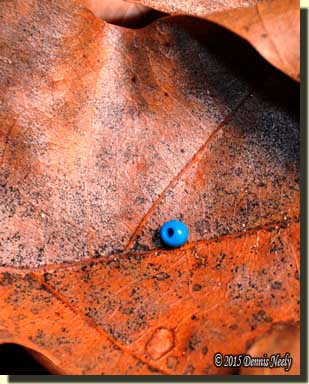 This week’s post “grew legs,” as I sometimes say. The journal entry recounts a lost blue bead from a leggin garter that came to rest in a cupped oak leaf in the middle of a December deer hunt. There is no pun intended between growing legs and a leggin garter. But as I reflected on that incident, I realized the comments deserved a page under “The Basics” section of the site. The essay, “Lost to Eternity,” is posted under “Progression of Age and Use.”
In addition, I started revamping the site in mid-November in hopes of better reflecting the content that readers want and are requesting. If you have some ideas, please share them in an email.
As I review past posts, essays that address basic concepts or reflect the guiding principles of traditional black powder hunting will be given page status. Some will need to be rewritten, and that takes time. Plus I am working on a new series of pages for “The Basics” section, and I have a number of clothing and accoutrement projects that will appear under the “How-to” category.
I had a great fall hunting season, probably the best in ten years. I didn’t kill a lot, but that was my choice. As you might expect, I came away with an abundance of journal pages to share in the future.
Thank you for visiting the site, be safe and may God bless you always,
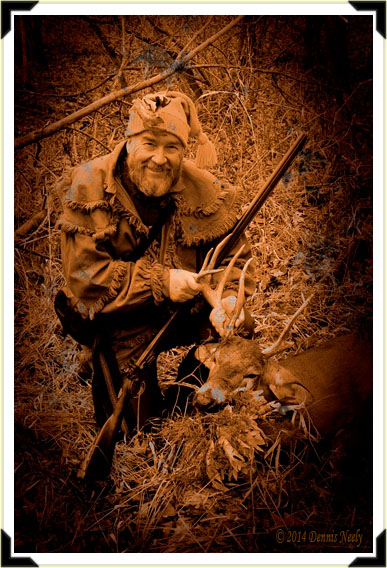
Traditional woodsman, Jeff Wacker, with a fine white-tailed buck taken with an outstanding shot from his French “D” flintlock smoothbore. Being of German lineage, Wacker reverently placed an evergreen bough in the buck’s mouth as a last meal, marked his own cheek with an oak sprig dipped in the buck’s blood, then placed the sprig in his voyageurs cap. Bottomlands of the River Raisin in the Old Northwest Territory.