“Harvesting Milk Weed Stems”

“Snapshot Saturday”

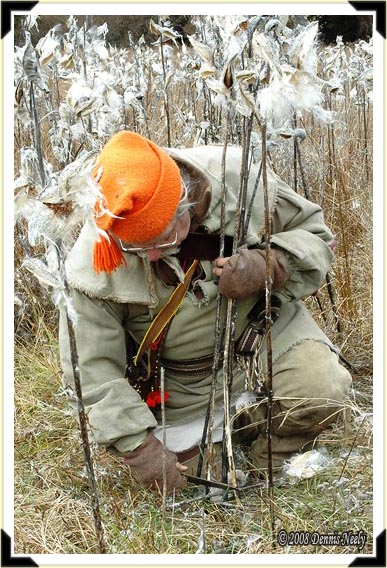
A traditional woodsman cutting dried milk weed stems for cordage.

A large milk weed patch teased the traditional woodsman who stopped to cut a handful of dry stems for a cordage lesson in the wilderness classroom. Three swamps east of the River Raisin’s headwaters in the Old Northwest Territory, in the Year of our Lord, 1794.

Posted in Snapshot Saturday, Wilderness Classroom | Tagged , , , , , , , , , , | Comments Off on “Harvesting Milk Weed Stems”

Confronted with Luke’s Story

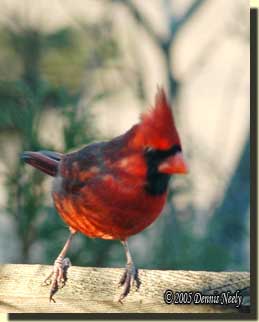
A brilliant cardinal perched on a dead twig. The quiet songster peered to the left, fixing its attention downhill. A hunter’s aging eyes followed its gaze; a plump fox squirrel bounded once, then disappeared in the dark spaces between the bases of the autumn olives and barberry bushes that obscured the lower two trails.

SA crimson cardinal looks from its perch.teel-grey clouds hung above the barren tree tops, cloaking the glade in a massive, almost ominous shadow, at the least, foretelling of an early nightfall. Yet, the cardinal’s crimson plumage glowed as if illuminated by a noonday sun, its forest presence magnificent, compelling, and entrancing.

After a minute or so, the cardinal glanced to the north, then turned to its right, spending an equal amount of time surveying the oak leaves that carpeted the hill’s upper flat. I turned a bit to my left to see what occupied the songbird’s interest. Twenty paces to the east another fox squirrel flung leaves and dirt as it dug at the drip-line of a young red oak. When I looked back, the cardinal was gone.

Disappointed, I returned to watching the hillside that led to the sequestered plateau. The cool, calm evening air carried no noticeable scent, no marker that set that evening apart from others, late in December of 1798. The celebration of the birth of the Christ was but six days away.

Reflections on the events of the fall, thoughts of the upcoming weeks and speculation on the severity of the winter came and went as I sat beside a powder-keg-sized red cedar trunk. The tree’s lower branches broke up my deathly silhouette, yet due to its size and the spacing of the scraggly limbs, I had ample openings through which to take careful aim. Now and again my eyelids grew heavy from fatigue, perhaps induced from the peaceful silence that surrounded my being.

A noticeable chill accompanied the day’s dimming. A deer’s hind leg pushed a patch of brown body hair to the east, upwind, just beyond where the cardinal perched. The Northwest gun’s muzzle eased in that direction. My right thumb began massaging its usual tiny circles on the hammer’s jaw screw. With a couple of steps, the whitetail’s head would pass through the first small opening.

A barren head dropped to the leaves. Another leg moved behind this deer, and the odds were it was antlerless, too. Then to the right a pair of ears twitched on the uphill side of the tangle that hid the first fox squirrel. A button buck’s head, then its neck plodded into view, still upwind, following a trail that forked before my cedar tree. The right fork was not an issue, but the left passed in front of the cedar fortress, then curved downwind.

All three deer paused and stood still at about the same time. The tiny plateau grew darker and darker until the day was done. My thumb slipped from the jaw screw and my muscles eased. Again, as if sharing a common thought, the three grey ghosts crossed the leaf-strewn flat, scuffing through half-damped brown skeletons with no care to the noisy ruckus they raised.

A solid five minutes after the glade grew quiet, I got to my feet, slung the portage collar that bound the bedroll over my shoulders and stalked back to the wagon trail, taking care that each step did not betray my presence and making sure an unseen twig did not slap my face.

A Different Christmas Message

In the southern half of the Lower Peninsula, Michigan’s muzzleloading deer season always ends a few days before Christmas. After hunting hard throughout the fall, the last few days of this season are a time for peaceful contemplation. That evening was no exception. To be sure, I still concentrate on filling a buck tag, but the complexion of the hunt changes.

This change is due to the realization that the probability of bringing home fresh venison diminishes with each passing day, and it is due to a shift in my emphasis as I look forward to returning to small game hunting. Another contributing factor is Christmas.

When I sit and cogitate on Christmas, as I did that evening, I most often think of the nativity described in Luke’s gospel—sometimes I think of Charlie Brown’s Christmas tree on Schroeder’s grand piano and Linus reciting the story while he held his blanket. But this year was, and is, very different.

In the last month or so, I have found myself confronted with Luke’s story of the angel Gabriel coming to Mary. I use the word “confronted” because the passages, or parts of them, have popped up under very unusual circumstances, and with enough frequency that one cannot help but take notice.

And as I sat that evening, I was thinking about the various circumstances and at one point I realized that I was telling myself, “this is a bit frightening”—nowhere near what Mary and Joseph must have experienced, if only for a few moments. In response, I stepped back and attempted to view the birth of Jesus from a broader perspective.

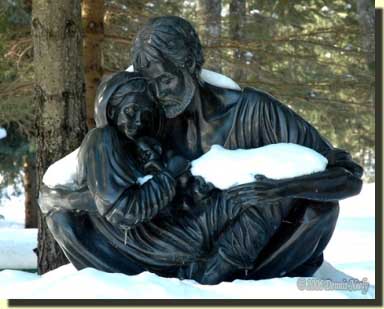
A statue of the Holy Family covered with snow.As the Christmas season progresses, the arrival of the shepherds, the wise men and the flight to Egypt unfold and take precedence—yet, there is little mention of what came before other than maybe a Gospel reading at church. But as a living historian, I have learned to view a passage from many different perspectives, and for that I feel truly blessed—especially with this passage:

“In the sixth month, the angel Gabriel was sent from God to a town of Galilee called Nazareth, to a virgin betrothed to a man named Joseph, of the house of David, and the virgin’s name was Mary. And coming to her, he said, ‘Hail, favored one! The Lord is with you.’ But she was greatly troubled at what was said and pondered what sort of greeting this might be. Then the angel said to her, ‘Do not be afraid, Mary, for you have found favor with God.

“‘Behold, you will conceive in your womb and bear a son, and you shall name him Jesus. He will be great and will be called Son of the Most High, and the Lord God will give him the throne of David his father, and he will rule over the house of Jacob forever, and of his kingdom there will be no end.’ But Mary said to the angel, ‘How can this be, since I have no relations with a man?’ And the angel said to her in reply, ‘The holy Spirit will come upon you, and the power of the Most High will overshadow you. Therefore the child to be born will be called holy, the Son of God. And behold, Elizabeth, your relative, has also conceived a son in her old age, and this is the sixth month for her who was called barren; for nothing will be impossible for God.’

“Mary said, ‘Behold, I am the handmaid of the Lord. May it be done to me according to your word.’ Then the angel departed from her…” (Luke 1: 26-38)

Merry Christmas to all, be safe and may God bless you.


Posted in Deer Hunts, General | 3 Comments

“An Evening Meal”

“Snapshot Saturday”

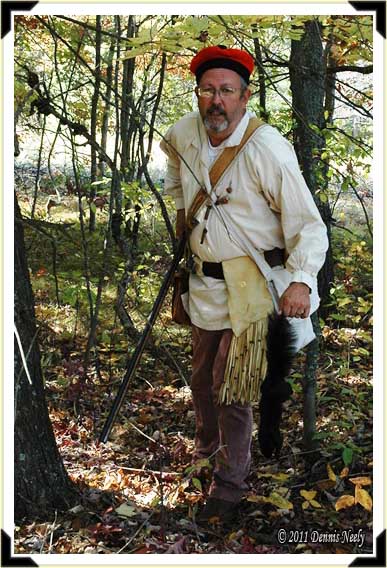
A traditional woodsman returns with black squirrel for supper.

Traditional woodsman Marty Grennier returns from the forest with a black squirrel for supper. Old Northwest Territory, late 18th century.

Posted in Snapshot Saturday, Squirrel Hunts | Tagged , , , , , , , , , , , , | Comments Off on “An Evening Meal”

Paying Humble Reverence

Winter moccasins stalked a favored lair. The scrub apple tree appeared taller, the two red cedar trees fuller with more dead branches on the trunks’ lower third. The first autumn olive to the south arched eastward, its upper branches touched the sedge grass at the swamp’s edge. I knelt. The view to the north and to the south was different, but a woodsman expects that from year to year.

A traditional woodsman sits wrapped in a scarlet trade blanket.Aching hips searched for a comfortable spot on the woolen bed roll. Cold fingers pulled the outer layer of the scarlet trade blanket up around stiff shoulders. The black stripe at the four-point’s hem ran vertical, following the contour of each arm. With the prime checked, the Northwest gun rested across dark-blue wool leggins dotted with stick-tights and tiny burrs.

Down the way, on the swamp’s opposite bank, two does, each with a trailing spot-less fawn, exited the path that crosses a few paces north of the mud-clogged spring. Beyond the deer and over the small hill, three black-bodied wild turkeys perched in the top-most branches of a huge cottonwood.

Eleven Sandhill cranes flew overhead, east to west, each trying to speak at the same time: “Urrr-ggooou-aaa, Urrr-ggooou-aaa.” The biggest doe stepped to the north, then disappeared into the tight-growing cedar trees. I lost sight of the others.

Maybe twenty minutes later, putts and clucks from agitated turkeys crescendoed into a full scale ruckus, again, over the small hill and not far from the cottonwood. Without much conscious thought, the Northwest gun’s muzzle eased southward, and my glances lingered in the direction of the fuss.

Straight across the swamp a small doe plodded through the autumn olive bushes, seventy or so paces distant. The wild turkeys settled to an occasional bantering of putts. Two strings of Canada geese ke-honked over. Another deer, then another passed south to north, but I had no way of determining if these were the same whitetails I saw earlier or different ones. And where was the fourth?

Ears perked up in the deep swamp grass, eighty-plus yards away, this side of the mid-point between where I sat and the muddy-spring trail. The new arrival, a fair-sized doe, took her time crossing the swamp, from my side to the far edge. But once the shoulder-high sedge grass ended, the doe bounded up into the cedar trees and out of sight.

Not five minutes later, a set of white tines, two points up on both sides plus the beam tips, crossed where she had, but without the same caution. This fine young buck stopped at the short grass and sniffed the ground like a hound that’s lost a scent. His head popped up, he licked his shiny black nose, then looked to the north. The six-point had no brow tines. With a fast walk, he, too, melted into the cedar trees.

In due time, three more does picked their way through the autumn olives and cedar trees straight across from where I sat. Then a plump rump came and went in a shadowy space between two cedars, to my right, up the hill. I saw a hind hock. Then the six-pointer’s head nuzzled the ground as he stepped into an opening. He turned sharp to the south, then back to the north before raising his head and walking down to the crooked box elder.

Facing straight at the wild apple tree in front of me, the buck dropped his head to the scrape pawed out between the tree and the swamp’s east edge. The scrape was just beyond “Old Turkey Feather’s” effective distance. Sitting patient was the only choice.

Unraveling a Woodland Mystery

I find the comings and goings of white-tailed deer fascinating, whether viewed from an historically-correct 1798 perspective or in the context of the modern-day here and now. And despite fifty years spent on the North-Forty, if I wish to be made a fool of, I simply have to prophesy to an inquisitive bystander what the deer are going to do at any given point in time.

Unless a deer has a distinctive identifying feature, it is almost impossible to follow that deer’s movements once it leaves one’s sight. When the two does with fawns melted into the cedar trees, I couldn’t help but wonder if I would see them again that 18th-century November morn, and if I did, how would I know for sure they were the same critters?

The only true way of knowing would be to get up, walk to the crossing and take up their tracks, but the terrain, to say nothing of other whitetails in the area, deem that an almost impossible task. Plus, such a bold action would spook any and all deer close by, or at the very least, modify their true habits.

Now don’t get me wrong on this point. Countless times I have tracked and backtracked deer just to learn what they did or did not do on a particular hill or at an important trail juncture or in the hidden corner of a dense thicket. Unraveling these mysteries are, after all, basic lessons for the 18th-century wilderness classroom.

Some of these woodland studies are best undertaken when it is not open deer season, yet some offer the greatest fruits only during the height of a chase. Experience dictates the difference, even if that experience is the eventual result of a poor decision. And I would be less than honest if I didn’t note that in recent years I find myself interrupting a still-hunt more often than not because I don’t understand what the deer did or why. I suppose that comes with the gray hair.

Fresh snow helps, too. During Michigan’s December muzzle-loading season I find my alter ego striking off on a specific buck’s tracks in hopes of coming upon him in his bed, or better yet, waylaid by the scent of a receptive doe. Such stories are numerous with mixed results; most times the tracks cross a fence and enter onto someone else’s property—sometimes never to be seen again.

As the six-pointer walked back up into the cedar trees, my mind kept mulling over this topic. About five years ago a family member called, asking for help getting a fine doe out of the woods. It was already field dressed, but it was a long haul out and the dragging goes a lot easier with someone to share the story with.

I’m always up for such adventures, and in my growing excitement I asked where he was when he took the shot. He told me, and then I asked, “Where are you now?” He was on the opposite side of the swamp from where he shot the deer.

When I arrived, he retold how the doe had come down behind him, upwind, how he turned and how he saw her run off under the Hawken rifle’s thinning white smoke. He went on to say that he lost sight of her, then saw her on the opposite hill, before she stumbled and died. He said he never let her out of his sight as he crossed the swamp.

After loading her in his truck, I asked him to show me where he sat. He retold the story and I found the hair from the double-lung shot. Then I started off in the direction the doe had run, and he asked, “Where are you going?”

“I’m going to track this deer. You should come along.”

“Why,” he said as he scowled at me, “it’s dead and in the truck.”

“So the next time you shoot a deer you’ll have a better understanding of what this one did,” I said as I found the first blood.

That doe proved difficult. The round ball was high in the lungs; most of the blood pooled in the chest cavity. A drip here and a small speckle there was all that marked its death trail until it got through the swamp. It kept to an earthen ribbon that many deer traveled on, which made matters worse. It took over an hour to unravel the first seventy or so yards of that deer’s escape. All the while I was teaching, explaining and once or twice, casting in circles to find the next sign.
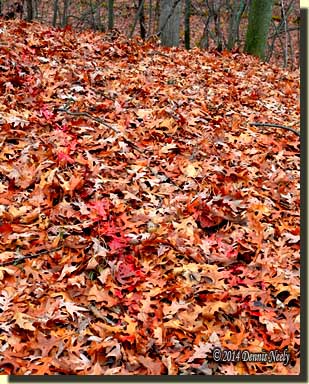
A through-and-through trail on damp oak leaves. I had a similar circumstance this past week. I wasn’t much help, but a neighbor let me tag along while he dressed his deer. I helped him drag it out, all of forty yards, but not before I took a good gander at the trail that fine buck left on his death run. Such practices open up one of the greatest teaching tools in the wilderness classroom: following the blood trail of a wounded deer.

Sometimes I start at the shot, and sometimes I backtrack from the end to the beginning. Both methods offer unique insight into the instinctive escape routes taken by our beloved white-tailed deer. Such tracking is a sad and humbling experience, often marked with solemn prayers of thanksgiving, but it is also a tremendous learning experience, one that comes along once in a year or two, maybe less frequent.

And much to my surprise, tracking a dead deer is a part of the hunt that is often overlooked, muddled up by the exuberance of the kill, cast aside and forgotten like the entrails. Many, and too frequent, are the instances where an experienced hunter gives me a puzzled look when I ask if he or she backtracked the deer.

To some degree, tree stands or elevated people boxes give the modern hunter an advantage when it comes to recovering a wounded deer. I don’t argue that point, but a huge woodland lesson is outlined on the ground, if only one is willing to take the time to review the signs, learn the ways of the forest and pay reverence to the creatures we all pursue.

Give traditional black powder hunting a try, be safe and may God bless you.
Posted in Deer Hunts, Skills | Tagged , , , , , , , , , , , , | 1 Comment

“Taking Careful Aim”

“Snapshot Saturday”

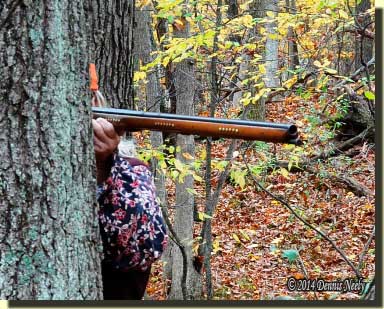
A traditional woodsman aiming his flintlock rifle.

The day after Christmas, in the Year of our Lord 1755, a French woodsman (Jon Hollenbeck) seeking meat for the garrison at Fort Pontchartrain du Detroit, took careful aim at a fine doe. New France, near the headwaters of La Riviere aux Raisins.

Posted in Deer Hunts, Snapshot Saturday | Tagged , , , , , , , , , , , | Comments Off on “Taking Careful Aim”

The Intent of This Glorious Journey

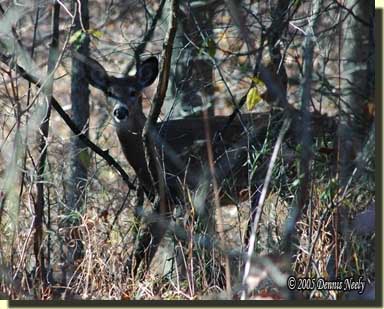
A button buck stood and stared. Thick black hair bristled down the top of his neck, not long, but noticeable. The black mane, a genetic trait that first appeared forty or so years ago, shows up from time to time in the white-tailed bucks that frequent the River Raisin’s bottomlands. Like his wily ancestors, this wise-beyond-his-years youngster sensed danger lurked close by while others sauntered north, unconcerned.

Ten minutes before, on a cold December morn in 1798, six deer exited the big swamp and plodded into the sunlit hardwoods that populated the basin-like valley. The group turned north, single file, two fawns trailing two does in order. The button buck emerged last and followed up, maintaining about a fifteen-pace distance. He seemed to lollygag behind, taking his time as he glanced about. When he turned his head, the sun highlighted two auburn colored bumps the size of Brown-Bess musket balls, leaving little doubt as to his gender.

The six moved on at varying paces, bunching up, spreading out and bunching again. The middle doe paused at the point where the trail came closest to my lair, a twisted box elder tree growing close to an almost dead red cedar tree, thirty paces uphill. She craned her neck, licked her nose and then bobbed her head up and down, trying to get the scarlet-blanket-clad woodsman that sat in the brush to betray himself with a subtle movement. After a dozen or so attempts, the doe gave up and the six walked over the knoll and out of sight to the north.

A wary white-tailed button buck.But the button buck lingered, standing motionless with his body shielded by a red oak tree and two clumps of autumn olive. He displayed no desire to keep up with the plodding entourage. Instead, he peered out into the swamp, checked his back trail, glanced uphill and half-dropped his head with his eyes fixed on the trail ahead. But he did not budge.

At least ten minutes passed, then he began his own still-hunt up the slope: one step, then a long pause, another step, another hesitation…

When he came even with the box elder, he sniffed the air and spent a fair amount of time surveying the hillside in all directions. A broken down autumn olive bush separated us like an old fort’s palisade; once in a while I caught sight of an ear or his shiny black nose.

For no apparent reason, the button buck commenced a steady walk up the hill, stopping eight or nine paces shy of the ridge crest. Still upwind of my lair, the wilderness classroom lesson continued—for both of us. Again, tedious minutes passed, filled with sniffs, nose licks and glances to all points of the compass, and some in between. A resumed still-hunt occupied the next dozen minutes before the young buck’s tail flicked side-to-side and he disappeared over the rise.

A Change in Habits

In an email exchange a week ago I lamented to my good friend and fellow traditional hunter, Darrel Lang, that I was disappointed that it had been a while since I posted a new missive to this blog. He offered a possible post, short and sweet:

“Gone to the woods to hunt deer! Will return when the season is over or my tag is filled!”

Engaging in as many traditional black powder hunts as I could was a major goal coming into the fall. Squirrels, ducks and wild turkeys occupied most of my efforts in October, and Canada geese and turkeys took center stage in early November.

By the start of Michigan’s firearm deer season, the weather was like that of late December, except colder than last year. The three worst days of the first week, I reverted to the trading post hunter persona, because his clothes are warmer than those of Msko-waagosh, the returned white captive. But I refused to give up, and on the Friday after Thanksgiving, Red Fox tolerated a calm, 10-degree morning in the glorious Old Northwest Territory, bettering last year’s comfort level by a whopping eight degrees.

Although I have not yet filled a tag, more by my own choice than a lack of opportunities, the fall has been a tremendous success, especially the white-tailed deer season. But the definition of what constitutes “success” is where the traditional hunting philosophy parts ways with modern, high-tech adventurers.

Traditional woodsman aims his Northwest trade gun from behind an oak tree.Many of my 18th-century sojourns have included failures, most minor, across a broad spectrum of topics: clothing, accoutrements, techniques, 1790’s skills and woodland knowledge. To be fair, a contributing factor was, and is, the addition of several new or refined items of material culture that in the midst of a simple pursuit didn’t perform in the same manner as a hunter hero once described. Yet, keep in mind that for the traditional black powder hunter such failures are really success stories—practical, hands-on discoveries of a history-based, backcountry lifestyle.

An Ojibwe-style man’s hood, fashioned after several museum artifacts attributed to this region, is the latest culprit. But learning to live and survive with the personal possessions attributable to a given bygone era is an integral part of all wilderness classroom lessons—frustrating, thought provoking, educational and fun, all at the same time. And many of these lessons will eventually make their way into my scribblings during the coming year.

But the most profound and noticeable challenge is the change in the habits of the white-tailed deer. In 2012, epizootic hemorrhagic disease decimated our deer herd. The death toll was heaviest among the older does, the teachers of the herd. I saw more wild turkeys than deer that fall. Last year was an improvement, but several close-by deer hunters and I noted that the does with fawns seemed small and didn’t adhere to the time-tested travel patterns of their mothers.

Throughout the summer and into the fall, this change became more evident. The deer still exhibited natural survival skills, but in different ways than the deer that succumbed to EHD. By mid-October doe trails that once were churned-up earthen thoroughfares sat idle, strewn with leaves. Some deer went this way, while others went that way. A humble observer can only assume they all reached their intended destinations, which is, after all, the intent of their journey.

When the cold and snow of early November hit, the deer traveled in groups like they did decades ago. With the passage of multiple deer, trails formed in the snow and other deer followed the paths already broken. But these habits were new to this generation of deer, born out of wilderness survival necessity, rather than generations of experience.

And so it was that cold December morning in 1798. The six bunched up and spread out as if they were feeling their way through the dense cedar trees for the first time. I doubt that was the case, but that was the impression left, and there is no way of knowing.

As the button buck picked his way up and over the ridge, I found myself cogitating as he progressed. Here I was, a new character conceived in the fall of the EHD outbreak, feeling my way through a unique living history circumstance, establishing thought patterns different from those of the fort hunter persona.

In the time that it took the young buck to traverse the sunlit hillside, I realized the magnitude of putting forth the effort to spend more time afield this fall. The resulting trials and tribulations bestowed upon me a wealth of new knowledge, along with a host of tantalizing questions and possibilities. I had, at least temporarily, sacrificed writing time for an opportunity to breathe meaningful life into a blossoming characterization. And that is, after all, the intent of this glorious journey.

So head to the woods, be safe and may God bless you.
Posted in Deer Hunts, Persona | Tagged , , , , , , , , , , , | Comments Off on The Intent of This Glorious Journey

“Pine Forest Trail”

“Snapshot Saturday”

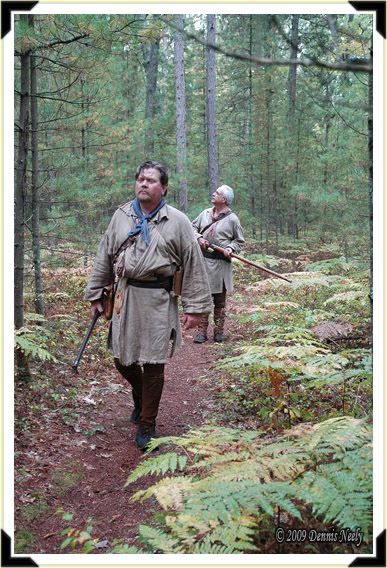
Two traditional woodsman explore a forest trail.

Two tenants of the forest follow a fern-lined trail through a young pine forest. John Booy (front) and Jim Aude (back) spent an afternoon meandering along a game trail near Marl Lake in the Old Northwest Territory in the mid-1760s.

Posted in Living History, Snapshot Saturday | Tagged , , , , , , , , , , , | Comments Off on “Pine Forest Trail”

“The Flint Inn”

“Snapshot Saturday”

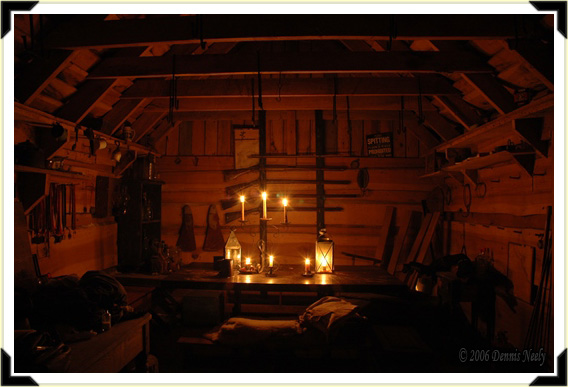
The candle-lit inside of a log cabin.

The warm glow of candles illuminates the interior of the “Flint Inn” at the Curly Gostomski Primitive Campground on the National Muzzle Loading Rifle Association’s home grounds in Friendship, Indiana, sometime in the 18th century.

Posted in Hunting Camps, Snapshot Saturday | Tagged , , , , , , , , , , , | Comments Off on “The Flint Inn”