“Snapshot Saturday”
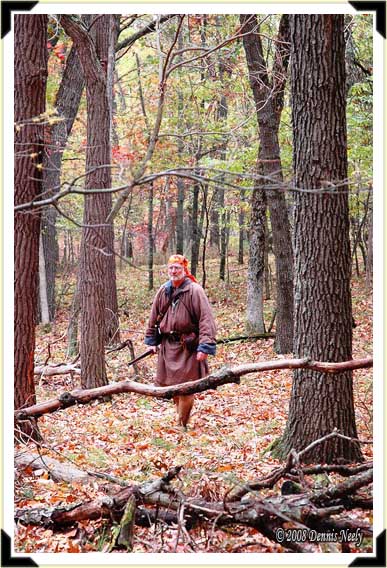
Jon Hollenbeck, a lowly French hunter from Fort Ponchartrain du Detroit, wanders the forest in search of fresh game. New France, 1750.
Jon Hollenbeck, a lowly French hunter from Fort Ponchartrain du Detroit, wanders the forest in search of fresh game. New France, 1750.
Four Sandhill cranes winged toward the River Raisin. A sparkly hoarfrost coated the short prairie grass, every barren twig and the magenta-colored cedar boughs. A crimson cardinal flitted across the clearing, then landed on one of the autumn olives that grew on either side of the doe trail. Ice crystals drifted from the twig where the cardinal perched. My buffalo-hide moccasins pressed on, carrying me deeper into the Old Northwest Territory of 1792.
The sharp hooks of a raspberry switch clawed at a leather leggin, but could not hold on. Frost dusted the linen hunting shirt’s sleeve as the historical me slipped into the cedar trees that cover the east face of the ridge.
“Gob-obl-obl-obl! Obl-obl-obl-obl!” The wild turkey tom was a ways down the ridge, maybe even with the south island. My moccasins whisked on with renewed urgency. Fly down would be early that morning.
“Gob-obl-obl-obl! Gob-obl-obl-obl!” Two gobblers hollered a second or two apart from across the big swamp, sounding like they were roosted in one of the big oaks that dot the hillside.
The doe trail angled uphill, then wandered around a clump of four fallen cedar trees, pulled down by an ice storm the winter before. On the north side of the windfall, two of the cedars formed a small man-sized cove. The portage collar slipped from my shoulders, and I used the leather loop to set the rolled blanket to the left of the opening. With a sigh of relief, I sat, checked the Northwest gun’s prime and then rested the trade gun on my crossed legs.
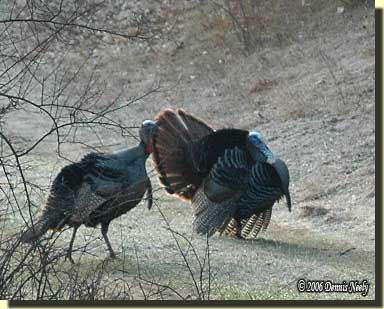 The two toms on the east side of the big swamp were the most boisterous. They flew down first, too. On that cold April morn, the hens never make a single cluck, but I heard birds fly down from the oak grove by the wild apple tree. After about ten minutes, the two gobblers started gobbling again: “Gob-obl-obl-obl! Obl-obl-obl-obl!”
From my lair, it sounded like the two gobblers were standing at the edge of the swamp, near the narrows. A hen appeared about sixty paces to the north of my cedar fort. Two or three more followed; all walked down the hill in the direction of the bantering toms. I knew then there was little chance of enticing the toms with love tones from the wing-bone call. I tucked the creamy white radius bone back in the front of my shot pouch.
As I sat mulling over my choices, movement to the left caught my attention. I fought the urge to turn and look, but rather, I squinted to avoid eye contact. Old Lady Gray, a smoky-gray hen with a staunch anti-hunter attitude, walked along the upper doe trail, not ten paces distant.
The wary hen looked uphill, then down, then took a few steps to the north. She still-hunted along that trail, then began putting. I knew she had not seen me, or knew of my presence. Something else disturbed her. She putted her way to where the other hens disappeared, and I never knew why she continued to sputter.
About the time I lost sight of Old Lady Gray, the gobblers stopped. I sat for a while, then ascended the hill with the idea of circling to the north, sitting in a downed oak top and waiting for the gobblers to begin their mid-day stroll.
About ten years ago, a veteran traditional hunter contacted me seeking advice with a problem he had with a new smoothbore. Christopher’s wife bought a 28-gauge, iron-mounted fusil de chasse at the Kalamazoo Living History Show® as a birthday present for him. Chris wanted to hunt turkeys that spring, but he could not get the holes out of the shot pattern.
We talked through the loads he had tried, and there was nothing that stuck out as unusual that might cause the holes. The smaller gauge smoothbores can sometimes be problematic when working up a hard-hitting turkey load, but there seemed to be no reason for the blown patterns. One of the loads matched what I would have suggested, so I started with that load as an example.
With turkey season on the horizon, now is a good time to think about proper turkey loads. Each smoothbore is different, but a responsible traditional black powder hunter must know what load patterns best in his or her smoothbore. As respectful hunters, we owe a quick and humane kill to the game we pursue. And the only way to achieve an effective load is through range time at the patterning board.
The first rule of muzzleloading range time is only change one load component at a time. If more than one component is changed, say the powder charge and the over the powder wad, which is responsible for the change in the pattern? After talking with Chris, I discovered he was changing two components at a time, thinking he was speeding up the patterning. It took some talking, but I finally convinced him to abandon that practice.
He was using 3Fg black powder, which burns with a greater breech pressure. Using the starting load, I suggested he increase the charge by five grains, and then ten grains. If he saw no difference, then I suggested that he drop the starting charge by five grains. Pushing up the powder charge beyond the ten grain limit would simply overload the arm.
We next plotted a series of wad column changes that covered the standard wad columns favored by competition shooters. This list included lubricated and unlubricated fibered wads and using two .125 cards over the powder with no fiber wad. It is important to keep in mind that turkey hunting usually requires only one shot or two, as opposed to the multiple loading demanded by a sporting clays course, for example.
And using the starter powder charge, we laid out a method for adjusting the shot volume. On this subject, I related the difficulty I had patterning my wife’s trade gun. Her shortened chief’s grade smoothbore did not pattern #4 or # 6 shot well, but settled in to consistent patterns for #5 shot.
A couple weeks later, Chris called back. He was frustrated with the results. When I asked about changing shot sizes, he simply said “I only have the one bag of shot.” I offered to send him some sample quantities, but somehow that offer turned into helping him at the range.
Chris brought along his old pattern papers, and we looked through them. All the patterns had the same fist-sized holes, in different places with each shot. The little voice inside my head that I don’t pay enough attention to kept whispering “something’s not right…something’s not right…”
I laid the first three test sheets from that range session on the tailgate and stepped back. “What could it be?” Chris asked.
“I don’t understand why the shot is tearing the paper like this,” I said, pointing at the elongated tears that peppered the pattern. “I want you to use my shot and see if it makes a difference,” I said handing a leather shot bag of #5 lead to Chris. While Chris loaded for the next shot, I started circling the funny tears, which surrounded the holes.
When the smoke cleared, Chris’ 28-gauge left a perfect pattern in the felt-penned circle, with a killing amount of hits in the cartoon-turkey’s head. A look of relief filled Chris’ eyes. As we walked back to the bench from the patterning board, I said, “let me see your shot, please.”
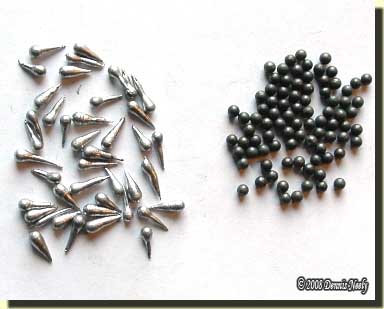 Chris poured shot from a leather sack into the palm of his hand. The bag contained a mix of shot from #4 to #7 1/2, interspersed with a healthy portion of drip shot. “That’s it,” I said, picking out a large, tear-drop-shaped shot. “The drip shot is the culprit…”
By mixing the shot that his friends gave him, Chris inadvertently violated the “only change one load component at a time” rule. In essence, he created a Frankenstein shot that would not perform well under any circumstance, out of any smoothbore.
By testing a uniform load of one size of shot, his patterning problem was solved, and as he found out with further tests, his 28-gauge performed well with a variety of shot sizes, wad columns and powder charges. Plus that basic load passed a standard penetration test—a tin can placed at the intended maximum distance—too.
Spend time at the pattern board, be safe and may God bless you.
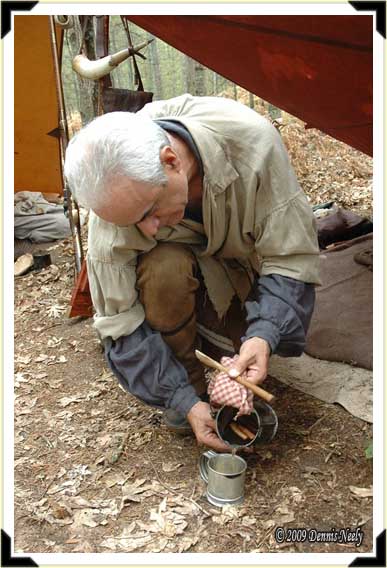
Traditional woodsman, James Aude, brewed sassafras tea, then poured his portion in a tin cup. “Old Geezer Scout,” Marl Lake, Old Northwest Territory, 1790.
Crystalline ice bowed trees and bent bushes. Huge white snowflakes floated in the calm. A fresh, fluffy white carpet erased a winter’s worth of life-stained snow. At the edge of the thicket, tawny prairie grass stood stiff, encased in the remnants of a freezing rain from a few nights before. The grassy ice-spires crackled and popped with each footfall of my buffalo-hide moccasins. This was Eden; this was the Old Northwest Territory of 1796.
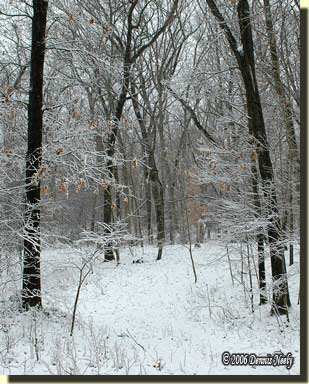 That morning’s course skirted a deep wash, tangled with stunted red cedar trees and box elders, broken and twisted by the natural progression of time. Here and there an odd-shaped hole marked a box elder’s gnarly roots. One of the dens had the new snow pushed back with a dirty-sand imprint of where a rabbit sat. Fresh tracks led to that hole, but the rabbit was gone. My stomach growled in a fit of angry frustration.
With Old Turkey Feathers cradled in my arms, I stood and visually back-tracked the rabbit. The familiar indentations curved in the direction of the raspberry patch at the gully’s mouth. My eyes scoured the snow around a big fallen cedar tree’s now gray and weathered skeleton. Three shadows suggested another bunny’s comings and goings. As I plotted a path down the steep bank, I whispered the hunter’s prayer, “A clean kill, or a clean miss. Your will O Lord.”
I knew the descent would prove treacherous. Even on the flatter ground, the fresh snow was slippery on the ice-crusted under layer. I chose the doe trail that hugged a box elder so I could support myself with a hand against the tree’s forked trunks. I took my time, placing each moccasin with care and testing the footing before committing my full weight.
Once in the bottom of the wash, I paused, then still-hunted to the fallen cedar. Matted grass draped over the cedar’s lower branches, turning the big tree into wilderness boarding house for creatures. The three shadows were just that, shadows. I circled the tree, pressing my left moccasin against a branch now and then, shaking snow, cracking branches. The boarding house was empty.
Again my stomach growled with a twisting convulsion. Out of curiosity I followed the holed-up cottontail’s tracks to the mouth of the gully—seeking out a lesson in the wilderness classroom. A dozen paces before the raspberry patch, the rabbit’s early-morning adventures lay mapped in the snow with crisscrossing romps to a multitude of cedar trees. The puzzle was not worth the time to unravel, for I knew that rabbit was gone.
Much to my surprise, that rabbit avoided the raspberry briars, circling it instead. There was not one track within the purple switches. All that remained to search was a patch of bent-over prairie grass large enough to hide three, maybe four small whitetail deer.
I almost bulled through the grass, but thought better of the situation and stopped to check the trade gun’s prime, to make sure it was still dry and ample. To be sure, the prairie grass held out little hope. I saw no tracks, but I had been fooled before. I was hungry and did not wish to return to camp empty-handed.
I approached the tiny haven slow, then paused. I looked left, then right, then stepped forward. Brown fur flashed from beneath my left buffalo-hide moccasin. The rabbit took three, long hard bounds to the left. The flintlock’s sear clicked. Another bound or so and the square, brass buttplate slammed to its rightful place. The turtle sight chased the rabbit’s flagging white tail as it darted behind a head-high cedar tree, silver with ice.
Two bounds beyond the cedar diversion, the twice-knapped English flint lunged. Sparks streaked. Gunpowder took fire.
“Kla-whoosh-BOOM!”
The Northwest gun’s muzzle belched a long, fiery, orange tongue. White, sulfurous smoke rolled through drifting snowflakes. Shards of black soil flew. Cream-colored wooden slivers somersaulted. A squirrel-sized slab of green-moss-covered bark dropped as the cottontail emerged unscathed from the right side of a thick, dead, box elder trunk. I watched as the rabbit zigged and zagged up the rise, then vanished in the tight-packed cedars that guarded the crest of the next hill.
This particular traditional pursuit occurred many years ago. I happened on this story while searching my journal for a specific turkey hunt. I had to chuckle, because I still remember the moss-covered piece of bark that fell straight down after the bunny cleared that box elder tree. That chunk dropped with the finality of a guillotine’s blade, albeit in slow motion. And like so often happens, to this day I do not remember seeing that box elder jump up in the bunny’s path.
Last fall I held out great hopes for grand adventures in the weeks after the end of Michigan’s deer seasons. When I started the fall hunts, my goal was to guide the new historical me—an older man, captured in his youth, adopted into an Ojibwe family, and who returns to his birth relatives, but cannot give up the Native ways—to a memorable “first meat” experience. I came close during fall turkey season. I tried for mallards and Canada geese, and did some squirrel hunting in early November, but opted to wait for a nice buck. That was not to be, either.
Winter at the North-Forty was similar to those of my youth—long, cold and harsh. In addition to deep snow and sub-zero temperatures, work, family and a bout with a lingering cough kept me out of my wilderness Paradise. To add insult to injury, a few days ago, I spotted three cottontail rabbits dancing about under a pine tree; it was pretty obvious their spring spawning run is on. I’ve seen fox squirrels chasing more than normal, too.
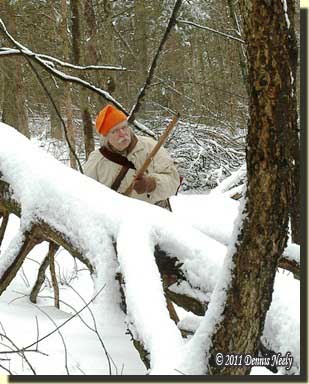 Although the primary emphasis of traditional black powder hunting is putting meat on the family dinner table, I don’t need a rabbit or squirrel dinner to survive the rest of the winter. This winter has been harsh on all of God’s creatures. I fully expect to find winter-killed game, and I’m not about to add to the grim total. Now is the time to allow the game to rebound, to replenish the forest. It is as it has been for centuries.
And that’s the beauty of traditional black powder hunting. I can enjoy a quick romp in the glade without having to kill anything—barring deep snow. I can still chase rabbits for a few weeks, but it is my choice whether or not I unleash the death bees.
In an odd twist of fate, the historical me has traveled full circle, and I am back anticipating taking a wild turkey as first meat. Most of our snow pack is still a foot deep, but I am looking ahead and thinking about wild turkeys. I feel the excitement growing. Dragging a few clucks on the wing-bone call that I keep on my desk might be cranking the anticipation up a bit, too.
I remember my stomach growling as I seated the wadding over the shot that morning. It was late February back then, too. I recall thinking the falling bark symbolized the end of the rabbit hunting for that year. But just because I missed, and just because the bark seemed like a slammed door, I did not stop the pursuit. I forged on that morning, circling to the north in hopes of heading off the rabbit for another go-round. And that is what we, as living historians, as traditional black powder hunters, do. We press on over the next hill…
Give traditional black powder hunting a try, be safe and may God bless you.
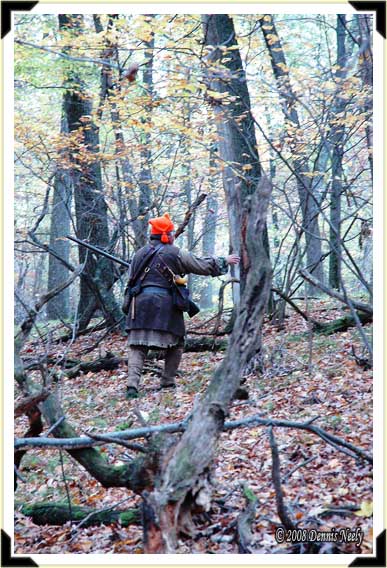
A lone British hunter assigned to Fort Detroit scans ahead for danger before breaking over a steep wooded hill. Fred Tonks, Lower Great Lakes, 1765.
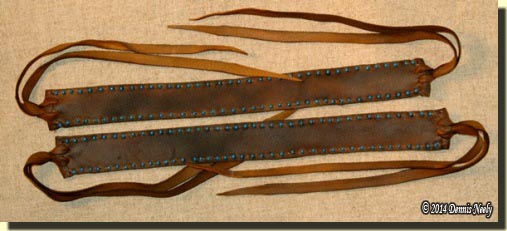 Another project has been added to the “How-to” pages: making a pair of buckskin garters. The introduction gives some background on garters with a strong Native American influence, appropriate for a native captive persona.
The first page deals with the factors I took into consideration, cites a specific museum example collected in the late-18th century in Michigan and the step-by-step making of a garter of buckskin. Splitting the garter tutorial into separate pages leaves the door open to expand on leggin garters, perhaps a finger-woven set and quilled or beaded legbands.
Be safe and may God bless you,

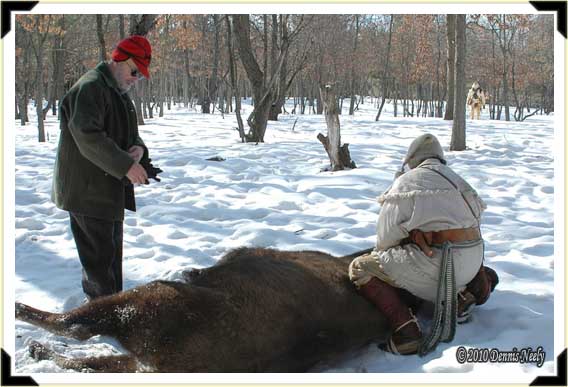
Rex Coleman (left) and Ed Schmidt (right) look over Coleman’s downed bison heifer as Gary Freiberger approaches from the distance. Mecosta County, Michigan, 1910
“Swip-it! Swip-it!” a contented blue jay, perched on a young cherry sapling’s topmost branch, sang a song seldom heard.
In the distance, in the muddy bottomlands beside the River Raisin, a tom turkey gobbled for the first time. My fingers dug around in the shot pouch until they felt the single wing bone. I cupped my hands about the round end, angled the bone down a bit and sucked in twice: “Arrkk, arrkk.”
“Gob-obl-obl-obl-obl-obl! Obl-obl-obl-obl-obl!”
After the old gobbler’s spontaneous response, I returned the wing bone to the pouch, standing it upright against the front seam where it was easily accessible. Out of habit, the Northwest gun’s muzzle eased in the direction of the great white oak that stands at the divide between the hardwoods and the bottoms. On that late April morning, in the Year of our Lord 1795, waiting seemed the best choice.
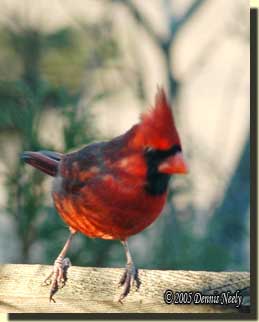 “Whit, tsu, tsu, tsu, tsu, tsu,” a crimson cardinal called as it bobbed on a flimsy witch hazel twig. “Whit, tsu, tsu, tsu, tsu, tsu…”
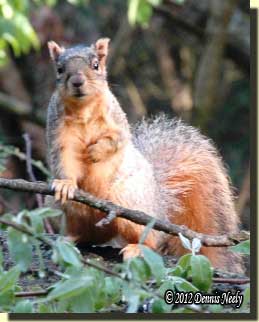
I listened to the cardinal sing and watched it more than I should have only because it was sitting in line with the last place I heard the tom gobble. I paid little attention to the song sparrows to my right or the fox squirrel scrounging for acorns to my left. Crows screamed from the steep wooded hill on the north side of the Raisin. Now and again a hen mallard squawked where the river turns deep and geese ke-honked from the sand flats.
“Gob-obl-obl-obl-obl-obl! Obl-obl-obl-obl-obl!”
The long-bearded turkey sounded closer. There was no question he heard the sullen clucks. Experience quelled the urge to reach for the wing bone. I sat back against the thigh-sized main branch, concealed within the broken top’s twiggy web. A chickadee landed not a trade-gun’s length distant, looked away, then took flight. I chuckled, confident the little songbird never saw me.
“Gob-obl-obl-obl-obl-obl!”
Although I could not see the lower trunk of the great white oak, it sounded like the tom was standing within the tree’s drip line. Clearly, he was approaching faster. I shouldered the trade gun and pulled my left leg up to support the forestock.
“Gob-obl-obl-obl-obl-obl!”
The gobble came from the other side of the hill that separated us. The tom had traveled fifty or so paces in a matter of minutes. My heart pounded and my breathing grew shallow and ragged. A shiny bronze shape appeared on the crest of the hill. The sharp English flint clicked to attention as I whispered the hunter’s prayer: “A clean kill, or a clean miss. Your will, O Lord.”
It was then that I realized the bird was moving in the wrong direction: west, not east. It’s body herky-jerked behind the hill’s rolling contour. My eyes followed the head, then I lost sight of it.
“Arrkk, arrkk.”
The two clucks stopped my heart from pounding. I took a deep, frustrated breath. An old raspy hen was coming to the gobbling tom. I reached for the smooth wing bone in desperation, thinking I was capable of enticing a wild turkey to forsake a flesh and blood hen standing on the hill’s crest. I knew better. I would simply have to wait until the hen lost interest in the tom.
A frequent complaint voiced by modern hunters is the constant noise in the forest. Tami and I hear this often at the outdoor shows, and sometimes at living history events, too. The songbirds, squirrels, chipmunks, blue jays, crows, Sandhill cranes, geese, you name it, they all get blamed for “disrupting my hunt.”
Not long ago, a camo-glad young man asked me about my passion for traditional black powder hunting. A few sentences into the discussion, the fellow maligned the forest creatures and asked, “Why don’t they keep quiet? I can’t hear the deer coming. In fact, I think they chase them away.”
I tried to project a Roy Keeler smile, the kind of disarming smile that exudes confidence and wisdom and softens the harshness of the advice that follows. “What you don’t realize,” I said, “is that the sounds you are complaining about are the sounds of a contented forest, a forest at peace and undisturbed.”
At that point I began to share an experiment that I propose when I feel an individual might heed my words and at least make an attempt at learning in the wilderness classroom: “Try this experiment. Approach the woodlot slow and quiet, then stand at the edge for ten minutes or so, until the birds are singing and the squirrels play. Watch and listen.
 “Next, enter the woods as if you are the king of the forest. Stomp right through the leaves. Snap twigs. Kick branches out of the way. Clear your throat. Show ‘em who’s boss. Then stop halfway to your destination. Watch and listen. Don’t linger, but continue on to your stand. Kick the leaves and twigs away from the bole of the tree and take a seat on your throne. Watch and listen.
“On another excursion, approach the woods as you did the first time. Stand at the edge until the birds sing and the squirrels play. Watch and listen. When you are ready, take two steps then pause for two minutes. Take two more steps and wait two or three minutes more, trying not to disturb the birds and squirrels. Continue to stalk your destination, but pause at the halfway point again. Watch and listen.
“When you reach the sitting tree, lean against the trunk for five or six minutes, then kneel and pause. Try to clear away the leaves in slow motion, without making a sound. Humbly melt into your place in the forest. Watch and listen.”
Rare is the time when outlining this experiment doesn’t draw strange looks and scowls. No one has ever come back and said they tried it, but that doesn’t surprise me.
When I relate a particular traditional hunting adventure, I find myself including the sounds of the glade. A prominent and respected outdoor writer once told me to “lose the bird noises…” To me, these sounds are an integral part of relating that particular moment. On the surface, the “Swip-it!” of the blue jay or the “Whit, tsu, tsu…” of the cardinal might appear to have no relevance to the story, but they are just as significant as a tom’s gobble or a buck’s grunt—they are the sounds of peace and tranquility.
I can’t begin to count the number of times I’ve heard the story of a big gobbler or a trophy-sized buck that did not come in. And so many times the explanation is that this creature of the forest possessed a sixth sense that knew “something was wrong.” Perhaps that is true, but no one ever asks the obvious question: “Was the woodlot contented and at peace?” The answers to that question are often eye opening.
I remember one 50-something hunter who never hesitated or thought when asked that question. He went on to tell how the fox and gray squirrels had been running all around his pop-up blind. He said he started throwing sticks at them to drive them off. He even left the blind to gather more ammunition, until they “ran away and quieted down.”
I smiled and asked, “Do you remember how you felt when you walked into a crowded room and everyone stopped talking? Did your sixth sense suggest ‘something was wrong?’” Unfortunately, he did not grasp my message.
Early in my journey down the path to yesteryear, I realized an important lesson hidden in the words of Joseph Doddridge. I have quoted the passage often, the one dealing with the old buck that displays “superior sagacity and watchfulness.” In Doddridge’s story, the old buck survives the valiant efforts of the hunter and is left free, an “uninjured tenant of his forest.” (Doddridge, 101)
Today’s hunting philosophy seems to put all of the emphasis on the harvest, an event that rarely consumes five minutes. If one tallies the total time expended in any given pursuit, this amounts to less than one percent of the effort.
In contrast, the goal Doddridge sets forth is to blend in to God’s Creation, to become a tenant of the forest, rather than a ruling monarch. When an individual accepts this humble calling and attempts to live as a forest tenant, whole new opportunities open up.
Seek to become a tenant of the forest, be safe and may God bless you.