Another Prudent Choice

A moccasin weaseled under brittle oak leaves. Slow and deliberate, the other toed a mossy patch. A long gaze spied nothing of importance. A perched blue jay cocked his tufted crown, but held his tongue. Down the slope, in a tangle of raspberry switches that ensnared an old treetop, a chipmunk chirped, then skittered along the upper limb with its tail straight up. After another glance about, weight shifted and the right moccasin advanced, then the left. The next pause, and the few after that, produced similar results.
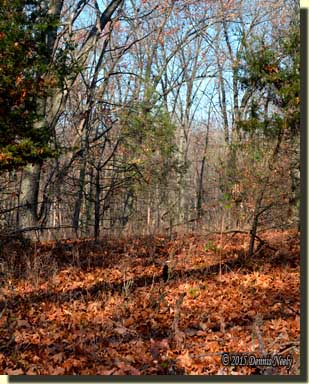
An uphill view of the ridge crest.That morning, in the Year of our Lord, 1795, a cautious still-hunt angled uphill on the sunny east slope of the hog-back ridge. An hour spent sitting quiet and scribbling musings on a folded journal page enticed neither fur nor feather close. Sequestered in a windfall, thoughts of wandering wild turkeys wafted in and out of the abbreviated sentences.

Then, across the big swamp, high up on the far wooded hill, three muffled clucks drew four more. The folded page and the brass lead holder slipped into the Ojibwe split pouch. With a roll, a push and a deep-gut sigh, I got to my feet, stretched and struck off on a still-hunt in search of that flock, or perhaps a single bird or two.

In due time my moccasins passed over a gentle knoll and struck upon a doe trail that led through a tunnel in a tight-growing cluster of red cedar trees. Deep in the shadows, almost to the far end, I knelt and surveyed the forest floor. From this vantage point I could see from the edge of the big swamp to the hill’s crest and well down the ridge’s steep eastern slope. In late November the white-tailed deer do the same, they stop within this humble fortress and watch ahead.

Eighty paces distant a fox squirrel dug in the brown, brittle leaves. Even with bad ears I heard it before I saw it. Beyond, a gray squirrel bounded along a limb, halfway up one of the hickories, where the sedge grass stops and the high ground begins. Somewhere over the crest a fox squirrel chattered, teasing, daring, taunting…

“Turkeys, we’ll stay on turkeys,” I whispered as I tried to convince myself not to abandon the pursuit of succulent fowls.

Two or three pauses into the warm sunlight, a plump fox squirrel jumped from an oak, rolled in the leaves and then started running straight at me. Startled by the commotion, I swung the Northwest gun’s muzzle to the left. The squirrel halted, stood upright, then scampered back to the safety of the keg-sized trunk. It spiraled around back, but in a couple dozen seconds appeared on a dead, barkless branch just above a few young cedar trees.

Two steps to the right, I knelt, rolled to my hips and sat with my back against a cedar tree. I rested “Old Turkey Feathers” across my lap and started reaching inside my black and red, floral-pattern trade shirt for a silk scarf. The squirrel watched as I slowly rolled the orange scarf and tied it about my head. The decision was made.

I reckoned the oak’s trunk was thirty-five paces away. The squirrel needed to be ten paces closer. “Fifteen steps would be ideal,” I thought as my mind shifted to squirrel hunting. Yet, my eyes spent more time scanning the hillside than keeping track of the squirrel. A passel of minutes passed. The squirrel fidgeted, flipped its tail and then circled around the oak. “A clean kill, or a clean miss. Your will, O Lord,” I whispered as my thumb fiddled with the cock’s jaw screw.

A Long-Standing Practice

As regular readers, some of you know that one of my favorite history-based hunting tales involves John Tanner: the time he changed his load, changed it back and then blew his gun up trying to kill a bear. Tanner’s hunting camp that spring was a day’s journey from the trading post…

“I killed by myself twenty otters, besides a good many beavers and other animals,” he wrote. (Tanner, 60)

He was out checking his traps when he came upon some ducks…

“…taking the ball out of my gun, I put in some shot, and began to creep up to them…” (Ibid)

In essence, when the opportunity presented itself, Tanner adjusted his plan to match the game at hand—from checking his traps to stalking wild ducks on a pond. But as he progressed, he discovered an even better “end-cap special” in his local woodland grocery store…

“As I was crawling cautiously through the bushes, a bear started up near me, and ran into a white pine tree almost over my head. I hastily threw a ball into my gun and fired, but the gun burst about midway of the barrel, and all the upper half of it was carried away. The bear was apparently untouched, but he ran up higher into the tree. I loaded what was left of my gun, and taking aim the second time, brought him to the ground.” (Ibid)

For me, these few sentences hold so many classroom lessons, some are “never dos” that make one shudder, but the positives are a major reason why I often quote this particular passage. Like Tanner, I took advantage of the game at hand on that pleasant Monday morning—I switched from hunting wild turkeys to putting a squirrel in the pot.

A part of that success is due to being prepared while in the glade. Not necessarily prepared in an 18th-century sense, but rather as a 21st-century living historian crossing time’s threshold ready to minimize the modern world’s intrusion into my 1790s scenario.

As I sat against that meager cedar tree, I never gave the orange silk scarf a second thought. A hunter orange head covering is a standard, tag-along item for my alter ego on most turkey chases. Now and again it gets left home or on a tent pole in camp, but most times, either spring or fall, I carry one.

This practice is not grounded in primary documentation, but rather represents a small dose of measured compromise with regard to modern hunting rules and regulations. The intrusion is minor and limited to the few seconds it takes to roll the scarf and tie it. Since embarking on the returned Native captive persona, two wraps around my head and the transgression disappears from conscious thought.

The hand-dyed silk scarf is new to me, purchased from Mary Brandenburg last March. Before I bought the scarf, I used a cotton head cloth, which I must admit took up valuable space inside my shirt or hunting pouch. Unlike the old cloth, the silk scarf compresses thin and does not leave a noticeable bulge. I even don hunter orange when I walk out after taking a turkey; years ago I read of a camo-clad hunter who was wounded carrying his spring bird out of the woods.

But in the fall, there are circumstances, like that morning, when I want to adapt to the forest’s offering. I can’t begin to count the number of hunts where such a switch took place—both ways, hunter orange on or hunter orange off. With each circumstance, safety has always been the first concern; there are some locations on the North-Forty, mostly along property lines, where I would not think of removing an article of hunter orange clothing. I would never follow this practice on public land or upon an unfamiliar plot. On that morn, I saw no danger…
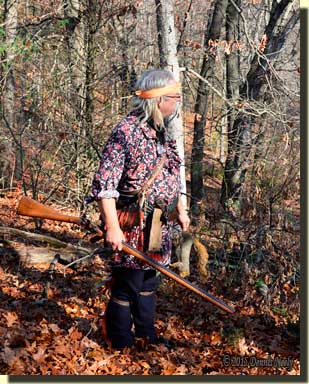
Still-hunting while carrying a fox squirrel.The fox squirrel jumped to a nearby cedar tree. It held fast and peered at my cedar. In a dozen shallow breaths, it climbed out on an opposite twig, hopped into the next cedar, then spiraled earthward. Once on the ground, it took deliberate bounds downhill. Working the trigger with my index finger, I felt the sear drop into the tumbler’s full-cock notch.

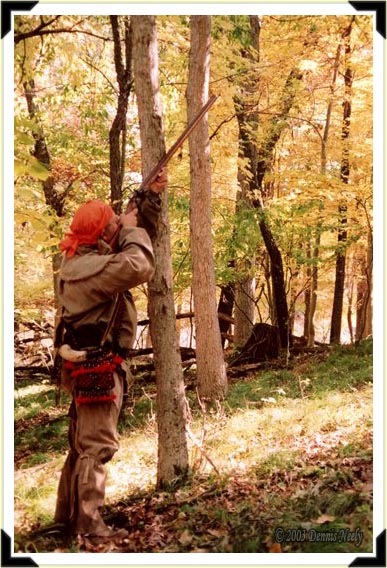
During the wait, a modest autumn olive with yellow and green fish-shaped leaves came to signify an appropriate distance for unleashing the death bees. The squirrel paused behind that marker, out of my sight. The Northwest gun rose to my shoulder. My left elbow rested on my left knee, pulled up a few minutes before when the squirrel slipped to the back of the oak. Two hops later the smoothbore belched fire and a mighty roar: “Kla-whoosh-BOOM!”

Leaves flew. Autumn olive twigs fluttered. White smoke shrouded the fox squirrel. I rushed to my feet, but saw the forest tenant’s lifeless form. Before reloading, I knelt and offered a prayer of thanksgiving, not only for the blessing of the fox squirrel, but also for making a prudent choice.

Give traditional black powder hunting a try, be safe and may God bless you.
Posted in Clothing & Accoutrements, Squirrel Hunts | Tagged , , , , , , , , , , | Comments Off on Another Prudent Choice

“Waiting Out A Bushytail”

“Snapshot Saturday”

A traditional woodsman aiming at a squirrel in a tree.

The fox squirrel’s bushy tail hung over the red oak limb, betraying its position. Making cutting noises, the woodsman waited to unleash the death bees when curiosity forced the squirrel to look down. Old Northwest Territory, one hill east of the River Raisin, 1790.

Posted in Snapshot Saturday, Squirrel Hunts | Tagged , , , , , , , , , , | Comments Off on “Waiting Out A Bushytail”

“Perhaps there is a chance…”

Stillness prevailed. Half visible to the west, the evening sun blazed orange with an outer aura of lavender. A fox squirrel chattered where the hardwood hills descend to the young maples, then blend with the River Raisin’s muddy bottomlands. The acrid scent of falling oak leaves hung in the quiet solitude of that day, in the Year of our Lord, 1796.

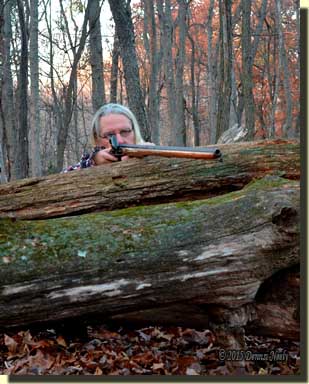
A traditional woodsman rests a Northwest gun over a downed log.“Arrkk.” A hushed cluck caused a wary woodsman to turn about slow and roll up on his wool-clad knees. The Northwest gun’s muzzle crept over the bark-less, uppermost limb of a tangle of three treetops, downed one at a time in succeeding summers, decades ago. The sharp, English flint snapped to attention. The turtle sight waited with anxious anticipation as a discerning eye watched over the back flats of the trade gun’s browned barrel.

In a minute or so the dark shape of a lone hen turkey moved among the oaks, maples and hickories on a far knob. The bird chose an erratic course. At a prominent white oak the fowl’s direction changed as it began to circle toward the treetop fortress. “Perhaps there is a chance,” the returned Native captive whispered.

Alas, a couple dozen turkey steps closer the hen again paused, looked about and struck off due west. With a finger working the trigger, the sear returned to the half-cock notch. Muscles relaxed, and breaths slowed. Turning back, the forest tenant settled down onto the blanket roll. By then, the fox squirrel ceased its chatter.

Backlit by a gorgeous orange sunset, the bushy-tailed rodent ascended an angled maple branch, climbed out on a thin twig, hesitated, then leaped to a similar twig on a close-by oak. The squirrel again hesitated, hopped along a limb, then disappeared.

With little light left, fifteen Canada geese rose up from the Raisin, creating a mighty commotion as they assembled and veered to the east. Thankful for the blessing of a peaceful afternoon jaunt, the woodsman scrambled to his feet, stretched and began walking in the same direction the geese took.

The 1790s Beckon a Weary Time Traveler

October flew by with fewer hours afield than hoped. At times it seems that the pressures of modern existence conspire against an already weary time traveler, leaving a heap of expectations unfulfilled. The bagpipes, violin and drums of “The Gael,” performed by the American Rogues and the American Air Force Symphony, even fails to assuage the disappointment.

Unfortunately, life demands choices, and right now finding the time to get to the woods overrules pounding the keyboard for a full-length blog post. A lingering stretch of outstanding weather here in Michigan doesn’t help, either. I want to be in the woods every waking moment, and that desire is unreasonable, to say the least.

Last night’s excursion fanned the passion that drives me to seek out pristine 18th-century moments. Well after dark, I realized that I never scribbled a single word in the journal. That is so not like me, but it reflects the stress of these last few weeks.

That said, my addiction dictates that I don linen and leather, strike off through time’s portal and frolic in the joyous Eden of the 1790s in the Old Northwest Territory. I can catch you all up, dear readers (as John James Audubon used to pen), when the driving rain comes or the snow flies. Perhaps there is a chance at a fine fowl this day…

Give traditional black powder hunting a try, be safe and may God bless you.
Posted in Turkey Hunts | Tagged , , , , , , , , , , , , | 1 Comment

“Unpleasant Reality”

“Snapshot Saturday”

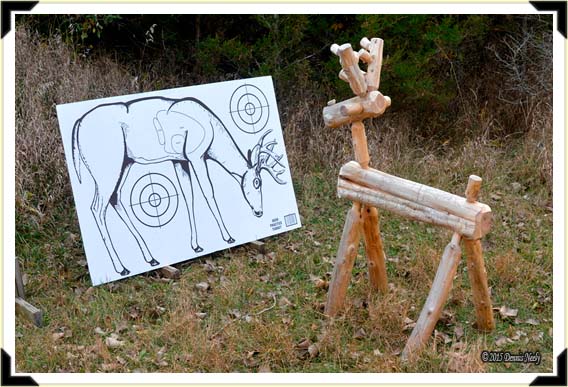
A cedar-twig deer looking at a cardboard deer target.

Buford, a young whitetail buck sporting a modest set of first-year antlers, grew up frolicking in the security of that small clearing. On a fine October morn, the youthful buck crossed the grassy opening on his way to checking a scrape. An unfamiliar, rather two-dimensional deer caught his keen eye. He inched closer and came face to face with the harsh reality of 18th-century wilderness life… Old Northwest Territory, 1796?

Posted in Deer Hunts, Snapshot Saturday | Tagged , , , , , , , , , , , , | 1 Comment

“Digging a Hole”

“Snapshot Saturday”

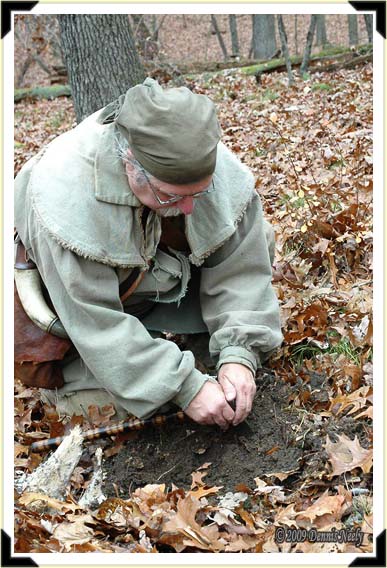
A traditional woodsman using a tomahawk to dig a hole.

The aroma of fresh-turned earth filled the air as a traditional woodsman dug a hole for a station camp’s angled ridge pole using the blade of his tomahawk. Damp, loose soil in the sequestered hollow piled up quickly. By nightfall the shelter’s ridge and rafters awaited a brush covering. Old Northwest Territory, one hill east of the River Raisin, 1794.

Posted in Hunting Camps, Snapshot Saturday | Tagged , , , , , , , , , , , , , | Comments Off on “Digging a Hole”

“Waiting on a Fox Squirrel”

“Snapshot Saturday”

A traditional woodsman, half-hidden in a windfall, waits on a fox squirrel to close the distance.

On a warm October afternoon, a traditional woodsman sat quiet in a windfall, watching a plump fox squirrel bound up the slope. The squirrel frolicked just beyond the Northwest gun’s effective distance and treed when the woodsman arose and began a slow, deliberate stalk. Old Northwest Territory, east of the River Raisin, 1792.

Posted in Snapshot Saturday, Squirrel Hunts | Tagged , , , , , , , , , , | Comments Off on “Waiting on a Fox Squirrel”

Fording the Pigeon River

“Old Turkey Feathers” held no charge. With hammer down and frizzen up, the Northwest trade gun’s tarnished-brass butt plate squished into the soft, wet sand. Msko-waagosh, “the Red Fox,” settled to his haunches, using the smoothbore’s forestock more as a supportive stick than an instrument of death. Before him, at the river’s edge, the once native captive unraveled multiple sets of deer tracks mixed with those of squirrels and a wandering raccoon.

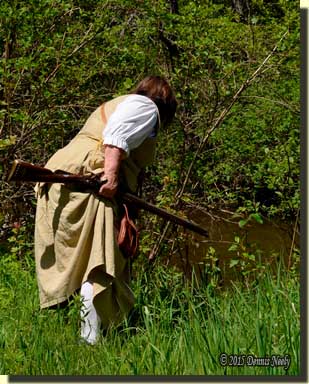
A frontier wife checks for elk signs near the Pigeon River.On that pleasant June morning, in the Year of our Lord, 1796, the woodland tenant who refused to give up the old ways of his adoptive Ojibwe family glanced over his shoulder at his frontier wife as she checked a gravel patch, a dozen paces upstream. Her chiefs-grade trade gun, “the Silver Cross,” held no charge as well. “Just does, a fawn and a squirrel here,” she said in a hushed tone.

Not long before, the couple ventured around a slight bend in the Pigeon River and happened upon a gurgling rapids. Just below the rocky shoal the pair paused at a shallow crossing. Small round river stones, covered with a light coating of green moss, lined the bottom as the cold, clear water flowed on into the wilderness. The backcountry husband and wife sought elk sign that day.

Finding not a trace, Msko-waagosh rose to his feet, stepped back and sat in the grass. He pulled off his elk moccasins, untied his beaded leg ties and removed his blue wool leggins. “I will check the other bank,” he said as he got to his feet. After folding his moccasins and leg ties inside the leggins, he walked to the river and began to cross, taking great care to watch each step on the slippery rocks.

The current pushed against his lower legs. The cold water numbed his ankles as he clutched the wool bundle close to his body. On the far side, he set his garments on a rock and searched the shore barefoot. “There is nothing here, either,” he said, “and the trail is denser over here.”

Once back on the west bank, the woodsman walked beyond the gravel, sat and dried his legs with handfuls of short, green grass. The dark wool leggins warmed his legs as he pulled on his moccasins and scrambled to his feet. “It’s time to move on,” Msko-waagosh said.

Dealing with Crossing Water

Last June the Michigan Outdoor Writers Association held their summer conference at Gaylord, Michigan. Gaylord’s Treetops Resort, located a few miles east of town at 3962 Wilkinson Road, hosted the attending writers. The MOWA members travel to a different host city each year, sampling the Pure Michigan experiences that area offers.

On Friday night, the Gaylord Area Convention and Tourism Bureau provided a “Welcome Reception,” which highlighted the organization’s “All Outdoors!” tourist initiative. Saturday is a designated workday for the outdoor communicators with an official activity list that features a sampling of the host city’s many attractions, natural resources and/or recreational opportunities. Some writers strike off on their own adventures, which is what Tami and I did.

We chose a traditional black powder hunting scout in the Pigeon River State Forest area at Vanderbilt, north of Gaylord. The historical scenario for that sojourn was to scout for elk along the Pigeon River with hopes of sighting one or more within an 18th-century wilderness context.

A couple of weeks before the conference, I spoke with Rick McDonald, a Michigan Department of Natural Resources Forest Technician who works out of the visitor headquarters building. We discussed our intent to make sure the scout complied with all game regulations. I had specific concerns about carrying the smoothbores, but as long as they were unloaded, there wasn’t an issue. As an added consideration, we removed all round balls and shot from our pouches and our horns held no black powder.

Beyond looking for elk signs, we entered our 1790s Eden with minimal expectations. The weather was gorgeous and the bugs restrained themselves. We found the Pigeon River with little trouble and at one point we watched a doe on the far bank while a red-tailed hawk circled overhead and a close-by poplar’s leaves rattled in a gentle breeze.

As we moved downriver, we found it necessary to skirt a couple of modern campsites, and then we came upon the tiny rapids and the river crossing. The discovery was not without 21-century distractions, but by facing north the intrusions disappeared in our ancient world. Despite the cold water, I found myself compelled to attempt a stream crossing in true period-correct fashion.

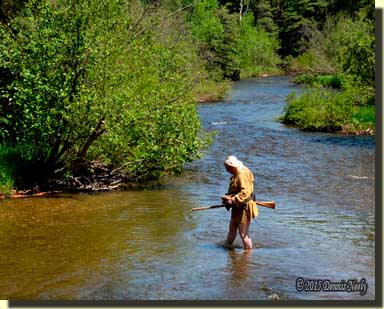
A traditional woodsman mid-stream in the Pigeon River near Vanderbilt, Michigan.Elk moccasins, buckskin or wool leggins and water come together at the strangest times in the wilderness classroom, yet they pop up with surprising regularity, often providing a fresh, 18th-century learning experience and with a little luck, a pristine moment. Over the decades, I have learned the circumstances surrounding such woodland lessons dictate the best response, sometimes casual and sometimes urgent. On that June morning, the former was the case.

John Tanner addressed the rigorous rules followed by the young warriors during their initiation while with a war party. In the midst of his lengthy explanation, he spoke of dealing with water:

“…They must, if possible, avoid wetting their feet, but if they are ever compelled to wade through a swamp, or to cross a stream, they must keep their clothes dry, and whip their legs with bushes or grass when they come out of the water…” (Tanner, 109)

Tanner’s words formed the lesson plan that morning, right down to using grass to dry my legs. There was no urgency to the crossing; plenty of time existed to strip down, fold the clothes and carry them across the shallows. The learning came with mentally overcoming the numb ankles, working with the stiff current and placing each foot with care on the slippery rocks. A sudden slip, a loss of balance and a broken leg in the middle of the fording would have changed the entire complexion of that outdoor laboratory experiment.

Jonathan Alder spoke of following a similar regimen when crossing the Ohio River, a much wider and deeper adventure than the Pigeon was:

“…we went up on the bank and peeled an elm, and made a bark canoe. We all put our blankets and guns and clothes in it and one Indian tied a piece of bark to one end of the canoe and put the other end round his neck and struck out for the other side. We all plunged in one after another, so as not to swim in a huddle for fear of getting entangled with each other…” (Alder, 84)

Likewise, my trading post hunter persona always turned to Meshach Browning for advice on dealing with water in cold weather.

“On the morning when the first snow fell, I rose early, intending to hunt on the west side of the Great Yough. river. I went to the river, which, being pretty well up, the water reached about half-way up my thigh. I took off my pants and moccasins, waded over, and after again putting on my clothes, I felt first-rate…” (Browning, 250)

In both instances, the trading post hunter and Msko-waagosh, the returned captive, avoid getting wet feet while engaged in a simple pursuit. Knowing the North-Forty as I do, there are ample places to cross swamps with a minimal chance of getting damped or soaked. And there is always the choice of “walking around” a potential water hazard—again in adherence to John Tanner’s young warrior comments.

In Michigan, weather conditions exercise a tremendous influence over a living historian’s encounter with water. Although the air that June morning was warm and pleasant, the Pigeon River ran cold and harsh, numbing my ankles before I reached the halfway point of the crossing. In August or early September, the water temperature would not be an issue, but by late September the river’s flow would cool again.

For some reason, I always remember the cold-weather dunkings. Perhaps that is because I’ve never fallen through the ice in mid-August. When a traditional woodsman hears that stomach-wrenching first crack, and I seem to be a magnet for such happenings, the circumstance affords little time to think, much less sit on the bank and strip off warm clothing.

A number of years ago, while on a bobcat hunt, I slipped on a snow-covered log as I crossed a much smaller stream that still ran open. The temperature that afternoon struggled to reach ten degrees above zero. Balanced on a tiptoe, the icy water came to mid-calf. Only a trifling amount got past my moccasin tops, which were tied snug. The frigid jolt of seeping water was period-correct, and the blanket-wool liners performed in a 1790s manner as well, wicking the moisture away from my skin and nullifying the mishap.

Charles Johnston, taken captive in 1790 by Shawnee warriors, told a similar tale. In a few brief sentences, I shared a feeling of kinship with a woodsman I will never meet, never knew:

“…we came to a creek. A log lay over it, five or six feet above the surface, connecting one bank with the other. We began to walk across this. The greasy moccasins I wore were so slippery that I tumbled into the stream. Luckily, it was no deeper than my waist and I had no difficulty getting to the other side. The savages are so well known for their sternness that we are ready to suppose they are entire strangers to mirth. But any happening like this never failed to draw loud, repeated bursts of merriment from them.

“I had never experienced trials and hardships such as those I was now undergoing. Still, my health was not injured by wading creeks, falling into the water, sleeping in the open air in all kinds of weather, or by any of the other inconveniences I encountered on this long, painful march, the first of its kind I had ever made.” (Drimmer, 200)

And therein resides the elusive mystique that draws one to engage in a traditional black powder hunt or scout: to experience the texture of life, as close as possible, in a bygone era. There was, it seems, no other choice but to ford the Pigeon River…

Keep your toes dry, be safe and may God bless you.
Posted in Elk, Research, Wilderness Classroom | Tagged , , , , , , , , , , , , | 2 Comments

“Not Far Away”

“Snapshot Saturday”

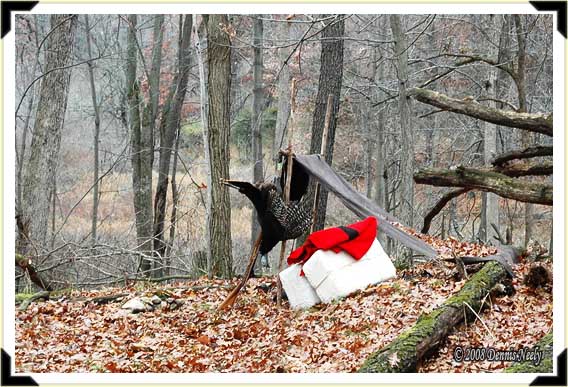
A wild turkey hanging on a pole in a hunting camp.

That fall, in the Year of our Lord, 1795, a simple canoe tarp served as a traditional woodsman’s humble abode. Two ridges east of the River Raisin, Old Northwest Territory.

Posted in Hunting Camps, Snapshot Saturday, Turkey Hunts | Tagged , , , , , , , , , , , , | 2 Comments