Time to Take a Look…

Two sharp clucks betrayed a young wild turkey. Beyond, deeper in the cedar grove, a fox squirrel chattered. Sixty yards distant a cottonwood leaf, heart-shaped, palm-sized, still green in the center, whipsawed back and forth in the steady north-northwest breeze.

“Kla-whoosh-BOOM!”

Both the turkey and the squirrel grew silent after the Northwest gun thundered. A distant crow cawed; nothing persistent but rather as one just passing through. Black gun powder granules tumbled to the trade gun’s warming breech. Not long after the wiping stick coaxed a linen-patched round ball down the bore and seated it firm on the charge.

A red-tailed hawk kited in from the south. Its graceful image broke into sight above my forehead, not high yet not low in the cloudy afternoon sky. “Scu-reeeeee…Scu-reeeeee!” the raptor screamed as it banked its wings and circled off toward the River Raisin.

“Kla-whoosh-BOOM!”
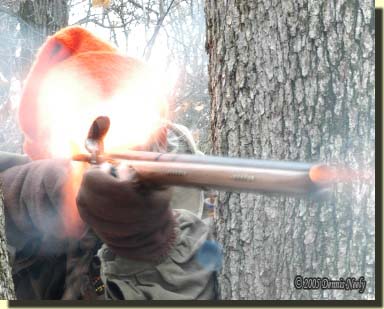
The Northwest gun's pan flashes and the main charge roars.Heavy white smoke raced to the southeast. The cloud expanded and thinned as it filtered into the cedar grove. Some minutes later a pair of blue jays swooped low over the prairie grass, then rose up and perched in the cottonwood’s foliage. I watched the jays as the wiping stick swabbed “Old Turkey Feathers’” fouled bore with a water-soaked linsey-woolsey patch. Once clear of the tube, the greasy-black patch fell with the others in the little pile to the right of the tarnished-brass powder measure.

With the Northwest gun leaned against the red trade blanket on which the smoothbore’s fixings laid in a neat semi-circle, I turned left and looked at the ragged hole in the practice target. “It’s time to go look,” I whispered. And with that I started walking down range.

Range Time with a Purpose

The stapler snapped three times. Being frugal, I use only one staple to hold a target’s bottom edge, even in a stiff breeze. The orange folder, the one that held this go-round’s worth of sight-in targets, acted as a makeshift backing pad as I began filling in the six rows of information, noting the patch lubricant was the variable changed in that five-shot group. Completed, the target slipped into the folder, joining the other fourteen “already shot” samples—the work of three separate range sessions.

Old Turkey Feathers is far from new, being 30-something years young. We’ll leave it at that as it is not considered proper or polite to ask a fine lady her age. But Old Turkey Feathers has temperamental fits, now and again, and those times of wayward behavior earned her a file of targets.

One folder, a dog-eared green one, keeps the 8 by 10 round-ball targets; a special stash in the basement holds rolls of brown-paper pattern board targets. Black felt pen slashes mark each perforation and the total hit count is recorded in the bottom left corner, along with the powder charge, wadding used, shot size, date, time, temperature and other noteworthy information. Some rolls record bird shot, others buckshot, and last fall a new set chronicled the wilderness classroom lessons of buck and ball.

My wife, Tami, questions keeping the growing stack of rolled up pattern-board targets, but when a problem arises the first place I go is the target file or the rolls. On many occasions the answer already exists, and I just forgot or drifted off into a bad habit with unfavorable consequences.

For those readers new to black powder shooting, or those contemplating veering off on the path to yesteryear, most veteran shooters suggest keeping notes of both practice sessions and competitive matches with a new longrifle or fowler. At the dawn of the 1980s, I should have listened to Homer Dangler and the late Paul Griffith and kept my targets with notes. I did not. Like so many memorable lessons in life, I learned the hard way.

Years ago, up Caesar’s Creek at Shaw’s Quail Walk on the National Muzzle Loading Rifle Association’s home grounds, a gentleman sat down next to me as I watched shooters bust most of the clay birds thrown. “Honey, how are you doing today? Ever shoot the quail walk?” the gent said. Calling me “Honey” caught my attention, and I later learned that was Max Vickery’s trademark greeting.

Max Vickery was an icon at the NMLRA, a national champion shooter with both rifle and shotgun. “Contagious enthusiasm” best described Mr. Vickery. We talked about chasing pheasants and rabbits, two of his fondest passions. When the conversation reached besting clay birds, Mr. Vickery offered a sage bit of advice: “You need to shoot a thousand birds.”

I’m sure he could tell from my perplexed look that I did not understand. He told me to set a thousand bird goal, each shot taken seriously, which translated into a lot of practice. He suggested spreading the birds over time, and when at Friendship, I should shoot the quail walk as often as I could, regardless of my score. He assured me at the end of a thousand birds I would see a real improvement in my wing shooting skills, and I did.
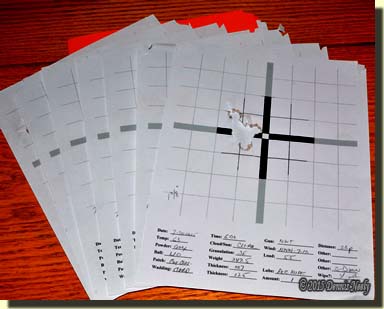
An afternoon's worth of trade gun practice targets.Mr. Vickery’s advice can be paraphrased to “You need to shoot a thousand round balls,” too. Years ago I lost count at ten thousand. After all, once a traditional hunter reaches a level of proficiency that suits his or her requirements, the only shot that matters is the next one.

Not long ago a forum thread caught my eye. The original question dealt with what was a reasonable distance for taking a deer with a smoothbore. I have addressed establishing an
“effective distance” in a number of posts on this site and in magazine articles.

The answer is for each hunter to establish his or her criteria as to the group size needed to humanely bring a deer to the table—six to eight inches is common. The next task is to assess the ballistic limitations of the chosen smoothbore and the physical skills of the person pulling the trigger. The distance at which either the arm or the individual can no longer maintain a consistent six-inch group is the outer limit of the hunter’s effective distance. To gain this knowledge requires range time with a purpose.

What concerned me with this particular post was the comments that presented “factual information” that is inconsistent with the targets produced by Old Turkey Feathers over the past 30-plus years. One respondent who is respected for his historical knowledge made authoritative statements based on ten shots with a new-to-him fowler.

To make matters worse, others based their comments and assumptions on the “findings” of the first writer, repeating them over and over without questioning the limited number of shots on target. I do not doubt the person’s results, but his conclusions based on such a small sample are incorrect, and further, support the misconception that smoothbores are inaccurate.

A gentleman used to deer hunt on a neighboring property to the North-Forty. He sat on the same hill with an Ithaca Deerslayer shotgun. He thought nothing of taking running shots, which we forbid on this side of the fence, because of the low probability of a clean kill. Most of his volleys were three to five shots, and the result was the same—no venison.

When we talked, I asked if he ever sighted the shotgun in at a range or practiced with it. He said he had, noting he took “two to five shots” and when “the last one hit close to the bulls-eye” he figured it was “zeroed in.” The same happened in the later years when he added a nice scope—he’d take a few shots and when one hit the bulls-eye he was set to go. He never spoke of adjusting the sights so his point of aim matched his point of impact, yet he felt his gun was shooting “right on,” based on one shot that happened to hit where he wanted it to.

The point I am trying to make is that any testing in the wilderness classroom should be undertaken with a purpose, barring plinking and just shooting for the fun of it. Now the purpose for range time might vary, but the results should be verifiable and easily duplicated at future sessions and especially under actual hunting circumstances.

In essence, someone else with a similar smoothbore should expect to follow the same loading procedures and achieve the same results. If a test result cannot be duplicated, it is worthless unless it contributes to further understanding that moves the individual closer to a solution to a problem or helps improve that person’s skill level.

To take ten shots and report the results of those ten shots is one thing. To use those results to make a definitive statement, one that does not match others’ results, is quite another. And when those statements influence newcomers to shy away from smoothbores, as one person stated, the erroneous findings become a terrible disservice to the traditional black powder hunting and the black powder shooting sports communities.

Give traditional black powder hunting a fair try, be safe and may God bless you.
Posted in Research, Worth thinking about... | Tagged , , , , , , , , , , , , | Comments Off on Time to Take a Look…

Breechclout How-To Added

The step-by-step instructions on making and decorating breechclouts are well underway. Be sure to check them out under the “How-To” section in the site’s navigation bar.

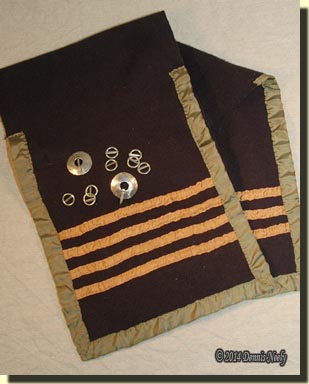
The finished breechclout ready to add trade silver.The discussion starts with a heavily documented introduction to the clout as it relates to returned native captives. The post goes into a little more detail about how I arrived at the design and ornamentation of the breechclout that I have used for the last two-plus years. I included some of the questions I ask myself when creating a living history persona and some of the thought processes I follow when making clothing or accoutrement decisions.

In trying to keep the How-To instructions relevant to a broader range of characterizations, cutting out the basic breechclout and how I decided at the dimensions is set apart in its own page. I also included some hands-on discoveries I made in the wilderness classroom. Nothing special, but ideas that I think are worth mentioning.

Adding the hand-dyed silk ribbon binding and ornamentation will come next, and I will include some comments on what I discovered with the ribbons and with the trade silver pieces as well.

Keep in mind this is just one traditional hunter’s opinion—everyone has a little different way of stepping through time’s portal and returning to yesteryear.

Be safe and may God bless you

Dennis Neely

Posted in Clothing & Accoutrements, Research, Wilderness Classroom | Tagged , , , , , , , , , , , , | Comments Off on Breechclout How-To Added

“Shadowy Ambush”

“Snapshot Saturday”

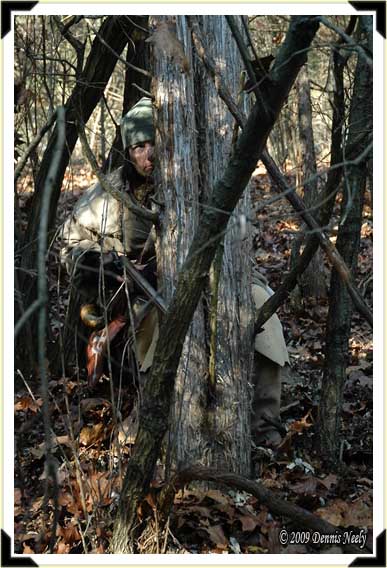
A huntress sitting behind a forked red cedar tree.

The lady of the forest favored the morning shadows and a forked cedar tree for her ambush. Old Northwest Territory, in the Year of our Lord, 1794.

Posted in Snapshot Saturday, Turkey Hunts | Tagged , , , , , , , , , , | Comments Off on “Shadowy Ambush”

With Renewed Vigor in His Step

Sunshine warmed the glade. Overhead, a gentle breeze rustled drying, brown, yellow and crimson leaves. To the south, a pair of blue jays swooped side-by-side from a tall red oak, then parted ways. A young doe wearing its first winter coat nuzzled ankle-deep leaves, searching for a missed acorn. She perked her head up when a plump fox squirrel dove from a shag-bark hickory, rolled once, then bounded off. As the squirrel spiraled up a stout white oak, the doe shook like a sopping-wet cur, then grounded her nose once again.

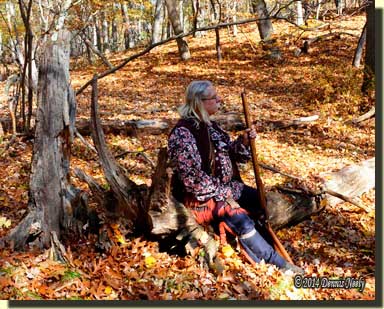
A traditioinal woodsman sitting on a log in the woods.In the midst of that pleasant mid-October afternoon, the tribulations of backcountry life in the Year of our Lord, 1796, weighed heavy on a returned captive’s mind. The creatures of the forest went about their daily routines, giving little consideration to the woodsman sitting in the dappled sunlight at the butt-end of a barkless, hollow, fallen log. The woodland tenant sat motionless, observing the comings and goings while absorbed deep in thought.

Some days the returned captive with the shoulder-length gray hair sat in front of the log facing east, and on others he sat watching the western knoll. The wind, the sun and the time of day determined which side he favored.

Then other days he might recline against a special white oak, over the rise and a bit to the southeast. Still others might find him sitting cross-legged on the shadow-side of a maple, the one with the storm-fallen oak top hugging its trunk, up the hill from the crossing trail he called “the isthmus.”

On those occasions, a Northwest gun lay across his lap. The death bees rested in tranquil resignation, too. Sometimes the brass lead-holder scampered across a folded page, and again, on others it might not. But always, with little warning, the reflective moment passed. The end was always the same. The returned captive regained his feet, woke the death messengers by checking the smoothbore’s prime and struck off in an unpredictable direction with renewed vigor in his step.

A Difficult Dimension to Add…

The creation of the returned native captive persona continues to be a taxing undertaking. I never considered all of the nuances of re-creating an individual with a cross-cultural upbringing. For example, last Tuesday night, a half hour into Isadore Toulouse’s weekly Online Anishinaabemowin (Ojibwe) webinar, Isadore asked:

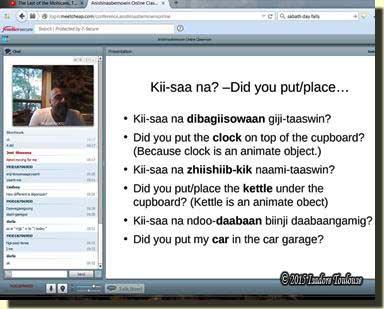
“Kii-saa na zhiishiib-kik naami-taaswin?”

Thankfully the PowerPoint slide on the screen gave the answer to his question:

“Did you put/place the kettle under the cupboard?”

Screen capture of PowerPoint slide.The slide demonstrated the correct way to ask in the Ojibwe language, “Did you put/place…” (Kii-saa na…) an animate object somewhere. In Anishinaabemowin (“the language”) objects are either animate or inanimate. In this case, a kettle is animate.

The next slide offered a couple of simple questions for inanimate objects, the first being:

“Kii-toon na emkwaan giji-doopwin?” or “Did you put/place the spoon on top of the table?”

I frantically typed notes as Isadore explained the differences in the language. On the one hand, I recognized “taaswin” as “cupboard,” “naami” as “under” and “giji” as “on top.” I felt a rush of enthusiasm as I learned “zhiishiib-kik” meant “kettle,” a word that would have been common in my alter ego’s 18th-century vocabulary, but in a matter of seconds all that elation came crashing down when I could not for the life of me recall “zhiishiib-kik.” As my father used to say when he thought I wasn’t paying attention, “In one ear and out the other.”

The Online Anishinaabemowin weekly classes taught by Isadore are free at 7 pm each Tuesday night during the school year. He speaks little of himself, but he is Odaawa and was raised speaking the language in his home. His “Auntie Shirley” pinch hits for him when a prior commitment keeps him from his beloved class.

Isadore exudes a deep passion for his heritage and his simple lessons are devoted to preserving the language by passing it on to others. From attendees’ comments and responses during the classes, it appears that most participants are Native American—Ojibwe, Odaawa or Potawatomi. They login from all over the world, some with a working knowledge of the language and some who wish to learn the language of their ancestors. And then there is a living historian who wishes to flesh out a new persona.

If an 18th-century captive spent a short time with his adoptive Ojibwe family, then knowing the language might not be necessary for an honest and truthful portrayal. But if an alter ego grew up as an adopted member of an Ojibwe family and returned to the settlements later in life that would not be the case—he or she would remember at least some of the language. And that pretext has driven my desire to gain a rudimentary vocabulary in Anishinaabemowin.

I’ve “attended” Isadore’s classes for over a year now, but alas, I can only recognize a handful of words or phrases. Some have made their way into my portrayal, but I find myself stumbling over the correct pronunciations, a reality that Isadore tries to alleviate by insisting that students repeat the words after he says them. Early on, my wife walked by the office and asked, “who are you talking to like that…”

For me, a deep sense of responsibility accompanies learning another culture’s language. As a living historian, I wish to engage in an authentic, 1790-era experience. But that simulation must also show respect for the Ojibwe people and their heritage. I think, at times, this inner need to re-create the language in a positive, period-correct sense is an obstacle to practicing what I have learned.

And this learning of the Ojibwe language has not been devoid of pristine moments. Early on, I felt desperation at just trying to understand what Isadore or Auntie Shirley said when either of them went into an “immersion lesson,” speaking entirely in Anishinaabemowin. The first time I didn’t understand a word, and the frustration drove me to the woods, which led to a few moments in time where I shared a feeling of kinship with Jonathan Alder:

“Despite my adoption, I was frequently low and not satisfied. Mrs. Martin and I were separated and the white man had left. I saw him only occasionally afterwards. There was no one living soul that I could talk with or understand except occasionally when I would meet a white prisoner. In this condition, I got very lonesome. I would set [sic] and think for hours remembering my home, my mother, and my two brothers. I was so full of sadness that I would be ready to burst out and cry. I made it a rule every day for a whole year at about three o’clock in the afternoon to go down to the river bottom to a certain walnut tree and sit down and cry for an hour or so until I could give full vent to my feelings. Then, I would get up and wipe up, and wash to prevent their knowing that I was in so great trouble. It is surprising to think how much relief that gave me. Notwithstanding my efforts to conceal my troubles, my Indian mother could see it. As soon as she could make me understand, she would frequently talk to me and tell me not to be troubled. I learned very fast, for the boys and girls took a great interest in my welfare and would try to amuse me and learn me to talk. I was a favorite with them” (Alder, 49-50)

Hopefully, after the first of the month I will have time to start making flashcards. Isadore also suggests labeling items around the house as an aid to learning. I expect to do that, especially applying labels to the trappings of this glorious pastime…

Give traditional black powder hunting a try, be safe and may God bless you.
Posted in Persona, Research, Skills | Tagged , , , , , , , , , , , , | Comments Off on With Renewed Vigor in His Step

“Perilous Crossing”

“Snapshot Saturday”

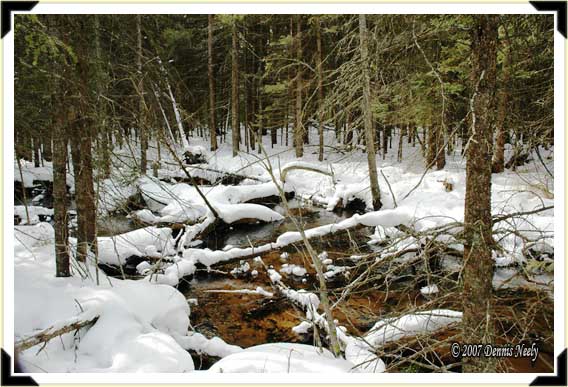
An open creek deep in the forest.

The hounds bayed in the distance as they pushed an old male bobcat farther to the west. The melodic barking circled closer, leaving little doubt the open creek needed crossing, but would it be safe? Old Northwest Territory, 1792.

Posted in Bobcat Hunts, Safety, Snapshot Saturday | Tagged , , , , , , , , , , , , | Comments Off on “Perilous Crossing”

“The War’s Toll”

“Snapshot Saturday”

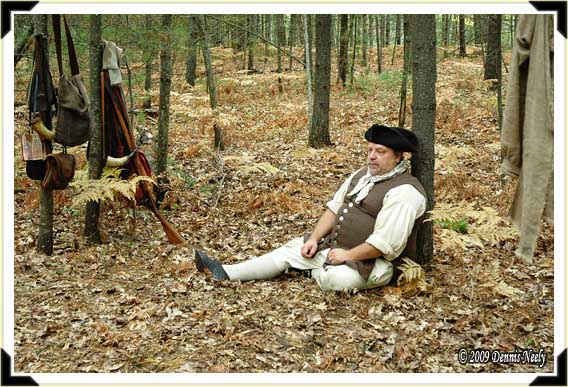
A War for Independence re-enactor sitting against a tree in the forest.

A War for Independence re-enactor, Tim Richards, sits against a tree in the forest, contemplating the war’s toll. “Michigan Geezer Scout” station camp, Marl Lake, 1780.

Posted in Living History, Snapshot Saturday, Squirrel Hunts | Tagged , , , , , , , , , , , , | Comments Off on “The War’s Toll”

‘Hawk Bit Guard “How-To” Added

This week’s post started out as a discussion about how I came to the decision to make a leather bit guard with a Native American influence for the Long Lake ax, rather than the more elaborate Alexander-MacKenzie-style sheath and shoulder strap.

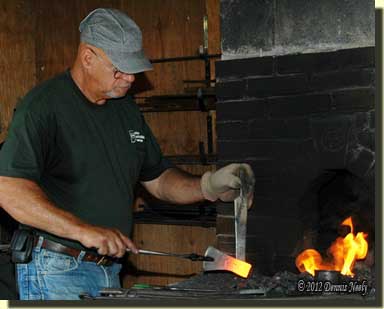
John Cummins forging a reproduction trade ax.

John Cummins forging a reproduction of an 18th-century ax head found in Long Lake near Hastings, Michigan.

I’ve had the Long Lake ax head for longer than I wish to admit to. John Cummins did a fine job with duplicating the head with only a photocopy to work with. Hafting the ax proved problematic, and once completed I needed to protect the historical me from the ax’s keen edge.

Like so often happens, an article “grows legs” and morphs into a much bigger project, and thus the addition of two more pages to the How-To section of the site.

The first is an introduction that addresses some modern safety concerns, tells how I came to the decision to make a bit guard and what primary documentation I based this not-so-period-correct choice on.

The second page is the actual How-To for making a bit cover. Down the road, I expect to make a sheath for the Long Lake ax as I will be using it with my trading post hunter persona, too—same trade ax, same 1790-era time period and region, but different social standing and background for the persona.

With any luck, over the next few weeks I’ll make a dent in my backlog of How-To projects that are already completed. These articles take a lot more time than a blog post, so please bear with me.

Be safe and may God bless you,

Dennis Neely

Posted in Safety, Skills, Wilderness Classroom | Tagged , , , , , , , , , , , , | Comments Off on ‘Hawk Bit Guard “How-To” Added

“British Squirrel Hunter”

“Snapshot Saturday”

A British hunter from Fort Detroit reloads his musket.

A British hunter (Fred Tonks) from Fort Detroit pours a charger of shot down the bore of his fusil. In a few moments he turned to the south and continued on his quest for a second fine fox squirrel for his evening meal. A short distance from the River Raisin, 1763.

Posted in Snapshot Saturday, Squirrel Hunts | Tagged , , , , , , , , , , | Comments Off on “British Squirrel Hunter”