The Beauty of Learning by Doing

A fox squirrel teased at first light. Unaware death lurked so close, the bushy-tailed squirrel frolicked in the leaves, then bounded downhill. When it reached the crossing trail, it sounded like a doe walking slow. A score of minutes into that last day of November, in the Year of our Lord, 1796, a second fox squirrel scrounged in the leaves beneath a red oak that leaned heavy to the east.
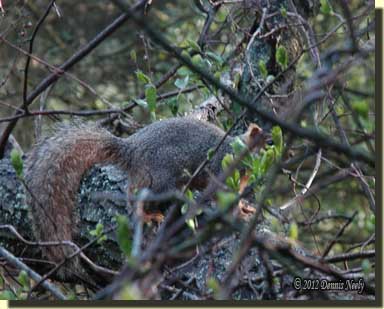
A fox squirrel sits on an oak branch.The pair alternated climbing a tree and flailing dirt and duff about. Aside from a blue jay that came and went, these two offered the only noise in the forest. I leaned back against the largest of three oaks that grew close together halfway down the east hillside of the long ridge. On the one hand, the trees formed a man-sized fortification, and on the other their close proximity made swinging the Northwest gun’s muzzle difficult at best.

Not long after, I glimpsed the sleek back of a big deer. Between the trees and the thick cover at the edge of the big swamp, making out the whole deer was impossible. As deer parts came into view, a left foreleg, a thick belly, a right hock and a well-rounded rump left little doubt about the deer’s size or maturity. An ear dropped, four antler points stood tall, then whisked away in an instant. Front legs and hind legs changed places. Arteries pulsed harder.

The buck’s head reappeared behind a haze of autumn olive twigs and dead cedar branches. He hesitated long enough for a count. I recognized the deer as the eight-point whose antlers angled in with a noticeable slant. He was a mature buck, one fit for any woodsman’s table, and only forty-paces distant.

The Northwest gun’s butt slipped to the right of the oak behind me. The browned barrel and its anxious turtle sight stalked around the oak to my left. The muzzle edged forward as the buttstock returned to its rightful place. My left knee, clad in a blue wool leggin with new silk ribbons on the flaps, rose up to offer a solid support for the hoped for moment of truth. “A clean kill, or a clean miss. Your will, O Lord,” I whispered.

A shiny black nose dropped to the forest floor, then antlers up he took two steps to the east. A dead cedar tree entwined with purple raspberry switches lay to his right. He sniffed the ground again, dropped to his front knees and bedded, secure behind his own fortification. The tips of his tines hid in the gray mass of branches, fallen leaves and light grass.

The antlers turned about. I assumed he checked his back trail and the slope above. Then they vanished. I envisioned his noble head resting on his left shoulder or perhaps on the ground in front of him. Agonizing moments flowed into a river of minutes. A gray squirrel joined the two fox squirrels. The blue jay perched high overhead. I leaned back against the red oak and satisfied myself with watching the antics.

Valuable Lessons in the Wilderness Classroom

That was the first nice morning in the whole month of November, warm, overcast and a bit damp—the kind of morning where a weary, 18th-century time traveler could find great joy in the most insignificant of happenings. Yet, in the midst of this subliminal euphoria the kind of a morning when an eight-point buck might sneak in and take his rest in the presence of a hungry woodsman.

Not to leave anyone hanging, the buck slept at least an hour. Then a mature, cautious doe descended the hill, maybe eighty paces to the north. When she lingered at the break between the hillside’s cover and the open swamp, he pushed up to his feet and stared at her. She flicked her tail. He dropped his nose to the leaves and walked straight away, his vitals never in danger.

I was disappointed, to say the least, but having a mature buck come within forty paces, bed, sleep, get up and walk away without an inkling a returned Native captive had the turtle sight of a Northwest gun aimed in his direction was a tremendous accomplishment from a traditional woodsman’s perspective. A sigh of relief passed my lips, for here was a wilderness classroom lesson complete to perfection, a tangible indication that the creation of the new persona was finally coming together.
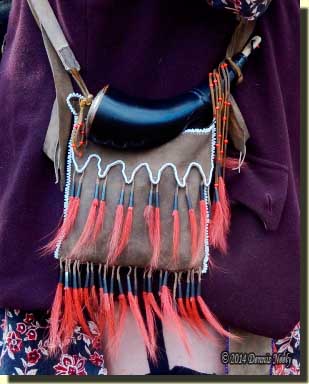
A deerskin shot pouch fashioned after an Ottawa original.That November morn culminated a week of working with the Ottawa-inspired shot pouch. The pouch took longer to construct than I expected, but my expectations and reality are often “out of sync.” But once completed, I moved on to the learning-by-doing stage of gaining woodland knowledge.

In researching the bag, what I would call an elaborate strap was included in the project, and the hope was to have the entire pouch ready to go by opening day of Michigan’s firearms deer season. When that deadline was no longer viable, I opted for a simple buckskin strap as an interim choice. Well, that proved to be a wise move.

This last week I started the planned shoulder strap. As I worked with the antique beads, I couldn’t help but chuckle at the timing of the project. Now I am hoping to have the pouch completed by the Woods-N-Water News Outdoor Weekend, but I am not holding my breath.

The first goal of any accoutrement project is to create an authentic item that furthers the overall impression of the characterization in a manner that is consistent with the historical record. So often, as dedicated living historians, traditional hunters put a tremendous amount of work and effort into researching primary documentation, evaluating that research, then constructing an artifact that closely resembles the originals.

For the really talented do-it-yourselfers or for living historians with deep pockets, “museum quality” is the gold standard. For the rest of us, coming as close as possible to period-correct with the resources available, either personal skills or cash, is the best option we can hope for. But for the traditional black powder hunter, securing a period-correct addition to an 18th-century captive portrayal, for example, is not the end of the research/documentation process, rather it must be viewed as one small step in an unending quest to experience the texture of life in a bygone era.

Years ago I made an Ojibwe-style, open top shot pouch. When I shared my plans with several other traditional hunters, to a person they all expressed concern that shooting supplies would be lost in the heat of pursuit, or that twigs, leaves and general forest debris would soon fill the pouch. Despite their warnings, I went ahead with my plans. In the months and years that followed, I learned none of those were valid issues.
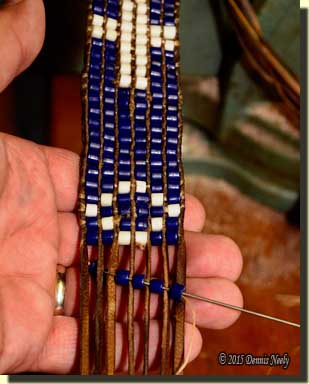
Weaving antique blue beads between brain-tanned thongs.This is the hands-on, learn-by-doing beauty of viewing the glade as a living, breathing wilderness classroom. As I worked on weaving the blue tube beads into the strap’s shoulder piece, I started wondering how this design would work under actual hunting conditions. Would the beads come loose? Would the strap’s shoulder be too stiff? Would it slip around and not stay in place? And further, how was it going to affect the function of the Ottawa-style shot pouch?

One of the keys to a successful historical simulation is wrapping one’s self in a cocoon of period-correct artifacts that push away the current century and insulate the time traveler against the modern world’s many distractions. And one of the keys to experiencing life in another time is allowing those artifacts to contribute and facilitate the gathering of knowledge and understanding.

Give traditional black powder hunting a try, be safe and may God bless you.
Posted in Clothing & Accoutrements, Deer Hunts, Research | Tagged , , , , , , , , , , , | 8 Comments

“Marl Lake Scout”

“Snapshot Saturday”

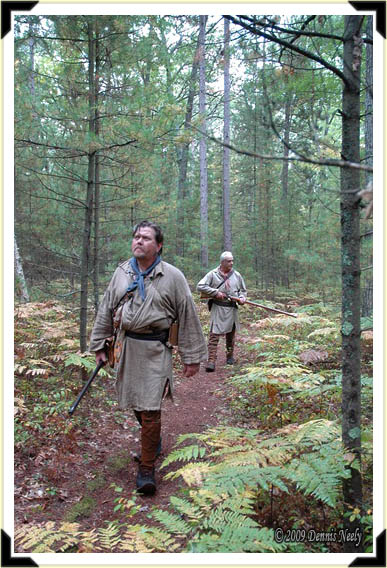
Two traditional woodsmen scouting a woodland trail.

Two traditional woodsmen, John Booy  and Jim Aude, scout a woodland path through the pine forest southwest of their humble station camp on the Cut River.

Posted in Scouts, Snapshot Saturday | Tagged , , , , , , , , , , , | Comments Off on “Marl Lake Scout”

“A Good Morning’s Work”

“Snapshot Saturday”

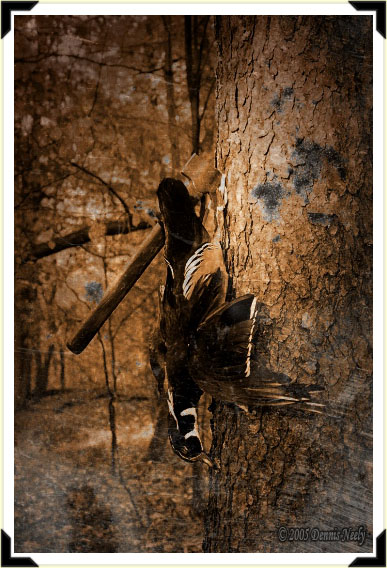
A daguerreotype image of a wood duck hanging from a belt ax.

A fine wood duck hangs from a belt ax, the blessing of an early morning jaunt to a secluded sandy bend in the River Raisin. Daguerreotype-style image, Old Northwest Territory, 1794.

Posted in Duck hunts, Snapshot Saturday | Tagged , , , , , , , , , , , , | Comments Off on “A Good Morning’s Work”

The American Rogues at the Big Mitten Fair

As of last evening, “The American Rogues” are scheduled to perform today, Friday September 4th, at the inaugural “Big Mitten Fair,”  at 3 pm in the “children’s” area and again at 5 pm in the open-air gazebo/pergola on the southwest corner of the fairgrounds.

Last night’s concert was phenomenal, to say the least. The Rogues’ performance far exceeded our expectations, and not just because they played beyond closing and then hung around to talk with their fans.

The show started with touching tributes to our veterans, firefighters and police officers. Throughout the concert the crowd interaction was great. The Rogues gave special attention to the children present, including a talented group of Irish dancers. At one point band members followed a youngster around in parade fashion as they drummed, fiddled and piped. Needless to say, Tami and I will be heading back to the Big Mitten Fair this afternoon. Come out and join us!

For those of you unfamiliar with the music of The American Rogues, if you have ever searched “The Last of the Mohicans” on YouTube, then you will be familiar with their performance of “The Gael” with the U.S. Air Force Symphony:

The Big Mitten Fair will be held at Michigan International Speedway, 12626 US-12, Brooklyn, MI, 49230, through Labor Day, Monday, September 7th.

Be safe and may God bless you,

Dennis Neely

Posted in General | Comments Off on The American Rogues at the Big Mitten Fair

In the First Five Minutes…

Crows shrieked near the meadow. All week substantial flocks, bolstered by young spring hatchlings, cawed at imagined villains with hopes of stirring to flight a real adversary, such as one of the young barn owls from the far ridge or the fledgling red-tailed hawk that perched on a red oak’s uppermost twig some days ago.

A warm southwest breeze rattled the tall cottonwood’s heart-shaped leaves as the sun’s brilliant glow crested the cedars and slipped among the mighty tree’s branches. Damped by dawn’s heavy dew, the air smelled humid and thick with a faint hint of drying prairie grass.

The young doe looking to the south.A hundred-plus-paces distant, a young doe’s head appeared in a stand of wild carrot. Two hoof-falls produced her neck and shoulders, clothed in summer’s cinnamon hair. She paused, turned her head south with a noticeable jerk, then stared upwind in search of the source of the scent that did not belong in the clearing. A single crow cawed; a second offered a harsh response, then a brief silence followed.

Goldenrod sprigs, perhaps a third yellow and interspersed about the clearing’s edges, swayed in an easy, rhythmic motion. Milkweed stalks, not yet topped with lavender flowers, stood stiff. Two cardinals, one visible on an outstretched cottonwood limb, “whit-tsued” back and forth as light streaks stretched across the moist, shimmering prairie grass.

That morning’s thin haze lingered, blurring the dark, shadowy spaces that define the depth and mystique of the cedar grove’s hilly terrain. Overhead, patches of azure broke through the wispy white clouds that rushed to the north with an unknown urgency. Four or five black crows winged over the tips of the hardwoods that populated the last hillside before the big swamp without uttering so much as a single squawk.

A dash of sunlight now caressed the cinnamon-colored doe’s thin neck as she glanced uphill. Perchance the flailing crows attracted her attention, too. She looked straight ahead into the grove, took two steps, then nuzzled the ground. With her head half-raised, she sniffed a clump of lacy-white wild carrot, then plucked a small flower. Unconcerned, she walked behind a bushy autumn olive and out of sight. Thus, the first five minutes of a splendid August morn ticked away, deep in the Old Northwest Territory, in the Year of our Lord, 1796.

Paying Attention to Details

Not long ago, I had a casual conversation with a modern archer regarding a fine buck he had taken last fall. His tale started with the buck stepping out from thick cover. He told of drawing his “blank-brand” bow, holding the “blank-brand” mechanical release against his cheek, and the “blank- brand” arrow he used with the “blank-brand” broadhead. The tree stand, camo and scent products all came with brand names that I assume I was supposed to recognize.

Thankfully, I don’t get cable or satellite television. We barely get electricity here at the North-Forty, but I now and again see outdoor programs in the hotels we stay at when on the road. And based on that viewing, this fellow sounded like his hunting persona was a conglomeration of hosts from the modern shows, or should I say “infomercials,” I’ve seen.

When I asked about notable happenings on the rest of the hunt, he was at a loss. He possessed no knowledge of the trees or bushes that grew in his locale. He could not name one bird or animal that he saw that day, nor could he describe the weather conditions, other than it was “a cloudy evening.” In essence, the details did not matter, only the point-total of the buck’s rack and the products that made the taking of that buck possible.

That conversation came to mind as I drove home from the Contemporary Longrifle Association Show, held at the Lexington Convention Center in downtown Lexington, Kentucky. Last weekend’s show was the first I have attended, although several friends and acquaintances have insisted, “you need to go” for the last five years. They were right.

At any point in time, I have a mental list of nagging questions that seem to elude documented answers. On the drive down, I ran through the list, prioritizing the answers that might lurk on the tables at the CLA Show. As questions came to mind, they wove their way into the conversations that my wife, Tami, and I had, usually in the form: “Keep your eyes out for…” Tami is great at spotting hidden gems and pointing them out to me.

For example, back in May a pile of Northwest gun components ended up on the work bench. The breech plug was set and the barrel was inlet into the maple stock. The lugs had been soldered on, but not finished. As I shaped the lugs with a file, I started questioning if the mortices for the barrel tenons passed through the web or if they were hidden on the original guns. That question never arose on the last Northwest gun that I built, but that is part of the learning process of such projects.

When such a question arises, I hit the books. With no definitive answer, I started calling gunsmiths and collectors that I know. Some said “Yes,” and some said “No.” At the National Muzzle Loading Rifle Association’s Spring Shoot, I spoke with several noted collectors and/or experts.

Most had no experience with Northwest trade guns and therefore offered no opinion. The Northwest gun is an animal unto itself, or so it seems, much like the Model “T” is an outcast to car collectors. One collector went to the back wall and took down an English fowler that he described as “more of a traded piece than a fowler.” That gun’s mortices were through the web.

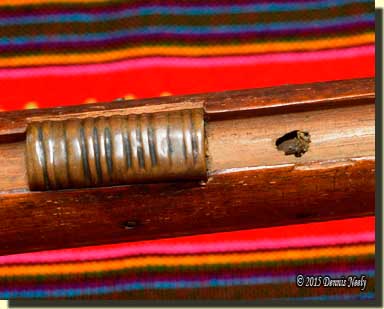
A Northwest gun mortice worn through from use.

An 1863 Barnett Northwest trade gun with what appeared to be a mortice worn through from use, rather than cut through by the maker.

At the CLA Show, William Basco was gracious enough to allow me to photograph and handle a couple of later Northwest guns and a chief’s grade model. Based on his experience, he felt some did and some didn’t, depending on the maker.

Several other English fowlers displayed through mortices, others did not. One plain fowler was so heavily used that the walnut forestock was worn away, exposing the ramrod. That gun was gone when I came back to photograph it—lesson learned.

I came away from the CLA Show with a reasonable answer to the mortice question—either method is correct, depending on the gun’s actual maker. And I found partial answers to at least three other questions, as well.

For traditional black powder hunters, the details matter, especially when viewed from an historical context. On the surface, whether a barrel’s tenon mortice passes through the web or remains hidden seems inconsequential to downing a fine buck or taking a dandy gobbler. But that tiny, nagging voice deep within every living historian knows when a detail goes uncorrected and thus does not take advantage of the best primary documentation available.

The traditional hunter’s ever-elusive goal is to come as close as possible to an 18th-century reality that can never be achieved to 100-, or 95-, or even 80-percent assimilation of “what was.” Alas, a basic principle of this glorious, addictive pastime is that we will always fall short, but with that principle follows the principle that we can only apply our best understanding of what is period-correct at that moment.

There was no fine buck or long-bearded wild turkey at stake on that August morning in 1796, only a joyous, although quick, jaunt back to the Old Northwest Territory near the headwaters of the River Raisin. I suspect the modern archer would have found the trip quite boring. Hearing distant crows, watching goldenrod and wild carrot plants sway, and taking note of a far off doe make for lack-luster video presentations.

But traditional black powder hunters view that circumstance from a different perspective. After sitting down, the brass lead holder skimmed across the page leaving gray impressions of the details of the texture of life in the 18th-century backcountry, with no brand names necessary. It’s amazing how much there is to see and experience in the first five minutes of a time-traveling adventure…

Give traditional black powder hunting a try, be safe and may God bless you.
Posted in Living History, Research, Scouts | Tagged , , , , , , , , , , , | Comments Off on In the First Five Minutes…

“Counting the Days”

“Snapshot Saturday”

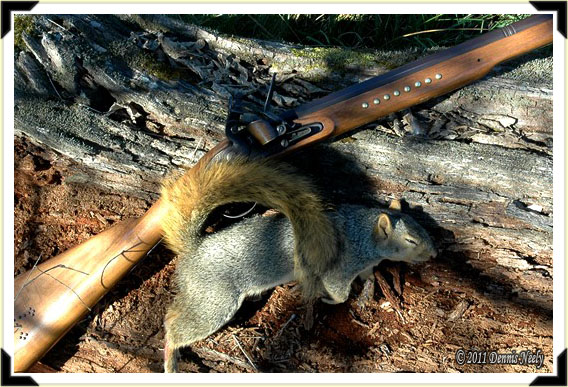
A Northwest trade gun and a fresh fox squirrel.

A fresh fox squirrel taken on an early-afternoon, time-traveling jaunt to the Old Northwest Territory, two ridges east of the River Raisin.

Posted in Snapshot Saturday, Squirrel Hunts | Tagged , , , , , , , , , , , | Comments Off on “Counting the Days”

In Search of John Kinzie

Green maple leaves fluttered. A light breeze riled the Chicago River. Puffy clouds scurried to the northeast. The air carried strange aromas mingled with an occasional whiff of foul-smelling smoke. Lake Michigan’s waters were but a brief paddle to the east, but out of sight. The cabin of Jean Baptiste Point du Sable stood on the opposite bank, but a hazy fog, not of this earth, all but erased the humble abode’s image from a studious time traveler’s mind’s eye.

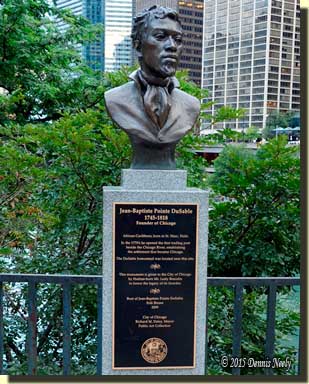
The bust of Jean Baptiste Point du Sable in Chicago.

A bronze bust, sculpted by Erik Blome, stands in ‘Pioneer Court,’ built on the du Sable homestead site on N. Michigan Avenue in Chicago, IL.

Evening shadows stretched long. A bark canoe with two forest tenants slowed, turned, then beached on the far shore. Trees grew tall well beyond the backcountry traders post and its outbuildings. Cows, sheep and a few reddish chickens wandered about. Split rail fences bounded a modest garden.

The trader and the Potawatomi visitors gestured, no doubt discussing the three fur bales in the canoe. The exchange seemed friendly, but businesslike…

Then, in a frustrating instant, the heavy “whoosh, whoosh, whoosh” of a dark blue tour helicopter’s flailing rotors dashed the scene with the same certainty as a rapid’s torrent tears and twists and splinters fragile bark canoes. As the invader flew to the west, the chopper’s image reflected off the silvered glass of Trump Tower. The Old Northwest Territory of 1796 passed away…


John Kinzie’s Trading Post

That evening I stood overlooking the Chicago River in a situation that was far from conducive for traveling back in time to the Old Northwest Territory and my beloved 1790s. The river had a greenish, artificial-looking cast to it. Thick, concrete retaining walls lined both banks. Wide, winding sidewalks with steel handrails followed the river’s course. Here and there, grassy patches sported installed trees and manicured shrubs. Blue and white tour boats docked where Pottawatomi bark canoes packed with furs, blankets or traded goods once beached. And every ten minutes or so that confounded helicopter whoosh, whoosh, whooshed overhead to the delight of selfie-stick-wielding tourists much younger than I.

And to compound my time traveling maladies, I felt a compelling need to jump ahead into the first few years of the 19th century, then on to early August of 1812. This task proved near impossible, partly from the distractions that surrounded me, and partly from my lack of historical knowledge of the not-so-distant future.

In the midst of modern-day civilization, I could not help but chuckle as I recalled Professor Jay Anderson’s analogy in Time Machines that living historians are like people in a boat drifting along a winding river:

“Every day, we see evidence of the present, but past and future times are hidden from us around the river’s bend. Still, they are there, waiting for us simply to step out of the boat and walk around the bend into the past. The problem is to figure out how to beach the boat…” (Anderson, 188)

But to achieve Professor Anderson’s lofty goal, a humble living historian must surround one’s self with stimuli from his or her chosen time period—in my case, 1796. This is hard under the best of conditions, but impossible at the intersection of N. Michigan Avenue and E. Wacker Drive in the heart of Chicago. Yet, I had to at least try. My wife Tami is used to the glassy-eyed look I get when my mind jumps over time’s threshold and scampers back. I saw her smile once or twice. She knew…

Long ago I learned historical characters come and go when sifting through the primary documentation associated with a chosen bygone era. Sometimes individuals disappear for years at a time, only to reappear on eternity’s stage through a happenstance or a passing footnote. The mention of William Wells, John Kinzie, Little Turtle and Madame La Framboise always command my immediate attention.

When reading through a narrative, especially one that deals with an actual hunt, I find it very difficult to restrain the historical me. After all, this fictitious personage acts as a vessel to hold a multitude of 18th-century nuggets, and what better way to add to that treasure than by tagging along on a hunter hero’s adventure, one he or she deemed worthy enough to write down? Alas, this mischievous behavior has been the norm for thirty-five-plus years; I don’t expect that will change, at least I hope it doesn’t!

You see, as I read a given historical passage, I can’t help but get caught up in the story. In the best of circumstances, the words evoke emotions and reactions that mirror those described by the author, two hundred years prior. I crave the few fleeting seconds when my simple pursuits parallel theirs, when the context of the 21st-century glade melts away and time knows no boundaries.

Like so many other traditional black powder hunters, I seek to experience what they experienced, to share an instant or two of kinship with a soul that I really don’t know that much about. I say that because it is difficult to sum up a life’s worth of hunting experiences in a few pages of the Draper Manuscripts or in the limited space allotted to a dictated narrative, as in the case of John Tanner.

Years ago the late Chuck Leonard introduced me to The Museum of the Fur Trade Quarterly. He insisted I subscribe, simply based on the quality of the research. I took his advice and spent a few more dollars to purchase the back issues, offered as a “package.” I spent weeks reading through those black and white pages. One evening I read an article by Charles E. Hanson, Jr., “John Kinzie and His Gun.”

Kinzie’s years in Detroit caught my attention. His time there predated my chosen time period, but the geographical location and the fact that he was a fur trader of note put him on my “watch list.”

The article told how the Museum of the Fur Trade acquired a long-barreled English fowler with “ribbed brass rod guides and brass ‘dragon sideplate,’ evidently a very early ‘chief’s gun’ or fine gun…” (Hanson, Jr., Museum of the Fur Trade Quarterly, Chadron, NE, Winter 1970, pgs. 1-5) The gun’s origin was not known at the time, but the initial cleaning process uncovered Kinzie’s name and initials, along with a silversmith’s personal cartouche.

“…the buttplate is worn and battered, the entire gun shows age and hard usage. It is however, of better quality than the ordinary Northwest Gun…” (Ibid, 3)

On one of my first trips to Friendship, about 1985, I purchased a “damaged/defective” fowler stock blank from Dick Greensides of Pecatonica River Long Rifle Supply with thoughts of copying John Kinzie’s gun. That was before I became so steeped in the Northwest trade gun’s mystical history.

The blank still stands near the workbench. Close friends and family members keep urging me to make a new Northwest gun for Msko-waagosh, my returned captive persona. I’ve looked at that stock a couple of times with thoughts of reworking it into the Northwest gun pattern. The recent trip to Chicago and a similar fowler Wallace Gusler displayed at Friendship have me thinking differently now.

Bronze stips in the sidewalk mark out Fort Dearborn's original walls.

Moderns pass by the bronze plaques in the sidewalk where the northwest block house of Fort Dearborn once stood.

I spent a lot of time roaming all around that intersection that evening. I traced out the bronze plaques inlaid in the sidewalk that marked the supposed walls and block houses of Fort Dearborn. This is where I tried to pull myself into the future, August of 1812.

Here I crossed paths with William Wells, another Native captive, taken at the age of 12. Wells garnered the attention of Little Turtle, the great Miami chief, and eventually married his daughter, Sweet Breeze. With Little Turtle’s consent, Wells became a captain in the Legion of the United States and scouted for General Wayne. He was wounded in the Battle of Fallen Timbers, and died leading the evacuation of Fort Dearborn.

Yet here again is another example of the characters that populated the 1790s in the Old Northwest Territory crisscrossing paths, raising more questions than answers. But more on that another time…

Give traditional black powder hunting a try, be safe and may God bless you.

Posted in Research | Tagged , , , , , , , , , , | Comments Off on In Search of John Kinzie

“Watching for Wood Ducks”

“Snapshot Saturday”

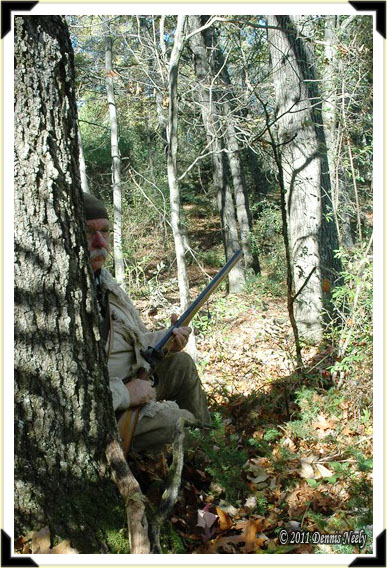
A traditional woodsman watching a puddle from behind and oak tree.

A dozen feet from a tiny puddle in the middle of the woods, a traditional woodsman sits behind an oak tree in hopes of ambushing an evening morsel. Old Northwest Territory, three ridges east of the River Raisin’s headwaters, 1795.

Posted in Duck hunts, Snapshot Saturday | Tagged , , , , , , , , , , , , | Comments Off on “Watching for Wood Ducks”