Maybe This Evening…

Reluctance entered the meadow. The frontier wife glimpsed the young doe’s snout first. Ears moved slow, front to back. Its head dropped, and only the whitetail’s shoulders remained visible. It took a step, then another. Its head popped up and stared straight at the woman who watched. Little doubt remained that the deer detected an intruder at the meadow’s edge, but it continued anyway. The backcountry wife whispered to Msko-waagosh, “Doe…to my right.”
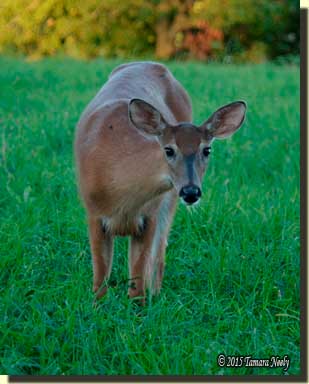
A brown-eyed whitetail doe looks straight on.Twilight’s shadows covered the green expanse. A welcome cool settled on the tiny plot of open prairie. A hint of flowering wild mint fragranced the air. Sunset’s golden shimmer bathed a tall oak seventy paces beyond the cautious doe. But she plodded on, browsing on grass here and plucking a flower there. Every few seconds she perked her head up and looked to the west. Her tail hung at rest and her muscles showed no sign of tensing, yet she exercised caution.

Ten minutes brought the doe inside fifteen paces. A butterfly breeze from the southwest, nose-on to the doe, did little to force flight. She browsed back and forth in front of the couple as if playing a woodland game, sneaking subtle glances. Even when she munched, those big brown eyes kept above the calf-deep grass.

By now, a half-dozen other deer browsed in the northeast corner of the clearing. A sweeping, upright forkhorn in velvet kept the other deer between himself and the big gully’s dead oak. On any other night the forkhorn would have been the focus of attention, but the young doe’s willingness to venture so close proved more worthwhile and educational. One could count the deer-flies on her back, neck and forehead and the scuff marks in her cinnamon hair.

As the light drew dimmer, the couple withdrew from the wilderness classroom and allowed the deer to browse in peace.

Looking Ahead to Fall

Early August is a time of peace in the glade, at least that’s how I view my excursions. The Northwest gun travels unloaded, or is exchanged for the not-so-period-correct Nikon, depending on time, place and circumstance. During these evening jaunts, our thoughts turn to the upcoming hunting seasons, and preparations begin with great anticipation.

I find myself looking at each knoll and valley as a potential station camp location. The cedar brush shelter is no more, thanks to a large dead limb that crushed the ridge pole. I doubt the cedar rafters of the old duck camp can support even the slightest of brush covering. By early September, I feel I have to settle on a location and style of abode for this year’s hunts.

Unfortunately, available time, not historical significance, will be the governing factor for this season’s hunting camp, at least that’s how the fall is shaping up. Moccasins need attention, one leggin needs re-stitching, and a new strap for the Ottawa-style shot pouch is on the list. Range time for the “Old Turkey Feathers” is a must, replacing the woven sash…oh, I get frustrated just thinking through the projects, and prioritizing does not help much.

The last couple of nights I have devoted an hour or so to the workbench. I made a muzzle rest for the Northwest gun, repaired a lock for a friend and last night I roughed out a new handle for the “Long Lake” trade ax.

John Cummins, one of the blacksmiths in residence during the National Muzzle Loading Rifle Association’s spring and fall shoots, hand-forged the head based on an artifact found at Long Lake in Hastings, Michigan. The ax is attributed to the 1790s, but this basic pattern spans many years. The ax weighs about a pound, as the originals did. The first handle I made did not grip well or maintain control of the heavier head. The only alternative was a new haft.

After supper I headed to the shop and started splitting out a new piece of black walnut from a limb section a friend dropped off last winter. On the second attempt, I had a thin billet that showed promise. The band saw trimmed away the sapwood, and the draw knife flattened one side to my satisfaction.
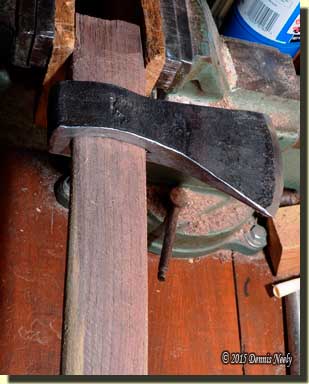
A trade ax head with a roughed-out handle.The head has a tear-drop eye, shaped with a mandrel driven in from the top during the latter stages of the forging process. Several of the eyes on original polled axes I’ve examined are formed in this manner, allowing the head to slide onto the handle and tighten as it is used, similar to the head design on a tomahawk.

The billet was somewhat damp, which I expected. For me, the dampness facilitates the rough shaping. I tried to take off a minimum of wood—just enough to allow the head to slide up the haft with some gentle hand pressure—knowing the blank would shrink as it dried out.

I got so wrapped up in this project that I never realized it got dark. Having the sound track from “The Last of the Mohicans” cranked up helped, too. Sweat dripped onto the wood. My elbows and shoulders ached. Yet I felt a great exhilaration as I worked the haft down. I stopped short of seating the head and set the blank aside to dry for a week or so.

After the head’s final fitting, I think I might add a leather grip similar to one I recently saw on a pipe tomahawk on the Contemporary Maker’s site. I use my woodland tools hard. I don’t abuse them, but I expect them to perform their intended tasks, plus being adaptable in unusual situations. Even with the new handle, the tear-drop shape is not the best fit for my hand. For sure, it is an improvement over the previous attempt, but not optimum. Like all of my 18th-century accoutrements, experimentation in the wilderness classroom will be the ultimate test. And this original example of a leather grip opens some possibilities for future lessons and laboratory study.

A couple of nights ago I spent some time sharpening the single bit ax that I use for felling. I have two red cedar trees down waiting to be “limbed,” but I wanted to touch up the ax before I started that project. Maybe this evening…

Give traditional black powder hunting a try, be safe and may God bless you.
Posted in Scouts, Wilderness Classroom | Tagged , , , , , , , , , , , , | 2 Comments

“Packing Up Camp”

“Snapshot Saturday”

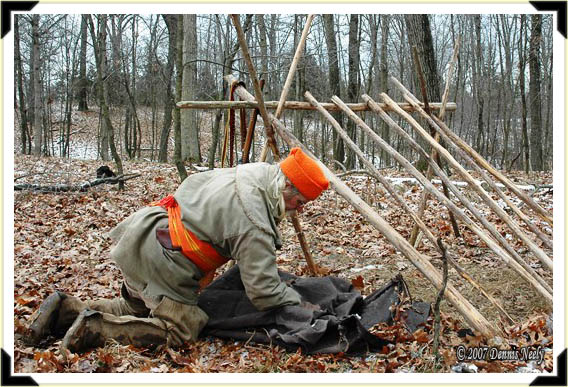
A traditional woodsman folds the canoe tarp that covered his humble shelter.

With heavy gray snow clouds looming to the west, a traditional woodsman packs up the canoe tarp that served as the covering for his humble hunting camp. One ridge east of the River Raisin in the Old Northwest Territory, January 11, 1794.

Posted in Hunting Camps, Snapshot Saturday | Tagged , , , , , , , , , , , , | Comments Off on “Packing Up Camp”

Discovering a Deception

Pines and oaks extended south into the alfalfa field. The top of a weathered cedar corner post poked through the scrub oaks, willows and raspberry tangles. A few paces south the doe trail entered the thicket, just as the settler pointed out. Here and there rusted strands of barbed wire rose from the matted grasses to a grayed cedar post, then drooped again, appearing useless yet still testifying to the property boundary.

Elk moccasins whispered along the trail as branches, twigs and sharp, purple switches tugged at buckskin leggins and a faded-green hunting shirt. Partway up the rise a young red oak tree angled out over the edge of the alfalfa. Only tawny-colored grass encircled its trunk creating an acceptable fort for ambushing wild turkeys.

When the doe trail wandered even with that oak, the would-be trading post hunter left the trail and tore through the thicket with caution. At the tree, the woodsman surveyed the calf-deep alfalfa, then sat cross-legged on the ground, a step east and a bit north of the trunk, enough so that the tree blocked any view of his deathly shape from the west. He faced somewhat west so that he did not have to twist his body to shoot due south.

The Northwest gun rested upon a raised knee. The frizzen opened and closed a half dozen times as I checked the precious prime every five minutes of so. I forced myself to abandon this nervous habit for a good ten, maybe fifteen minutes. Then the first soft “cluck” struck my ears.

A hen turkey heading for taller grass.Through a space in the grass, the sun reflected off a bronze-feathered back. The sharp English flint slowly came to attention. One last time, my right thumb and forefinger pressed the frizzen forward, then eased it back. The Northwest gun’s muzzle crept upward. I remember noticing the scent of blooming alfalfa on the afternoon’s gentle breeze.

In a moment, two young wild turkeys pecked their way into sight. More followed, with a bigger hen interspersed here and there, but the birds advanced too close together for a clean shot at one head only. My breathing grew ragged. Arteries pulsed.

The flock, some thirty birds in all, was straight out from the tree when it began to spread apart. The younger birds gave one large bodied hen, foraging tail-on twenty paces distant, a wider berth. The turtle sight perched just above where her neck met her body. I waited for that gray-headed prize to stand upright one last time. “A clean kill, or a clean miss. Your will, O Lord,” I prayed in silence.

The moment of truth arrived. The hen stood upright, facing away. The turtle sight clung to the back of that gray head. As I sometimes do, I felt the sear move in the tumbler’s full-cock notch, but I wanted to unleash the death bees when the turkey’s head was broadside, increasing the probability of a clean kill.

The gray head turned. The turtle sight clutched the brown eye. And then I saw the yellow kernel of corn in the hen’s beak. My trigger finger eased. My breathing settled. The veins in my neck stopped throbbing in time with my heart beats. My eyes glanced from bird to bird. Far out, a young hen dropped a golden nugget. There were more, many more…

Be Careful Where and With Whom You Hunt…

The first afternoon of my first fall turkey hunt in Alcona county, Michigan, ended in disaster. In those days, wild turkey hunting permits were issued on a lottery basis. We had two transplanted wild turkey flocks in our county, one over at Hanover and the other up at Parma. There was no turkey hunting in southern Michigan, a trading post hunter had to travel north if he wanted roasted wild turkey for Thanksgiving.

I was lucky and drew a permit, and a trusted fellow hunter arranged permission for me to hunt on a friend of his’ modest farm. I called the landowner ahead of my hunt dates, thanked him and introduced him to the theory behind my addictive passion, traditional black powder hunting. He assured me there were too many wild turkeys on his farm. They were destroying his crops and he wanted them thinned out. He was more than happy to extend hunting privileges to me.

Upon arrival that afternoon, the landowner walked me outback and motioned in the direction of his property lines. He told me my “best chance” was where the neighbor’s woods extended into the alfalfa field, and suggested I sit in his deer blind at the corner of the field/woods. I politely declined and stated that I wished to use the natural cover of the woods. He suggested I follow the doe trail and then he said the flock “goes along the north edge of the field and right past the deer blind.”

A traditional woodsman using a wing-bone turkey call.When I grew up, baiting of any kind was a poacher’s deception. I remember finding someone’s cut apples on the cross brace of an end post back near the River Raisin’s bottoms. When I told my dad he was livid. We went back before school the next morning and “cleaned up” the entire area. With that upbringing I have never used bait to take wild game. Times and attitudes have changed, and I want to make it clear that I am not passing judgement on anyone who follows the current game laws. I am just saying I prefer the challenge of approaching my game one on one.

Baiting wild turkeys, then and now, was and is illegal. But that didn’t stop this landowner, and it was obvious after the fact that he “salted the field,” as my dad used to say, daily. When I saw that first kernel of corn, I slowly pushed the frizzen up, and when the hen dropped her head I rolled the Northwest gun to the right, dumping my prime. As a side note, my trade gun didn’t have a name on that afternoon—it earned “Old Turkey Feathers” two days later in the last hour of my hunt on another farm.

A couple of the younger birds started “putting” with the movement, but the abundance of corn overshadowed due care and caution. And they were rewarded for staying the course, because the death bees remained in the smoothbore’s breech. I waited to gain my feet until the last turkey herky-jerked over the rise. Every bird passed that “people box” well within the Northwest gun’s effective distance, too.

I saw the landowner sitting on his back porch. It was a pleasant, cool and sunny afternoon. I saw him get up and walk into the house after the flock passed. His mannerisms suggested he was upset, and I suppose he told his wife that the guy with the flintlock didn’t shoot.

I remember thinking through what I would say when I came to thank him for the opportunity to “hunt” his land. Fortunately for me the flock bunched back up on the first “putt,” and I think I said that I never had a clear shot at just one head. We shook hands and he invited me back, but there was no point in returning to that property.

A couple of weeks ago I shared this story with a newcomer to traditional black powder hunting. I’ve told it many times over the years, and I meant it as a warning to be careful when hunting on land that one is not familiar with, especially when the landowner “guarantees a successful hunt.”

Unfortunately, this is not the only time I have found myself in this type of situation in fifty-plus years of outdoor life. When invited to hunt someone else’s property, I ask some rather pointed questions, in a polite and respectful manner, of course. In the handful of instances, I unloaded the minute I discovered the deception and left as quickly as possible without offending the landowner.

I suppose it is best that I relinquish the soap box now…

Be careful where and with whom you hunt, be safe and may God bless you.

Posted in Turkey Hunts, Worth thinking about... | Tagged , , , , , , , , , , | Comments Off on Discovering a Deception

“Two More Steps”

“Snapshot Saturday”

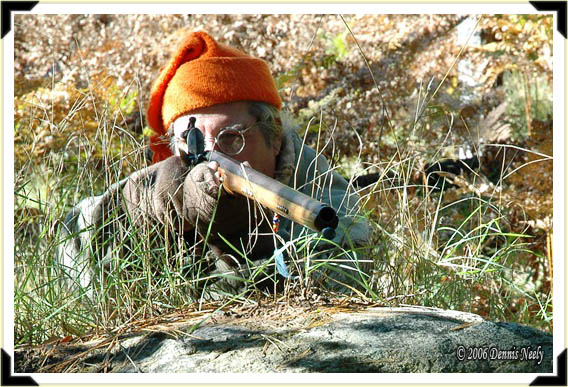
A traditional woodsman aims his Northwest trade gun from behind a large boulder.

Using a large boulder for protection, a wary woodsman takes careful aim. The question is, “At what?” Old Northwest Territory, west of the Black River, 1792.

Posted in Scenarios, Snapshot Saturday | Tagged , , , , , , , , , , , | Comments Off on “Two More Steps”

“Tending the Soup”

“Snapshot Saturday”

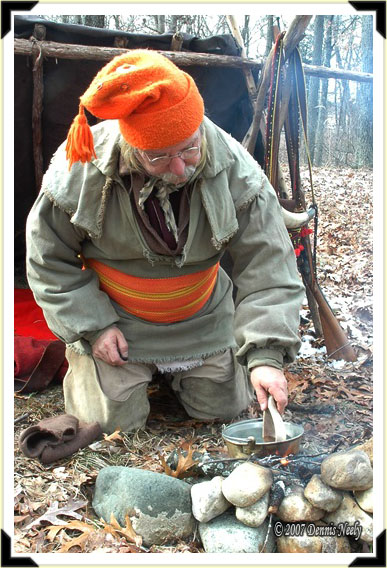
Stirring a thin soup over an open fire.

A few scraps of venison jerk and a handful of dried corn made for a thin soup on a cold January afternoon. Old Northwest Territory, one ridge east of the River Raisin, in the Year of our Lord, 1798.

Posted in Hunting Camps, Snapshot Saturday | Tagged , , , , , , , , , , , , , | Comments Off on “Tending the Soup”

There is Always One…

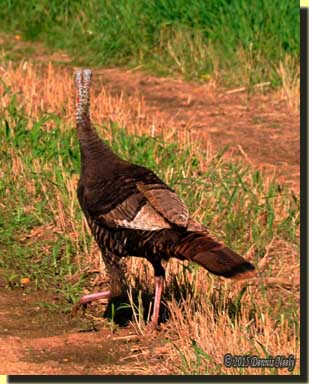
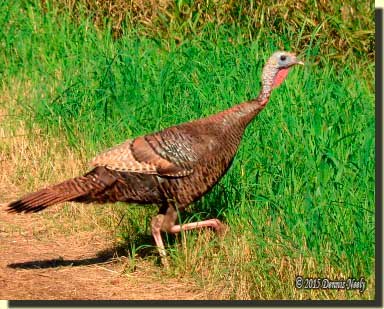
A wild turkey hen standing in the wagon trail.Bright sunlight shone on bronze feathers. The wild turkey hen had nary an inkling that supposed danger lurked so near. She stood upright and in full view at the edge of a sandy rut. The deep prairie grass, up the hill and to the northwest, occupied her gaze. Behind her, twenty-five paces down the wagon trail, a backcountry woodsman eased undetected around the long, sweeping bend.

The Northwest gun harbored no death bees. The cock was down, the frizzen up, yet stealth leaped to the forefront. Surprised by the fortunate happenstance, the woodsman stepped off the trail and sought refuge within the boughs of a broad-spreading red cedar tree, content to watch and learn and enjoy. With that simple discovery, the wilderness classroom came to order on a cool July morn, in the Year of our Lord, 1796.

Purple legs moved with great caution. The bronze beauty’s grey head turned; the bird’s brown eye scanned the back trail, but found little to be concerned with. “Putt,” the bird uttered in an almost imperceptible tone. “Putt.” Within a minute the first poult emerged from the prairie grass. Others followed, some walking straight for the hen, some pecking at the ground.

The hen turned to her right as the young birds gathered in the wagon rut opposite where she stood. Her head jerked, then her neck stretched high as her feet shifted her body broadside. It seemed clear that she detected a movement that did not belong, or perhaps saw a red-dyed deer-hair cone dangling in the gentle breeze. Whatever the cause, the next putts bore a distinct crispness.

Her demeanor changed in an instant. Her posture became rigid and she placed each foot with a calculated exactness that left little doubt she was unhappy. A half dozen steps later she was in the tall grass, but now the poults were in the open, heads up, eyes snapping about as each tried to discern the reason for the hen’s displeasure.

In the deep shadows cast by several large cedar trees, the once shimmering bronze body moved away from the wagon trail. The poults stood their ground as if afraid to follow. Then the same soft “putt” that first beckoned the youngsters from the prairie grass could be heard from a dozen paces off the trail. Two or three of the brown, mottled offspring started for the grass. Two or three others headed in the opposite direction, back into the prairie grass. The hen putted louder.

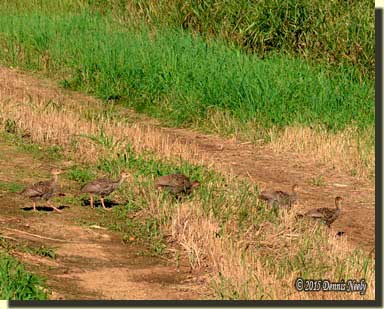
Wild turkey poults walk single file across a wagon trail.Head down, a dark body herky-jerked in the shadows. In a matter of moments, the hen’s gray head popped up about two paces off the closest rut. She putted again, and this time the poults obeyed, forming a single-file line that spanned the two sandy ruts and began snaking its way into the grass and the safety of the cedar trees’ darkened sanctuary.

But as always seems the case, there was one straggler, at least two hunter paces behind. The woodsman chuckled, then whispered, “There’s always one..”

Children of the Forest

This 18th-century scenario plays out, in a variety of versions, many times over the course of the summer months. July is always a delight, because the woodland youngsters start exploring and expanding the boundaries of their new world. For these children of the forest, some days begin with a casual introduction to the farm truck, others might include a rumbling tractor with a whirring mower and once in a while these novice wilderness tenants don’t realize a 1790s time traveler lurks in the boughs of an old cedar or sits in the shade of a shagbark hickory tree.

On warm sunny mornings, baby squirrels, pint-sized rabbits, fledgling robins, fluffy ducklings, fuzzy goslings, ugly signets or half-sized copies of Sandhill cranes make cameo appearances in the midst of my history-based excursions. To be truthful, I reap the greatest joy from observing the spotted fawns and mottled-brown wild turkey chicks. I could sit for hours, watching, learning and soaking in the wilderness wisdom that leaves one with a sense of invigoration for this wonderful pastime we call traditional black powder hunting.

The other evening, Tami and I happened upon a hen and her brood. The hen putted with a steady cadence, clearly giving instructions, but the youngsters milled about in the short grass as if deaf to mother’s teachings. Perhaps she was the same hen I happened upon that morning in 1796, because she returned to the clearing, putting with a sterner voice. Most of the youngsters followed her into the deep grass, but there was one that tarried, displaying a noticeable obstinate streak. “There is always one child that doesn’t listen to mother,” Tami said. We both laughed.

On a couple of occasions we have walked or driven by a brood hidden in the brush. The usual response is for the young tenants to take wing and seek safety in a tree close by. But in thinking about Tami’s observation, there are always one or two siblings that sit tight and don’t fly up until after the mother hen does, or they walk off straggling far behind her. Perhaps there is a universal truth of child rearing woven in the fabric of such occurrences?

Yesterday, I eased around the last cedar before the meadow. Eight white-tailed deer, seven does of varying size and one modest buck in velvet, occupied the knoll in the middle of the meadow. The buck and five does were bedded. The deer appeared contented and unconcerned as they basked in the bright sunlight. I chose to watch, as I most often do.

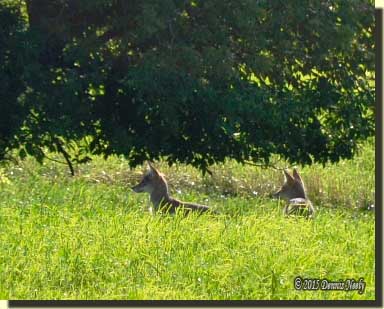
Long ago I learned not to concentrate on one creature or a group without giving equal attention to the entire area, including my back trail. As my eyes scanned the dew-laden grass, I caught movement straight ahead, first two alert ears, then two more. The coyote pups hid behind a tangle of tall grass the size of two bales of trade blankets.

Half-grown coyote pups watching deer in a hayfield.At first I thought the two young canines were hunting mice, but their attention wasn’t focused on the grass, but rather on the deer. A big doe, standing to the right and slightly ahead of the buck leered at the pups as if to say, “How dare you stalk us.” And in response, the young coyotes made no attempt to advance.

I stepped sideways to gain a better look at the coyotes, and when I did one of the bedded does spotted the subtle movement. She scrambled to her feet and stared at the large cedar tree, hacking away at the boughs that no longer served as pickets in an impenetrable fort. Three other does stood up and aligned their bodies, ears and eyes to the meadow’s southwest corner.

The coyotes took a clue from the alarmed deer and concentrated on the wagon trail and the open field’s west-edge cover. There was nothing I could do but stand my ground and remain motionless.

Two of the does turned around and started walking toward the hardwoods, which roused the buck from his morning rest. The closest coyote loped to the south and into the security of the first row of corn. The other bounded twice as if following, then it halted with an abrupt, stiff-legged stance. It glanced at its sibling, then spun around to face the skittish deer. After a longing look, the pup circled to its left and trotted to the corn, but did not enter. Instead, it turned back to the deer and took three steps in their direction. “There is always one,” I whispered with a smile.

Give traditional black powder hunting a try, be safe and may God bless you.
Posted in Scenarios, Wilderness Classroom | Tagged , , , , , , , , , , | Comments Off on There is Always One…

“The Prayer of the Woods”

“Snapshot Saturday”

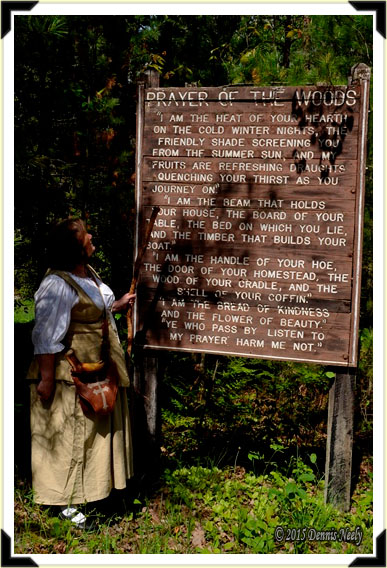
Prayer of the Woods at the Pigeon River Country State Forest headquarters.

Before she slipped back in time to the Year of our Lord, 1796, a lady of the forest paused to read the “Prayer of the Woods,” posted outside the headquarters building at the Pigeon River Country State Forest.

Posted in Living History, Snapshot Saturday | Tagged , , , , , , , , , , , , | Comments Off on “The Prayer of the Woods”

Erasing All Evidence…

The big red oak on the knob beckoned. Half the tree’s leaves, brown and brittle, littered the ground. The old hickory, three trees to the west, stood barren; a golden carpet, glowing like a candle lantern in the predawn murk, encircled its rough-barked trunk. Hunt-stained elk moccasins whispered on the doe trail that curled around the end of the swale hole, straightened as it broke over a slight rise, then angled east, thirty paces upwind of that red oak.

The cautious approach progressed in the last vestiges of the cloudless night’s chill. In a man-sized space between two bramble bushes a center-seamed moccasin cleared away the crunchy skeletons of the oak’s summer glory. Round, red berries, plump and full and glossy, lined the brambles’ spiny branches. The scent of fresh-scraped earth soon filled the air, mixing with the tannic acidity of rotting duff.

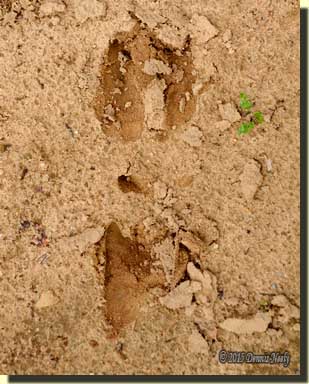
A two-and-a-half-year-old buck's tracks in the sand.The wool blanket roll thumped down in the hollowed-out nest. I took a seat upon the scarlet bundle, crossed my leather-clad legs and rested the Northwest gun on my thighs. It was mid-November, in the Year of our Lord, 1792. Every third day a fine buck deer traveled that trail, east to west. His deep track in a patch of sand betrayed the forest tenant’s woodland habits.

A while after first light, seven deer emerged from a swampy thicket, passed between the two wild apple trees in the grassy clearing, then walked into the east side of the woods, following the doe trail. The last doe in the strung-out line appeared skittish. Her head remained up with her ears constantly in motion. She glanced at the back trail once or twice, but concentrated on peering into the hardwoods.

I squinted and looked down in an attempt to melt into the barberry bushes, avoiding eye contact. A chickadee flitted about in front of me, flew back and forth, then bobbed up and down on a stout outer branch of the bramble to my left. “Chic, a-dee, dee, dee, dee… Chic, a-dee, dee, dee, dee,” the tiny song bird sang.

In due time, the morning sun warmed the thirty-acre woodlot, and not long after, I counted nine squirrels, five fox and four grays, romping about. Late in the morning, three muzzle blasts interrupted the song birds’ joyous melodies. A small flock of crows stopped cawing. I lost sight of most of the squirrels. The brass lead-holder scribbled on a folded page: “An ominous volley of three shots. Sounds like a British patrol close by. A woodsman must be careful.”

A large-bodied doe and two yearlings loped by, not running, but not walking either. Not long after, a first-year six-point buck sniffed the trail, which I consider a fortunate happenstance. I sat an hour longer than I should have, basking in the sunlight on that pleasant 18th-century Saturday. The buck of my desires never ventured by, perhaps scared off by the British patrol—or worse, providing fresh venison at their evening camp.

When the wind shifted a bit, I stood, stretched and returned to the sandy patch in the doe trail. My elk moccasin smoothed out the tracks, erasing all evidence of the morning’s wilderness travelers. Satisfied, I struck off to the west and spent the better part of the afternoon engaged in a slow still hunt. With an hour of daylight left and a favorable wind, I returned to the big red oak. The sand patch held six sets of doe tracks, but not a one from a buck. I smoothed the trail again when I left at dusk, hoping the buck I sought might pass in the night.

Another Woodscraft Skill

An oak split, dropped on the evening fire, popped and crackled as it started to burn. Yellow embers floated upward in the cool night air, bent on joining the sparkling stars above. Seven traditional black powder hunters sat around that fire, each telling tales of great bucks, and more to the point, missed opportunities. Tents of various styles and weather dotted the clearing in the pines. To the historical spectator, the scene fit Joseph Doddridge’s oft quoted passage:

“…he bent his course towards his camp; when arrived there he kindled up his fire, and together with his fellow hunter cooked his supper. The supper finished, the adventures of the day furnished the tales for the evening…” (Doddridge, 101)

“A neighbor to the south killed that fine 10-pointer,” I said, finishing up a deer hunting story from the prior November. Nods, grimaces and the pursing of lips followed, along with the usual one or two word utterances typical of veteran hunters who have walked that path one too many times.

“I don’t understand,” an experienced traditional woodsman said.

“His neighbor shot the deer,” was the quick response of another.

“No, explain why you smoothed out the sand, please…”

I don’t know when I first engaged in this woodland habit, early on in my quest for a taste of everyday life in the 1790s, I suppose. The question caught me by surprise. It forced me to think before I responded, because I smooth off certain sandy patches, like the one in the story, without conscious thought. Their use is an integral part of any stalk, still-hunt or ramble in my 18th-century Eden. The practice is akin to moderns posting trail cameras.

The North-Forty’s soil is a sandy-loam. Heavy rains wash the yellowish sand into the bare spots in the deer trails, slurries it to the surface in old scrapes or deposits it in a low-lying wagon rut. For me, these sandy patches, and/or any area of barren earth, bear witness to the comings and goings of the forest tenants.

If a woodsman sees a white-tailed deer or a wild turkey standing in a particular location, he or she knows an exact time of that critter’s existence in that specific place. On the other hand, tracks in the sand are an after-the-fact record, subject to interpretation and speculation, but still proof of passage. Such interpretation and speculation is the essence of woodscraft.

Some sandy patches are useless, because they exist in untraveled locations; others offer a wealth of information that helps tip the scales ever so slightly in the hunter’s favor. The first task is learning to distinguish the difference, taking into account that sometimes a plot’s importance is subject to seasonal movements or travel patterns. A year’s worth of careful observation is often required.

Game tracks tell the direction of travel, number and type of critters that passed, the relative size of each, and in some instances, indicate the owner’s sex and possible age. A brisk shower, an overnight rain, impressions left in an old moccasin print, dead twigs and leaves strewn on the sand by a stiff wind, and the degradation of the imprint’s edges all contribute to narrowing the time of passage.

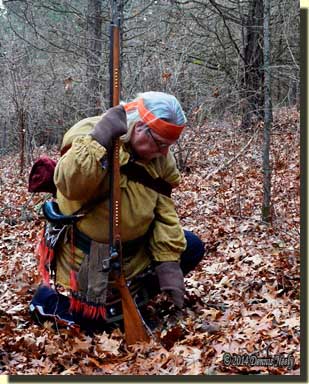
A traditional woodsman brushing leaves from a doe trail.

When the oak leaves fall, a woodsman must clear away the trail if he or she hopes to detect the passage of wild game.

But tracks can also be deceptive, looking fresh when they are days or weeks old. This is where smoothing out the sand plays a valuable role in establishing movement patterns. If a woodsman erases the evidence, or wipes the slate clean so to speak, he or she establishes a point certain in time.

On that day, it was a little after noon when I smoothed the sand. If, when I returned late in the afternoon, the buck’s track marked the earth, I would have narrowed his wanderings to the four-hour interval while I was still-hunting, but he did not, or if he did, he did not follow that trail. Likewise, by smoothing the sand when I left the glade at dark, I created another known benchmark.

Physical peculiarities, gained through past study, also aid in sorting out which animal or bird ventured by. For example, in late September of 1792, I saw that buck walk along the edge of a cornfield. I waited until he was gone, then stalked the field and spent a long time analyzing his tracks. If I recall, he was the buck with no dew claws on his right front leg. His toes on that leg spread an inch wider than normal, which set his hoof prints apart from those of other, like-sized bucks. Knowing that made his track easier to recognize—if the right front hoof had dew claws, it wasn’t the deer I was after.

Once learned, a woodscraft skill becomes second nature, performed with little conscious thought, and that is why I was so surprised at the question. I adhere to the woodland practice of erasing the evidence, but never think about it. Thus the thought never occurred to me that other traditional hunters might not know of it. And then I start wondering what woodland skills my hunter heroes applied to their simple pursuits that they never thought about writing down…

Give traditional black powder hunting a try, be safe and may God bless you.
Posted in Deer Hunts, Skills | Tagged , , , , , , , , , , , , | 4 Comments