“Snapshot Saturday”
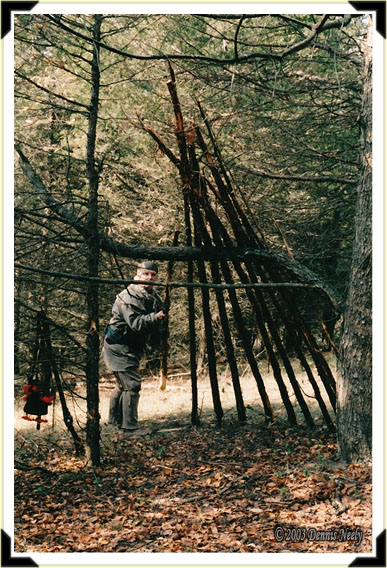
A low, horizontal branch of a wild cherry tree became the ridge pole for the fall duck camp. East of the River Raisin in the Old Northwest Territory, 1793.
A low, horizontal branch of a wild cherry tree became the ridge pole for the fall duck camp. East of the River Raisin in the Old Northwest Territory, 1793.

Hidden behind a downed oak trunk, Msko-waagosh, the “Red Fox,” watched a plump squirrel approach. Late October, two ridges east of the River Raisin, Old Northwest Territory, 1796.
A fox squirrel appeared on a white oak limb, to the left and a bit behind. It sat with its curled, bushy tail against the oak’s trunk and chattered, low and soft. The squirrel sounded contented. The morning light bathed the forest tenant. The pungent scent of drying leaves drifted down the hillside.
To the west, up over the ridge, another squirrel began the same rhythmic chant. No little birds sang that morning; none flitted about. The wild turkeys kept their tongues, too. Six black crows winged overhead, all silent, but two Sandhill cranes chortled off in the distance. It was late November, deep in the Old Northwest Territory, three ridges east of the River Raisin, in the Year of our Lord, 1792.
Some minutes later, the fox squirrel made its way down the tree and burrowed in burgundy-colored leaves. A deer coughed, up over the rise and down near the raspberry thicket. The exhilation sounded deep and heavy. Overtaken with a fit of exploration, the fox squirrel strew leaves all about, creating a great rustling. Above the unnecessary commotion, I heard a stout twig snap.
Arteries pulsed. Hips shifted to the right. My left leg pulled back slow, the knee rose up. The Northwest gun’s forestock rested on the buckskin leggin. My thumb fiddled with the firelock’s jaw screw. The deer coughed again, a few steps to the west, not all that far from where the main trail crossed over the rise.
Under a large, broad red cedar tree, just off the ridge crest, two front legs move, then stood still. I tried to peer through the cedar boughs, but the tangled mass was too thick. For an eternity I glanced back and forth from the forelegs to the earthen trail. Maybe fifteen minutes later a thick-necked body took two steps down the hillside. The deer’s head remained concealed behind the cedar tree, but there was little doubt it was a buck.
Two quick steps forward and a drop of the head confirmed my suspicions. The young buck displayed a proper set of first-year antlers with seven creamy-white tines. My right thumb pulled the trade gun’s English flint to attention as my finger worked the trigger to avoid the sear’s telltale click. My left arm eased the forestock up until that elbow planted firm into my left knee.
Three steps, maybe four, and the death messenger would embark on its fateful journey. As the turtle sight waited for the moment of truth, I whispered the hunter’s prayer: “A clean kill, or a clean miss. Your will, O Lord.”
But then the buck’s head jerked up with a noticeable sense of concern. I heard three soft footfalls. The fox squirrel stopped pawing under the leaves, stood straight up, then with a flick of its tail it raced to the safety of the white oak’s trunk. A patch of brown fur moved through a small, shadowy opening in the underbrush. I suspected it was the coughing deer, but the fur’s closeness to the ground did not match that of a white-tailed deer.
The buck stared at the rise, lifted its right front leg, then stomped down with a hard thump. The fur stopped. It was then that I saw the black tip of the coyote’s nose, seventy paces distant. The bold beast continued to walk over the rise with the arrogance of a hungry predator. Moving real slow, the Northwest gun’s turtle sight found the coyote’s side of a little clearing around where the deer trail first breaks over the knoll. The remains of two dead fawns, found at the edge of the meadow’s prairie grass in early June, made the choice simple.
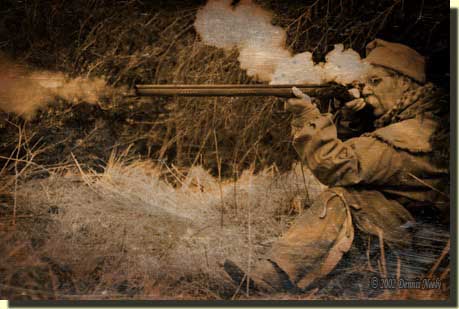 The buck stomped when the coyote was two strides onto the opening. The turtle sight grasped a dark spot just below the critter’s ear. The English flint lunged. Sparks flew. Priming flashed…
“Kla-whoosh-BOOM!”
Yellow fire streaked from the muzzle. White smoke roiled. The trade gun’s thunder echoed through the forest. Debris flew straight up beyond where the coyote once stood. Tail down, the seven-pointer’s rump disappeared with a hint of white. Hooves over antlers he ran, until the sound of crashing leaves and snapping branches evaporated in the silence of the glade.
After the wiping stick thumped another death sphere firm against the gunpowder, I walked to the little clearing. I expected to find no hair, no blood trail. For me, hitting an apple-sized target at that distance would require more luck than skill. But I had to try; I had to take a chance at what lay beyond the young buck.
I had a quiet and inspiring conversation with a fellow traditional black powder hunter at Friendship this past week. We sat in the shade of a canvas fly on the Curly Gostomski Primitive Camp at the National Muzzle Loading Rifle Association’s home grounds in southern Indiana. It was hot, humid and sweat soaked everyone’s linen and leather, which contributed to the eventual frustration that surfaced.
After catching up on family, the conversation turned to 18th-century loading methods for rifles, then to smoothbore loads, then to maintaining authenticity during a traditional hunt, and on to period-correct attire and accoutrements for specific historical re-enactments. As so often happens, the topic narrowed to primary documentation sources and the current interpretations of those research materials.
Another veteran traditional hunter wandered in and took a seat. He sat and listened, but when he entered the discussion, he did so with a “thread-counter’s attitude,” as my host later described it. As people walked about the camp area, this fellow dissected each one’s clothing and gear with a bit of an acid tongue. We both felt uncomfortable. Almost in unison, my host and I said, “We are all at different points on our journey.”
It was pretty cold under that fly for a couple of minutes. Then the subject changed to “people who helped us” on our own journeys and the lessons we learned from folks who were willing to share what they knew. The gent softened his tone when he started talking about his mentors, thirty-plus years ago. This led to a great sigh and an apology for being too critical of others.
As it turned out, he was dealing with a lot in his life, which is not offered as an excuse, only as an explanation of motivation. He came to Friendship hoping to step away from his own situation for a few days, but he couldn’t shut life’s concerns out of his head.
From time to time and in varying degrees, all traditional hunters face problems or circumstances that cloud and color their perspective on venturing back to yesteryear. That’s just part of the human condition, especially in these times. But we must all strive to rise above following the path of criticism and choose instead the path of sharing and teaching.
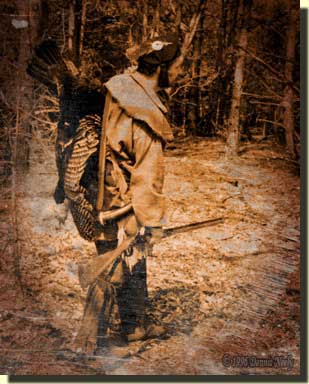
Yes, that is dark brown hair and a hodgepodge of not-so-period-correct garb, but a wild turkey still graced the family dinner table.
The next morning found me up the hill, standing in front of a large tarp filled with one man’s lifetime accumulation of living history gear. A close friend of his brought “his camp” to Friendship to sell. Facing the need for assisted living, his time traveling days had come to an end. Hand-forged knives and hawks, Hudson Bay blankets, cooking utensils, a gorgeous Great Coat, custom rifles and smoothbores, bags and horns lay on the blanket like bleached bison bones in the prairie sun.
Down the way, two streets over, an enthusiastic couple asked advice from a long-time vendor of living history goods. It was their first time at Friendship and they both had a shopping list. The vendor explained about being focused and basing purchases on historical documentation. He suggested other vendors to contact for specific items. One of the neighboring vendors went into her tent and brought out several outfits, explaining why she chose them and what to look for.
If you remember those days, you recall how foolish some of those first purchases were, and how far we missed the mark. Searching through my photo archives always brings a good laugh. But the traditional hunter’s goal is, and always has been, to engage in a portrayal that is better than yesterday’s, but not quite as good as tomorrow’s. Like the coyote’s unexpected visit, the pristine 18th-century moments we all seek still lie beyond the next rise.
Give traditional black powder hunting a try, be safe and may God bless you.
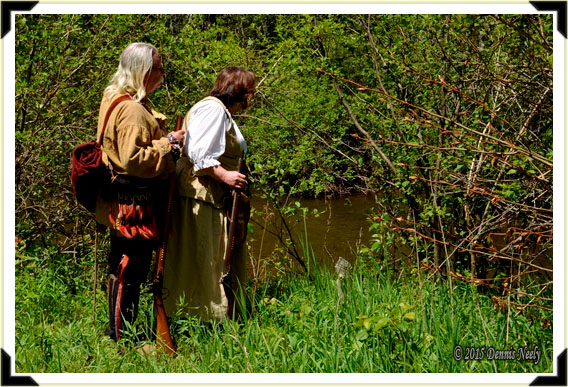
Beside the quiet-flowing Pigeon River, a frontier wife glimpses a young white-tailed deer standing on the far hillside, about forty paces distant. Old Northwest Territory, 1796.
Black powder tumbled to the breech. Tamara tapped the brass measure against the muzzle of her chiefs-grade trade gun, the “Silver Cross,” as she always does, making sure every last granule of her modest turkey load made it down the bore. “Should I use one card or two?” she asked, turning to look at me.
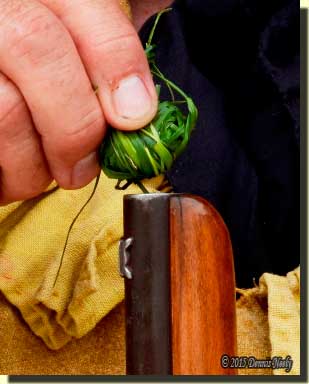 “Go with one, like you usually do,” I said as black powder flowed from my buffalo horn, some spilling over the sides of my tarnished adjustable measure. I dumped that charge in my own trade gun with a quick upsetting motion, then slipped the measure back in my shot pouch. I bent forward and grasped an appropriate amount of torn grass that lay piled at my feet. Standing up, I formed the dozen or so blades into a ball about the size of the death sphere. I sensed all eyes were on “Old Turkey Feathers” and the green, natural wad that I held in my right hand as my left hand slid the wiping stick from the smoothbore’s ribbed brass thimbles.
Tom Lounsbury stepped close, peering into a small camera. “Hold it a minute, I’d like to get a shot of your grass,” he said with a wry smile that gave away his double entendre. I obliged with a broad grin and looked straight into the camera. Over his shoulder, to the right, Mark Cargill’s eyes were wide with disbelief.
Tam stood with her wooden range rod tucked under her left arm as a charger full of #5 lead shot rattled down the tube of the Silver Cross. After seating the grass wadding firm on the powder charge, I proceeded to measure out my own “normal turkey load” of #5 lead shot. I then formed a half-sized ball of grass and tamped it firm over the shot column.
Mark originally asked us to shoot at the patterning board from the 40 yard marker, but after explaining the cylinder-bored guns’ limitations, Tam and I took our places at 25 yards. She primed and fired at the right board, and I did the same on the left. I saw the main wad drop in the sand about ten feet in front of my board. Mark and the other writers got to the pattern boards before we did.
Upon viewing the patterns, one writer expressed surprise at the apparent uniformity; another expected decent performance, noting today’s technology is based on yesterday’s practical experience. Mark Cargill started focusing his iPad on Tami’s pattern, and soon he and Tami were hovering over the screen in the shadows cast by an elevated platform.
Early each June, the Michigan Outdoor Writers Association travels to a Michigan host city for the group’s summer conference. This year MOWA met in Gaylord. Treetops Resort, located east of town at 3962 Wilkinson Road, served as the hub for the weekend gathering.
A “Welcome Reception” at the Gaylord Tourism Bureau on Friday evening got the weekend off to a great start with enjoyable networking and fellowship. At the end of the reception, Mark Cargill, a founding partner in Target Telemetrics LLC, gave a short presentation on the company’s newly developed “Automatic Shotgun Patterning” application written for Windows and Macintosh platforms. “Shotgun Profiler” is a similar application for the iPhone or iPad. Mark offered a free demonstration at the Northland Sportsmen’s Club of Gaylord, 1592 Old Alba Road, on Saturday afternoon.
On Saturday, attendees scatter to the four winds partaking of a variety of outdoor adventures that make their way to print in the weeks that follow. Tami and I opted for a wilderness scout in the Pigeon River Country State Forest, a short drive northeast of Gaylord. We were looking for elk and deer. We didn’t seen any elk, but we had a wonderful time exploring the shores of the Pigeon River. At one point, I took off my moccasins and wool leggins and forded the cold-running river, just to say I had done it. Tam just laughed and shook her head.
Late in the afternoon, we arrived at the Northland Sportsmen’s Club, still dressed in 18th-century attire. The well-groomed grounds offered little in the way of wadding material. As we walked to the pattern boards, I took a quick detour into the pines behind the parking lot and broke off two handfuls of narrow-bladed grass. I don’t think anyone saw me place it on the ground beside where we planned to load for the test; everyone was too busy studying our linen and wool outfits, which brings us to the beginning of this post.
The application proved impressive, especially if you’ve ever counted pellets in a 30-inch circle. Tami grinned when she told Tom Lounsbury I had three bundles of rolled up pattern targets in the basement. She said I’d never throw them away, because I worked too hard counting holes.
For Tami’s target, the iPad counted 92 death bees, 69 within the 30-inch circle. I thought she was using a 7/8 ounce load, which would be 148 pellets for a pattern percentage of 46.6 percent. Tami got to thinking about that number and decided to count out her pellets. After checking, she realized she used the wrong measurement and only loaded 130 pellets, for a corrected pattern percentage of 53 percent. Not bad for the Silver Cross’ cylinder-bored barrel.
Old Turkey Feathers showed slightly better results with the grass wadding. In either case the supposed turkey died a humane death, which is the whole reason we go to the trouble of patterning our firelocks. But the big thumbs up from the afternoon was not confirmation that the guns produced good patterns, but rather the resulting questions and the opportunity to promote traditional black powder hunting and the versatility of 18th-century smoothbores.
The following weekend I traveled to Friendship, Indiana, and camped on the home grounds of the National Muzzle Loading Rifle Association for the Spring National Shoot. On Sunday afternoon, folks congregate at the chunk gun range for the Gunmaker’s Match. A “competitor,” and I use that word loosely because this event is all about having fun, must shoot a gun of his or her own manufacture, thus the name Gunmaker’s Match.
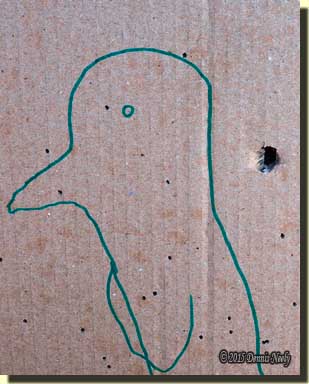
The “winner” from the previous year makes two identical targets, usually 14 to 16 inches in diameter, with artwork of his or her choosing. One target is shot at and the other acts as the trophy for the match. The maker designates the “bulls-eye,” some artistic element on the target, usually off to one side.
Cloaked in secrecy, in a dark corner of Gunmaker’s Hall, a non-competitor rotates the target to his or her liking, covers the front with one-inch grid paper and screws on a backer board. At the end of a relay when the line is safe, the backer board and target are carried downrange an “undisclosed distance” and set firm. Makers pay three dollars for one shot, and if they miss the target, they have to pay another dollar. All of the money goes to support Gunmaker’s Hall.
Once loaded, a shooter is called to the line while onlookers hoot and holler all manner of distractions. I loaded in the first platoon. I had a neat pile of grass on the loading bench that brought a few surprised stares as I rolled it into a ball. One gentleman asked what I was doing, while another builder who knows me said “Denny always loads his smoothbore with leaves and grass.” That comment raised several eyebrows. I felt a sudden urgency to hold up my end. The target was closer this year, not 130 yards out like in the past.
Gerry Rubbo’s shot hit an inch to the right of dead center—a safe location given that the bulls-eye is rarely there. She smiled when she walked back to the bench—she knew she was safe, too.
I was so intense on hitting the target that I did not follow through with my shooting plan. Knowing the grass-wadded ball would drop about five inches over the estimated distance, I planned to sight four inches above dead center. I primed and eased Old Turkey Feathers to my shoulder, but the turtle sight grabbed Gerry’s mark like it obsesses with a wild turkey’s eye at the moment of truth.
“Kla-whoosh-BOOM!”
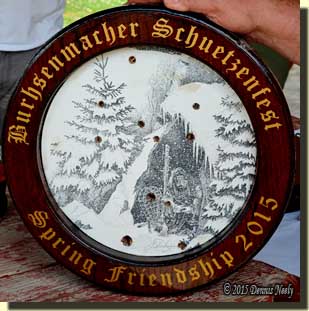 Under the roiling smoke I saw splinters fly. The hole was obvious, six or so inches lower than Gerry’s and to the left. For me, just hitting the target is a huge accomplishment, because this match is geared to the rifle shooters. I smiled as I walked back, thrilled that the grass-wadded ball proved itself. The gentleman who questioned my sanity looked surprised, then he smiled, too. Camaraderie is the nature of this event. Then a little voice inside me warned, “You might be making two targets for next June.”
At the end of the match, the target sported 13 hits. Justin Vititoe’s round ball struck closest to the trappers cap. It was Justin’s first time entering in the match. He was pestered into plunking down his three dollars, and his benefactor “overlooked” explaining the rules.
When Justin learned he would be making two targets for next June, he looked up and said, “Oh, really? Are you sure that’s my shot?” His dad said, “Don’t worry about it, I can make the targets.”
To my way of reasoning, that’s two thumbs up for natural wadding…
Give traditional black powder hunting a try, be safe and may God bless you.
Back in late May, Tami and I were guests on the set of James Townsend and Son’s YouTube Channel. Jonathan and his crew were gracious hosts, and he is as easy going as he appears in the videos. At the end of the taping session, Jonathan asked if I would do a short interview about traditional black powder hunting. The completed segment was posted last evening. Take a look!
If you are not familiar with James Townsend and Son, be sure to check out their online store. Their YouTube Channel carries a wealth of living history information, including a series entitled “18th Century Cooking.” Usually Jonathan answers viewer questions on Thursday, and he also discusses historical resources during the “Friday Resource Forum!” And don’t miss the show’s rising star, Miss Ivy, as she helps make a hot chocolate drink, tends the herb garden and makes candied violets!
Tami and I want to extend a special ‘Thank You!’ to Jonathan and his crew for their wonderful hospitality. We had a fun time, and we hope we can do this again in the near future.
Give traditional black powder hunting a try, be safe and may God bless you.
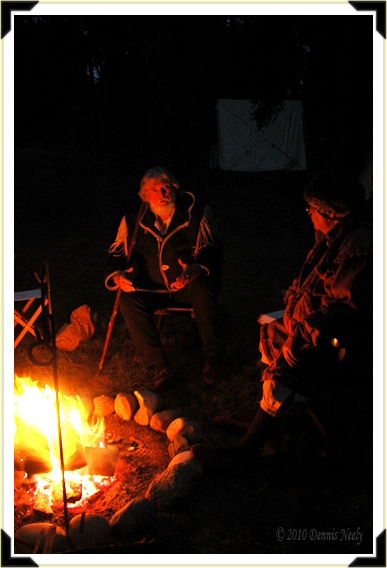
Two hunters swap stories beside an evening campfire. After a pause, the gray-haired woodsman begins to tell of a great moose hunt, many winters before. Ron LaClair (left) and David Graham (right), Swamp Hollow, late 18th-century in the Old Northwest Territory.
“I hunted a lot,” Jeff Wacker said. “It was late October, during archery deer season. Fall turkey season was on, too. Any chance I got I was hunting for deer, when I got up in the morning before work, and at night after work.” Jeff is an avid traditional archer, and that made my pestering a little easier—now he is also a traditional black powder hunter.
“One morning I was just beat,” he said with a sigh as he leaned back on the sofa on his screened-in back porch. “I told Sue (Jeff’s wife), ‘There’s no way I’m climbing up in a tree stand. I’m going turkey hunting.’ Every morning I’d see a flock of toms come off the ridge to the east. They’d come down through the woods and head to the river like clockwork.
“I went out to the barn and loaded up the French ‘D’ per the instructions of my mentor. It was still dark when I headed back to the woods to intercept the turkeys. It started to get light and the birds started cackling. A half hour after daylight here they come, five of them, but this time all hens. In the fall you can shoot hens, and I thought to myself ‘these will be better eating than a tough old tom.’
“I had a hen walk in. I stepped off twenty-two paces afterwards. My paces are about a yard, well within the effective distance of the load I had in the French ‘D,’ or thought I had. She presented herself—a broadside shot, head up. I took aim. The gun went off, but it didn’t recoil as much as it usually does with the hefty load of shot.
“I was using a measure and a half of #5 lead shot over a card and two fiber wads,” Jeff said with another sigh. Jeff custom built his 20-gauge fusil several years before this sojourn. “I’ve found that load patterns best in the French ‘D.’ I topped it off with a thin, over-the-shot card.
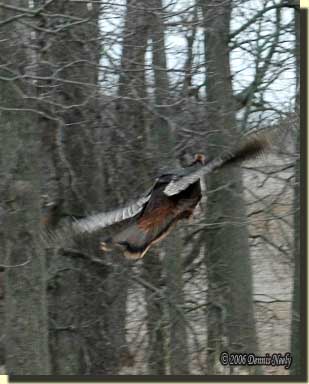 “I shot and the bird went right down. I smiled and didn’t bother reloading. I stood and started to walk over to retrieve my bird. I got halfway there and she jumped up and flew away, off toward the river. I watched her, taking note of the direction she flew. I walked that way. I thought I would find her dead on the ground. Where she stood I saw there were no feathers on the ground, and as I walked I started thinking about the gun not having the right recoil,” Jeff said. He never found the hen.
“I relayed what happened to my mentor. His first words were: ‘Did you put shot down the barrel?’ I answered with a smart-alecky: ‘Yes I did! I remember measuring it!’ He said one of two things happened, either I didn’t put the shot in or the over-the-shot card wasn’t seated properly and I lost my shot out of the barrel walking out in the dark. That had to be what happened, and if it was, I hit the bird with the fiber wads, knocked it over and stunned it for a minute,”
Conscientious hunters, modern or traditional, give serious attention to misses. The second guessing begins when the game jumps up and flies to the river bottom or runs off into the thicket, all the while showing no sign of injury. Hours pile up as the search widens, and it is during those agonizing times that the mind replays the moment of truth over and over and over, looking for the minutest of clues as to what went wrong.
In the last few weeks, I have run across three other incidents relating to lost or loose shot columns, which brought to mind Jeff Wacker’s hen—plus I have a story of my own to add. In all three tales, like Jeff’s, the shot was lost prior to pulling the trigger. One gentleman found part of his #4s when he vacuumed the carpet in his truck. I can imagine what that sounded like.
Among traditional black powder hunters who love smoothbores there seems to be a tendency to treat the loading of a round ball different from that of shot. Perhaps this is due to the versatility of these guns and the need to develop an efficient load matched to the wild game pursued. But regardless of one’s mental attitude, all projectile loads in a smooth-bored black powder arm must be treated with equal respect and loaded with the same care and caution.
Near the beginning of any presentation on black powder safety there is always a serious discussion about “short-started loads.” A short-started load refers to dumping powder down the barrel followed by a projectile that is not seated solid on that powder charge (Fadala, 98). The exact understanding of the physics involved is still in question, but the result is the same: when the powder ignites, the resulting pressures do not move an up-bore load, but will instead cause the barrel to bulge, or worse, explode in the shooter’s hands.
It is important to note that the term “short-started loads” is all inclusive, rather than referring to the phenomenon as “short-started round balls,” because this dangerous condition can exist with any projectile or projectile combination.
A common preventative measure for short-started loads is to mark one’s ramrod so it is easy to see when the projectile is seated firm on the powder, but that method is not foolproof. For example, my wiping sticks have a quarter-inch orange band painted around the rod. When the bottom of the band is even with the muzzle, my competition round ball load is seated properly. But since I use a variety of loads and compete in matches that require both round ball and shot, I have to be aware of where that orange band is supposed to be in relation to the muzzle for the different load combinations.
In the case of shot, the shot column must be kept tight once it is seated. Most folks use the thin over-the-shot cards, but whatever material is used, it must fit the bore with enough friction to hold an ounce-plus of shot from coming loose or spilling out during the course of a hunt.
When discussing the loss of Jeff’s shot, I asked if he remembered using an over-the-shot card. I have seen individuals, myself included, get ahead of themselves and forget the card, only to hear the shot rattle down the bore when the barrel was tipped down to prime. After much soul searching, one of the other traditional hunters said he didn’t remember seating a card, and after looking, found the remnants of the missing shot on the ground near where he loaded.
I next asked Jeff if his ramrod tip was flat or concave and if he started the card on edge or if he pushed it flat with his finger once it was in the bore. If a ramrod tip is concave, or hollowed out to fit a round ball’s spherical shape, and the card is not flat in the bore before it is run to the breech, the card might stay somewhat vertical and “knife” into the shot column, rather than seating flat.
Likewise, if the ramrod tip is flat, which Jeff’s is, and the card is not pushed flat to start, the tip’s flat face can fold the card’s thin edge over on the way down the bore. Once a few pellets escape on the folded side, the weight of the remaining shot can tip the card in the bore as they spill out. In a worst case scenario, only half of the shot escapes, leaving the rest of the pellets loose, creating a short-started condition.
Maintaining a tight card to bore fit is also important when shooting a double-barreled shotgun. The recoil from firing the first barrel can sometimes dislodge a poor-fitting card, in effect short-starting the second barrel.
In addition, cards fit better in a fouled bore than in a clean tube, especially one where a film of oil remains. After some experimenting, the fellow with the lead-lined truck carpet discovered this was his problem. If a card slides down the bore too easy, further care and examination is warranted.
An hour into a duck hunt, I moved “Old Turkey Feathers” off my lap, set the butt on the ground and held the muzzle upright. I heard the bismuth shot rattle. I dumped the prime, pegged the touch hole and pulled the wiping stick from the ribbed thimbles. The over-the-shot card was an inch or so off the shot. I reseated it and added a second card. A short while later I shucked the smoothbore up and down. The shot column was loose again. I walked out and went home.
 A month before I bought a bag of new cards—same gauge, same supplier. I pulled the two cards from the morning’s duck hunt. They came out too easy. I measured the diameters with a dial caliper, then dug around in the muzzleloading cabinet for a sample of the old cards. The old card was eight-thousandths bigger. The manufacture had “upgraded” their tooling and the old dies were “not to spec.” I exchanged the 20-gauge cards for 19-guage, and that solved the problem.
Jeff is still not sure what happened that morning, but subsequent trips to the patterning board with the French “D” added one piece to the puzzle. At least one of the double fiber wads hits the cardboard targets hard, sometimes penetrating clean through. He is convinced one or both wads hit his hen and knocked her down. Now if we can just figure out what happened to his shot?
Take care loading any smoothbore, be safe and may God bless you.