“Snapshot Saturday”
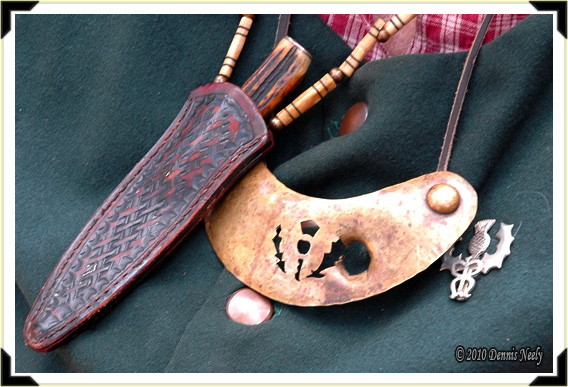
The eerie void of a death messenger’s visitation, to the right of the Scottish thistle on the tarnished brass gorget, begged an explanation… Swamp Hollow, mid-1770s in the Old Northwest Territory.
The eerie void of a death messenger’s visitation, to the right of the Scottish thistle on the tarnished brass gorget, begged an explanation… Swamp Hollow, mid-1770s in the Old Northwest Territory.
Elk moccasins left shallow prints in the sandy soil. Beyond the once majestic oak’s spear-like stump, a long-bearded tom turkey watched three hens peck their way to the east. The farthest hen perked up first, then the other two and finally the gobbler. The hens walked straight away. The tom hesitated and looked like he might fluff up in a show of dominance.
Then the young, grey-headed turkey on the right started to run. She took flight, flapping hard over the meadow. The wind from each downward beat sent a small wave rippling over the prairie grass. The gobbler folded his feathers tight, and like the two remaining hens, quickened his pace. One-by-one, the trio ducked into the safety of the waist-deep grass.
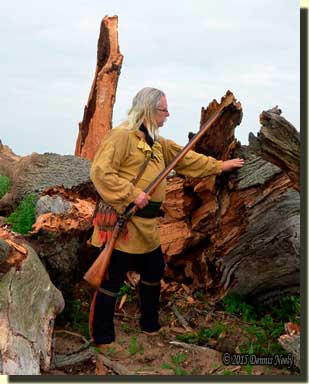 My moccasins marched onward. The wool leggins grew warm, the breechclout chaffed and I began to perspire as the sandy prints drew closer to the downed monarch. Standing beside the first fractured limb, the size of a stout man’s torso, I felt my face flush. A big sigh broke the morning calm. The inevitable reality of the forest lay sprawled before me. Then a long string of geese approached from the southwest, each uttering a single honk that echoed over the open rise like “Taps” played at Arlington.
The trunk splintered apart, clearly rotted through. The south roots, severed just below the ground, flailed soil all about as the trunk pulled free—almost two centuries of surviving Mother Nature’s furies undone in an instant. No doubt, a lightning strike, a score of years ago, contributed to the tree’s demise. Chunks of punky heartwood littered the ground. Here and there, ants carried white larva to safety. Two distinct sets of fresh raccoon leavings added an irreverent insult.
I touched the bark as one touches the casket of a beloved grandmother. As I rested my hand, a wood tick crawled from under the linen shirt’s open cuff. I killed it before I bowed my head.
When I again looked up I glimpsed doe ears bobbing in the meadow. To my surprise, a tiny fawn burst from the grassy haven at the edge of the field, fifty or so paces to the west of where the turkeys entered. Its coat was cinnamon brown and the spots brilliant white. It bounded and pranced with youthful exuberance. A nervous doe followed four strides behind. With great effort, the upset mother ushered the youngster back into the security of the deep prairie grass.
“As a life leaves, another enters,” I whispered as I turned around and struck off to the east.
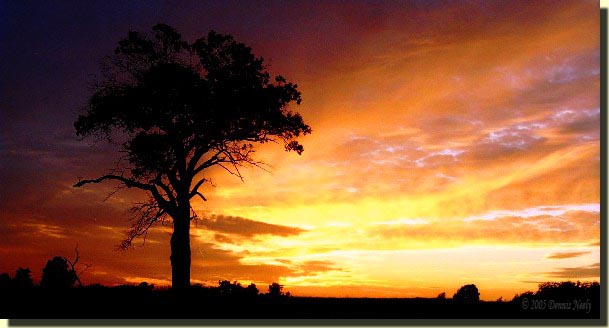 Since I was young, six or so, I have felt a connection to Nature, the land and especially to the trees that grow on the North-Forty. I think my Grandmother Sturgis instilled deep-seated feelings in me. We used to take walks in her backyard, which was “in town,” and my brother and I were required to name off the species of each tree on our way to her lush garden.
When I first discovered the “section oak,” as I call it, was down, I felt the same pangs as one does when a family member dies, then the mourning begins and eventually the healing. That tree, among many others, is, or was, a favorite of mine. I can’t begin to count the number of times I sat under that specific oak tree, sometimes hunting and sometimes for contemplation or reflection. And over the years, that section oak has acted as a guide to yesteryear. Somehow, passing under its spreading branches and whispering leaves ushered me over time’s threshold and back to my beloved 1790s.
One of my earliest recollections was my dad’s admonition: “Leave the section trees alone.” These are trees that happened to grow square on the surveyors’ section lines that created uniform townships under the Land Ordinance of 1785 (Bragdon, 86). A section is a mile square and a township is six sections to a side, or 36 sections—unless local politicians get to quibbling and the end result is a different number of sections, as in the case of Columbia Township. Human nature never changes.
There used to be four section trees—three red oaks and a white oak—along the north/south section line that starts where Hervey Parke drove a hickory stake in 1824. This tree was the sole survivor, and now it’s gone. Surveying manuals refer to such trees as “line trees,” but since I grew up with my dad calling them “section trees” that’s the term I use.
Section trees are the bane of farmers, especially today’s mechanized land tillers. Specialized sprayers with 100-foot articulated arms don’t maneuver well around them. As a youth, I remember seeing LeRoy Ehnis plowing that field with the shiny new red and white International 560 that replaced his faded Super M. As he rumbled westward through the oak’s shade the front tricycle wheels reared up like a great stallion. I thought Mr. Ehnis was going to flip over backwards, then the root severed releasing the plow point, averting a fatal disaster.
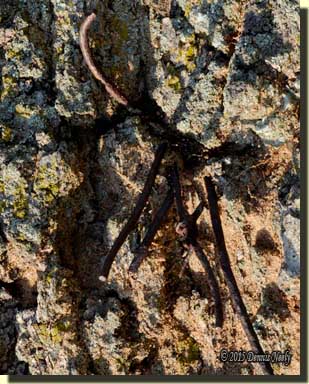 I remember three strands of barbed wire sticking out of the trunks of all four trees. Dad said it was left over from the 1930s, before the fences came down to make the little fields bigger and easier to plow. A few rusted strands still protrude from the great oak’s deep-furrowed bark.
Ten years ago I returned to Michigan State University and enrolled in the Department of Writing, Rhetoric and American Cultures—leave it to a university to come up with a fancy name for “writing classes.” As a student in Professor Laura Julier’s “Writing Nature and the Nature of Writing,” I was required to have a semester project and I chose the section oak. I sat against that tree’s trunk, rain or shine, almost every day and recorded my “thoughts, feelings and reflections” in my journal. Mother died just before semester’s end, and I never completed the treatise. Professor Julier gave me an “incomplete.”
That tree became literary quicksand. As an avid living historian, curiosity got the best of me, and I ended up researching the original surveyor’s notes. Hervey Parke didn’t mention that tree, but he did mention others, none of which I was able to locate.
Next I felt compelled to “age” the tree. I used several methods, shy of a test boring, and with the help of a forester the tree was aged at 165 to 170 years old (this was ten years ago), not around for the 1824 survey, but about a foot thick for the 1880 re-survey.
Excitement grew as I realized the significance of that five year window: the acorn sprouted between 1835 and 1840. The Elder Calvin Harlow Swain traveled from New York State to the Michigan territory and founded the little settlement of Swainsville in 1832. Settlers came, and in 1836 the village was renamed Brooklyn. Perhaps that majestic red oak entered this world when Elder Swain and his family walked from Napoleon to his 40-acre parcel? And if not, it is quite possible its slender stem supported a dozen or so leaves when the village residents change the name?
In the early 1960s a three-tailed twister roared down that field. The section oaks lost some limbs and a lot of leaves, but they survived. I remember when lightning split the massive white oak, the next tree to the south. Kenny Creger sawed the tree up, Then Mr. Ehnis hired Ernest Hudson to remove the stump.
“…he heard my father used dynamite,” the late Jack Hudson said as he retold the story of how his dad got him out of bed at the crack of dawn to help “blow that stump.” Everyone laughed when Jack told how they used too much dynamite on the north root, blowing the stump over the road.
“…It took down the telephone wire and two strands of barbed wire on top of the fence…Doc Sirhal went through right underneath it. It took the windshield wipers, they were exposed at that time on the Cadillac he had…right off the windshield, and they went on over in the field, along with the stump…there wasn’t a scratch on his Cadillac…” (Jack Hudson interview, November 23, 2005)
Perhaps one of the saddest realizations is that mention of the section oak will soon fade from my 18th-century scribblings. That tree saw the founding of a town, the coming of settlers to the Michigan territory, the birth of a great state, westward expansion, the Civil War, World War I, World War II, and on and on and on.
The majority of the folks buried in Highland Cemetery came and went during that tree’s lifetime. One or two stapled barbed wire to its trunk, a few tilled the soil under its spreading branches, others harvested wild game and at least one of us ventured back to the 1790s while sharing the warm afternoon sun or a torrential rain that nourished its existence. What a witness to history…
Think about the tree you sit against, be safe and may God bless you.
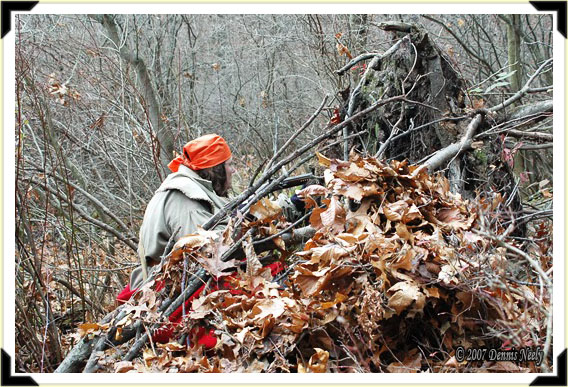
Impatience gripped a belle of the woods as she sat hidden behind an upturned maple’s root ball. Up the steep slope in front of her, forty paces distant, three white-tailed does with nary an inkling of her deathly presence followed a meandering trail. The last kept looking back, offering the hope of a rutting buck’s pursuit… Tamara Neely, mid-1790s, one swamp east of the River Raisin in the Old Northwest Territory.
A yellow birch tree popped. The bang rattled through the frigid bottomland like a hostile rifle shot. A blue jay started to scream a warning, but quit after the first penetrating “Jay!” It flitted to the top of a nearby maple. After a few seconds it swooped low over a snow-covered patch of sedge grass, then rose up and perched on the lowest branch of the noisy birch. It cocked its blue tufted head from side to side as if perplexed.
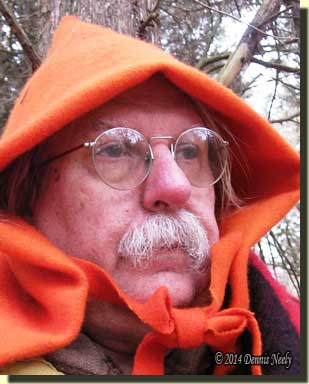 The light snow resumed. The Ojibwe-style wool hood limited the view to the north and to the south, more so than a pupil in the wilderness classroom was comfortable with. “The hood needs a different tie and it is still too deep,” the brass lead holder scribbled. With that revelation, I slipped the folded page into the buckskin envelope, along with the lead holder, and tucked the journal under the Northwest gun’s butt stock.
Round white balls tumbled into the folds of the crimson trade blanket as the snow pelted down. My eyes looked left, then right as I sat cross-legged on the mossy root ball of a scrub maple, just inside the west edge of the sedge grass haven. To the north, another tree cracked in the unseasonable cold. I realized I had lost track of the blue jay.
Five Canada geese winged high overhead, headed south in silent resolve. Picked clean by earlier flocks and browsing deer, few kernels remained in the cornfields. In the bottoms, sixty paces distant, the River Raisin lay frozen over. The constant current made crossing treacherous in the coldest of Januarys, promising certain death in mid-December.
“No geese, no Sandhill cranes, no song birds, no white-tailed deer—all that remains is snow, a lone blue jay and a foolish old woodsman braving December’s desolation,” the knife-sharpened lead scrawled.
About an hour later, the soft snap of a brittle twig announced the arrival of a roaming deer, a late-spring doe traveling without the wisdom of her mother. If the winter’s harsh start continued, I envisioned a grim future for this frail creature. She stopped not fifteen paces distant, pawed away the snow and nuzzled the ground. She lapped up two tongue’s worth of snow, but displayed no caution, no inclination for self-preservation. I assuaged the trepidation I felt for her by telling myself I was well hidden behind the walls of an impenetrable sedge grass fort. I knew better.
Not long after the doe disappeared in a cattail tangle, shivers overtook my being. Perhaps I was the frail tenant of the forest? I stretched my legs out from under the trade blanket and flexed my toes and ankles. I looked about, then rolled on my right hip to check for movement behind me. In due time, I scrambled to my feet. I fought the urge to shake the snow from the blanket, choosing instead to blend into the wintry glade as I stalked back to the high ground and the sanctity of a warm homestead.
It has been my practice to frame an entire hunting season around a specific year in the last decade of the 18th-century. This helps focus attention on a narrow slice of history. My time traveling on this particular day landed me in 1796 in the Old Northwest Territory.
On two different occasions in the last week I have tried to articulate that point to surprised individuals who had no idea what traditional black powder hunting was all about. The motivation behind visiting the mid-1790s while on a deer or turkey hunt seems foreign to most people, especially modern hunters. Some shake their heads in disbelief while others ask subtle questions to satisfy their tweaked curiosity. Now as it happened, the discussion I had with both individuals evolved to the same assumption: “Well, you can’t do that in the winter, can you?”
The enthusiastic “Sure, why not” drew raised eyebrows. I fought off a pride-fillled snicker. You see, what we take for granted, most people cannot begin to fathom. Although they are polite enough not to ask, you can see in their eyes that they are asking themselves, “Why would a sane human being abandon modern creature comforts and subject himself to the physical punishment of the River Raisin’s wintry bottomlands? And how can he possibly come away feeling overjoyed, refreshed and satisfied?”
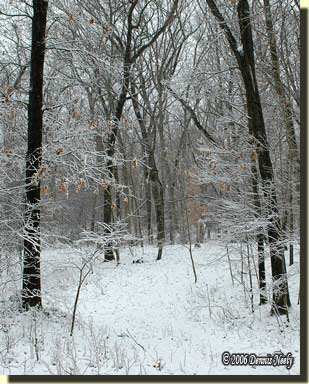 Experiencing the unique exhilaration associated with this glorious pastime knows no time limit and certainly very little restriction due to the elements. It’s sticky and humid as I pound the keyboard; the temperature passed eighty-degrees several hours ago, yet here I am re-living the sudden pop of yellow birch trees, watching a lone blue jay investigate and feeling concern for the scrawny fawn on that snowy December morning when the mercury struggled to hit double digits.
To be fair, for many time travelers the pursuit of living history focuses on creating an authentic historical impression that is shared with spectators. In museum settings or battle re-enactments, a guest’s satisfaction is the driving economic force and personal comfort is an important consideration—spring’s greening to fall’s vivid colors defines “the season.” There are exceptions, like the Nouvelle Annee re-enactment at Historic Fort Wayne, held the end of January in Fort Wayne, Indiana. But again, the slightest snowstorm or cold snap impacts attendance at such events.
Traditional black powder hunting is not a spectator sport. As I have said on a number of occasions, there are no bleachers, no gallery, no whispering commentators, no blimp droning overhead and the like. In most cases, the traditional woodsman’s time-traveling adventure is a solitary quest, a one-on-one, sometimes raw nerve encounter, between a linen-and-leather-clad gatherer and the creatures of the forest. Relishing the sheer challenge of measuring up to such an endeavor is worth the price of admission.
Working through the historical intricacies of perfecting a persona based on the lives of long dead hunter heroes can be a humbling and difficult task. The goal of any traditional hunt is to put meat on the family dining table, but adhering to the methodology described in the words of a long-forgotten narrative is just as important as having a proper load or picking the right time to take the shot.
For me, the satisfaction is in the hands-on doing and not necessarily in the taking of wild game—that is a bonus. Sharing the same physical discomfort and associated emotions with a kindred spirit, two-plus centuries removed, is a valued prize worth sacrificing for. I knew before I stalked the scrub maple in the sedge grass that the conditions of that historical simulation were not conducive to returning home with fresh venison. In an outdoor world dominated by trophy book critters and constant sensual bombardment from a host of commercial media sources, grasping this concept often eludes even the most astute observer nestled snug in the sanctity of a warm homestead.
Brave the elements for the prize is unmatched, be safe and may God bless you.
“Take a little time to pray.
Take a little time to ponder…”
–Opening refrain to “Take a Little Time” by Fr. Tom Helfrich
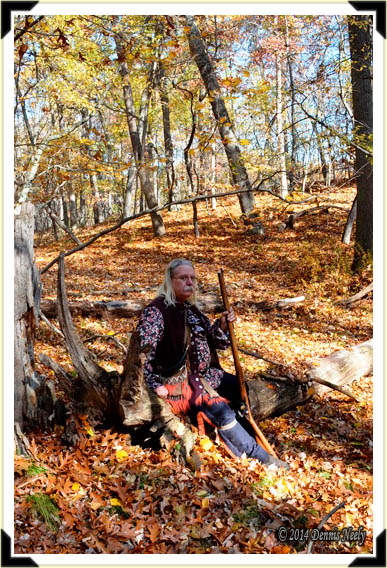
Oak leaves sprouted a few days ago. The maple and wild cherry trees are well ahead, almost complete. The lone shag-bark hickory to the north sports leaves the size and shape of a half-grown cottontail rabbit’s ears. Ahead and to the right, witch hazel leaves flutter in the cold, penetrating west wind. Patches of trilliums dot the forest floor like mythical Lilliputian umbrellas—some concealing round flower buds. If not for spring’s explosion of green, a humble woodsman might think it mid-October, not mid-May of 1795.
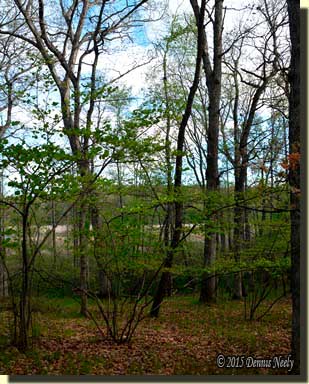 Three days of rain pushed the River Raisin beyond its banks. To the west the river is sky blue and appears summer warm, to the north November grey, frigid and threatening. To the west, lush canary grass stems grow waist high, but to the north, weathered, broken and tangled cattail stems offer a bleak reminder of winter’s harshness. Such are the circumstances of a woodland tenant in the Old Northwest Territory.
The sharp honks of Canada geese that flew in at first light punctuate the melodic warbles of red-winged black birds. Two white swans paddle against the current adjacent to the mud flats where lily pads float like emerald isles on an azure sea. Down the hill, calf-deep skunk cabbages carpet the soggy peat of the river’s bottom land.
I have yet to hear a wild turkey’s “arrkk,” or “cluck,” or “putt;” nary even an aborted gobble. But the birds often remain silent in a steady breeze such as today—nonetheless that never quells the joyous anticipation for what the next moments hold.
My back rests against a modest white oak as I sit cross-legged on a wool blanket roll. The Northwest gun, charged with a healthy swarm of death bees, lies across my wool leggins. A thinning juniper, reaching chest-deep on my human shape, encircles the north side of the lair. I am only half-hidden. “With the hens on the nest my best hope is to glimpse a bright red head with a shimmering bronze body as it picks its way through the greenery,” I scribble on a folded page.
Based on careful observation, I knew a mature hen had a nest just over the hill to the south, among the downed poplars and the large fallen red oak. Two hills over, another hen frequented the hardwoods to the northeast of the yellow tree, or so I surmised from her travels. In past years, long-bearded gobblers skulked through the crease where the bottomlands meet the oaks and cherries and hickories of the higher ground as they journeyed from nesting hen to nesting hen. Armed with that knowledge, on a cold May morning, Msko-waagosh waited in ambush.
To be honest, I am a bit envious of hunters, modern or traditional, who walk into the glade, sit down next to any tree, yelp nonstop for twenty minutes and have a mature tom waltz up in full display with a sign swinging from its neck that says “Take me, I’m yours.”
That scenario seems to be the popular storyline for this year’s spring turkey season, at least here in Michigan. I’m beginning to wonder if some unknown side effect associated with traveling back in time has befallen the wild turkeys on the North-Forty. My neighbor to the north, Jeff, who is also a traditional black powder hunter, and I discussed this topic yesterday. We both are scratching our 18th-century noggins, because our birds are few and far between, and the toms that are out there have the best anti-hunter security system we’ve ever seen.
As Jeff lamented, we have both killed a lot of gobblers, but the days of calling nonstop and having a longbeard strut right in, with or without a decoy spread, are long gone—at least with our flocks. This year’s colder weather and the resulting delay in spawning takes some of the blame for the turkeys’ evasive habits, but a significant increase in poor calling is the big culprit.
For the last ten years we’ve had to deal with younger birds being educated by all manner of unnatural-sounding enticements, and the older turkeys, having attended these classes before, just stand and watch the spectacle. Please don’t misunderstand, we can get birds to respond, but getting them to come within the effective distance of a smooth-bored flintlock is difficult.
On a number of occasions I have quoted Joseph Doddridge on the mandatory bird calling education of the youth of his era (Doddridge, 122-123), and pointed out several of Meshach Browning’s classic wild turkey hunts and his reliance on speaking “a few words in the turkey language..” (Browning, 122, 229 & 339). But Browning includes a different sort of turkey hunt in his narrative, one based on stealth, stalking and ambush:
“…one of the children came in and told me there was a flock of wild turkeys in the cornfield. I took my rifle, crept slyly round till I got the fence between them and myself; when lying down on the ground, I crawled to the fence, and there waited to make my selection. One of the turkeys had assumed the control of all the corn-shocks; and if, while he was picking an ear at one side of a shock, he heard another turkey on the other side, he would run round and drive him off. He would not allow any gobbler to pick at the same shock with himself.
“After he had driven three or four way, and they all seemed in dread of him, I called to him, in a low tone, ‘You are a fierce old tyrant, and it won’t last you long.’ This I knew would cause him to stand still, so that I could have a fair shot at him.
“When he heard my voice, he could not tell where it came from; and straightening himself up, he stood as still as he could, looking for the cause of the noise. I then fired at him, and over and over he went…” (Ibid, 163-164)
I view this passage as encouragement from the grave to try different approaches when the situation allows or when calling is not the best option—justification to “run and gun,” as neighbor Jeff says. All too often living historians get caught up in the overall romance of a given hunter hero’s tale. I have to constantly force myself to step back and delve deeper into a passage, to seek out the secrets hidden in the words.
Browning went on to say the gobbler “weighed twenty-six pounds; being the largest turkey I ever killed” (Ibid, 165). Dear reader, can you imagine telling such a story today? “…I took my rifle, crept slyly round…,” “…waited to make my selection…,” “…I [spoke] to him…,” and “…he stood as still…”—which part of a tale like that do you expect to see on a modern outdoor television show?
Last February, in the midst of a traditional hunting discussion, I was asked: “How many turkeys have you killed by calling them in, and how many by ambush?” Two of the participants, long-time veterans of the old ways, appeared flabbergasted. One said he believed the only way to kill a wild turkey was by calling it in. I responded by giving a thumbnail sketch of Browning’s story, and then I answered the question with “about fifty/fifty.”
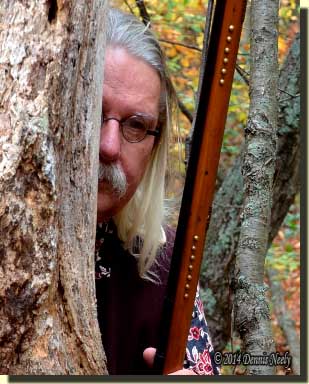 When the circumstances of the forest are as they have been the last week or so, I prefer to set an ambush based on careful observation. With the hens on the nest, the toms tend to follow a daily routine along the same trails, across the same fields, and strutting in the same areas. The most the hens utter is a single hushed cluck or putt, thus a single, judicious drag on the wing bone is all I ever use, if that.
The trick is to observe and learn and attempt to become a tenant of the forest. I have yet to be in a situation where I thought I could speak in a low tone to a gobbler, but the thought is always in the back of my mind, and when the time is right I intend to try. I have stopped deer and squirrels with a soft kissing sound, and once I froze a first-year six-point buck with a whispered “Hi there.” So for now, Msko-waagosh, the Red Fox, will sit in ambush…
Give traditional black powder hunting a try, be safe and may God bless you.
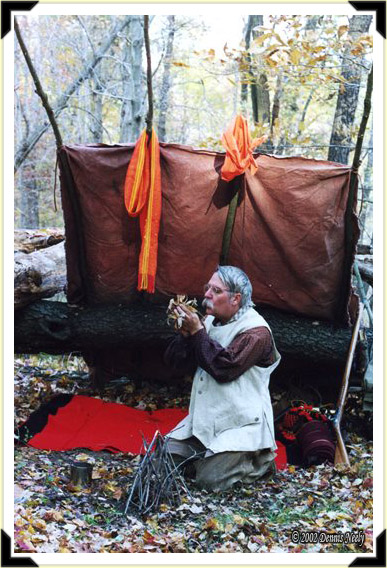
After stretching the canoe tarp over a makeshift set of rafter poles, the traditional woodsman struck flint to steel and kindled the evening fire. Old Northwest Territory, within sight of the River Raisin, 1796.