“A Fine 9-Point Buck”

“Snapshot Saturday”

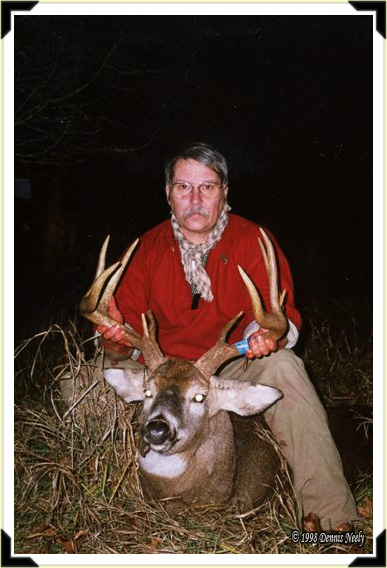
A traditional woodsman holding a long-tined 9-point buck.

The buck stepped out to the edge of the big swamp with five minutes of shooting time left. He flung his head back and scratched his upper shoulder with his long-tined antlers. The turtle sight held steady. Old Northwest Territory, three ridges east of the River Raisin, mid-1790s.

Posted in Deer Hunts, Snapshot Saturday | Tagged , , , , , , , , , , , | Comments Off on “A Fine 9-Point Buck”

The Northwest Gun was Useless

A green leaf fell from a dried nettle stalk. Seven leaves remained, drooping from a tawny stem adorned with brown globs of seeds. Some stalks held more leaves, others less. Counting staved off the damp November cold that Wednesday morning, three ridges east of the headwaters of the River Raisin, in the Year of our Lord, 1792.

“…it is time to move along,” the brass lead holder scribbled on the folded parchment page. “I am cold. My body aches from sitting still. Will stalk the lower deer trail north, with the wind at my back…”

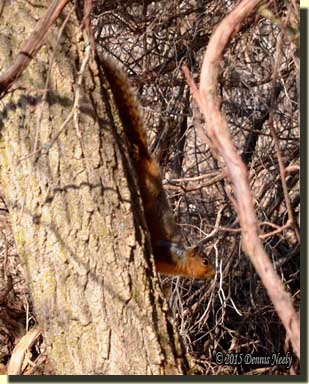
A fox squirrel stretches out on a tree trunk.About an hour slipped by. As I leaned against a red oak a fox squirrel scurried down a boxelder tree, ten paces distant. Once on the ground, the bushy-tailed tenant of the forest rummaged about in the leaves, oblivious that danger stood so near. It dug in the duff; leaves and dirt flew. It turned to its right, then burrowed deep in the leaves.

Two bounds brought the squirrel closer. It searched with a vengeance, then emerged with an acorn clutched in its paws. The fox squirrel sat on its haunches with its tail curled up along its spine. Its whiskers twitched as it cut on the acorn. I waited, content to see if I, too, was a true tenant of the forest.

A ways beyond, in a cluster of poplar trees, I decided to sit a spell. My left moccasin cleared an earthen nest in the leaves. I knelt in the shadows, and pulled the blanket roll, bound by a leather portage collar, over my head and placed it in the nest. The air smelled of fresh-turned earth and wet, moldy oak leaves. I sat cross-legged with my back against the biggest poplar, half-hidden behind a large oak limb that once crashed down between the two greenish-grey trunks in front of me.

In a while, a mature doe meandered along the upper trail, north to south with the wind at her nose. She was about even with the poplars when I saw a long white tine on her back trail. The Northwest gun’s muzzle eased up when she looked away. The downed limb blocked her view as I lifted the frizzen to check the smoothbore’s prime.

Nose down, forsaking all others, the “Big 6” followed her scent. The buck was about four-and-a-half years old with thick antler beams extending beyond his ears. Similar bucks would sport nine or ten points at his age, but not this one. He was a balanced six-pointer with two long, heavy tines and five-inch brow tines, a magnificent specimen. Despite his antler count, he was a mature, dominant sire of the herd, a buck I had not seen since early October.

My thumb curled around the hammer’s jaw screw as the sharp English flint rose to attention. But as I removed my thumb it brushed the flint’s side. My heart sank. The flint’s outer edge skewed to the right. Out of instinct, I grasped the black beveled rock with my thumb and forefinger; it pulled free. The Northwest gun was useless. I had no choice but to sit and watch as the Big 6 sniffed south, not forty paces distant.

Learning to Manage a Flint Lock

Hunting with a smooth-bored flintlock is not without its challenges. The most often heard complaint is that a lock “klatched,” which translates to the lock failed to ignite the priming charge. The sound of a rock hitting steel without the resulting “Kla-whoosh BOOM!” is enough to coax one’s stomach into uncontrollable somersaults. If you’ve hunted with a flintlock for any amount of time, you know the feeling.

To add insult to injury, klatching is the inline salesperson’s dream, another reason to tout the “unreliability of an ancient arm.” But a klatch can be caused by a number of oversights from not keeping the flint’s leading edge sharp to a loose hammer/tumbler axle fit—and a host of other maladies betwixt and between.

When a guest at an outdoor show raises questions about the reliability of the flint ignition system, in most cases parroting the inline salesperson’s litany of tribulations, my usual response is: “A flint lock requires proper care and management. If the Northwest gun fails to fire, the fault is mine for not managing the ignition system properly.”

Pa Keeler helped me some when “Old Turkey Feathers” was new, but I “didn’t want to bother him with stupid questions.” Not asking for help was a huge mistake, which is why I always tell anyone new to traditional black powder hunting to “find a mentor and ask questions, no matter how silly they seem.”

In my limited muzzleloading experience, I never had problems with the musket cap on the Zouave rifle going off. I assumed I should get similar results from a brand new flint lock. When I didn’t, I kept to myself, resigned to learn to manage the Northwest gun’s lock through trial and error—kind reader, the emphasis was mostly on error, peppered with a healthy dash of poor judgement. Looking back, I didn’t want to admit that I was having problems. To me, it was a sign of a basic failure in my hunting/shooting abilities, and I couldn’t bear to hear myself say “I can’t do this.”

To be fair, part of the problem was mechanical. After all, a flint lock is a somewhat complicated machine, and not all klatches are due to operator error. For example, the first half dozen outings the smoothbore klatched more than it fired—at first once or twice, but the frequency of misfires grew worse. My frustration level soared, but I tried to maintain a positive attitude as I eliminated possibilities. As a last resort, I spoke with a gunsmith at the parts kit supplier. On his advice I packed up the lock and shipped it off. As it turned out, the frizzen was soft.

To a large extent, the re-hardened frizzen pushed me over that hurdle and got me back on the trail to yesteryear. I downed several ring-necked pheasants, took some squirrels and brought a rabbit or two to the pot. But I still klatched more than I thought proper.

Securing the English Flint

In the early years, I cut a stiff leather pad—the “clam shape” that fits the contours of the upper and lower jaws—and used it to secure the flint. But the Northwest gun’s lock is large and takes an inch-and-an-eighth flint, plus the mainspring is heavy and pounds the rock hard against the frizzen. The flint’s size coupled with the mainspring’s power did not bode well for holding a flint solid in the hammer’s jaws—and that was the next woodland classroom lesson.

I tried softening the cowhide with neatsfoot oil, experimented with elk, moose and deer hide, and hammered a lead round ball flat, but nothing worked with any consistency. At the worst possible moment, like when the Big 6 sniffed after that doe, the flint would be loose, or go flying when the trigger eased the sear from the tumbler notch.

A sharp English flint wrapped twice with buckskin.Then at a gun show I saw several original Northwest trade guns on display. One had the flint wrapped in old buckskin, running side to side. The gentleman said he asked about the flint’s unusual wrapping method. The family that owned the smoothbore told him it was always that way, and to the best of their knowledge that was how their ancestor hunted with the gun.

That evening I cut a deerskin strip and wrapped the flint in the same manner, using two layers top and bottom. I tried and tried to dislodge the stone, but could not; I broke a flint tapping on it with a brass hammer. In the weeks and months that followed, the English flint never came loose once.

A couple years later I read Charles E. Hanson, Jr.’s “Smoothbores on the Frontier” in The Book of Buckskinning IV. Most of the guns picture had no flints in the jaws, but then I turned a page and staring square on was a later model Northwest trade gun with the flint wrapped side-to-side (Scurlock, vol. IV, pg. 116).

The vast majority of late-18th-century documentation, surviving smoothbores and paintings and illustrations favors the clam-shape, leather flint pad. Each smoothbore is different, which is both a curse and a blessing, but in the case of “Old Turkey Feathers” that style flint pad proved unreliable. Thankfully, an unknown hunter hero from long ago directed me to an alternative solution, one that has served me well for three decades of gallivanting about the forest and never rendered the Northwest gun useless.

Give traditional black powder hunting a try, be safe and may God bless you.

Posted in Deer Hunts, Muzzleloaders | Tagged , , , , , , , , , , , , | 4 Comments

“A First Wild Turkey”

“Snapshot Saturday”

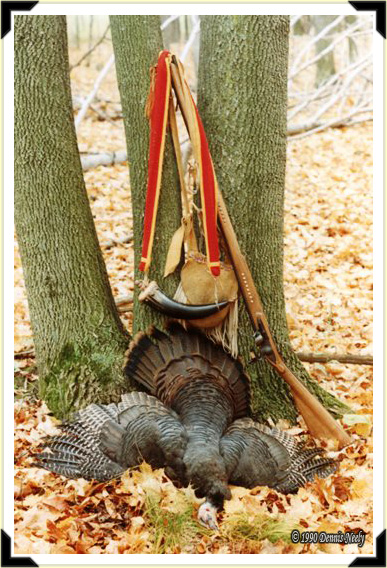
A wild turkey hen laid out in front of a forked maple tree.

A first wild turkey hen, a first shot pouch, a first powder horn and an as yet unnamed Northwest trade gun. At the muzzle blast the flock dispersed in all directions. Bronze feathers floated in the air, and as I ran to the downed fowl I thought “Old Turkey Feathers” fit the smooth-bored flintlock. Old Northwest Territory, 1790.

Posted in Snapshot Saturday, Turkey Hunts | Tagged , , , , , , , , , , , , , | Comments Off on “A First Wild Turkey”

An Endless Journey to Eternity

Two hard rains swelled the River Raisin. A humble woodsman stood on the first knoll to the east of the lily pad flats. Bright, mid-morning sunlight turned the coffee-brown waters a stunning azure blue. A solitary white swan paddled against the current. Overhead, a cold, northwest wind whipped the budding treetops. Mouse-ear-size leaves dotted the autumn olive branches, and in the bottoms, ankle-high skunk cabbages offered the only hint of late April’s greening.

Called a "Widow Maker," the upper part of a dead trunk hangs in a maple tree.With reluctance, buffalo-hide moccasins turned away from the river and stalked across the opening where a canoe-tarp lean-to offered refuge a dozen Octobers before. At the base of the hill, the wind gusted with a noticeable rush, almost moaning. A dead oak twig cartwheeled earthward with a faint clatter. Back behind, at the edge of the bottoms, the barkless, upper half of a keg-sized maple trunk, a ‘widow maker’ as some call it, hung suspended in a stouter sibling as it had for the last five or so winters.

Farther east my moccasins paused beside a shag-bark hickory tree. A fine buck fell to “Old Turkey Feathers,” thirty paces south, twenty-plus seasons ago. Straight ahead a ten-pointer provided winter sustenance, and just to the right of that a young buck parlayed with the death messenger. To the northeast a long-bearded gobbler came home for supper and just over the hill the death bees swarmed about an unsuspecting wild turkey in the midst of a sudden October thunderstorm.

The air smelled damp, plain and ordinary. White clouds moved with haste, now and again blocking the golden orb and plunging the forest into a foreboding, dusk-like shadow. A hearty dose of recollections spiced my thoughts on that blustery morn, in the Year of our Lord, 1795.

Overcome with an aimless wander, my moccasins made their way around the huckleberry swamp, through the black locust stand and up the next rise. Nine cobblestones, gathered with some effort, rested in a neat pile beneath a modest red oak. A dead limb dislodged by a violent rainstorm the summer prior lay across the site of long-gone canoe-tarp camp.

I leaned against the oak, then thought back to the warm afternoon in late September spent constructing that fall hunting camp. I remembered looking up into the trees to make sure no widow makers lurked. The branch was not dead then, but times change and life in the forest progresses along on its endless journey to eternity.

Recollecting the Past

Sometimes unusual 21st-century circumstances facilitate 18th-century time travels. Last week I spent a morning rummaging through three of my earliest photo albums, searching for a specific image. As the pages flipped one after the other, I couldn’t help but pause now and again to relive some of those first traditional black powder hunting adventures.

A couple of the pictures kept eating at me, so later that evening I pulled out one album in particular and took a closer look. What caught my eye was the grey felt top hat I use to wear. That top hat was a Christmas gift, back in the early 1980s. In a passing conversation I had mentioned that I had found several images of fur trade clerks wearing top hats and my brother acted on my comments. The following winter I added a dark brown buckskin hat band, adorned with a seed-bead, Ojibwe-style floral design.

Back then I wasn’t paying much attention to the “who,” “when” and “where” of living history: the life station of the person I wished to emulate, matching the time period of the images to the 1790s, or focusing on the lower Great Lakes region. Spurred on by romantic thoughts after missing a six-point buck with a Civil War reproduction Zouave rifle, my only desire was to try to discover what it was really like to hunt in a late-18th-century manner.

Until I began reading Mark Baker’s column, “A Pilgrim’s Journey,” in MUZZLELOADER Magazine in the late 1980s, I had no idea what I was trying to accomplish had a name: “living history.” The Northwest trade gun didn’t have a name then, either.

On a couple of occasions, in the heat of a deer chase, I realized my mind had slipped into another century. Again, it was Mark Baker’s writings about Professor Jay Anderson’s theories on “time traveling” that introduced me to the idea of seeking out “pristine historical moments:” fleeting points in time when a traditional woodsman’s experiences match those contained in the journal of a long-dead hunter hero.

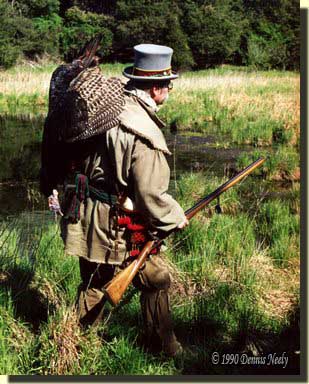
A traditional woodsman with a wild turkey gobbler.By the early 1990s I began re-examining the historical basis behind my trading post hunter persona. Following the example set forth in “A Pilgrim’s Journey,” everything came under scrutiny, including the grey felt top hat. By then, the top hat was a loyal and welcomed companion for most of my sojourns; it appeared in many photographs. As an aside, I feel compelled to note that wearing hunter orange was not a regulation when all this soul searching took place.

But the primary documentation and late-18th-century illustrations and paintings did not corroborate the hat’s style—at best attributed to the late 1820s. Disappointed, I set the hat on a shelf where it now collects dust. I still wore an orange wool tuque in the winter, but I switched to wearing head scarves or no hat at all.

When I found the image I was looking for, I saw the top hat first off. My stomach rolled; my heart pounded; and I felt ashamed. I looked for another image, one without the hat, but there were none—deep down I knew that. In the moments that followed, I vacillated on whether or not to include the image with the article, but the grey top hat with the beaded band is an integral part of the story of my alter ego’s journey back to the 1790s.

Traditional black powder hunting is a learning experience. In the early years, with flintlock in hand and outfitted in “questionable” historical garb, I just wanted to hunt like our ancestors had. Guided by my “best understanding” of the past, I put food on the table in what I thought was a period-correct manner.

A decade later, that best understanding had changed; I put food on the table, and did so in what I thought was a period-correct manner. Another decade passed, and then another…I put food on the table, and did so adhering to my best understanding of what hunting in the 1790s was all about.

In another decade, my traditional hunts will seem like so much foolishness, just as those a decade ago appear today. But this is the wondrous attraction of traditional black powder hunting, a life-long learning experience, an endless journey to eternity.

Give traditional black powder hunting a try, be safe and may God bless you.

Posted in Scouts | Tagged , , , , , , , , , , , | 1 Comment

“The Winter Lean-to”

“Snapshot Saturday”

A one woodsman winter lean-to after a fresh snowfall.

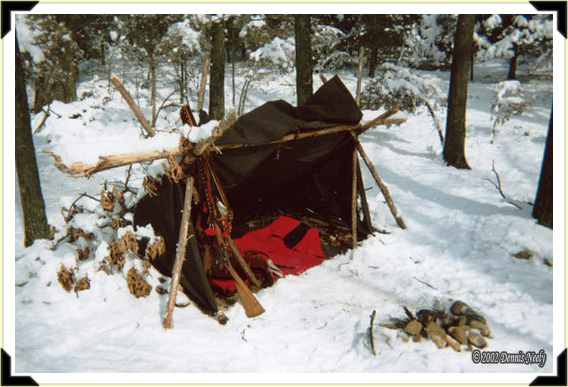
A morning fire takes hold after a fresh snowfall. This was the first winter for the ‘huckleberry swamp camp,’ and the tiny abode afforded many valuable lessons in the wilderness classroom. Old Northwest Territory, one hill east of the River Raisin, 1790s.

Posted in Hunting Camps, Snapshot Saturday | Tagged , , , , , , , , , , , , , | Comments Off on “The Winter Lean-to”

The Big Swamp Grew Quiet…

A close approach proved impossible. The two toms roosted high up in an oak tree that leaned north on the first island. The pair walked onto the wooded mound the evening before. Dawn’s greyness, accentuated by a thick cloud cover and a thin, damp fog, gripped the fen and the surrounding forest.
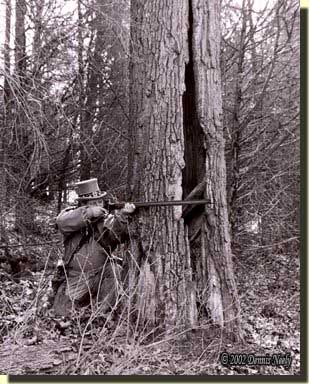
A traditional woodsman behind a lightning-split red oak tree.

The old red oak has always been a favorite lair. In the days before Michigan required hunter orange, I thought the gray top hat with the Ojibwe-style beaded band was period-correct. How times have changed…

Soft elk moccasins, new at the time, whispered down the slope. Near the base of the hill on the east side of the big swamp a red oak skeleton stood. The tree is still a favored haunt. The topless monarch is hollow. The west face carries a nasty lightning split. Copper-colored rotted wood, half-hidden under raccoon dung, rests knee-deep in the shell. It was mid-April, in the Year of our Lord, 1790.

Around the bend, a hushed “putt” broke the morning’s serenity. A stern-sounding “arrk” echoed out over the dense cattail patch. A different hen started a long yelp. “Gob-obl-obl-obl-obl-obl! Gob-obl-obl-obl-obl-obl!” Both toms cut her off after the second cluck. Much to my pleasure, the wild turkeys chatted for the next twenty minutes.

I tried to listen to the hens, memorizing their cadence and counting the number of clucks. When a yelp began, I sucked air as if a wing-bone call rested between my lips. I dared not attempt to respond, first because the spring turkey season had not yet begun, and second because my laments would be lost is such a furor. On that morn I did not want to be deemed another sex-crazed hen by a wary gobbler—a humble woodsman has standards, you know.

Instead, I sat on the cleared ground behind that oak tree with the prickly thicket to my right, content to watch and listen and learn. Toward the end of the rants, one of the two gobblers on the island switched tone. He gave a startled, shortened gobble, then some sharp putts and a popping-like cluck.

Four different sets of big wings flapped on the far ridge. A cluck here and a distinctive putt there told that the birds were moving fast to the south. To my right, still roosted, a hen uttered a six-note yelp. A different bird answered with ten clucks, rapid and agitated. The first hen mimicked the long diatribe; mixed in the middle of her sentence I thought I heard a coyote’s bark. The second yip left no doubt. The toms gave a double gobble and the hens began putting.

It was then that I wished the Northwest gun that rested across my lap held a hearty charge. A couple of minutes passed, then two hens flew to the right of my lair, coasted over the island and landed on the ridge crest. The toms took flight and joined the hens. Then the big swamp grew quiet.

Traditional Hunting’s Excellent Safety Record

“Favorite turkey load” is always a popular discussion point on the eve of spring turkey season. When the topic comes up, I never cease to be amazed at the lack of attention to detail or the willingness by some traditional black powder hunters to offer “tried and true” loading recommendations, especially when it comes to powder charges.

Traditional black powder hunting and the black powder shooting sports have an outstanding safety record—the result of decades of hard work and education. A large portion of the credit for that accomplishment goes to the National Muzzle Loading Rifle Association for their steady vigilance in promoting the safe and proper use of black powder as a propellant. Most of the muzzleloading clubs around the country, the world for that matter, adhere to the NMLRA’s safety rules and regulations.

A second excellent source of information is The Complete Black Powder Handbook by Sam Fadala. I believe the 5th Edition is the current work, published in 2006. There are other reputable sources, but these are the first I go to when a question arises.

As living historians, we must all recognize our chosen time period came with no disclaimers, no guarantees and no “do-overs.” Each individual was responsible for his or her own actions—along with the “period-correct” consequences that accompany not paying attention to important details.

The same holds true for the handling of the arms associated with a given time period, station in life and geographical location—the “who,” “when” and “where” of living history. The individual is responsible for knowing and understanding his or her arm and the safe handling, loading and shooting procedures associated with that specific shooting iron. And coupled with that understanding is the implied responsibility to practice at the shooting range until a minimum level of competency is acquired to safely use the gun in the heart-pounding adrenalin rush of an actual history-based hunting situation.
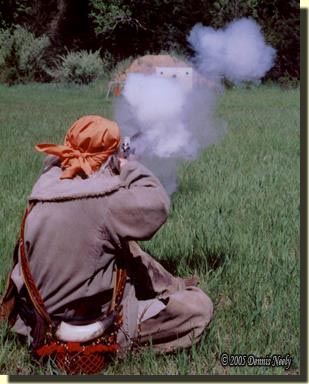
A traditional woodsman shooting from the sitting position.When talking about a favorite load, I try to preface my comments with “this is what I have found works best in ‘Old Turkey Feathers,’” or whatever arm I am referring to. That caveat is based on actual research of proper load parameters, extensive range testing and years of hands-on experience in the field, all with safe operation as the primary consideration for establishing an efficient hunting-load choice.

In addition, I have a number of friends with a solid knowledge of modern ballistic science. When I have a specific question, I go to them for an explanation of the factors that are acting on whatever problem I am studying.

Most of my ballistic knowledge is based on actual hunting situations, because my concern is with achieving an acceptable level of accuracy that assures a clean and humane kill. Thus the bulk of my attention focuses on modest loads that produce a tight group or pattern and sufficient projectile penetration to get the job done, quick and neat.

FFg vs. FFFg Granulation Breech Pressures

The arms we use for our traditional black powder hunting adventures are designed to use only black powder or an approved black powder substitute, such as Pyrodex®. Never use modern smokeless powders in any rifle, shotgun or pistol designed for black powder.

Just because these muzzleloaders and black powder cartridge arms are reproductions of what some people characterize as “ancient technology” does not mean they are simple. They are not. There is a minimum level of care and concern that must accompany the safe use and handling of the guns from yesteryear.

When I first started down this path, the rule of thumb was that one used FFFg (refered to as “3Fg”) black powder in a gun of .50-caliber and smaller and FFg in larger bores. In recent years, this principle has fallen by the wayside, and today a majority of black powder shooters use 3Fg in their smoothbores, pistols and rifles, because of its cleaner burning properties that result in less fouling.

The “Fg” designation refers to the size of the black powder granules and is meant to maintain a level of uniformity from batch to batch and manufacturer to manufacturer. For common granulations, Fg is the coarsest and 4Fg is the finest, although finer priming powder granulations are sometimes available.

The chemical composition is the same regardless of granule size, but the burning rate and resulting breech pressure increases as the kernel size gets smaller. The burn rate is due to the exposed surface area: a granule of Fg takes longer to burn and produces less pressure than a kernel of 3Fg, for example. Due to its small size and high pressure, FFFFg, or 4Fg, powder is never used as a propellant, only as a priming powder.

Because each granulation produces a different breech pressure, any black powder load discussion that includes mention of a powder charge must specify the granulation used. But in the last couple of years, “favorite load discussions,” especially on Internet forums, chats and web postings, have started ignoring the difference between the two common granulations of black powder used for traditional hunting: 2Fg and 3Fg. This is a huge mistake with the potential for creating life and death consequences!

The comparison between the two granulations most often quoted is that 3Fg produces 25-percent more breech pressure than the equivalent charge of 2Fg. I have asked, but never been shown test data to support or refute this percentage, but 25-percent seems to be the accepted differential. If you know of a documented source, please share it.

The importance of this comparison is apparent when switching from 2Fg to 3Fg. An established powder charge of 85 grains of 2Fg must be adjusted to compensate for the 25-percent  increase when converting to 3Fg, or to 68 grains of 3Fg. To do so, the grain measure of 2Fg, 85 grains, is divided by 1.25; and to convert a 3Fg charge to a 2Fg charge, the 3Fg grain measure is multiplied by 1.25. But when making any conversion from one granulation to the other, one must realize that range practice is required to produce the similar results.

In addition, when loading shot the standard axiom is to load an equal volume of shot to an equal volume of black powder using the same measure. The new 68 grain charge of 3Fg requires a smaller volume measure than the 85 grain load of 2Fg, which unbalances the overall shot column. At the patterning board, I found that a measure and a third produced the desired results. And because bismuth shot is lighter than lead, I had to make some adjustments in my waterfowl load, as well.

This time of year, when folks tend to share “favorite turkey loads,” make sure the individual specifies which black powder granulation he or she is using, and remember to do the same when you enter the discussion. And beyond that, understand that the stated load is for someone else’s black powder arm and not yours. Temper their experience with diligent range experimentation and keep safety to the forefront of your thoughts at all times.

Give traditional black powder hunting a try, be safe and may God bless you.
Posted in Safety, Turkey Hunts | Tagged , , , , , , , , , , , , | Comments Off on The Big Swamp Grew Quiet…

“Laying the Ridge Pole”

“Snapshot Saturday”

A traditional woodsman lays a red cedar ridge pole for a hunting camp lean-to.

Thoughts of the upcoming fall hunting seasons filled the traditional woodsman’s head as the longest red-cedar pole dropped in place on the two tripods. In days to come, in story after story, the tiny lean-to shelter would be referred to as “the huckleberry swamp campsite” in the hunter’s journal. Old Northwest Territory, one hill east of the River Raisin’s headwaters, 1790.

Posted in Hunting Camps, Snapshot Saturday, Wilderness Classroom | Tagged , , , , , , , , , , , , | Comments Off on “Laying the Ridge Pole”

Bits and Pieces, Here and There

A brilliant sun did little to warm the cedar grove. Mid-morning rays created shoulder-wide golden paths, east to west, up and down the gentle slope. I paused beside a purplish-black-barked wild cherry tree. My gaze danced upon the greyish, winter-weathered oak leaves that carpeted the ground. The air smelled empty with the occasional hint of rotting deer pellets. I felt a shivery chill. I walked on.

Somewhere ahead a cardinal called, “Whit, whit, tsu, tsu, tsu, tsu, tsu…” Behind, one answered in like tones. The notes sounded crisp and clean and spring like. Winter moccasins followed an earthen trail to the west edge of the grove. My eyes continued the search out into the little prairie, but saw nothing. I turned back, then squinted as I crossed through a sun spear. About then a single gobble, quite a distance away, broke the monotony of my quest.

A ways on, fresh turkey droppings encircled the base of a modest maple tree. My course zigged and zagged through the grove’s lower half as if seeking an elusive blood trail. Just beyond a tangle of fallen cedar tree skeletons, forty-some paces distant, an odd, bluish colored object, bathed in sunlight, caught my attention. I turned away and dipped to the prairie’s edge again, but alas, in vain.

My blackish moccasins angled uphill to the northeast. At twenty paces I recognized the intrusive object. Without stopping I grabbed it with my bare left hand, wadded it up and stuffed it into my linen shirt, uttering a whispered snarl.

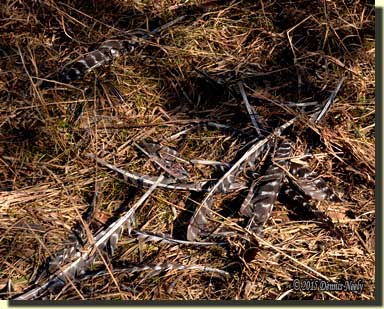
Turkey wing feathers scattered on the ground.“Gob-obl-obl-obl-obl-obl!”Again the tom warbled, but farther away, which was a relief as I did not wish a chance meeting.

I next came upon a small grassy clearing. To the east of a rotund cedar tree covered with grape vines, I spotted bits of white strewn where they did not belong. I looked about as I walked straight for the sun-speckled patch. Again I grumbled, for I saw what I hoped I would not see: wild turkey wing feathers strewn about the ground. Two more feather piles to the east told the gruesome story. From the feathers’ shape and size, it was a young bird. Such is the way of the forest.

An Hour Here, An Hour There

That Saturday morning’s jaunt centered on hunting for shed antlers. It seems I found everything but an antler: a handful of wind-driven plastic grocery bags, a broken-over white ash tree, some new-fallen cedar trees, the green and blue shingle wrapper and the turkey feathers. That is the nature of these short woodland adventures.

After a long, hard winter I look forward to hunting shed antlers, if for no other reason than to just get reacquainted with the North-Forty. It was cold that morning, about eighteen degrees when I started out. I stretched the allotted hour into two and still made it back home in time for a special session of my Online Anishinaabemowin webinar. But I made it out, and that was a great victory!

The transition from winter to spring carries mixed blessings. Turkey season is not that far off, and there is still work left over from winter. Thus, the search for sheds will continue in the midst of wrapping up winter projects, time permitting.

Circumstances beyond my control took up the greater share of February. A colder-than-normal March kept me from the North-Forty more than I like, leaving me with a general feeling that my time is not my own right now. This week’s cold rains and sloppy mud did little to help matters. But again, this is the way of the forest.

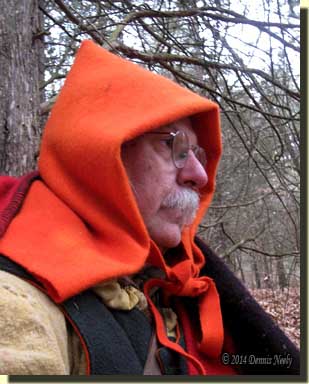
A traditional woodsman wearing a hunter-orange Ojibwe-style hood.In times like these, I find it best to stop, sit with my back against a stout oak tree, take a deep breath and count my blessings. With interruptions, I got a hand-sized patch sewn on the trading-post-hunter’s knee breeches. It took four range sessions, but I made some new discoveries when I experimented with the buck and ball loads.

In late December I started hunting with a wool Ojibwe-style hood, even though I ripped the stitching out, cut it down, then re-sewed it four times. The stated size of an existing museum example did now allow sufficient peripheral vision to suit my hunting style. Now I just need to add the beads around the face opening and two rows of ribbon. For me, projects like the Ojibwe hood are spread over many sittings, an hour here and an hour there.

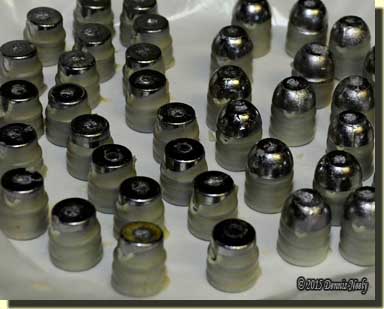
I’ve yet to fire the 2-band Enfield Musketoon, but I cast some round balls, a few “wad cutters” and an equal amount of Minie balls on the only “warm” afternoon in February. Another day I got them weighed and sorted, and then two weeks later I experimented with a forty-year-old formula for skirt lubricant. I have the initial powder charges researched and targets printed. I just need the rain to stop and find an hour…

Lube covered "wad cutters" and Minie balls.I lost some red cedar trees this winter, victims of the power pole replacement project. Several are large enough to supply logs for the lean-to station camp project. The trade ax is sharp and the tomahawk ready to start “limbing.” I just can’t get to them because of the mud. My shoulders and back are the governing factors on that task—an hour is about all they will take.

Oh, and I need to find time to make flashcards to help Msko-waagosh learn a few rudimentary words of Anishinaabemowin—but that is a topic best addressed with another posting. As I sat against the oak, surrounded by a foggy mist, I thought through the little victories. I have accomplished a lot since last fall, despite all the setbacks.

Traditional black powder hunting is not all about chases and simple pursuits, rather, this pastime centers on enjoying the entire living history experience from researching, to reproducing, to hands-on experimenting in the wilderness classroom. To be fair, I am my own worst enemy, because I shift priorities mid-project, or as a crisis arises, instead of finishing one task and then starting the next.

A good example is the Musketoon. After three years I am just starting to get a sense of who Msko-waagosh really is, and I don’t need any intrusions slowing the learning process. Plus I’ve come to the conclusion that the Red Fox needs a Northwest gun that is his alone, which will take a passel of hours to complete.

But after thirty years of dreaming, the opportunity to purchase the Civil War rifle presented itself and I acted. In looking back over the winter, about a quarter of the hours were spent on researching the new musket and making the necessary preparations to shoot the rifle, weather permitting. And of course I have to go hunting with it in a traditional manner, which will require a basic set of 1870s era Michigan settler’s duds…

Well an hour just opened up in this afternoon’s schedule. The rain started pattering on the window so it looks like I won’t make it out shed hunting today. But not to worry, I have a workbench that needs attention—I began clearing it off two weekends ago, or was it three??

Find an hour here and there, be safe and may God bless you.
Posted in Scouts, Wilderness Classroom | Tagged , , , , , , , , , , , , | 2 Comments