A Time Traveler of Sorts

A hint of brown moved behind a red cedar tree. Brittle leaves clattered overhead. Arteries throbbed. A cool breeze carried the aroma of rotting duff as doubt festered. A dark foreleg stepped, then paused. Heartbeats stacked up like wood corded for a long winter. Another leg flexed, black with wet mucky socks that stretched above the knee. The deer dropped its head; petite, creamy tines followed.

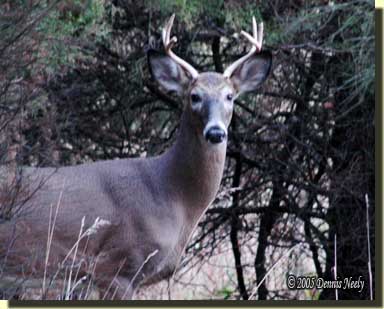
The young buck sniffed the earthen trail. His nose twitched, swinging side to side, sorting scents. After the next hoof-fall, the cautious whitetail raised his head a bit and looked about. His pink tongue licked his snout. The deer melted into a tangle of leafy autumn olive bushes, then continued his still-hunt, not 30 paces distant. I counted six points with no brow tines.

Beyond the buck, three squeaky clucks told of a wild turkey wandering downhill in search of an evening roost. Intrigue grew; a bigger, broader, fuller-bodied, elusive buck sometimes trailed this little one. As it so often does, my right thumb fiddled with the flintlock’s jaw screw as I watched where the small stag came from, not where it was going.

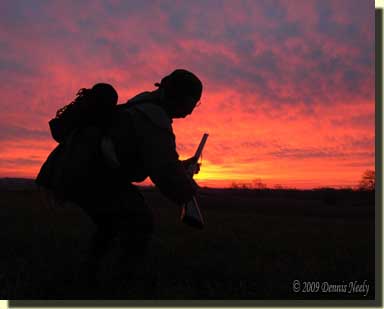
A dozen steps downhill from the main doe trail the six-pointer turned about quick, then gazed to the north. The bigger buck preferred to skulk about with the wind at his rump. On that evening in 1792, an approach from the north seemed probable, I reasoned. I eased my left leg up, rested my elbow on that knee and settled the Northwest gun against my shoulder.
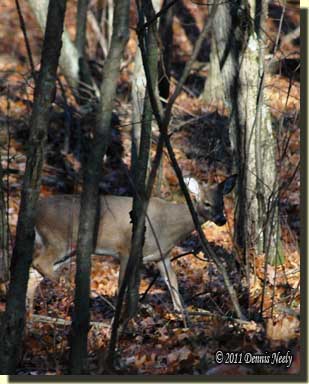
A yearling doe wanders on a lower trail.The turtle sight stalked the young stag back uphill. It stopped and sniffed again at the doe trail, sneaking a handful of quick glances in the direction where I hoped the big buck stood. After a few minutes, a yearling doe scampered past the six-pointer on the downhill side. To my surprised, the buck paid no attention to her. A second deer followed, and again the little stag ignored her.

Far off to the east a large flock of geese took wing, or so it sounded. The air filled with goose music; the does’ footfalls jostled leaves about, but I never heard them over the thunderous ke-honking.  As the geese crossed the River Raisin the young buck flicked his tail twice, then walked off to the north. I waited until dark, but the sagacious buck never arrived.

“Why are you dressed like an Elf?”

The navy-blue plastic chair squeaked when I shifted my weight. A gray-haired lady of slight build took a seat in the library’s auditorium, intentionally leaving an empty chair between us. We exchanged nods, and I said, “Good evening.” She gave me a strange look as she removed her calf-length, beige wool coat, then responded with a hesitant smile.

The moderator for the Carnegie Library’s reading night adjusted the podium and tapped the microphone. As folks filed in, curiosity got the best of the lady. She turned to me and asked, “Why are you dressed like an elf? Are you reading a children’s book tonight?”

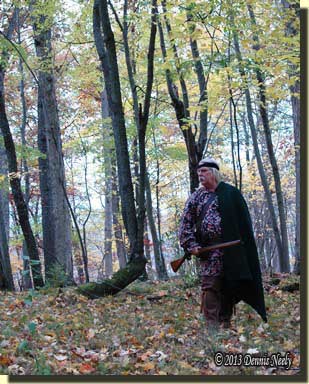
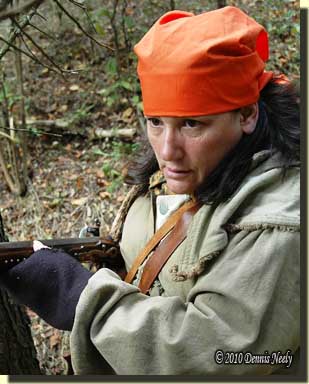
“No,” I said, trying to stifle a laugh, “I’m a living historian. These are the clothes of an 18th-century woodsman. I write about the Old Northwest Territory, the River Raisin and hunting in the 1790s. I’m a time traveler of sorts, and I’ll be reading the beginning of a true adventure set in 1794.”

The lady raised her eyebrows when I mentioned “time traveler of sorts,” but I overlooked her reaction and went about describing what I was wearing and how each garment was documented through the writings of a favorite hunter hero, museum artifacts or paintings and illustrations from my chosen time period.

That’s not the first time that my mention of time travel has drawn such a response; I’m sure it won’t be the last. I have even been rebuked by other traditional hunters for being a “bit over the top” with such comments.

I read just before the intermission, and I never made it to the refreshment table. My new-found friend and two other guests had never met a living historian, much less a traditional woodsman, and the questions gushed forth. After explaining some of the passage that I read in the context of 18th-century life, the conversation turned to the basics of this glorious hobby.

“Sagacity” and Time Travel

During the second intermission the lady zeroed in on time traveling, what I meant and how it worked. I spoke of the buck that I chased for three seasons and used the words “superior sagacity” when describing that stag. I told of how at the strangest times in the pursuit I felt like I was living a portion of a passage in the journal of a long-dead author, and how a living historian’s version of time travel involves creating a bond with someone who lived long ago.

A look of quiet contemplation overtook the lady when I said “superior sagacity.” After a pause, she shared how her father used that word and how “you took me back to when I was a child and I remembered my father and our old house.” I didn’t miss the opportunity to tell her, “You just time traveled.”
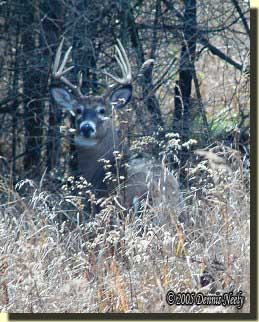
A 10-point buck looked straight at me.I explained that I couldn’t quote the entire passage from Joseph Doddridge verbatim, but that the reverend’s use of “superior sagacity” when describing a wily buck came to mind more than once during that fall’s hunts. For me, superior sagacity acts like a mental trigger, a sudden poof of the sorcerer’s smoke that sends the historical me hurtling back through time’s portal. Even the sound of the words as they trip from the tongue possesses a magical effect.

“Often some old buck, by the means of his superior sagacity and watchfulness, saved his little gang from the hunter’s skill by giving timely notice of his approach. The cunning of the hunter and that of the old buck were staked against each other, and it frequently happened that at the conclusion of the hunting season the old fellow was left free, [an] uninjured tenant of his forest…” (Doddridge, 101)

In the short time that we had, I touched on the writings of Professor Jay Anderson and how he spoke of experiencing the “texture” of life in the past, which meant for me to learn what it felt like to live in the 1790s and what it felt like to hunt in that era.

I went on to say that Anderson used the analogy of present-day folks drifting in a boat on a winding river, of how the past was hidden from us just around the bend. He pointed out that the trick was to figure out how to beach the boat and walk around the river’s bend, to experience a breakthrough within one’s mind that frees us from the present so we can explore the past.

“Can you smell the room where your father was? Feel the carpet or the weave of his coat? Do you remember what his voice sounded like?” I asked. “That is the texture of the past that we seek.”

“I remember his cologne, and the carpet was wool and very scratchy. It happened so fast, the memory only lasted for a second or so,” she said, clearly trying to bring back that moment.

“Welcome to time traveling,” I said as the moderator called us back to our seats. I had just enough time to tell her that living historians chase after these pristine moments, points in time when the past seems real, if only for a few heartbeats.

Give traditional black powder hunting a try, be safe and may God bless you.
Posted in Deer Hunts, Living History | Tagged , , , , , , , , , , | Comments Off on A Time Traveler of Sorts

A Hallowed Prize

Lavender clouds reflected off still water. At the small puddle’s far edge, the image of four poplar trees rooted in tawny canary grass mirrored wilderness reality. Beyond, a young deer slipped through the maple saplings, paused at the wild apple tree, then wandered off into the thicket.

Close up, a dew drop raced down a bent sedge grass blade, hesitated at the dried and shriveled point, then fell, leaving another wet spot on my buckskin leggin. I moved my forearm so the folds of my canvas frock covered the Northwest gun’s lock; my hips scooched to the right on my blanket roll to ease the tingling sensation in my thigh. I grew impatient. I don’t recall what year it was, only traveling back to yesteryear.

A wedge of four mallards winged west, crossing over the watering hole on Shorty’s homestead. Not long after, a red-tailed hawk flapped from a tall hickory at the edge of Shorty’s woodlot. It glided over the thicket with the browsing deer, then swooped up into a stately oak that stood alone on the hilltop. Not one crow cawed or chased the raptor.

On that mid-October morn, the warm, moist air smelled plain and ordinary, certainly not fall-like. Sparrows flitted about, along with an occasional red-winged blackbird and a robin or two, but all remained silent. The usual east to west flights of puddle ducks never materialized, but I sat still, clinging more to hope than reality.

A deep orange flooded the eastern horizon. Not long after, the sun’s golden yellow peeked over the tree line, forcing a return trip to the 20th century. With the blanket roll slung over my shoulder, my elk moccasins backtracked on the slender doe trail that snaked through the canary and sedge grass, the trail I followed in night’s last breath of darkness.

A traditional hunter stalks through the swamp just after sunrise.The retreat from my lair was more of a hunched over still-hunt, rather than an outright walk to high ground and the wagon trail that led home. Over the years, a late-from-the-roost duck or two met the death bees along that trail, and despite the lack of ducks a shred of hope still existed.

Past the fallen oak, around the old box elder, I stopped and gazed east. I did not want to leave so I lingered a few minutes. Then a black dot darted side-to-side as if navigating the tall cottonwoods that ringed the modest pond on the neighbor’s farm. I dropped to both knees and pulled a clump of golden grass over my head and shoulders. The dot veered south, then turned to follow the thin swampy ribbon that led to my puddle. “A clean kill, or a clean miss. Your will, O Lord,” I whispered.

A Conversion to Bismuth No-Tox shot

Thirty some years ago, the versatility of a smooth-bored barrel tipped the scales when I weighed purchasing a rifle or a smoothbore kit. A Virginia fowler, Brown Bess, fusil de chasse and the Northwest gun were all in the running. After doing some research, checking local histories and purchasing a copy of The Northwest Gun by Charles E. Hanson Jr., I decided on a Northwest trade gun.

Like so many newcomers to traditional black powder hunting, my first priority was deer hunting. The learning curve for round balls proved a bit steep, until Pa Keeler helped me out. But I was a bird hunter, too, and once I had a grip on spitting out death spheres, I turned my attention to chasing small game, including waterfowl.

That was before non-toxic shot requirements, so I gained a quick education on proper loads of lead shot for everything from Canada geese to woodcock. In October, I especially loved hunting ducks each morning before work. Minutes were limited, but if I hurried back to the house, I could still make it to work with time to spare.

A large cattail swamp a mile or so to the east offered protection for the birds’ night roost. Just after first light, small wedges started appearing over the eastern tree line as mallards, wood ducks and a few teal winged west to spend the morning loafing and feeding on the big mill pond in town or the lakes beyond. Some would drop in to the string of puddles for a quick snack, and now and then, a bird landed on our dinner table.

The first year or two of the lead ban, muzzleloaders were exempted from the non-toxic shot rules. When inclusion came, there was no substitute for lead available that was suitable for the softer barrels of a front-loading smoothbore. I had no choice but give up waterfowl hunting.

Then one day I was talking with a fellow black powder bird hunter. He told me Bismuth No-Tox Shot had just been approved; he knew this because he tested the shot in his flint double guns for the Bismuth Shot Company. He gave me about a pound to try, and that fall found me pursuing waterfowl again. That last-minute wood duck succumbed to one of my first shots using Bismuth.

More than Chasing Whitetails

One side effect of Michigan’s muzzleloading deer season and dedicated black powder seasons across the country is the common misconception that muzzleloaders are “only for deer hunting.” The overwhelming emphasis on in-lines, high-powered scopes and long-range accuracy fuel this misunderstanding. We hear the “only for deer hunting” comment a lot at the outdoor shows and it offers us a chance to flip open the photo albums and show a variety of game taken with our beloved smoothbores.

The historical record bears out the versatility of the cylinder-bored tube. For example, in 1804 John Sayer engaged a native hunter by the name of Outarde to supply his trading post. Sayer’s brief journal entries include a number of instances where either Outarde or some of the other Native hunters supplied waterfowl to the trader:

“…my Hunter brot: the Meat of 2 Deers & 60 fine fat ducks.” (Birk, 37)

“…my Hunter & Pierro gave me 30 large Ducks.” (Ibid)

“…my Hunter brot 30 Ducks, 3 Geese. Pierro 18 Ducks…” (Ibid, 38)

The journals of other hunter heroes include passages that describe taking wild turkeys, rabbits, squirrels, raccoon, porcupine and a host of other small game, to say nothing of cranes, swans and a few other species that are no longer hunted, at least not in Michigan or the neighboring states.

But the proof lies in the doing, and that is the essence of traditional black powder hunting. If a traditional hunter thinks only in terms of deer hunting, he or she misses a tremendous opportunity to form a bond with the hunter heroes of old. Thinking beyond whitetails opens new avenues for re-living history in the wild, to say nothing of expanding the joyous exhilaration that accompanies any trip back in time.

The approaching wood duck held close to the center of the swamp. About 40 paces out, the colorful drake shied away from the puddle I sat beside that morning. If its course held true, I reckoned the duck would pass over my concealment. The sharp English flint clicked to attention. “Old Turkey Feathers’” muzzle inched skyward.

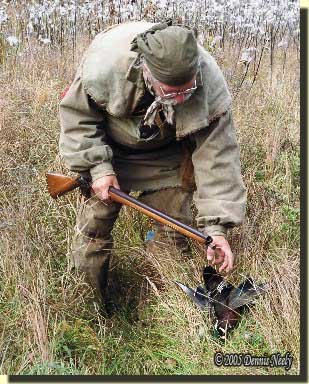
A traditional woodsman picks up a wood duck from the swamp grass.The Northwest gun’s flat, brass butt plate slammed into my shoulder as I rose up. The turtle sight clawed through the streaking fowl, through its green head and through its beak. The hammer lunged. Sparks flew.

“Kla-whoosh-BOOM!”

The trade gun’s muzzle raced on, leaving the rolling cloud of white smoke behind. The buttstock dropped from my shoulder. The wood duck cartwheeled earthward, then bounced twice in the short grass that grew on the high ground. That October morn ended differently than expected with a hallowed prize.

Try pursuing other game, be safe and may God bless you.

Posted in Duck hunts, Scenarios | Tagged , , , , , , , , , , | 2 Comments

Too Many Memories…

The brush camp needed work. The humble abode offered shelter for a starry night, but the cedar-bough covering lacked fullness and would never shed even the slightest of showers. The ridge pole and rafters held years of life; the grape vines that lashed the frame together would see the next spring. Weeds grew in the stone fire pit; what little kindling remained sat in a rotted, punky hump.

A blue jay sung a soft melody as my moccasins circled the camp on a calm afternoon in mid-October of 1798. After walking about, I pulled the blanket from my left shoulder, folded it square and dropped it beside the oak that supports the angled ridge pole. The tree’s heavy bark felt warm on my back. Green leaves rustled overhead; the air smelled of distant smoke. A fox squirrel chattered somewhere near the watery edge of the huckleberry swamp.

The old camp occupied my daydreams earlier in the day, and I considered reviving it for the fall hunts. Making it habitable again demanded at least an afternoon’s worth of labor, maybe more. My mind drifted to past times, to wild turkeys and white-tailed deer that returned with me to the brush shelter. I recalled the winter the ridge dislodged under the strain of a heavy, wet snow, and reminisced about rabbits, fox squirrels and one fat, fuzzy raccoon.

As I sat, I found myself feeling squeamish, like a stranger who had come upon someone else’s camp. In truth, all of those memories belonged to an 18th-century woodsman who supplied meat for a small North West Company trading house a ways down the River Raisin. The tiny brush camp did not fit, I did not fit. Simply put, that shelter held too many memories.

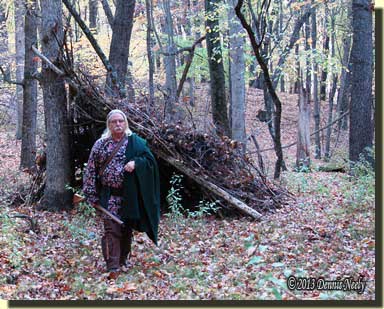
A traditional woodsman walking away from a brush shelter.I scrambled to my feet, adjusted the blanket over my shoulder and struck off to the east. In a short distance, my moccasins crossed the wagon trail, then chose the buck path that leads south. A woodpecker tapped on a dead oak limb at the bottom of the hill. I paused at a low-spreading juniper and took a seat. The hardwoods grew quiet and restful. I clucked once on the wing bone call and waited a spell.

In due time I began to still-hunt to a favored location overlooking the isthmus between the two halves of the nasty thicket, a place wild turkeys liked to pass on their way to the evening roost. A fox squirrel barked slow and steady, over the isthmus and up the knoll where I killed a fine buck a few Decembers ago. When I came to the spot, I pulled the blanket around my shoulders and sat hidden behind an oak with a huge broken limb that tented against its trunk.

A few minutes passed, then a turkey clucked soft and abrupt, maybe eighty yards to the south. My thumb pressed hard on the trade gun’s hammer. I turned a bit and squinted, enough to block my eyes from view, but not enough that I couldn’t watch the hillside. More minutes passed, then leaves rustled in the unmistakable rhythm of footfalls.

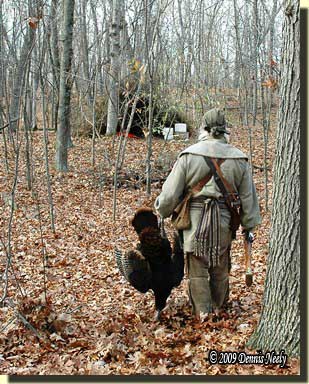
I came to realize the sounds were to my left, not straight ahead. With great care I eased about. Not forty paces distant, autumn olive leaves moved against the gentle breeze. The leaves bounced along the buck trail with a steady, plodding cadence. At a break between trees, a descent first-year buck, a five-pointer I think, stepped out. A heavy, forked branch from a fresh-rubbed autumn olive bush draped over his shoulders; I saw small twigs entwined in his left beam. The young stag wore his woodland mantle with an air of pride and a hint of arrogance, as if to say, “Don’t challenge me!”

Down the hill, at the isthmus’ mouth, a graceful spike shadowed the 5-pointer’s course. Geese ke-honked off to the east. The spike stood half-behind a good-sized oak, sniffing and watching. A turkey clucked again, but not much closer. Growing clouds dimmed the forest well before the sun set. Now and again, a whiff of wood smoke accented the growing drama. Two soft clucks seemed to answer the first. I turned back and squinted at the hillside, hoping for a chance.

The flap of big wings dashed those hopes. The little spike walked to the north and I don’t know where the five-pointer wandered off to. A whitetail snorted in the distance. Two trees behind me, a fox squirrel started into its end-of-day chatter. Another joined in, and in a few minutes my moccasins began the lonesome trek across time’s threshold.

A Fall Hunting Camp

It is almost impossible to pick up the narrative of an 18th-century hunter hero and not read about some sort of hunting camp or make-shift shelter. In early November of 2009 I spent several afternoons constructing the brush camp, inspired by Meshach Browning’s “bush-camp:”

“There was a little shelter, made of pine bushes…” (Browning, 110)

The traditional woodsman returning to a fall turkey camp.A heavy snowstorm in February of 2010 flattened the camp; the limb the ridge pole rested on broke from the additional weight. The following fall I rebuilt the camp after choosing a better support and securing the ridge beam with several wraps of stout grapevines.

I have had many different station camps over the years; some used overnight, others for a month or two, and some, like my cedar bush camp have stood the test of several years. Most often, a shelter comes to life based on an old woodsman’s journal that happens to hold my fancy at the time, and that lasts until another author’s words capture the imagination of the historical me.

To be perfectly clear, I do not spend days or weeks on end in these camps, as much as I’d like to. Please keep in mind that sometimes the entire hunt, including camp time, lasts for less than two hours. Modern life just never seems to afford the time for more extensive traditional black powder hunts. That frustrated me for two decades, and as a result, I never seriously considered building a station camp because I knew “I would never use it.”

Then, on a whim, I pitched the wedge tent and left it up for a couple of weeks during duck season. I started each hunt at the camp. I stowed the gear that I didn’t need for the river, but knew I wanted later in the morning. At the end of the morning’s hunt, which a busy work schedule usually limited, I returned to camp to sit a spell before hopping the next time machine back to the future. And after all, the historical hunts I read about either started or ended at camp.

The following fall, a lean-to that incorporated a single canoe tarp sprung up overlooking the huckleberry swamp. Again, I started and ended each hunt at that camp. Now and then I napped in the sun “at the camp,” repaired moccasins or kindled an evening fire for an “in camp supper.” I cleaned and skinned game at that lean-to, and I left it up until the canoe tarp rotted off the frame.

At times I have pitched the wedge tent for a special hunt, or if the weather was good, spread out a trade blanket beside a wind-fallen tree trunk. Last year the Browning-inspired camp saw little use, but this year I was hoping to change that, but the emotions I experienced sitting in that camp surprised me.

On that evening, the cedar bush camp seemed misplaced in the midst of the historical me’s time travels. I’m not sure what my emerging persona will do for fall shelter, perhaps nothing at all for this season. I’m content to let my alter ego make that decision. But that evening I learned a valuable lesson: the old camp holds too many memories…

Add a shelter to your traditional hunts, be safe and may God bless you.

Posted in Hunting Camps, Scenarios, Turkey Hunts | Tagged , , , , , , , , , , | Comments Off on Too Many Memories…

The Swirling Waters of Uncertainty

A small white spider ran over my moccasin. Canada geese ke-honked off to the east. Witch hazel leaves with pale yellow outer edges and soft green inner hearts fluttered in a cool northwesterly breeze. The air smelled damp and plain on that mid-October morn, in the Year of our Lord, 1798.

The maples and yellow birches in the Raisin’s bottoms stood bare; the oaks in the main woods still showed their summer greenery. The wild cherry trees sported sparse yellow patches; orange and crimson maples dotted the edges of the huckleberry swamp. Across the River Raisin, along the base of the far ridge, a clump of hickories shone a brilliant gold. To the east, in the middle of the long, narrow clearing, milkweed down clung to open pods atop leafless stems.

“Jay! Jay! Jay! Jay!” Several blue jays exchanged half-hearted alarms in the huckleberry swamp’s impenetrable thicket. Around the bend, where the old campsite looked down the hill into the tangle, a deer snorted, but not real hard.

“Gob-obl-ob.” The turkey cut short a muffled exclamation, but I heard enough to know the bird was on the trail that crossed the little knoll due east of the big oak we called the “yellow tree.” I scooched my hips to the right, pulled my left leg up and rested the Northwest trade gun on that knee. The turtle sight pointed at the black locusts; the trail the turkey was on broke into the clearing there.

A traditional woodsman sitting with his back to an oak tree.A gust pushed the wayward hairs that hung from my temples. A quiet cluck, then another confirmed more wild turkeys. I mentally paced off the smoothbore’s effective distance. The doe trail angled in front of my lair, but I suspected the fowls might hug the swamp’s edge and wander up the hill, keeping out of sight and range of the death bees.

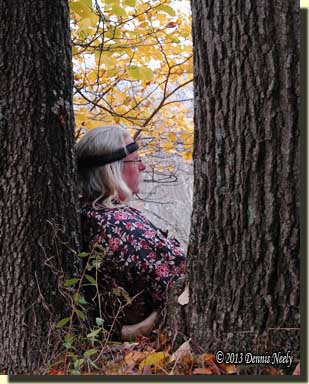
The forest’s sanctity embraced my soul. Not long before, a haunting intuition suggested a humble hunter should pause at the clearing’s tree line. I dropped a lightweight trade blanket to the ground and sat with my back against a powder-keg-sized oak. A second, much larger oak blocked my deathly shape from the view of any creature that happened into the clearing and glanced north. A juniper grew close in front, and the witch hazel branches were a few feet to my left.

“Gob-obl-ob.” A pair of soft clucks and a putt answered. The gobbler still followed the doe trail; the hens sounded ready to break into the open on the swamp-edge path. A single deer’s legs walked south to north, way up the hill, well beyond the gobbler.

Flapping wings broke the solitude. A turkey flew around an orange maple and dropped down near where I thought the hens were. Putts and sharp pops betrayed the flock and the new arrival—it seemed unwelcome. Much to my delight, the turkey music turned and began to flow in the direction of the doe trail and the gobbler’s last call. Then the woods hushed.

In a short while, a light-colored wild turkey took wing, landing in the orange maple’s foliage, short of the top. I heard one, maybe two birds flap up. Blue jays raised a ruckus out in the huckleberry bushes. I wondered what spooked the birds into roosting; I expected to see a coyote cross the clearing at any moment.

I waited a while more, but never saw another turkey. Unfortunately, the sun’s location told me that morning’s time traveling must come to an end. I scrambled to my feet, draped the blanket over my left shoulder and zigzagged tree to tree straight away, slipping away from 1798, hoping my presence would not be detected.

A Living Historian’s Honeymoon

Whether an individual is new to traditional black powder hunting or a seasoned veteran, the inclusion of a persona within any given historical simulation adds a new dimension to the pursuit of wild game. It is important to note that some traditional hunters never feel a need for a persona, and that is fine. The choice is personal.

For those who embark on creating a persona, a period of rapid learning, tolerance of the unknown and a bit of frustration accompany the stitching together of any alter ego—a living historian’s honeymoon, of sorts. A healthy dose of measured compromise (the art of taking stock of a given circumstance within a simulation, evaluating the negative impact on the overall outcome and applying a remedy that reduces or neutralizes that impact) helps smooth the initial wrinkles.

In simplest terms, a persona is a vessel in which one can stash away all the primary documentation pertinent to that fictitious individual’s social standing, geographical region and time period. Each snippet of documentation is like a puzzle piece, and as pieces accumulate a clearer picture emerges of that particular woodland character. Now and again, pieces that do not fit must be discarded, or, at the least, reevaluated.

In the early days of an emerging persona, a swirling conglomeration of history, personal interpretation and the results of experimentation in the wilderness classroom seem to bombard the mind with a relentless flood of questions and a trickling of answers. This is a natural part of the traditional woodsman’s learning process, but the apparent confusion that exists must be kept in perspective. At times, maintaining the proper perspective is a daunting task.

The Three Elements

As I waited in vain for the turkeys to venture closer, I found myself mulling over the relationship between traditional black powder hunting’s three elements: historical traditions, a reliance on black powder arms and fair-chase hunting.

Before, after and throughout any traditional hunt, the relationship of the three elements constantly adjusts to the situation. For example, dressing for a hunt and preparing one’s mindset with regards to a specific time period, life station and geographical location places a greater emphasis on the traditional element; stalking a deer swings the importance to the hunting element; and at the time of taking the shot, reliance on the black powder arm is foremost.

For newcomers to traditional black powder hunting, the mastery of all three elements is all but impossible, yet the challenge this presents is a major draw to the pastime. Again, the relationship shifts within each hunt and as problems arise. A missed deer might result in a few trips to the range to overcome whatever caused the errant death sphere, or a bounding white flag might dictate time spent on still-hunting or stalking skills.

With a blanket draped over his left shoulder, the woodsman slilps away.In the case of an experienced traditional woodsman adding a new persona, a large amount of “carryover” exists between the three elements, depending on the persona chosen. If a different black powder arm is necessary, the knowledge base from learning to maintain, handle and fire the old arm safely gives the new alter ego a tremendous head start.

The same holds true for one’s understanding of a specific game species’ preferred habitat, food sources and seasonal travel patterns and the traditional hunting skills used to pursue that critter. Fine tuning might be necessary to match the intricacies of the new characterization, but that is part of the fun of delving into a different persona.

As a 1790s woodsman attempting to supply meat to a small North West Company trading post, the historical me worked hard learning to hunt in a style consistent with 18th-century primary documentation. Whether it is the modern me or the historical me, I possess a working knowledge of which trails the turkeys prefer, the time of day they like to use them and the alternative courses they sometimes take. The challenge now is to adjust that knowledge to match the new persona.

The end result of all that cogitating is a realization that I do not have to relearn the skills I already possess, I just need to be more cognizant of the relationship between the three elements. This revelation has brought a sense of inner peace and quelled the swirling waters of uncertainty.

Give traditional black powder hunting a try, be safe and may God bless you.
Posted in Living History, Persona, Turkey Hunts | Tagged , , , , , , , , , , | Comments Off on The Swirling Waters of Uncertainty

A Dose of Reality

Distant crows hollered and screamed. Geese ke-honked near the River Raisin. A single stinging nettle stem snapped under a damp buckskin moccasin. A dozen footfalls away, the grayed branches of two different cedar trees, each half-submerged in the pond’s clear water, beckoned.

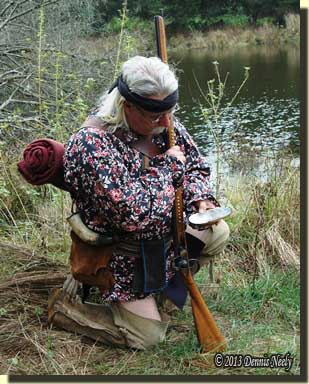
A traditional woodsman examining a large clam shell.An unseen mint plant, crushed in the midst of stalking the dead cedars, perfumed the air. A trade gun’s length from the cut bank a clam shell lay in the matted grass, discarded by a hungry raccoon. I knelt, examined the pearly-white dish and considered taking it along. I chose to leave the shell in 1798.

A dew-laden cedar bough, green with fresh, summer’s growth, brushed the sleeve of my new ruffled shirt. Water droplets streaked the forearm and darkened the fabric’s print. The black mucky soil beneath my moccasins felt spongy, soft and soothing. Yet, a step or two farther, a jagged root sent a sharp pain shooting up my right leg.

In due course, I eased the blanket roll from my shoulders and settled back against a thigh-sized box elder, bent horizontal by some disaster. I cradled “Old Turkey Feathers,” my Northwest trade gun, in my arms and watched for ducks winging low over the swamp grasses. A hefty charge of bismuth bees waited impatiently in the smoothbore’s breech.

Despite a warm, rising sun shivers washed up and down my spine with increasing regularity. Dew soaked through my buckskin moccasins, chilling my toes. The bottom hands-width of each leather leggin was wet, and my ankles grew cold. To add to my growing misery, now and then a lingering gust of pre-dawn briskness cut through both shirts.

“Ke-honk, honk, honk…” The calls of a single goose echoed off the islands in the big swamp. The honking came closer. I stepped to the right and damped my knees with the moisture that surrounded a lush sedge grass clump. The yellowing blades stood chest high; the blade tips touched the lower branches of a modest cedar tree.

In a few seconds, two geese broke over the cedars that cover the ridge. The lead goose ke-honked twice; the trailing bird remained silent. As they passed over the swamp’s center, the back bird bent its head down and took a quick look at the pond. I squinted in anticipation. The trailing goose altered a few wing beats, but the first goose held steady. The fowls were gone as quick as they arrived.

From experience, I thought it best to remain hidden in the grass. The telltale look displayed casual interest in the little pond’s solitude. I allowed ample time for the geese to view the potholes to the south, swing west to the mill pond and return, but they never did. As my legs grew stiff, my new alter ego and the old historical me spent some time getting acquainted. The ensuing discussion continued on the long walk back to camp and lasted well into the night. On that pleasant October morn, the harsh reality of a native captive began to set in.

One Lesson at a Time

There is, perhaps, no colder time during the day than the interlude between night and the breaking of the sun’s warming rays over the eastern horizon. Some mornings, the seconds tick by with excruciating slowness, especially when cold is pressing hard on a body shared with an historical personification. Yet, after all, is it not the combination of the living historian’s physical, mental and emotional circumstance that sets the stage for experiencing a true and meaningful kinship with our hunter heroes from long ago?

The creation of any new persona brings great joy and a tremendous surge of anticipation, along with a good measure of trepidation and a healthy dose of frustration. Thirty-plus years ago, I experienced similar exhilarations and misgivings, and I guess I have forgotten much of that. Time does that, buffs off the rough edges and leaves only the gem shining through, or so it is supposed to be.

Hidden in the captive narratives are tiny snippets that deal with the hardships of trying to survive in a wilderness society. John Tanner’s journal discusses the realities of starvation and cold. One of his many stories deals with a man found sitting next to a salt creek:

“…we saw a man sitting…we found him stiffened by the cold, and when we took our hands off him, he tumbled to the ground…” (Tanner, 80)

That duck hunt, set in the Old Northwest Territory of 1798, was not a first-time outing for my new alter ego, but it was the initial “cooler weather” sojourn. Trying to live within the confines of the clothing and accoutrements outlined in the sketchy journal passages is difficult, but that is the lot traditional black powder hunters choose.

With the old persona, a hunter providing meat for a small, North West Company trading post, I had years to perfect period-correct cold-weather garb. At the outdoor shows, we are often asked “How do you hunt in the cold?” In response, I flip through the photo albums and tap my finger on one particular image. “It was eleven-degrees below zero when that picture was taken, on a bobcat hunt near Lewiston, Michigan,” I say with pride. I suppose it is bragging a bit when I tell of a modern hunter who bought state-of-the-art hunting boots, guaranteed to 40-degrees below zero, and how he asked me why I wasn’t cold wearing moccasins as he hopped from foot to foot, trying to warm his feet.

Cradling "Old Turkey Feathers" while watching for mallards.I am finding that starting over presents a unique set of challenges, but I expected that. To be honest, the personal tests of my own ability to research and then live out what I find is a huge part of why I looked forward to developing a captive persona. With any luck, the process will take years and afford countless hours of learning in the wilderness classroom.  And I knew adapting to cold weather would be the first hurdle, given the limited amount of clothing documentation Tanner offers.

At one point, Tanner tells of a trader named “Mr. Wells” who would not give the white-captive-turned-Native-hunter credit. Tanner offered eight silver beaver ornaments in payment for a capote, equal in value to “twice the price that was commonly given for a capote…”

“He took up the ornaments, threw them in my face, and told me never to come inside of his house again. The cold weather of the winter had not yet set in, and I went immediately to my hunting ground, killed a number of moose, and set my wife to make the skins into such garments as were best adapted to the winter season, and which I now saw we should be compelled to substitute for the blankets and wollen [sic] clothes we had been accustomed to receive from the traders.” (Ibid, 172-173)

Making a capote is in my future; hunting ducks or turkeys wrapped in a crimson trade blanket is not. But keeping warm as Michigan’s temperatures follow their inevitable downward curve is my immediate concern. Tanner never mentions wearing a match coat, only blankets and capotes.

The October duck hunt taught me that leather leggins have to give way to wool and two trade shirts are just not warm enough. For now, I’m content with learning to live with wearing a wool breech clout. A silk head scarf, worn turban fashion, is more comfortable than I expected, and I have already purchased a piece of hunter orange wool to make an Ojibwa-style hood or cap. And Tanner’s reference to “wollen clothes” has me rethinking a wool trade shirt, but more research is needed on that point.

Fortunately, John Tanner’s narrative is not the only one I am relying on. As I told my new-found friend on the walk out, the returned captive and the trader’s hunter had a long conversation. And in the midst of that exchange, the North West post’s hunter cited a vivid passage in Jonathan Alder’s journal:

“…The weather had been changing all day and by this time it had turned very cold…We started back to camp and hadn’t gone far until Big Turtle killed a turkey…he noticed that I was getting very cold, so he gave me the turkey and told me to run, thinking to warm me up in that way. Presently, we struck the prairie and the difference in temperature was so great that even if I had stripped off half my clothes in the time, I could not have felt the cold more intensely. We hadn’t gone more than half a mile until I began to get very numb…

“Freezing, like drowning, is not such a very hard death. I had been getting very cold for sometime, then my limbs began to get still and very much benumbed before I began to fall in the snow. I was getting quite sleepy and if I had been alone and saw some place to have laid down, I should have done so and slept my last on that day on the Sandusky Plains…” (Alder, 67-68)

Days like those described by Jonathan Alder are a ways off, I hope. In the meantime there are lessons to learn in the wilderness classroom. And with that, I’m off to the woods for another dose of reality…

Give traditional black powder hunting a try, be safe and may God bless you.
Posted in Clothing & Accoutrements, Duck hunts, Persona, Research | Tagged , , , , , , , , , , , | 2 Comments

“…eight more yards”

Light snow fell, pushed about by an uncertain, swirling breeze. A button buck wandered downhill from the ridge, followed by a small doe. The scruffy doe looked straight at the toppled cedar tree, perked her ears and canted her head. A hearty snort seemed inevitable, but instead she walked due north, disappearing in the cedar tangle that guarded the upper trail.

My wife and I lurked behind the cedar tree’s gray, needle-less branches. Tami watched the uphill trails; I sat cross-legged with a clear view of the lower paths. Two more whitetails came and went over the course of the next twenty minutes. Both glanced at our cedar fort, but neither detected danger. The shifting breeze died to a butterfly breath. Despite the cold that evening in late-November, in the Year of our Lord, 1792, grew quite pleasant.

Sometime later an old turkey hen clucked on the ridge. I shifted my hips to the west and repositioned “Old Turkey Feathers” across my legs. I saw one bronze shape, then three, then more. Wild turkeys flooded over the ridge crest like battle-tested Hessian soldiers on a bayonet charge.  At the same instant, swan-shot-sized snowballs began falling with a hushed, rumbling sound.

Within sixty seconds we found ourselves prisoners; two dozen or so turkeys surrounded our lair, the closest not more than four trade gun lengths distant. The birds looked speckled from the clinging snowballs. Some walked in compact circles, never taking their eyes off our besieged fort. Two fat hens, the commanders, stood tall beyond the root-ball as they popped and clucked and putted orders. Then, as quick as they broke over the hill, big wings flapped and our captors flew up to roost.

A lady of the woods watching a buck come closer.The snow squall ceased. Down the hill, upwind of the toppled cedar, we both saw creamy-white tines. When the tines dropped to the forest floor, Tami eased to her right, her thumb fidgeting with the hammer of her cut-down, chiefs-grade trade gun. The young buck crossed under a big, spreading red oak, then angled farther to the east. He nosed the ground. Tami shouldered the “Silver Cross” and cocked the hammer. I heard the sear click.

“Grant her a clean kill, or a clean miss. Your will, O Lord,” I prayed. I saw her lips move. I smiled, thinking she offered the hunter’s prayer at the same time I did.

Short tines rose upward. The buck turned broadside. My wife waited. We both heard the single, raspy “putt” behind us, but the buck seemed to give the warning no mind. The Silver Cross’ brass turtle sight moved about. The six-pointer looked to the south, then the north, but never at our humble cedar. He turned around, nuzzled the ground and walked back to the spreading oak. He stood for a good while, then loped away.

“That was close,” Tami whispered. “I just needed a few more steps; eight more yards.”

Understanding Effective Distance

A few weeks ago a seasoned traditional black powder hunter brought up the subject of effective distance. He thought he understood the concept, but asked for clarification, anyway.  At the end of the ensuing conversation, he suggested I might devote a blog post to discussing the importance of knowing one’s effective distance.

The concept of effective distance is an ethical choice spawned by a deep respect for the wild game traditional hunters pursue. In any given woodland encounter, it is easy to pull the trigger and unleash the death sphere, but infinitely more difficult to weigh the circumstances and choose not to. Either choice is wrought with consequences, but in the latter, those consequences are easier to live with.

As traditional black powder hunters, we each bear a responsibility to the game standing or flying in front of our collective turtle sights to execute the best, most humane shot possible, a shot with the highest probability of effecting a clean and quick kill. In a broader sense, we also must shoulder a similar sense of responsibility to our fellow hunters, both traditional and modern, by adhering to a high level of ethical conduct when afield.

Those of us who prefer smoothbores have at least two effective distances, one for shot (which can vary with shot size) and one for round ball. In either case, the guiding question that needs to be answered is: “How far can I shoot with a high probability of a quick and humane kill?”

There are at least four factors that must be looked at to answer this question:  one’s own personal ability, the capabilities of the gun, the load used and the terrain hunted. For the most part, these factors are pretty straight forward, but when combined they can become a bit tricky to unravel.

On that November deer hunt, Tami entered the woods with an effective distance of 35 yards for her round ball load in the Silver Cross, as determined on the practice range. How did she arrive at the 35-yard limit, you ask?

Tami set an allowable shot grouping for the game she intended to hunt—deer. She wanted to be able to place all her shots within an eight-inch circle, a choice consistent with accepted ethical hunting practices.

To eliminate doubts about the Silver Cross’ capabilities, she asked an experienced shooter to test her load and the trade gun. Shot from a bench rest, the Silver Cross and the selected load grouped within six inches at 50 yards. Confident of the gun’s performance and the load, she started shooting off the bench at 25 yards.

After a few practice sessions, Tami learned to hold the same sight picture, which tightened the groups within the eight-inch limitation. She switched to shooting from a sitting position, which she intended to use for the actual hunt. By opening day, Tami acquired a skill level that allowed her to place all of her shots within the eight-inch circle from 35 yards—her effective distance.

But the final factor, the terrain hunted, came into play on that evening. The six-pointer stopped at about 38 yards. On that knoll, the cedar trees grow close and the lower branches are dead, sometimes giving an appearance of a clear shot while unseen branches lurk in the death sphere’s path. Taking a shot at that distance increases the probability of a deflected round ball, resulting in a “bad hit.”

A nice six-point buck looking straight on.The falling snow, swirling wind and visibility limited to 35 yards or less made the downed cedar a prime location. By the time the buck headed uphill, Tami knew her best, open shot was a tiny clearing at 32 yards—the true effective distance governed by the shot presented on that terrain.

In essence, Tami hunted within her effective distance, minimizing the temptation to take a low probability shot filled with the potential for unpleasant consequences. And by sitting next to her, I accepted her limitations, thus allowing the terrain picked to reduce my effective distance. To date, we have not determined the ultimate capabilities of the Silver Cross, simply because we don’t need to, and won’t, until such time as Tami’s personal marksmanship pushes that issue.

A similar situation exists with Old Turkey Feathers. Using a competition load with a patched round ball, my effective distance was 75 yards. But experimenting with natural materials for wadding and period-correct loading practices opened my round ball groups up. The change in load now becomes the limiting factor, reducing my effective distance to about 50 yards.

At 85 yards, the competition load starts to “tail off,” going in whatever direction the wind pushes it, much like the late Hoyt Wilhelm’s knuckleball. Changing the powder charge affects the point where the wandering begins, but that is an unnecessary load adjustment, because my personal ability to maintain a consistent sight picture nullifies the distance gained.

Turning to shot, the capabilities of a cylinder-bored barrel most often determine a traditional woodsman’s effective distance. On the surface, the choke-less bore is often cited as a cumbersome disadvantage, especially by modern hunters who convert to the traditional hunting philosophy. I’ve hunted with the same cylinder-bored Northwest gun for 35-plus years and don’t see it that way. But again, terrain selection is often the key to continued success.

In reality, shot loads all but remove personal ability from the list of contributing factors. The capabilities of one barrel over another also prove minimal. The prime consideration becomes maximizing the efficiency of the powder-wad-shot column, which demands hours of time at the pattern board.

I’ve come to the opinion that most traditional hunters overlook or ignore this crucial aspect of determining effective distance with respect to shooting shot. The common mindset seems to accept the 25-yard limit as standard, giving little thought to pattern density, shot size performance and adequate penetration.

A number of years ago I helped a traditional hunter pattern his Tulle. He kept “missing” turkeys, and was sure the gun wasn’t shooting straight. He was using the “heavy turkey load” a friend recommended. He talked about “patterning” the gun once, at a commercial-size baked bean can.

This poor fellow stood slack-jawed after the third shot printed on craft paper. All three patterns had a huge hole in the middle. An adjustment to the wad column solved the problem. When he started experimenting with shot sizes, I knew I had a convert, and before that practice session was over, he added four yards to his effective distance.

Check out your effective distance, be safe and may God bless you.

Posted in Muzzleloaders | Tagged , , , , , , , , | 4 Comments

My Mouth Watered…

A wild apple thumped the ground. A blue jay perched, a few cedar trees distant, but kept its tongue. Somewhere down by the big cottonwood a fox squirrel chattered. A gentle breeze swayed the tree tops and brought the first aromas of fall. It was a pleasant September morn, in the Year of our Lord, 1795.

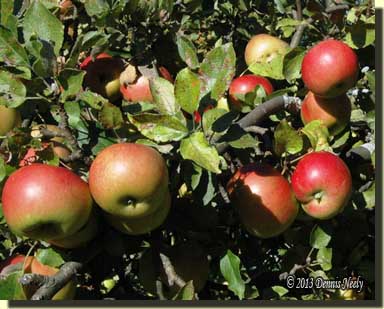
Ripe apples waiting to drop.Geese ke-honked over the River Raisin, winging south to north, or so it sounded. Another apple fell, bouncing twice. The blue jay flew off. With a loud ruckus, Sandhill cranes protested some transgression, off by the meadow. In a dozen minutes the third half-red fruit hit and rolled in a lazy circle. The abundant bounty, spawned by heavy spring rains and moderate temperatures, added a sound to the glade not heard in many years.

After a short pause, I scrambled to my feet and still-hunted along the doe trail that stayed uphill of the last place where I heard the fox squirrel bark. “Old Turkey Feathers” held no charge, for that morning’s wilderness lesson centered not on taking game, but rather on breaking in the assembled accoutrements of my returned-captive persona.

A short ways down the trail, my alter ego leaned against a lightning-scarred cherry tree. I checked my back trail out of habit, and there, on the lower path, just past the cottonwood’s drip line, stood a young whitetail. The small deer showed little concern, and looked as if it had just gotten up from its bed. Perhaps it heard the apples thump, too.

Many years ago, when the wild apple trees produced an abundance of soft, sweet fruits, I took great pleasure in watching the whitetails change their normal paths so they could browse beneath those trees. I wondered if this deer might do the same.

In a minute or so, the young doe followed its ancestors’ habit and veered off the trail. After a short jaunt, it sniffed two apples, then picked up a smaller fruit in its mouth. The “crunch, crunch, crunch” sounded just as I remembered. It picked up a second apple. My mouth watered as it crunched away.

Crashing the Time Machine

A number of years ago, a French woods-runner from the 1750s and I shared an oak tree. We sat back to back, and because of the tree’s girth, we had to turn half around if we wished to see each other. The morning was similar to my sojourn back to September of 1795. Even though our time travels were a generation apart, we shared the 18th-century through hushed whispers.

The black squirrels showed no inkling to participate in our historical simulation, and as the morning turned warm, my woodland companion grew impatient. I heard him rummage through his rather spacious hunting pouch. “Are you hungry?” he asked.

“No thank you,” I said. “I have an apple in my shot bag and a few walnut meats in my weskit.”

“I brought jerk. I’ve got Southwest Mesquite and Texas-style barbeque.” As the Frenchman elaborated, I heard the horrific, gut-wrenching sound of our time machine crashing into that big, spreading oak.

A couple weekends ago, at the Woods-N-Water News Outdoor Weekend West, held at the Kalamazoo County Expo Center, a guest asked me what I took along to eat when I was on one of my traditional hunts.  My answer was the same as it always is: “Some walnut meats and maybe an apple. I prefer to hunt hungry.”

Now, my version of “hungry” and John Tanner’s version are worlds apart. I pray that I will never truly know the deprivation he experienced. When I can plan ahead for a journey back to my beloved 1790s, I eat light or not at all. But going without food for a day was commonplace to Tanner, as it was for the vast majority of my hunter heroes:

“Only Oon-di-no, the man who had remained with me before, wished to stay, that his women might dry the skin of the last moose he had killed, so that they might carry it with them to be eaten in case of the failure of all other supplies.” (Tanner, 224)

As I explained to the show guest, when my stomach growls, I find my senses a bit keener and my desire not to mess up a stalk more compelling. I move slower than most woodsmen and exert myself less, which I suppose translates into burning fewer calories. For me, carving up an apple or munching on five or six walnuts is a treat.

A Smorgasbord of 18th-Century Food Ways

The conversation with the inquisitive guest, coupled with the local bumper crop of apples and nuts tweaked my curiosity. As I plunge headlong into a new persona, I thought it best to take a beginning look at the cross-cultural food ways of Native captives.

One evening I pulled out John Tanner’s journal and that of Jonathan Alder. I started a grocery list of sorts, writing down the foods those two encountered in daily life. I found referencing each entry cumbersome and counterproductive, with a few exceptions, but I also discovered a great similarity between the foods they list and those of a common fort hunter.

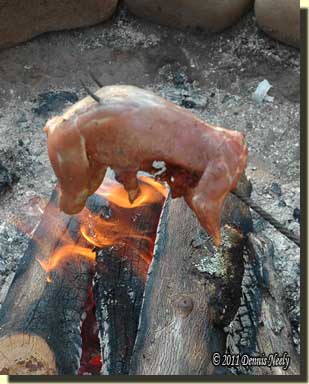
A plump black squirrel roasting over an open fire.With a little thought, I expect most living historians would come up with the basics: wild turkeys, ducks, geese, deer, bear, elk, and sometimes moose. In the Great Lakes region, buffalo might not make that list; rabbits, white fish and trout would—sturgeon, cranes, swans and turtles might not, but all made it into the two narratives.

The journals mentioned turkey eggs, gull eggs, buffalo tongue (both fresh and dried), porcupine, raccoon, wild hogs and dogs:

“When I arrived, I accounted for my whole outfit; having the peltries I had purchased in exchange for every article, except some powder and shot which we had ourselves expended in hunting. The price of this was deducted from my pay in my final settlement with the agent of the American Fur Company. Then ten dollars as the price of the dog we had killed in the extremity of our hunger, and which had been the means of saving, not my life only, but that of the nine Frenchmen that were with me.” (Ibid, 263)

Maple sugar, salt, honey, assorted herbs, wild rice, bear oil, corn, beans, squash, pumpkins, blueberries (both fresh and dried), beechnuts and just “nuts” make the wilderness shopping list. Pawpaws, mussels, crayfish, pemmican and tea are there, too.

Jonathan Alder details the process for jerking and drying buffalo, which mirrors that of so many other 17th- and 18th-century observers. He goes on to note:

“Jerk is ready to eat and very handy, especially on a march. An Indian with very little trouble can pack enough of it on his back to last two weeks when he is on the trail. And if you stew it in a little vessel with bear’s oil, it is delicious eating.” (Alder, 38-39)

Alder doesn’t mention adding “Southwest Mesquite and Texas-style barbeque” flavoring—the simple remedy for this oversight is to stop speaking after “I brought jerk.” He does, however, address the lack of bread on a number of occasions:

“We stayed here [up Big Darby Creek] several weeks hunting and feasting on the fat of the land, which consisted of venison and deer meat without bread.” (Ibid, 40)

“Their manner of living was so different from what I was used to and their food didn’t agree with me. Most of their diet was meat. Occasionally, they would have hominy and beans, but bread was a thing I hardly ever saw. Salt was an article scarcely used in their victuals.” (Ibid, 50)

Despite this lengthy grocery list, I have no desire to change my austere trail food choices. That is not to say I will not partake of wild game at a traditional hunting camp, only that I won’t be stuffing pumpkins, sturgeon or a chunk of dried moose hide in my bedroll anytime soon.

Give your 18th-century food ways some thought, be safe and may God bless you.

Posted in Living History, Scouts | Tagged , , , , , , , , | Comments Off on My Mouth Watered…

Inspired by John Tanner

Moonlight washed over the canvas village. Stars twinkled in the ethereal darkness; fires flickered down in the valley. Candle lanterns glowed in the evening’s pleasant coolness, and once in a while a candle’s light moved from camp to camp. A banjo twanged to the south, and a mountain dulcimer droned to the east. Uphill a ways, a reveler’s distinctive laugh brought an involuntary chuckle.

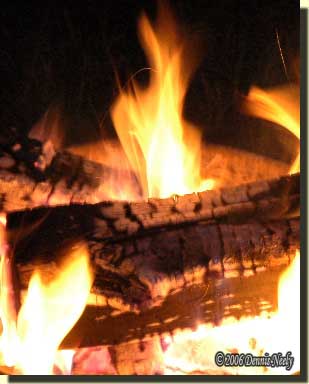
Yellow flames and the cherry-red coals of an evening camp fire.“What are you going to do?” Tami asked as we both sat mesmerized by the soft dancing flames of our own campfire. She rearranged the scarlet, four-point Whitney blanket around her ankles and the hem of her calico dress. “What does the documentation say?”

“One thing is sure, I can’t keep doing nothing. Right now, time is the limiting factor,” I said as I concentrated my gaze on one wispy tongue of fire. Turning side-saddle in the folding chair, I rested my right arm over the oak backrest. The pungent perfume of wood smoke drifted our way as I sipped cool water from the canoe cup. “The answer to that question is not easy, it never is.”

A ram’s horn blared twice, somewhere over by Laughery Creek in what’s called “the six acres,” a limited hook-up camping facility on the home grounds of the National Muzzle Loading Rifle Association, in Friendship, Indiana. Our conversation paused as we both waited for the inevitable response, which took much longer than normal.

Now there is a mythical, almost magical, air that engulfs one’s inner-self at Friendship, if you let it. The experience is hard to describe—“you have to be there,” as the saying goes. Like an invisible mist, this mystical aura comes and goes—on the shooting range, while swabbing out fouling or in the wee hours of the night. It possesses a will of its own, seated deep in an unmistakable kinship with the souls of yesteryear and the old shooting irons of long ago.

On that September evening, the ram’s horn exchange ushered in a quiet peace. Tami and I talked of the prospects for the fall hunts, the course of our living history adventures and my new persona: an individual captured in his youth and adopted by the Ojibwa or Potawatomi who eventually returned to white society in the lower Great Lakes, but could not find it within himself to give up the hunting ways of his Native American family.

A New Ruffled Trade Shirt

For some folks, Labor Day marks the end of summer, but for me, the Fall National Championship Shoot at Friendship is the benchmark. The week-long shoot falls at the beginning of small game season here in Michigan. Although I didn’t shoot this year, most years the stiff competition and wide variety of events serves as a tune-up for hunting. Indeed, inhaling the glorious stench of spent black powder should awaken any woodsman’s sense of wilderness wanderlust.

At that point in the evening, our discussion centered on a new trade shirt. Mid-summer I purchased a fine piece of linen to make a ruffled shirt, but the time needed to hand-sew the garment just never materialized. Faced with the immediacy of a fall turkey hunt, an impending outdoor show and the availability of ready-made shirts at Friendship, Tami tried to convince me to part with a few hard-earned dollars. She was right, and I agreed.

Any given persona is rarely based on one individual’s life, and my answer to “What does the documentation say?” reflected the need for a broader sampling of primary references. This persona is inspired by John Tanner, one of my favorite hunter heroes, but Tanner says little about his shirts, other than “I had bought a shirt…” (Tanner, 193). And of course, Tami jumped on that statement.

Jonathan Alder talks of being given “a calico shirt, breech clout, leggings, and moccasins” at his adoption (Alder, 45), and at James Smith’s adoption ceremony he says “They gave me a new ruffled shirt…” (Smith, 30). As the rams’ horn one-upsmanship began again, we moved on to the obvious question of what constituted “calico” and “ruffled.”

The “documenting” of any item incorporated in one’s persona should include a reasonable mix of the written word, existing museum artifacts and paintings, illustrations or drawings from the period. Sometimes this mix of primary sources is not possible, but that is still the goal.

I know of two ruffled shirts attributed to the Great Lakes region. One belonged to Sir John Caldwell, an British officer in the King’s Eighth Regiment of Foot who served at Fort Detroit about 1780 (Brasser, 2), and the other, on display at the National Museum of the American Indian in New York, is attributed to Major Andrew Foster, another British officer who acquired the shirt between 1790 and 1795 in the region between Fort Michilimackinac and Fort Miami.

Countless images of ruffled shirts exist to aid in selecting an appropriate representation. Although his paintings and sketches date from the late 1830s, I have found the work of George Winter to be a helpful guide in my journey of discovery (Cooke & Ramadhyani), especially as it relates to the Potawatomi people who lived in the area about the headwaters of the River Raisin and the North-Forty.

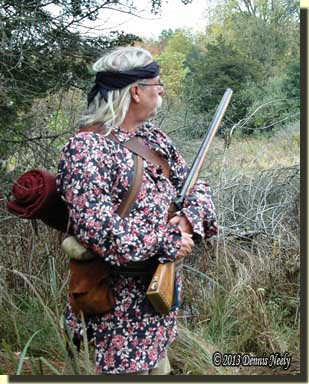
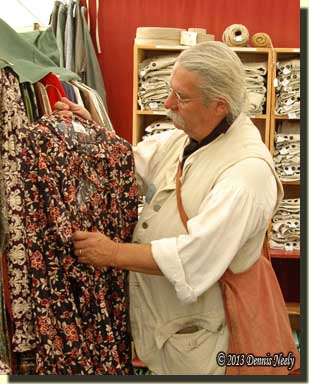
A traditional woodsman looking at a trade shirt on a merchant's rack.The next morning found me searching the racks of several different merchants who set up shop at Friendship. I found a floral-print ruffled shirt amongst the offerings at Michael Pullins’ Ohio Valley Peddler. The cotton fabric’s pattern approximated designs I remembered from Textiles in America: 1650-1870. The shirt’s length measured 40 inches, a tad longer than the Caldwell or Foster shirts, which measure a little over 36 inches. A friend who has seen the Caldwell shirt noted that the hem appeared to be torn, thus shortening the shirt—a possible choice for this garment.

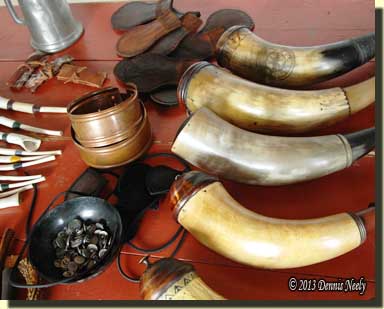
The sleeves are a bit long for my arms. Around the corner and down the stone path from the Ohio Valley Peddler I remembered seeing a pair of copper arm bands at the horner’s shop, sitting on the back table, overshadowed by several fine powder horns and assorted trade goods.

Two copper ornaments sitting amongst other trade goods.Arm bands were a common trade item and often included as personal adornment by both the Ojibwa and Potawatomi. Tanner doesn’t mention arm bands specifically, but on a number of occasions he references silver ornaments, including “…I stripped off all my silver ornaments and hung them up in the lodge…” (Tanner, 67). Maybe?

The resident horner asked a fair price for the copper arm bands, and once in place, they should solve the shirt’s long-sleeve issue. Native Peoples from Michigan’s Upper Peninsula mined and traded copper. Until I can afford silver ornamentation, I need to do further research on the copper arm bands.

Right now I am in the infant stages of developing the returned-captive persona. The ruffled shirt, the arm bands and the other material goods I am assembling represent my best understanding of what constitutes a truthful interpretation of my persona’s life circumstance. In a month or a year or even several years down the path, the folly of this attempt may bring a smile to my face or even a hearty belly laugh.

But the point I wish to emphasize is that I am not waiting to enjoy my new alter ego’s life experience. I am not hesitating because I lack exact, unequivocal, irrefutable evidence for every aspect of my kit. I am moving forward, and doing so with the full intent of pursuing wild game as a native captive who returned to white society, but can’t give up the Ojibwa or Potawatomi ways. And besides, when I release the death bees, the wild turkey, the fox squirrel and the cottontail rabbit give little mind to the historical significance of a native captive’s attire.

Give traditional black powder hunting a try, be safe and may God bless you.
Posted in Clothing & Accoutrements, Persona | Tagged , , , , , , , , | Comments Off on Inspired by John Tanner