“What if” Cogitations

Deer flies swarmed. Mosquitoes the size of hickory nuts lit on the back of my left hand. I could not swat without tucking the Northwest gun under my armpit, and I presumed the little beasties knew that. That morning, in the Year of our Lord, 1795, as I wandered around the cedar grove’s perimeter, the only sound I heard was the constant buzzing of insects.

Once again the morning song birds held their tongues, perhaps due to the scorching heat and stifling humidity. At the old apple tree, a lone crow chased a fledgling red-tailed hawk, laboring with a chipmunk dangling from its talons. The crow cawed now and then; it seemed to have lost its heart for the chase, and by then, so had I.

The trail’s sandy patches warmed the bottoms of my elk moccasins like a stone resting beside an evening fire. Dragon flies flitted about the meadow’s boundaries as if afraid to wing their way into the center, out in the heat. A wild cherry branch hung limp, broken for no reason, festooned with wilting, withering leaves. A pair of adult Sandhill cranes flew over. I stood and watched. They spoke not. I moved on.

The sweltering ramble continued for some time. At the meadow’s east side, I found ample shade and a light wisp of a breeze. I sat cross-legged and began scribbling my impressions on a folded page. The air smelled of hot dirt and damp, fresh-crushed weeds. For some reason the deer flies and mosquitoes abandoned me. Industrious black ants came and went. One crawled over my buckskin leggin.
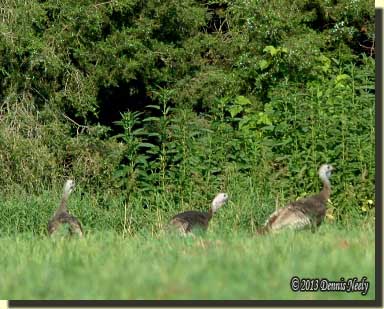
Three wild turkeys walk on the trail.A few sentences along, I looked up and spied the gray head of a half-grown wild turkey, skirting the cedars on the trail that passed the broken cherry branch. In an instant, another head popped up, then another. Over the next few minutes, the heads of seven different birds appeared, disappeared and appeared again as the young fowls wandered north, following the same trail as I had, not long before.

“Old Turkey Feathers” rested on my lap, unloaded and still oiled. I watched three birds in particular, the leaders of the flock, and wondered if my alter ego could make the shot, some hundred paces distant. A round ball would have to hug the meadow’s gentle rise and clear the crest before beginning its descent. The death sphere’s path would be a “worm burner,” indeed.

As I watched, I recalled the young jake that flew across the big swamp, landed a dozen or so paces away and the three opportunities he presented, in an historical sense, of course. I was reasonably certain I could hit the mark with all three of those shots, but I knew the over-the-meadow shot was another story.

Changing Clothes Isn’t Enough

So there is no misunderstanding, I feel compelled to share a disclaimer of sorts. In Michigan, it is not legal to hunt wild turkeys with a solid projectile, and the legal shot size is restricted, too. As a responsible traditional black powder hunter, I adhere to all game laws and seasons, and work them into my hunting scenarios in the form of measured compromise: measuring the circumstance (in this case, modern hunting regulations) and applying a reasonable compromise that does not detract from the essence of the historical hunting scenario.

That said, it is not illegal to sit with an empty trade gun on one’s lap and run through a host of “what if” and “could I” situations that mirror the shots taken, or attempted, by my hunter heroes. The upshot of those cogitations are lessons best addressed at the practice range.

This summer holds more questions than answers. At every turn, I find myself reaching out to other traditional black powder hunters for their thoughts and insights, but even then, my wonderings seem to grow exponentially.

The lessons and resulting questions of the Fort Greeneville Match keep mulling in my mind. From the emails, comments and conversations I have had, other folks are thinking, too. Personally, I have tried to categorize and prioritize the lessons learned from that experience. Those that I have spoken with have different “take-away messages” from my tale, and this is both the beauty and the curse of the wilderness classroom.
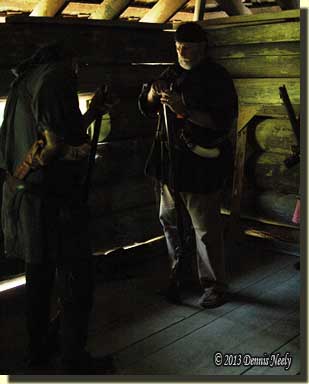
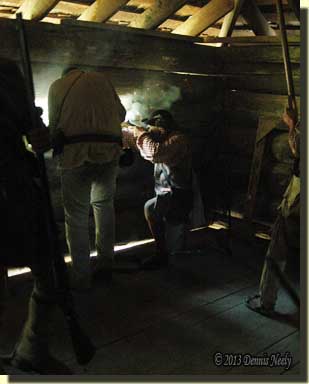
A traditional woodsman reloads in the fort's darkness.The major point of my sharing the Fort Greeneville Match was to demonstrate that we should all embrace the opportunities that exist to round out a persona, consistent with historical documentation. We must recognize that our hunter heroes’ life happenings were as diverse as ours are today, within the context of the 18th-century American frontier.

As I so often point out, it is simply not enough to change clothes and hunt with a black powder arm. Instead, I urge each living historian, in order to gain full benefit from this hobby, to foster a mental attitude that seeks to re-create the past in a meaningful and truthful manner. With any luck, the end result is a greater understanding of the scant words of a long-dead woodsman, and sometimes, when the smoke clears, we see our historical selves from a completely different perspective.

In following up on one aspect of my forting up, I returned to Joseph Doddridge:

“A well grown boy, at the age of twelve or thirteen years, was furnished with a small rifle and shot pouch. He then became a fort soldier, and had his port hole assigned him. Hunting squirrels, turkeys and raccoons soon made him expert in the use of his gun.” (Doddridge, 123)

Now I’m shooting a smoothbore, and there are hindrances to that, to say nothing of being far from a lad of “twelve or thirteen years.” But what stuck with me and dovetailed with my current train of thought was the “…soon made him expert in the use of his gun.” With that passage lingering in the dark corners of my mind, it was only natural that I would question my ability to sling a death sphere across the meadow at a target simulating one of those hens.

Thus, one of the revelations that came out of defending the fort was the fact that I no longer know the limitations of this aging body or Old Turkey Feathers at distances farther than my normal effective distance. I have grown comfortable and confident hunting with those time-honored parameters. And with that comfort, I fear a bit of complacency has settled in.

With my research into using natural materials for wadding, I have come to realize that that distance has been subconsciously reduced. Again, this is all part of being a responsible traditional hunter and respecting the game I chase, but nonetheless, I feel a deep compulsion to return to the practice range and spend the rest of the summer testing and re-evaluating what I think I already know.

Give traditional black powder hunting a try, be safe and may God bless you.
Posted in Persona, Scenarios | Tagged , , , , , , , , | Comments Off on “What if” Cogitations

At the Little Bend

Abundant spring rains brought lush summer growth. A warm July night, in the Year of our Lord, 1795, produced a dense morning fog. Moisture dripped from every leaf, every bough, every sprig and sprout. My linen trade shirt felt damp, the air moist and oppressive. The remnant of a skunk’s displeasure perfumed the glade. A ways down the trail a wild turkey hen clucked, its tone soft and subdued: “Arrkk…”

Normally boisterous crows and blue jays held their tongue; the cardinals and sparrows offered no songs of joy. An eerie, yet peaceful silence marked the new day. But the serenity did little to quell the buzzing mosquitoes and persistent deer flies. The shirt’s sleeves hung long and open. As I rambled, the cuffs swung to and fro, shooing the pesky demons away, to some degree. White hair hung free about the shirt’s collar in hopes of protecting my neck.

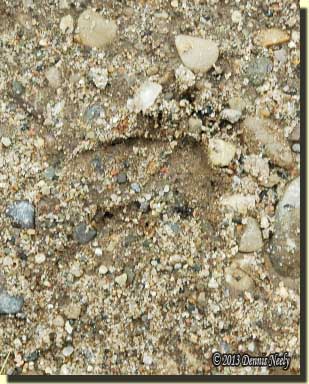
A doe's hoof prints in the sandy gravel.A young doe’s faint track in a sandy spot told of its passing. From the looks, the deer crossed the trail an couple hours before, cloaked in night’s abyss. Curiosity pushed me to unravel the whitetail’s course as it wove amongst the sand and dew-tipped blades of green grass. The creature stepped to the left, then the right, then back to the left. The doe seemed concerned with the trail, now overgrown with thick-leaved autumn olive branches that curved earthward. The tracks zigzagged twice more, then headed straight over the hill to the ridge’s west face. I did not follow.

My elk moccasins attempted to hug the left wagon rut, but the underbrush forced me to change from depression to depression as I walked. Despite my best effort, water splattered my sleeves and pelted the backs of bare hands. Sprinkles tickled my upper thighs and spotted my buckskin leggins. I contemplated covering the trade gun’s lock as I would in a rain storm, but chose to tuck it deep in my right arm pit.

The wagon trail disappeared at the little bend I depend on as a guide to favored lairs farther down the ridge’s slopes, both east and west. I stood still and looked about. A red-tailed hawk drifted overhead. A crimson cardinal flitted into the shadowy safety of the cedars. But my gaze kept returning to those two ruts, gobbled up by summer’s growth.

Wilderness Roads

The narrow ruts might never heal. A few feet to the east, a wide depression meanders along the ridge crest. My father said as a youngster he was told it was an Indian trail, a part of the Great Sauk Trail system. If that is true, man’s presence is evident, despite Mother Nature’s best effort.

Hefty cedar trees grow in the supposed Indian trail, but the depression can still be seen and followed, over time’s threshold and back to the edge of 21st-century civilization. As I stood there, I marveled at the choking growth that occurred over such a short period of time. The scene reaffirmed what I already knew: wilderness roads need constant clearing.

True, from my alter ego’s perspective, the urgency to clear away the dense foliage existed in the far off future—over two centuries distant. The land management plan for the North-Forty includes the periodic maintenance of the property’s two track road, but it does not indicate within which century the work must take place.

The History of Jackson County Michigan tells of Jacksonburgh’s first settler, Horace Blackman, and his trip west from Ann Arbor in the early summer of 1829:

“The city of Detroit was at that time an old, dilapidated looking town, with a population of 2,220. The Chicago road had just been built at the expense of the United States Government, opening an avenue of travel through the southern part of the [Michigan] Territory, and along this route a few small settlements were beginning to emerge from the wilderness. Ann Arbor at this time was the extreme frontier settlement west of Detroit. It was a small village, containing three or four stores, two public houses and some 500 inhabitants. Here was the end of the road going west.” (History, v.I, 167)

In an 18th-century context, a lone woodsman and his occasional companions do not require a road through the wilderness. Animal trails suffice. With the River Raisin close at hand, the canoe, bateau or pirogue provide a connection to the eastern settlements, like Frenchtown. And where rivers did not flow, the horse provided easy access.

As I stood there, I realized how quickly the path grew full from neglect, and at the same time I realized how quickly the settlers poured in, as well. In those later years, one or two pack horses eased the journey west, especially for those hearty individuals, like Horace Blackman, enamored with establishing a frontier homestead in the newly surveyed wilderness. But the road stopped at the little village of Ann Arbor.

Learning from an Overgrown Path

There are two basic types of vegetation along my wagon road to yesteryear: slow growing cedar trees interspersed with a few hardwood saplings and the fast growing autumn olive, an invasive species native to Asia, unknown to the Old Northwest Territory of 1795.

Some consider the aromatic red cedar an invasive species, too, because it was native to the Northeastern United States and spread west in the latter decades of the 19th century. I find no mention of the species in the early surveyors’ notes, or journals of this region, but the cedar trees dot my 18th-century Eden and find their way into many of my scribbled entries.

The autumn olive is aggressive and demands more modern methods of control that have little value for the living historian. But the cedars and hardwood saplings present a tremendous learning opportunity for the traditional woodsman—a chance to learn road blazing skills firsthand.

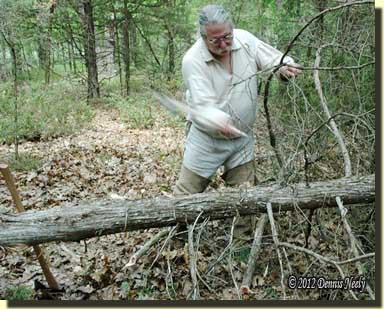
I began maintaining the wagon road in a period-correct manner about two years ago with a tomahawk and felling ax. The progress is slow, but faster than the cedars’ growth rate.

Cutting limbs from a cedar tree with a tomahawk.Like all exercises in the wilderness classroom, the first lessons were difficult. A sharp tomahawk or ax is a must, and the proper technique requires developing a keen sense of hand-eye coordination. Controlling the ax’s bit is imperative, as is learning when to strike a limb, branch or trunk at an angle or straight on. And there is a method to notching a tree for felling as well as cutting the trunk into usable logs.

From the traditional hunter’s perspective, maintaining a wagon road by hand fosters additional insight into the frontier ways of our beloved hunter heroes. At the very least it offers period-correct campfire stories, like the time a falling tree’s crown hung up on a neighboring oak’s lower branch.

To be sure, the tale is not as harrowing as Jonathan Alder’s about the bear hunt and his perilous fall from a broken poplar tree (Alder, 75-76). The details are a bit more hilarious, set in the mid-1790s, and for now, best left for another time.

Give traditional black powder hunting a try, be safe and may God bless you.
Posted in Living History, Skills | Tagged , , , , , , , , | Comments Off on At the Little Bend

“Never Been Outdoors!”

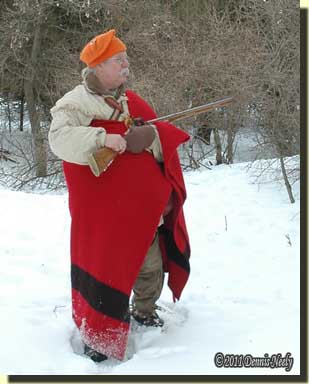
Stars sparkled in a moonless heaven. Wool-lined moccasins whisked through the fluffy snow. Years ago an ice storm tipped a good-sized cedar tree to the south, just shy of the ridge crest. I paused there to adjust the four-point scarlet blanket that draped over my left shoulder. The night air was calm, but cold. After all, it was late November, back in 1795.

The River Raisin, a few ridges to the west, was not yet frozen over. As I recall, snow squalls marked the week, along with a steady north wind. On that gorgeous morn, I wore the trade blanket more out of habit than necessity.

A traditional woodsman wearing a four-point trade blanket.The trail bent east with a long sweeping turn. At the start of the bend, my buffalo-hide moccasins headed west in search of one particular oak tree. As I stalked through the last of the cedars, barren skeleton-like branches tugged and clawed at the blanket’s tails, but failed to hold a grip. One raked my right cheek; another slapped the back of my right hand.

In the graying darkness, I made out the oak’s familiar shape, just over the ridge and a bit down the steep west slope. A year had passed since I sat at that oak and I got it in my head that that was the morning to seek out my old friend. My left moccasin scuffed away the snow and stiff leaves from the trunk’s north side. The ground was not yet frozen, and for a brief moment the aroma of fresh-turned earth filled my nostrils.

I leaned the Northwest gun against the tree, pulled the blanket snug about my hips and sat cross-legged with my left shoulder pressed into a little hollow in the tree’s coarse bark. With the firelock resting across my legs, I checked the prime and arranged the red-wool folds over my hunt-stained leather leggins. I sat in solitude, waiting on first light.

Raspberry bushes grew on the hillside, too thick to walk through in some places. Halfway downhill a deer trail passed through the spiny, purple switches; another path followed the edge of the nasty thicket. The bucks like to chase the does back and forth along those two trails early in the morning after a fresh snowfall.

I sat a while before a wild turkey squeaked to the north—poorly forged hinges make a more tolerable sound. A coyote yipped off toward the river bottom, and in due time, the crows’ morning melee began. Other turkeys started popping, then clucked. After those birds flew down the first doe appeared, on the far side of the thicket. Two others materialized, and the three browsed in the direction of the isthmus, away from where I sat.

Fox squirrels dug in the snow. Two blue jays watched, but never uttered a peep. Upwind of the oak, a small, button buck meandered around the thicket’s corner, acting like he wasn’t sure if he should go uphill or head into the tangle. He lingered for a good thirty minutes before choosing the former.

Mid-morning a brilliant sun broke over the ridge crest. Still wrapped in the blanket, I grew too warm with the heat on my back. Nothing ventured by after the button buck, so I arose, descended the slope and spent the rest of a glorious 18th-century morning still-hunting around the thicket and the huckleberry swamp.

Adding Value???

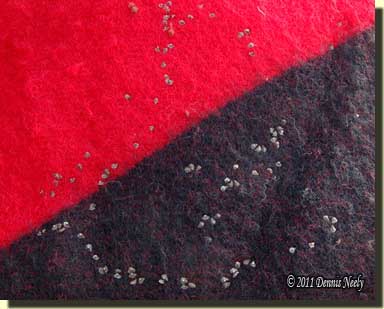
Sticktights_On_Trade_BlanketA few days ago I saw an advertisement for a “museum quality” blanket, hand-woven by a well-respected weaver. I could only assume the current owner was attempting to add value to the asking price when he or she noted the blanket had “…never been outdoors!” All I could think about was the “sticktights” (a local catch-all name for plant seeds that stick to anything) in the scarlet blanket, and how I wished that blanket showed more wear and tear than it does. I am proud to say I cannot claim it has never been outdoors.

I am often kidded about hunting with my “blankie,” mostly by modern hunters. Sometimes I dish the jibes back: “If it’s good enough for Linus, it’s good enough for me.”

From there, the discussion often goes to the somewhat universal use of wool blankets by 18th-century backwoodsmen from the various eras or with differing social standings. Substantial documentation exists for the issuing of blankets, but I often refer to T. C. Wright’s statements regarding the practices of Josiah Hunt, one of my hunter heroes. In his written affidavit, Wright told of the necessity of having a fire to keep from freezing in the coldest months:

“…it was necessary to have a fire; but to show a light in the enemy’s country was to invite certain destruction…” (Howe, 199 or Payne, 42-43)

Wright went on to tell how Hunt dug a small hole with his tomahawk, kindled white oak bark from a dead tree and buried the “coal pit” with dirt, leaving two air holes to control the smokeless combustion of the glowing embers. Hunt spread bark and brush to keep off the cold ground, then:

“…he sat down with the ‘coal pit,’ between his legs, enveloped himself in his blanket, and slept cat-dozes in an upright position… (Ibid)

Josiah Hunt depended on a blanket for his wilderness survival as he made daily forays into the forest to supply game for the officers of General Anthony Wayne’s Legion. Unfortunately there is no explicit description of his blanket. But that reference, coupled with several others from the Lower Great Lakes in the 1790s, forms the basis for hunting while wrapped in a wool trade blanket. I suppose instead of quoting the practices of a contemporary cartoon character I should change my response to: “If it was good enough for Josiah Hunt, it’s good enough for me.”

I’ve used the same four-point scarlet trade blanket for at least six years. I have a lighter weight blanket that I use in the fall, because the heft of the four-point blanket causes me to sweat too much when the temperature is above 25 degrees. According to Wright,

“…he [Hunt] declared he could make himself sweat whenever he chose [referring to his coal-pit fire]…” (Ibid)

If I ever thought of selling my scarlet four-point, the sticktights would surely undermine any claims of delicate use or a museum curator’s level of quality care. The prickly little beasties ornament the lower edges of the trade blanket, especially in the area of the wide black stripe. I slept next to a campfire two falls ago while on a traditional black powder hunt near Mio, Michigan, and one of my hunting companions was horrified at all the debris imbedded in the blanket’s thick nap. He expressed a somewhat common concern when it comes to my favorite blanket: “It must be awfully uncomfortable and scratchy?” To the contrary, the sticktights are the price of firsthand, real-life lessons in the wilderness classroom.

In the last five or six years, similar statements like that of “…never been outdoors” have come to be the accepted norm. I don’t mean any disrespect, but to me, such phrases sound a lot like the classic used car salesman’s claim: “only driven to church on Sunday by a little old lady from Pasadena.”

I understand the motivation behind the statement, but it befuddles me as to why anyone would tout that an accoutrement has never been to rendezvous, a re-enactment, or some other living history venue. And yet, in the hobby those words hold greater sway than stating that an object is well-worn?

One of my favorites is “never fired a round ball.” For me, those types of statements elicit specific recollections, like inspecting Ted Jayson’s .32 caliber southern mountain rifle, the one he affectionately calls “Ugly Betty.”

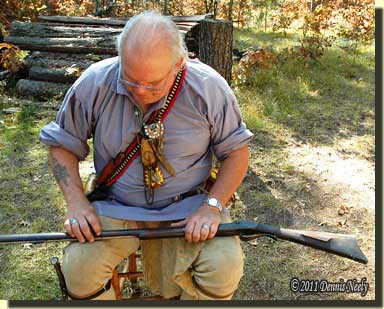
Ted Jayson pointing out some rasp marks on the rifle's stock.“She’s a tack driver,” he said during an impromptu show-and-tell session at the same traditional hunting camp. “I didn’t give much for it. It’s got rasp marks. It’s real rough, but I’m not going to jinx her. She’s percussion with about a 915-pound trigger pull. No butt plate. An antler nose cap and heel plate. A filed steel toe plate.  A 42-inch Green Mountain barrel. A simple walnut stocked southern style gun. It’s a perfect tool. I didn’t shoot that squirrel, Ugly Betty did.”

Traditional hunting is not a spectator sport. I have to constantly remind myself that living the 18th-century lifestyle is not for everyone. It is not easy, but the rewards are tremendous and the fun is unmatched. To say the least, you can’t do it on the couch or in front of a computer screen—you have to be an active participant. Like my clothing, accoutrements and blanket, you won’t see “never been outdoors” etched on my headstone.

Live the 18th-century life, be safe and may God bless you.

Posted in Clothing & Accoutrements, Living History, Worth thinking about... | Tagged , , , , , , , | Comments Off on “Never Been Outdoors!”

Forting Up

The hand-hewed stair seemed steeper, the uneven steps higher. Progress proved slow, the staircase being narrow and confining. Trepidation marked each moccasined footfall. A knowing silence fell upon the twenty-five souls, each pondering the fort’s fate, and his or hers, too. In a smattering of minutes, sweating humanity packed the blockhouse’s second floor as the commander gave orders. Only minutes remained before the first volley. It was June 11th, in the Year of our Lord, 1794…

A loud yell sounded the alarm. “To the fort, everyone to the fort,” I heard in the forest, to the southwest of the blockhouse. A younger man walked fast by me. The stranger never looked my way nor spoke. An abandoned evening meal simmered in a brass kettle in front of a grayed wedge tent, pitched beside the fort. Woodsmen, mostly carrying rifles, bumped shoulders as they entered the south door, then turned right to the stair. I held back, choosing to enter last.

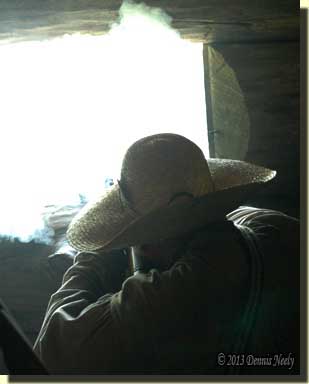
A woodsman fires through the gun port while others load.A settler wearing a dirty frock removed the slab doors from the portals. Bright light streamed in. “Commence loading,” Captain Roberts said in a clear, yet stern voice.

Steady fingers measured gunpowder. Wiping rods thumped patched balls to a half-dozen breeches. Moccasins shuffled as two volunteers shoved their rifle’s muzzle through the break cut in the fourth log from the floor. Each knelt, then primed. The younger man crossed himself, then took careful aim and waited on the Captain. “FIRE!” Captain Roberts yelled.

The two rifles roared at the same instant. Thick white smoke trailed from the muzzles as the pair scrambled to their feet, making way for the next two defenders. Again, two different woodland warriors poked their rifles through the cut in the logs, knelt, primed and peered over the sights. The right rifleman fired first, then the left.

The sulfurous stench of spent gunpowder filled the cramped, second-floor room as the fort’s defenders alternated at the gun ports. The afternoon’s sweltering heat pressed down through the cedar roof shingles, adding to the day’s stifling humidity. Shaky fingers grasped brass and horn powder measures, often spilling a portion of a lethal charge before it reached the safety of a warming barrel. Patch knives slipped, leaving ragged edges. Once in a while a death sphere thudded on the plank floor, then rolled to rest in an open crack with an eerie foreboding.

“I heard it hit,” a greasy hunter said to a well-dressed merchant trying to get to his feet. “You did?” the gentleman asked, straightening his linen waistcoat. Those two brushed shoulders as they passed, which was all too common. In succession, each pan flash illuminated the darkened cavern, lingering as a momentary white patch floating before my eyes. Then all too soon Captain Roberts yelled “Cease Fire!”

In Defense of Fort Greeneville

The Battle of Fallen Timbers in August of 1794 marked the end of the “Indian Wars” that plagued the frontier settlements for five decades. On August 3, 1795, General Anthony Wayne, along with the prominent Native American chiefs of the Ohio country, signed the Treaty of Greeneville at Fort Greeneville in northwest Ohio.

Reading through the journal accounts of that era, which happens to fall in the middle of my chosen time period, it becomes obvious that the dangers and violence associated with daily life in the Old Northwest Territory led to a healthy caution among backcountry woodsmen. The problem traditional black powder hunters face is how to re-create the feelings and emotions evoked by everyday hostilities, and more to the point, how to incorporate those conditioned responses into the fabric of a traditional hunting scenario.

In the late 1990s, Ricky Roberts and several of his fellow living historians discussed this problem, wondering what it must have been like to defend a frontier fort against a hostile attack. Others got involved in the discussion, and in June of 1999, Ricky Roberts’ wonderings evolved into the “Fort Greeneville Match” at the National Muzzle Loading Rifle Association’s Max Vickery Primitive Range, located on the association’s home grounds in Friendship, Indiana.

This unique shooting match honors all participants in the conflict: General Wayne and his men, the chiefs and warriors of the Miami Confederacy and the backwoods settlers of the Old Northwest Territory. The setting is the fort at Greene Ville prior to the signing of the treaty, and the premise is the fort is under attack. Folks close by the two story blockhouse on the Max Vickery Primitive Range are urged to “fort up” and mount a common defense. Fortunately, the attackers don’t return fire.

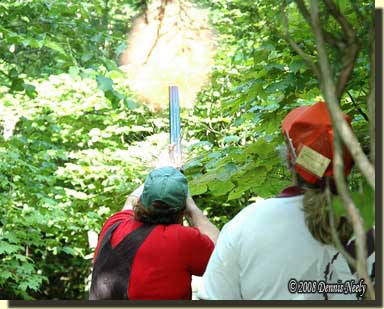
Smoke fills the window as a defender fires his 18th-century rifle.To maintain the historical integrity of the time period, the match is for flintlocks only—rifles, smoothbores and military muskets. Everyone must dress in period clothing, and to make the competition fair, each participant draws a playing card to match up in three-person teams. Two teams shoot in each relay, one team to the left gun port and one to the right. The targets vary each spring; this year eight-inch steel clangors hung at about 90 yards.

Team members start with their guns loaded and unprimed. Shooters load and fire as many times as they can during a set time (this year it was five minutes), priming only when the muzzle is through the window and pointed safely downrange. A certified range officer keeps the stop watch and oversees both teams.

The “Blockhouse Classroom”

I first competed in this event in June of 2003. Much to my surprise, I came away with a tremendous sense of kinship to the other members of my team and to several of the characters who wander through the history of the Old Northwest Territory.

For example, about a month ago I was studying Jonathan Alder’s narrative. At one point, Alder wrote about a skirmish with General Wayne, told from the Native American perspective. Within the passage is this vignette:

“An Indian that stood behind a tree close by asked me why I didn’t shoot; he was loading and shooting as fast as he could. I told him I didn’t see anything to shoot at. ‘Shoot those holes in the fort,’ he said, ‘you might kill a man.’ I told him I didn’t want to shoot. ‘Well then’ said he, ‘you had better get out of here. The first thing you know you will be shot.’ Said he, ‘Didn’t you see the bark fly a little above your head there a little bit ago?’” (Alder, 110)

This passage got me thinking about the Fort Greeneville Match. For a number of years, the complexion of this match has been more about learning and less about winning. I have been a part of a winning team before, but I now look at that match as an extension of my wilderness classroom—the “blockhouse classroom” if you will—a setting that offers a traditional hunter the opportunity to experience a few fleeting minutes of frontier life first hand.

When I read “…loading and shooting as fast as he could,” I vowed to concentrate on the loading of “Old Turkey Feathers.” In the last year, I have discussed the traditional loading process of a Northwest trade gun with a number of knowledgeable living historians. Opinions vary, as one might expect, but prior to the match, I chose to test one theory in particular. The results were mixed and need further testing and refinement before I go into detail.

But in the midst of my test, I discovered two limiting factors that I never considered. The first is the amount of round balls a person carries and the second was the interdependence upon other combatants.

When Ricky called for a cease fire, I had to dump my eighth shot into the bank. There is no question I could have loaded and fired more often during the match, but that was dependent on the rhythm that was established between myself and my partners. It became clear that attempting to step ahead would upset the other fellows’ loading processes and the team’s efficiency. This concern, in turn, highlighted the need for a consistent level of accuracy, in essence the importance of making each shot count.

Along those same lines, I started questioning how many round balls were carried. I had 22 in my pouch, and at my established rate of fire, I came with enough to last for just under fifteen minutes. I immediately started thinking about the purchase of thirty round balls for a prime beaver pelt, but the additional eight balls only adds another five minutes of fire power. So the question is, “How many rounds did they consider enough?”

I understand that the British documented how many balls were issued to each soldier, and I think there is some guidance in those numbers.  But I also believe a forted situation is different, to say nothing of casting rifle balls during a prolonged siege. And as Alder’s narrative suggests, which side your persona is on makes a difference, too. At the very least, these issues deserve more discussion and a heap of pondering.

To be sure, treeing in the forest eliminates the dependence on other shooters vying for the same gun port, but that still doesn’t answer the latter question. Like so many wilderness classroom lessons, I came away with more questions than answers. But by the same token, the “blockhouse classroom” provided another memorable 18th-century experience.

Give traditional black powder hunting a try, be safe and may God bless you.
Posted in Living History, Wilderness Classroom | Tagged , , , , , , , , | 1 Comment

North of Laughery Creek

The Laughery Valley tortures flintlocks. The summer heat and high humidity are mostly to blame. The same conditions that foster a gorgeous array of lush spring vegetation humble the flint and steel ignition of my beloved “Old Turkey Feathers.” Spent gunpowder fouls thicker. Black goo forms in the priming pan before the smoky wisps cease flowing from the touch hole. The buckskin wrapped around a stout English flint softens, allowing the rock to come free at the most inopportune time. And quite often, when the barrel is heated from successive shots, a traditional woodsman can feel a hint of moisture coating the frizzen’s face.

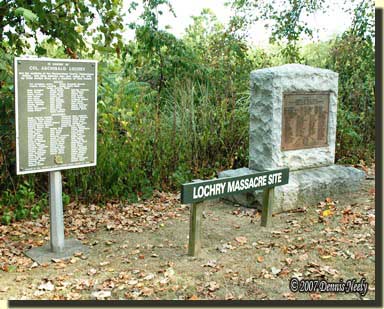
Historical plaque and stone monument for Lochery's Massacre. MOn August 24, 1781, a small flotilla of Pennsylvania militia from Westmoreland County, under the command of Colonel Archibald Lochry, spied a buffalo on the west bank of the Ohio River, near a large creek mouth. Someone shot the animal and the contingent landed in anticipation of a fine meal. The 104 members of Lochry’s command were traveling down the river as they attempted to catch up to the forces of George Rogers Clark as part of the plan to attack the British forces at Fort Detroit.

Unbeknownst to the militia, a small band of Native American warriors headed by Chief Joseph Bryant had been following the soldiers’ advance. Lochry’s men beached their vessels and went about preparing the buffalo and setting up camp. Seizing the opportunity, the Indians attacked. Low on ammunition and caught by surprise, the larger American force was overpowered and defeated in a matter of minutes.

Forty of Lochry’s men were killed in the fight, and he and several others were executed after the battle. The rest were marched off to Fort Detroit as British prisoners of the American War for Independence. In a twist of irony, Colonel Lochry’s name was incorrectly spelled as “Laughery” in the initial government report. The misspelling stuck, and to this day the Laughery Creek flows from Batesville to just south of Aurora, Indiana, passing through the sleepy little town of Friendship, home of the National Muzzle Loading Rifle Association. Today, a monument in the back of the River View Cemetery commemorates “Lochry’s Massacre” with a listing of all of the soldiers involved.

Pondering Archibald Lochry’s Defeat

I couldn’t help but think of Colonel Lochry and his Pennsylvania militia while I hastily changed the flint in my Northwest trade gun. Out of a hundred-plus flintlocks, I suspect some never fired, some fouled from the humidity, some klatched and yet others might have had flints loosen. There is no way of knowing, but when a Michigan hunter deals with the typical weather conditions of another region, the mind runs rampant, or at least mine does.

I pondered as I stood at the loading bench at Shaw’s Quail Walk, up Caesar Creek, which flows along the east side of the NMLRA’s home grounds. Caesar Creek empties into Laughery Creek, which splits the property, roughly 15 miles west of the Lochry monument. A self-imposed urgency surrounded switching the flint, but nothing like dealing with a surprise attack. I can only speculate, lacking firsthand experience. Hunting is a far cry from combat.

I discovered the loose flint after the trade gun’s lock failed to spark on the first station of the ten-clay match. Like bird hunting, a hammer-fall means a lost bird, and I did not wish to gamble on another lost bird. The flint’s wrap was fine about twenty minutes before, when I took my first fouling shot, but the gun sat while I waited for my relay to start. I noticed the leather felt more pliable than here in Michigan. A new flint rested near the tin that held my .125 cards, “just in case.” The trapper and scorer wanted to wait while I finished, but I told them to go on and that I would catch up. No sense in holding up the other shooters.

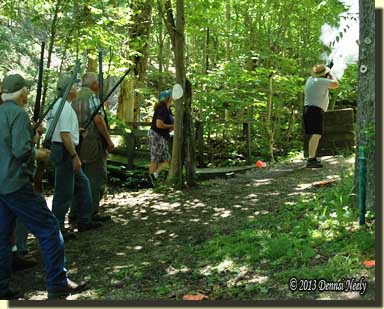
Shooting in the woods at Shaw's Quail Walk.

“Mus’rat Jack” dusts a fast-flying clay pigeon at Station #4 while the next competitors look on.

The course is set up by bird hunters, for bird hunters. This spring there were four clay birds in the woods and six in the field. The hunter starts with his or her gun capped or primed with the butt off the shoulder, below the armpit. Standing behind a painted stone, the shooter takes a few steps forward, like hunting in cover. The trapper has five seconds to release the clay, just as with a delayed flush.

The first two came from the same electric trap, to the right of the path. The difference between station one and two was the position of the hunter. Both birds rose like flushing quail, following the contour of a steep wooded hillside. The opportunity for a shot was narrow.

The third bird came from behind and to the left, arching high like a grouse winging to safety. A pheasant flushed just to the right and a bit ahead on the path, again flying high and almost straight away. Both birds were hard to see in the foliage and offered a scant few seconds to mount, swing and get off a clean shot.

Most of the morning competitors used double percussion shotguns, about half originals and half modern reproductions. As a courtesy, those of us shooting single barreled guns were allowed to move to the head of the line at stations 1, 3, 5 and 7 so we could get our first shot off and then reload while the double gunners shot. That saved time and moved the group along at a steady clip. Usually the course is laid out so two shots are taken from the same general area, again, saving time.

At the first station in the field, a fast mallard crossed right to left in front of the shooter, maybe 20 yards out. Quite a few hunters shook their head, because they shot just as the bird disappeared in the trees. The next bird reminded me of a Sichuan pheasant, hugging the cover low and flying hard as it angled right to left.

Next, a rabbit bounded along the edge of the tree line, left to right. In the afternoon, Fred Alford stepped into the shooting cage as about seven shooters stood in line, waiting their turn. After capping his percussion double, someone started singing/chanting “Kill the wabbit, Kill the wabbit,” from one of the old Bugs Bunny and Elmer Fudd cartoons. After the second “Kill the wabbit,” the whole line started singing, and by the third go round, many of the spectators had joined in. The distraction didn’t bother Fred. He called “Pull!” The right barrel boomed. The clay disc broke apart.

A wood duck arched high from the left and then a battue simulated a woodcock, or so I imagined. The last bird was the Sichuan pheasant, low and fast-flying, but presented as a close-by flush. Being low, that bird dropped quick; like so many folks, I missed what should be an easy hit.

But that is the fun of any quail walk. The birds are simple hunting presentations, which are the hardest to hit. The best score posted for the trade gun match was 8-5-3 (total hits, best string of hits, second best string of hits) and second was 4-3-1. By the end of the week, it will take a “9” or “10” to medal in the trade gun match. Sometimes a shoot-off is needed to settle multiple perfect scores—the competition is that tough.

I’ve been away from competitive shooting for about four years. I have come to prefer slipping away to my 18th-century Eden, instead. But I miss the shooting, and I miss the quail walk. Come September, I hope to spend more than one morning chasing the clays up north of Laughery Creek.

Give clay bird shooting a try, be safe and may God bless you.
Posted in General | Tagged , , , , , , , | 4 Comments

A Thousand Birds

“Old Turkey Feathers’” muzzle parted the prairie grass. A circle of white droppings, not more than a day or two old, stared back. Another roost ring, a few steps to the left betrayed the covey’s habit. My thumb eased the frizzen up, then back down. The prime looked good.

With the barrel held high across my chest, I zigzagged to the base of the hill where old box elder trees lay sprawled into the field like fallen soldiers. The grass grew deeper through the tree tops and hid most of the main branches. At each death pile, my left moccasin pressed hard against an upper branch, then rocked up and down, shaking the other limbs. The effort produced no bobwhites.

A warm October breeze slid down the hill and out into the prairie, barely rippling the browning stems. The sweet smell of drying corn filled my nostrils. Now and again a gnarly stick poked the bottom of an elk moccasin, warning me not to step firm. Orange and lavender painted the undersides of fluffy clouds; not much daylight remained.

My heart began pounding as I approached the largest debris pile, formed by three decent-sized trees fallen on top of each other. My thumb fiddled with the hammer screw; the muzzle crept away from my chest and out over the first trunk. Twice an elk moccasin shook a small portion of the tree top, and twice I moved on.

A doe’s bed, matted in the waist-deep grass, caught my eye. Before rocking the next main branch, I investigated the bed. A white dropping lay at the head end. It smeared, lifting my spirits. I forced myself to stand quiet. In a few minutes, I took three or four steps back to the top, determined to gamble the day’s remaining light on the three downed box elders. “A clean kill, or a clean miss. Your will, O Lord,” I whispered.

A Love Affair with Quail Walks

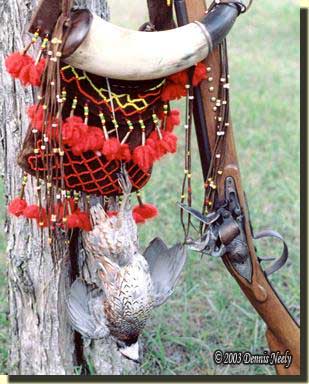
A bobwhite quail, a shot pouch, powder horn and Northwest trade gun.At the 2013 Field & Stream—Outdoor Life Michigan Deer & Turkey Expo in Lansing, one of the guests tapped his finger on a photo of the Northwest gun and a bobwhite quail. He expressed surprise and a hint of doubt at taking a flying quail with a muzzleloading shotgun. He thought muzzleloaders were “only for deer hunting.” Over the course of the weekend, a half dozen other guests shared the same misconception.

Taking a flying fowl with any shotgun takes practice. Growing up, I became frustrated with my inability to hit ring-necked pheasants, ducks, geese and quail with the 12-gauge Lefever Nitro Special shotgun. Mr. Myers, my next door neighbor, always responded with “Be patient, it takes a lot of practice.” If there is one attribute a teenager lacks, it is patience.

When I started down the path to yesteryear and completed building Old Turkey Feathers, my focus was on deer hunting, just as the gentleman said. But I was also a bird hunter, and I started scaring birds during small game season. I can still remember the first rooster pheasant that fell to the trade gun’s smoky roar—I jerked the gun when I pulled the trigger, but the resulting lunge provided sufficient lead to drop the bird. I knew it was a lucky mistake, but did that lemon pheasant and wild rice ever taste good!

I ventured to the National Muzzle Loading Rifle Association’s September National Championship Shoot in 1985 as a round ball shooter. There weren’t many matches for “gas pipes,” but I managed to place in the Smoothbore Seneca a year or so later. Over a two or three year period, Roger Rickabaugh kept insisting I should try the Quail Walk, as they had a “trade gun match.”

One morning I walked up Caesar’s Creek to Shaw’s Quail Walk and watched a match. I sat in amazement as the shooters, both guys and gals, broke most of the birds. At the end of the match, the scorer called out “eight” and “nine” a lot. When I heard “ten” (out of a possible ten clays) I couldn’t believe it. I knew I couldn’t hit a one of those birds.

A gentleman dressed in khaki work clothes saw me sitting there and took a seat on the bench, next to me. “Honey, how are you doing today? Ever shoot the quail walk?” the gent asked. The “honey” unnerved me a bit, well a lot. We introduced ourselves, and that’s how I first met Max Vickery. I learned later that was how Max greeted everybody.

Max was a national champion shooter with piles of medals and trophies. He was a past president of the NMLRA, and  I read his articles in Muzzle Blasts. From those articles, I knew he was an avid bird hunter. We talked bird and small game hunting and I bared my soul, admitting to the accidental rooster. He laughed and said, “Honey, I’ve done that a lot of times.”

Like Roger, he urged me to shoot the trade gun match, and when I expressed my fear of embarrassing myself, he started to sound like Mr. Myers: “Honey, be patient, it takes a lot of practice.” Of course, Mr. Myers would never call me “Honey.” But then Max said something that has stuck with me for all these years: “You need to shoot a thousand birds.”

He went on to explain that I should set that as a goal, that that was what he meant by practice. He assured me I would be a better wing shooter after those thousand clays, and he said there was no better place to start learning than at Shaw’s Quail Walk.

A shot at a clay bird in the woods.

My wife working on her first hundred birds. Here she misses a mid-sized, passing clay in the woods. “I can’t hit clay pigeons” is her usual response.

The quail walk is a hunter’s match, designed by hunters to simulate actual field conditions. The shooter starts behind a stake. When he or she steps past the stake, the trapper releases the clay—standard, midi or mini—in the next few seconds, just as a bird or rabbit might flush. At Shaw’s Quail Walk, there are usually six birds in the woods and a combination of four birds or rabbits in the open field.

At the time, I doubt if two hundred round balls had left the muzzle of Old Turkey Feathers. Through the winter, I mulled over Max’s advice. In the spring, I bought a Trius trap, sunk a post and anchored the contraption. My goal was to shoot two hundred clays before the June matches at Friendship. I don’t remember if I made it or not. But I went to Friendship determined to meet Max’s thousand bird challenge.

I spent the better part of the week at the quail walk—at least twenty rounds worth—and that kindled my love affair with quail walks. Tony Bowman saw me struggling. He struck up a conversation and offered to shadow me through a round. Max and Tony are both gone now, but I think of them often, especially when I bust a difficult bird.

The NMLRA Spring Shoot is next week, and I’m hoping to make it down to Friendship for a day or two. If I shoot nothing else, I hope to wander up Caesar’s Creek to Shaw’s Quail Walk for a round or two. I haven’t had the opportunity to participate in a quail walk in three or four years. If I can hit five birds I will consider it a success, for now. But come September, after some serious range time, I hope to do better.

I took a deep breath before flexing the next branch with my moccasin. It happened fast, the joyous drumming of twenty or so palm-sized wings. Brown feathery flashes exploded from the grass, flying to the four winds. A black-and-white-headed blur flew to the left, then curved around to my back.

The sear clicked. The buttstock jammed to its rightful place. I twisted around. The turtle sight chased the lightning bolt, then swung through. Sparks showered. The smoothbore thundered.

“Kla-whoosh-BOOM!”

As I picked up the limp quail, I said a short prayer of thanksgiving. Then I chuckled to myself as I imagined Max standing there saying, “Honey, I told you ‘a thousand birds.’”

Give a quail walk a try, be safe and may God bless you.
Posted in Quail Hunts, Skills | Tagged , , , , , , , | Comments Off on A Thousand Birds

A First Outing

A good-sized black ant ran along my bare thigh, then took refuge inside my buckskin leggin. Its pace slowed, tickling its way to the left, then to the right, just above my knee. Three times it tried to move farther down my leg, but the weathered, deer-hide whang, snugged around the leggin, thwarted its advance. The ant wandered into the morning’s brilliant sunlight, found its way to the side-seam and zigzagged down the flap. I lost interest after it crossed the second brown oak leaf.

Without thinking, my fingers fumbled for the wing bone and antler call. I sucked air through the hunt-polished bone and muffled the cluck with cupped hands. “Arrkkk.”

A wind gust swayed the top of a close-by oak. The north main branch was still attached to the tree, but hinged down with a half dozen limbs bent or broken into the earth. As the parent tree creaked and groaned, a wrist sized limb sawed back and forth in the dirt, a foot or so beyond my right moccasin. Concealed within the destruction, lost in the spring of 1794, I clucked again, “Arrkkk.”

A doe questions a traditional woodsman's shape.As the sun rose higher, the look of the forest changed. Now and again a cloud brought a dark, fast-moving shadow that dulled the day’s brilliance. During such an interlude, I saw an ear flick in the river bottom near the dead ash trees. Like the ant, the young doe occupied the moment as she browsed through the skunk cabbages. In the fall, the wild turkeys helped me pass deer-less days, and now, in mid-May, a deer here or a deer there returned the favor.

Some time passed before I decided to still-hunt to the northwest. As I got to my feet, I took note of the linen shirt’s open cuffs and how they flopped about on my wrists and the back of my hands. At first, I found the feeling strange and a bit perplexing, but it didn’t take long to realize such happenings are all part of experiencing a new persona.

The Discovery of William Filley’s Captivity

I have many hunter heroes. From the very beginning, I understood my quest to relive the past was different. While the majority of living historians chose to research and emulate the wilderness treks of historical significance, I chose to focus my research on the intrigues and intricacies of the actual hunts of a somewhat obscure group of backwoodsmen. After all, what sparked my interest in yesteryear was a nagging curiosity to experience what it was really like to hunt and survive in the Old Northwest Territory—specifically a plot of ground called the North-Forty.

My reading included the exploits of Boone, Kenton and a few of the other famous longhunters. By searching magazine reference notes and book bibliographies, I acquainted myself with Meshach Browning, Philip Tome, James Smith, Jonathan Alder, Josiah Hunt, John Tanner and other lesser known hunters.

About ten years ago I was in an old bookstore in East Lansing. Tucked away on the top shelf of the history section was a small, pale-green book wrapped in protective plastic. The little book called to me. Much to my surprise, the orphaned publication was the captive narrative of William Filley complete with a characteristic long title: Life and Adventures of William Filley, Who Was Stolen From His Home in Jackson, Mich., By The Indians, August 3d, 1837, and His Safe Return From Captivity, October 19, 1866, After an Absence of 29 Years.

I paid the dealer’s price without dickering and walked out clutching another obscure tidbit of local history. The timeframe was a generation beyond my beloved 1790s. Michigan had barely gained statehood, yet here was a captive narrative set in my home county. The abduction occurred near Fitch’s Lake, which today is Ackerson Lake, in a neighboring township not ten miles from my 18th-century Eden.

Experimenting with a New Persona

The inadvertent discovery of William Filley’s captive narrative planted a seed that took a while to sprout. The idea of a native captivity, historically based in this immediate area, always rattled around in the back of my mind. About a year ago, a new persona, one based on a Native captive who returned to white society but never gave up Native American hunting methods, started to take shape.

The plan was to have a persona in place, complete with the appropriate clothing and accoutrements, for this year’s spring turkey season. That didn’t happen. As my late wife Mary always said, “If you want to give God a good laugh, tell him about your plans for the future.”

Because my emphasis has always rested squarely on the pursuit of wild game, I entered the glade on that mid-May morning with an assembled outfit of appropriate clothing and accoutrements: elk hide moccasins, leather leggins gartered with buckskin whangs, a wool breechclout, a linen trade shirt, a woven sash, a silk head scarf tied turban style, a butcher knife, a trade blanket, and of course, a Northwest trade gun. I wasn’t about to give up a chance to hunt because a new pair of wool leggins or a ruffled shirt or a Native-influenced shot pouch didn’t get done.

To be honest, my expectations were not all that high with respect to meaningful time travel; first and foremost, I wanted an exciting encounter with a fine tom turkey. The morning’s outcome surprised me. The sojourn was different, in a positive way. I found it easy to slip the bonds of the 21st century, and once back in the Old Northwest Territory, I felt like a different person. The clothes felt different, my attitude was different and my perspective on that morning was different.

The linen shirt’s open cuffs, the bare thighs, moccasins without knee socks and the silk turban all felt different. I still-hunted with greater caution, was more patient when I took a stand and paused for longer periods of time. My impression was that I saw more game. I stalked past four does at various times during the morning and that feat seemed easier than normal. Now and again my subconscious rifled through the passages recalled from Tanner, Alder, and Smith, seeking “what would they do” guidance as the chase unfolded.

And as I sat watching the wind saw the limb back and forth in the soil, I resolved to delve deeper into my new acquaintance’s life…

Spend some time with your alter ego, be safe and may God bless you.

Posted in Persona, Turkey Hunts | Tagged , , , , , , , | Comments Off on A First Outing

Plus or Minus Three-Tenths

Few options remained. Daylight dwindled. Longer strides struck a balance between due care and a swift advance. With each footfall, the day’s tensions eased. The hasty still-hunt followed a well-used doe trail through a small stand of aromatic red cedar trees to the little knoll’s crest. December loomed a few days distant; as I recall, the year was 1792.

Fear of discovery, of running on to approaching deer, forced a pause. A leather-clad knee depressed the trail’s churned-up earth. A gentle, southwest breeze rustled the smaller cedar boughs as my eyes peered through a haze of dead branches, searching for legs, hooves and snouts. The air smelled cool and clean, but with a hint of far-off smoke.

A cautious descent found me standing a few paces from the last cedar at the big swamp’s east edge. Half crawling, I stalked the tree, eased back on my haunches and surveyed the swamp and opposite hillside. Satisfied, I shoved the blanket roll into a recess hacked in the tree’s lowest boughs, sat and pulled yellow grass up around me.

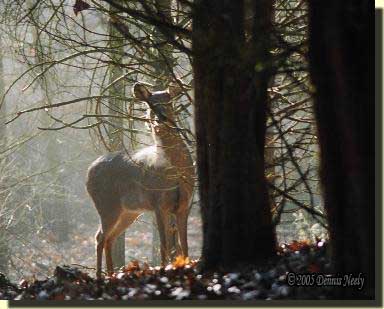
It wasn’t long before a doe and two yearlings ventured from the cedars on the far side of the swamp, about 60 yards away. The usual crossing trail at the south end of the watering hole was upwind, but the matriarch shied away, plodding instead to the downwind side of the pool. She started to cross, but jerked her head and looked into the cedars. The yearlings wandered about, but the older doe kept watch. With a flick of her tail, she turned around and ambled back into the cedar trees.

Two does and three younger deer came next. They milled about as if waiting for the day to ebb a bit more. Gray clouds obliged. One of the does stepped to the trail, but lingered, staring across the swamp. She sniffed the air, nuzzled the muddy path, then sniffed again.  She dropped her head and never raised it until she reached the east bank. The others followed single file. I estimated their closest distance at 30 paces.

Time weighed heavy. Darkness crept over the swamp. With but five minutes or so left, I glimpsed a foreleg. I saw a hind leg move before I saw the buck’s head. I knew he was the one I had jousted with for two years. I saw his tracks now and again, but despite hard hunting, I hadn’t seen him all season. He was almost 100-percent nocturnal.

Even in the failing light, the buck’s long, thick tines were unmistakable. To my dismay, he walked to the next trail south of the one the does used, which angled away from where I sat. When he looked away, I pulled my left leg up, shouldered the flintlock smoothbore and pressed my left elbow into my knee for a steady sitting shot. The moment of truth was at hand. “A clean kill, or a clean miss. Your will, O Lord,” I whispered to myself.

The buck stood at least ten paces beyond the trade gun’s optimum effective distance, and with a minute or so of light left, I pondered my choices. He dropped his head and sniffed the ground, offering a clear broadside shot. I had confidence in the death sphere, the steadiness of the rest and my own ability. My arteries throbbed and with each pulse the light grew dimmer and dimmer. The turtle sight held fast to a rumpled tuft of hair over his lungs, but doubt pricked my subconscious thoughts. The English flint never fell.

As darkness fell, the buck turned north. At the hoped-for-crossing-point, he sniffed the ground, first the does’ back trail, then where they entered the swamp. He chose to cross and I chose to sit and watch and learn…

Confidence in the Death Sphere

Lessons abound in the wilderness classroom. Some days we gain valuable 18th-century knowledge, and at other times we do not perceive the significance or relevance. On that late November evening, I had less than an hour to hunt. It takes but a few minutes to stalk the cedar tree by the watering hole, and at dusk the wind is usually favorable, unless a deer passes to the north.

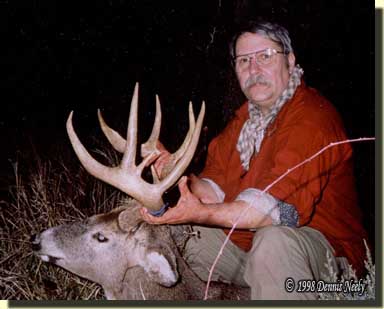
A traditional woodsman holding up a fine whitetail buck.A few days later, that buck succumbed to “Old Turkey Feathers’” fire and thunder; the circumstances were almost identical, other than the distance. But, as with so many of my wilderness stories, the most memorable lessons learned come a day or week or month prior to the actual taking of an animal or fowl.

Normally I use that evening story to point out the importance of living within a pre-determined effective distance, but I thought of that night as I started weighing some lead balls, cast a few days earlier. What came to mind was the “I had confidence in the death sphere” statement and how some classroom sessions don’t take place in the forest or fen.

One morning, a couple years after I began competing at the National Muzzle Loading Rifle Association’s Spring and Fall National Championship matches in Friendship, Indiana, I wandered along the main shooting line. Several pickups were backed up to the loading benches with their fiberglass caps left wide open. I couldn’t help but peak in.

The first had at least a dozen pint Mason jars, each about a third full of lead balls. A piece of duct tape on the top showed the size and what I eventually learned was a grain weight, measured to the tenth of a grain, written in felt pen. I saw similar containers in the next pickup. A simple question resulted in an unexpected lesson on casting and weighing round balls. I don’t remember the gentleman’s name for sure, but my mind suspects it was Clark Frasier—and who better to learn from.

The bench shooter’s message centered on maintaining consistency, and as a result of that conversation, I now follow a set process when producing my “trade gun bullets.” I begin with enough lead to complete the pouring session so the lead composition is the same for that batch. I inspect and adjust the mold before beginning and re-melt the first 25 or so balls until I am sure the steel mold is at working temperature. I prefer to tip the mold slightly to the ladle so the molten stream flows in the side of the sprue hole and allows the air to escape. At the end of the pouring cycle, I level the mold so a small puddle remains over the hole. I wait two or three seconds after that puddle solidifies, then two taps with a lead hammer cuts the sprue. The discarded lead drops to a cottonwood board, the mold opened and the ball gently plops onto several layers of old cotton cloth. I try hard to establish a rhythm to the movements.

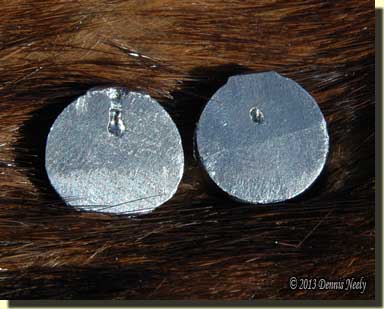
After that shoot, I invested in a 500-grain balance scale. All enthused, I went about weighing the unused balls from Friendship and discovered a twenty-plus grain spread for a sphere that should weigh about 345 grains. That explained why one shot would hit high, the next low and the third somewhere in between. Second guessing set in as I recalled two close misses on a ten-pointer—that’s when I took a serious look at my pouring technique.

Two light cast lead balls with air pockets.

An air pocket does not have to be very big to cause a trade gun ball to shoot high, missing the intended point of impact.

With conscious care on my part, I finally ended up with a descent batch and divided them into three lots—“match grade,” “lights” and “heavies”—with an acceptable tolerance of six-tenths of a grain (+ or – three-tenths) per lot. Those that “missed the cut” end up back in the lead pot. I was later told lights usually have air bubbles; a chisel and mallet proved that to be true. No one seems to have a reasonable explanation for the heavies, other than not keeping the mold tight when casting or a speck of lead trapped between the halves. It may just be the way the distribution falls, too.

Over time, I learned each lead batch scales out a bit different so I use up one container before replenishing the stock. I now have an assortment of containers with duct tape labels. The heavies and lights are relegated to range practice sessions. There never seems to be too many heavies, so they are shot up quick, but that is not the case with the lights. In an attempt to avoid confusion, the leather ball bag in my shot pouch always carries match balls, and that is all I ever use for hunting.

Now weighing trade gun balls to + or – three-tenths of a grain doesn’t fit into 18th-century thinking; the practice is simply a positive side effect of modern competitive black powder shooting. In the English factories where trade gun balls came to life, I suspect there was an element of consistency born out of repetitive action.

The truth of the matter could only be found by weighing a sack of balls left over from one of the trading houses, and I have never seen mention of such a find. In Colonial Frontier Guns, T. M. Hamilton tested the standardization of trade gun balls from various 18th-century archeological sites. He charted 5,175 balls based on actual measurement, but unfortunately, he didn’t think to weigh these relics (Hamilton, 134). I wish he had, and I wish he would have taken a chisel and mallet to a few of the lights. That would be revealing, to say nothing of unnerving a curator or two…

When John Tanner plunked down a prime beaver pelt or two buck skins for 30 round balls, the thought of air bubbles hidden in those balls never entered his mind. But thanks to a bench shooter those thoughts swirl about my mind, from time to time. Filling a ball bag from a container marked “match” is not period correct, but when a fine buck steps out of the cedar trees I have confidence that the death sphere is the best that it can be. I feel I owe that to the game that walks before Old Turkey Feathers.

Give traditional black powder hunting a try, be safe and may God bless you.
Posted in Deer Hunts, Skills | Tagged , , , , , , , | Comments Off on Plus or Minus Three-Tenths