“Remember the Raisin!”

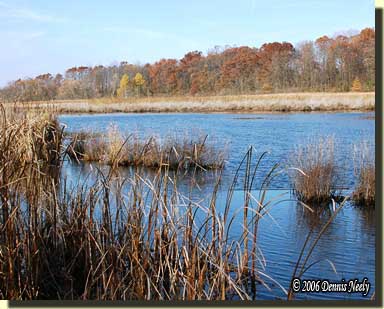
A stiff southwest wind riled the unfrozen River Raisin. Small flocks of Canada geese loafed on the south bank, in the lee of the gusts. Now and again a goose honked while others rested their heads on their backs. A broad sycamore leaf cartwheeled overtop short tufts of prairie grass. Wispy white clouds drifted. The day dawned with unseasonable warmth, nothing like those of mid-January in 1813, and smelled like a strange blend of winter’s dry cold and spring’s wormy, wet mud.

The wind carried the faint, marching cadence of snare drums, distant, foreboding, determined. In a few minutes, the shrill encouragement of fifes joined the drummer’s beat. It was then, when General James Winchester’s legion first came into view in the heart of Old Frenchtown, that three geese banked low overhead. Their constant ke-honking was no match for the fife and drum’s ominous drone.
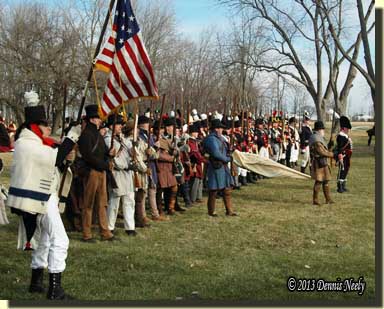
A line of militiamen stand at attention.Lacroix’s infantrymen of the Michigan militia, named for Captain Hubert Lacroix from the River Raisin settlement, led the column. At the east end of Frenchtown, the militiamen pin wheeled left with military precision. The same wind that brought the Raisin to life unfurled the company’s American flag, 15 stars and 15 stripes trimmed with gold fringe. The seriousness of the day marked each soldier’s face.

Other militia companies, some from as far away as Kentucky, and regular troops from the new American Army of the Northwest Territory marched onto the parade grounds. Colonel Henry Proctor’s British forces and their Native American allies stood shoulder to shoulder with the American forces, unlike the days of mid-January in 1813.

The Battle of Frenchtown Bicentennial

This past weekend about 300 War of 1812 re-enactors gathered at the River Raisin National Battlefield Park in Monroe, Michigan, for the solemn commemoration of the 200th anniversary of the Battle of Frenchtown, sometimes referred to as the Battle of the River Raisin. In addition to Michigan, living historians came from Ohio, Indiana, Illinois, Kentucky, Pennsylvania and Ontario, Canada, for the weekend activities.

Old Frenchtown (present day Monroe) was located at the mouth of the River Raisin at the western tip of Lake Erie. In August of 1812, General William Hull surrendered Fort Detroit to British Colonel Proctor, along with the entire Michigan Territory. By the end of the year, British troops and some of their Native American allies occupied the Frenchtown settlement.

After the surrender, President Madison appointed General William Henry Harrison commander of the Army of the Northwest Territory. Brigadier General James Winchester was second in command. General Harrison’s plan was to retake Fort Detroit during the winter. Harrison split his army, led his troops to Upper Sandusky and sent General Winchester with 2,000 untrained regulars and volunteers from the Kentucky militia to the rapids of the Maumee River, near present day Perrysburg, Ohio.

The residents of Frenchtown requested relief from the British occupation; Winchester sent Colonel Lewis with a detachment to Frenchtown, following a course down the Maumee then north along the frozen shore of Lake Erie. On January 18, 1813, Lewis’ men engaged a small detachment of British and Native Americans, driving them from Frenchtown. On January 20th, General Winchester arrived with 250 reinforcements. When Harrison heard of the skirmish, he ordered additional troops to Frenchtown, concerned Winchester might face a strong attack from Proctor.

General Winchester’s troops had not seen any heavy fighting prior to Frenchtown; he expected it would take days for the British to launch an attack. But British reinforcements, both regulars of the 41st of Foot and Native Americans, arrived from Fort Malden. Proctor marched his army over the ice of the Detroit River, bringing six cannons, and stopped five miles north of Frenchtown late in the day on January 21st.
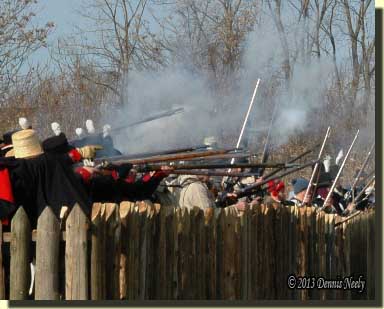
Winchester's troops fire from behind Frenchtown's north fence.The next morning, before daybreak, Proctor counterattacked, catching the Americans by surprise. The Americans were outmaneuvered and pulled back, sustaining heavy casualties. General Winchester was captured in a retreat. Proctor convinced Winchester that Frenchtown would be burned and all the wounded killed by his Native American allies, so General Winchester surrendered. The surrender ceremony was short because Proctor believed Harrison would soon arrive with reinforcements and mount a counterattack.

On the afternoon of January 22nd, Proctor’s British regulars, Canadian militia and those American prisoners able to walk (about 500) set out for Fort Malden. The wounded (about 60) were left behind because the sleighs were full; Proctor said he would return the next day with more sleds and take the wounded to Fort Malden.

The next morning, January 23, 1813, about 200 Native Americans entered Frenchtown, seeking revenge for their casualties. After a confrontation with Dr. John Todd, one of two surgeons left to care for the wounded, the massacre began. The wounded who could get to their feet were taken captive, those who could not were tomahawked. The Battle of Frenchtown, the largest and bloodiest military battle fought on Michigan soil, was now The River Raisin Massacre, kindling the battle cry “Remember the Raisin” for the rest of the War of 1812.

In the aftermath, Colonel Henry Protor was promoted to Brigadier General. General James Winchester spent a year as a prisoner of war. The American force sustained 379 dead, 561 wounded or captured; the British losses amounted to 24 dead, 158 wounded; and the Native American casualties were never recorded.

As an aside, Captain Hubert Lacroix’s militia unit was included in the terms of Hull’s surrender, disbanded and the men released as paroled prisoners of war in August, 1812. Today, Lacroix’s Company is the official War of 1812 Bicentennial Re-enactment unit for the City and County of Monroe, Michigan. As a sub-committee of the Friends of the River Raisin Battlefield (a 501c3 non-profit organization), members of Lacroix’s Company support living history programs at the Monroe County Historical Museum, the Navarre-Anderson Trading Post and the River Raisin Battlefield Park Visitor Center, in addition to participating at other War of 1812 events.

A Reflection and an Opportunity

Walking the park grounds is a humbling experience. For an hour or so the crack of muskets, the cannon thunder, the battle whoops, the brassy bugle notes and the pleasant stench of burned gunpowder gave a sense of life to the Battle of Frenchtown. But like all re-enactments, the crowds thin, gear gets stowed and all that remains are vivid memories, a wind-swept prairie and snapping flags in front of a modern-day visitor’s center.

Before we left, as we sat in the car talking, Tami commented that as the day progressed she felt a reverence for where she stepped. “Real people lived here and fought here and died here,” she said. “I feel a connection to them and a responsibility to them. More and more I feel the same connection on the farm.”
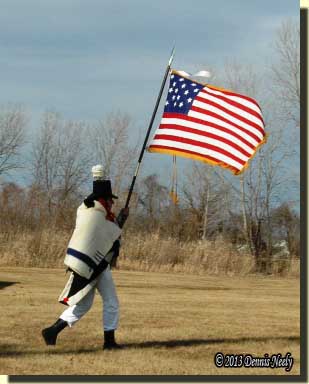
A member of Lacroix's militia caries an 1812 American flag into battle.The bicentennial of the War of 1812 is in full swing. As I watched the soldiers take their places at the “Frenchtown fence,” I realized a tremendous opportunity exists for traditional black powder hunters, both newcomers and old timers. The War of 1812 was America’s second War of Independence, and offers a myriad of possible traditional hunting personae or scenarios, depending upon one’s chosen time period. Yet, rarely have I heard a living historian depicting early 19th-century life in the Great Lakes region mention the war, and only once has the phrase “Remember the Raisin” been uttered.

Those that survived the war, regardless of their station in life, contributed greatly to the settlement of Michigan, and in a broader sense, the Old Northwest Territory. Out of curiosity, I picked up my copy of the History and Biography of Jackson County Michigan. Sticky notes mark several interesting hunting tales. The first I turned to was a story written by Reverend Asahel A. King and dealt with this grandfather, an early settler in Rives. In the midst of howling wolves, marauding black bears, herds of deer and a large turkey is this nugget:

“My grandfather, Asahel King, was born in Massachusetts, Sept. 15, 1781. In the 12th year of his age he was hired to go as a drummer in the State militia. He was a drum-major in the war of 1812. His company was ordered to Sacket’s Harbor [New York] in 1814. Before it got there the British surrendered. An important event happened at the harbor, which is worthy of record. As the British were surrounding the harbor, led by their general, and shouting ‘the victory is ours,’ the American soldiers were few in numbers and expected defeat; a young boy lay sick in a log cooper-shop; but seeing the danger, he leveled his musket at the general, fired, and he fell dead. The British became terrified, and supposing the building to be full of soldiers, they fled in dismay. This, added to other defeats, proved to be a great event in the closing of the war.” (History of Jackson…, 198 – 199)

Suffice it to say, any traditional black powder hunter who portrays an individual in the early 19th century, especially a former soldier who saw service in the War of 1812, should keep the phrase “Remember the Raisin,” on his or her lips. And on this day, two centuries removed, let us take a moment and offer a prayer for those who died and those who survived.

“Remember the Raisin,” be safe and may God bless you.
Posted in Persona, Scenarios, Worth thinking about... | Tagged , , , , , , , | Comments Off on “Remember the Raisin!”

“They’re still wild animals…”

Buffalo hoof prints pocked the frozen trace. Wool-lined moccasins crunched and crackled and slid about on the old snow in the near-zero January cold. Partway up a rolling knob a woodsman’s fur-backed mitten signaled for his two companions to halt. The French hunter crouched forward, then his head rose slow, following the curve of a pine tree’s trunk. After a long look-see he dropped to one knee. The mitten urged his partners closer, but with caution.

“Ahead…bedded…I count six, maybe more,” Ed Schmitz whispered. He tapped his chest and pointed west; he motioned Rex Coleman east, then the mitten curled earthward. Gary Freiburger nodded, acknowledging he was to remain by the pine. Freiburger’s .50-caliber flintlock downed a fine buffalo heifer the afternoon before.

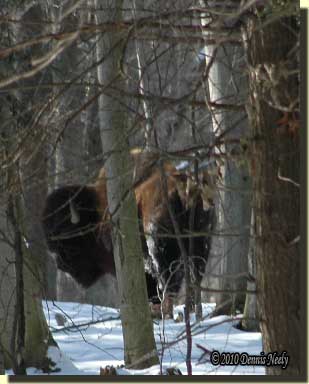
The bull buffalo got to his feet and started to walk away.As the two hunters stalked in different directions through the pine grove’s dark shadows, a magnificent bull got to his feet. In a few heartbeats a second, younger bull stood as the first turned and walked south. Cows and heifers got up, stretched, then ambled after the two bulls, nose to tail in a single file line. The three could only watch as the wild cattle disappeared over the hill’s crest.

“They headed south,” Schmitz said, still whispering as he peered at the empty hilltop.

“I can try to circle ahead of them,” Freiburger offered, “and cut them off before they get out of the woods. If you both go east, I’ll try to push them back on the east trail.”

“Okay, but be careful. You don’t need a buffalo charging you,” Schmitz said.

Not knowing for sure where the buffalo were, Coleman and Schmitz stalked tree to tree across the knob, down the far side and up again to the east trail. Once there, Schmitz brushed the snow off the two main limbs of an oak top, sat on the lower limb and rested his Fusil de Chasse over the upper branch. The woodsman’s deathly shape melted in to the natural lair. Coleman leaned against a stout oak, maybe 20 paces north of the oak top, half hidden behind the trunk.

Now and again the pair exchanged glances, but neither spoke or moved quick. The better part of an hour labored by, then Coleman made a faint kissing sound to garner his companion’s attention. With his eyes fixed on the center of the forest, Coleman made it clear the herd was approaching. From his sight line, it appeared they would pass to the west, rather than on the east trail, but neither hunter committed, choosing to wait.

At about 100 paces the column halted and the buffaloes milled about, looking like they intended to lie down. But the big bull seemed impatient. After a few tense minutes, he started to walk due east. The younger bull balked and stood his ground, but when the herd sire kept plodding, the young bull relented. The cows and heifers joined the procession. And at the east trail, the wild cattle turned north and closed ranks, nose to tail. The two woodsmen glanced at each other, then cocked and shouldered their arms. The moment of truth had arrived.

A Belated Pristine Moment

On that cold January morning, I tagged along on a traditional black powder buffalo hunt. I was dressed as an 18th-century woodsman, but I carried a Nikon camera, a journal page and a brass lead-holder instead of “Old Turkey Feathers.”

By my definition, the primary purpose of any traditional black powder hunt is to provide food for the family dinner table, but to do so in an historically accurate manner, centering on a bygone era of the hunter’s choosing. Ed Schmitz, Gary Freiburger and Rex Coleman were doing just that, but at a managed game preserve, which raises an important point relative to traditional hunting methodology.

The traditional woodsman could only watch as the buffalo walked away.The “third” key element of any traditional black powder hunt is the reliance on fair-chase—incorporating our rich American hunting history and using an arm stoked with black powder as a propellant are the other two. This third element, a fair-chase pursuit, clearly was not present; yet, I was hard pressed to tell the difference, other than the buffalo were not allowed to run for miles in one direction as the old journals sometimes read. As Ed Schmitz later said, “Les’ ranch covers a large area. When it takes me two and a half days to find an animal, at it all daylight hours, and you’re beat from the chase, then to get close and finally harvest [a buffalo], it’s a hunt.”

The other day, as I skimmed through Duncan M’Gillivray’s journal searching for a different passage, I happened upon one of his buffalo hunting exploits. In 1794, Duncan M’Gillivray, the younger brother of William M’Gillivray and a nephew of Simon McTavish (McTavish, Frobisher & Co.), wintered as a clerk for the North West Company at Fort George on the Saskatchewan River. On the trip to Fort George, M’Gillivray wrote:

“20th. Septr. [1794]…Tho’ we killed abundance of animals to maintain the people, yet the Buffaloes are not so numerous as usual in these parts…At 3 O’clock P.M. Mr. Shaw killed a large Stag; soon after I crawled up to 2 Bulls and shot one of them through the heart; the other hung over him as if to lament the loss of his companion and received my shot in the ribs upon which he advanced a little further and lay down with great composure. I was not unaware of the danger of approaching a wounded Buffalo in a capacity to shew his resentment, but I apprehended no danger from him, as he seemed mortally wounded, however he soon convinced me of my error, by suddenly starting up and springing upon me with the quickness of lightening, and before I had time to fly he caught me betwixt his horns (one of which tore my shirt and Jacket) and tossed me a great height in the air. Tho’ I was greatly stunned by the Fall, yet I recovered myself as soon as possible and discharged my piece at his head, which, with seeing Mr. Shaw running to my assistance, made him scamper away into the woods, where we pursued him and found him dead at a small distance, and if the approaching night had not prevented us we should have kindled a fire upon his hatefull carcase.” (M’Gillivray, 24 – 25)

This passage brought to mind Ed Schmitz’s admonition to Gary Freiburger, more of a reminder than a warning; Freiburger was fully aware of how dangerous an American bison can be. “This isn’t easy,” he later said. “They’re not tied to the fence…they’re still wild animals. They’ll kill you if you aren’t careful. They’re like a freight train.”

Caught up in the midst of a real life drama, Schmitz’s words, “You don’t need a buffalo charging you,” served only as a statement of fact. At the time, the passing phrase did not unlock time’s portal, rather it lay dormant for almost two years. I have read M’Gillivray’s words before, highlighted some of the sentences and even put a notation in the margin, but only after a firsthand pursuit of wild cattle did they come to life—my experience mirrored that of M’Gillivray. I also realized M’Gillivray failed to heed the warning, “I was not unaware of the danger of approaching a wounded Buffalo,” and the consequences of that choice.

Some traditional hunts turn out to be ordinary while others prove to be extraordinary. The latter is true of that traditional buffalo hunt, in part because it provided, and continues to provide, a number of pristine moments. As a traditional woodsman, I have no idea what the outcome of a given living history simulation will be. No time traveler does.

A specific list of dos and don’ts, either prior to or during a given traditional hunting scenario, simply does not exist. Certainly, diligence, attention to detail and an honest attempt at maintaining authenticity help, but there is no secret path, no magic formula for producing a meaningful and memorable historical simulation. The best experiences, the ones I cherished the most, materialize when I least expect it. Yet, in truth, such happenings can never come about if I do not strive to venture back in time at every opportunity.

Give traditional black powder hunting a try, be safe and may God bless you.
Posted in Buffalo, Scenarios | Tagged , , , , , , , | Comments Off on “They’re still wild animals…”

“I followed up the animal…”

A deer’s head bobbed up in the poison sumac and marsh elders. Its ears flicked front to back to front. It looked side to side displaying noticeable concern, then disappeared in the thick wet snow that clung to every twig and branch. In a minute, a second deer’s head appeared in the same spot. It looked about, but displayed less caution before vanishing. Well beyond the Northwest gun’s range, the deer teased a patient woodsman.

It was mid-December, in the Year of our Lord, 1793. The night’s snow tempered the fall’s unseasonable warmth. The air smelled clean, but heavy with moisture. Every bush, every bough drooped from the snow’s weight, forming an impenetrable curtain that worked both for and against the deer.

Now and again a white clump fell earthward, some broke apart in a crystalline shower while others thumped hard. When the first deer’s head popped up, I stood still. After its head dropped, the scarlet trade blanket that covered my left shoulder pressed against an oak trunk as I waited for the latest woodland scenario to play out. Although snow splattered the blanket’s folds, I was as vulnerable to detection as the deer were, yet Nature’s white curtain protected me, too.

Snow melted on my cheek as I watched the thicket, hoping for a fine buck to follow the two does. Uphill a bit, a crimson cardinal tried to perch on the tip of a cedar bough, but the little songster started an avalanche. The cardinal flew straight up, hovered, then looked down in wonderment before choosing a wind-fall oak limb.

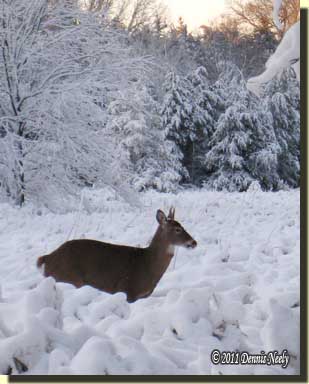
A whitetail deer standing belly deep in the snow.In due time my winter moccasins advanced. I followed the trail at the edge of the big swamp and headed south, taking single steps, then pausing. That morning’s still-hunt coursed around a little bend. During a pause, a patch of brown hair moved in the shadows of the cedar trees on the far bank. I watched. A foreleg stepped; a hind quarter followed. In a few minutes, a deer emerged, maybe 80 paces distant, sporting two graceful spikes.

The young buck showed the same cautious nature as the first doe, pausing as I paused, looking around as I had. It walked through the dead golden rod sprigs and stepped into the sedge grass, choosing a trail that angled south. A few steps into the swamp he stood straight-legged and peered south. I took that opportunity to drop to my knees. The buck looked north, but failed to fully check the little bend. Unsatisfied, he gazed south again.

With a shake of his head and a soft snort, the spike loped across to the safety of my side of the swamp. It seemed that this deer was bent on continuing south, but experience told me to wait and see. I reached under the four-point blanket with my left hand and pushed back the two layers in preparation to sit. As the young buck had done, I took a long look, then rolled back. “Old Turkey Feathers’” forestock rested on my left knee as I arranged the blanket so it would not interfere with a clean shot. With my back to the swamp, I watched the hillside trails, but the spike never came my way.

A Constant Flow of Movement

As living historians, traditional black powder hunters attempt to re-create the hunts of long ago. The traditional woodsman relies, in part, on the journals of individuals who lived in his or her chosen historical time period to re-create these adventures. When the historian happens upon an intriguing tale, he or she reads that passage, thinks about what it says and then re-reads it, sometimes over and over. By their very nature, most of these old hunting stories are sketchy at best and require long-term cogitations, additional research and experimentation in the wilderness classroom. That is the nature of living history.

The quest for an authentic and meaningful portrayal is endless. Yet, I fear that sometimes the disciplined research and the thirst for documented authenticity overshadow not only the personal skill development side of traditional black powder hunting but also the fun. Since October I have been re-reading and studying John Tanner’s narrative: The Falcon: A Narrative of the Captivity and Adventures of John Tanner. The primary purpose of this exercise was to gather a better understanding of Tanner’s clothes and accoutrements. But as I read, I found myself trapped in the narrow tunnel of material culture documentation, and so I thought it best to put Tanner’s journal aside for a couple of weeks.

This brief hiatus refreshed my perspective and helped me step from the confines of my tunnel thinking, at least far enough back to observe a bigger picture. Present in so many of the 18th-century journals and narratives is a somewhat constant flow of movement with respect to the hunter’s methodology, be it called “stalking” or “still-hunting.” And in Tanner’s case, many of his hunting exploits are prefaced with the movement that led to the discovery of his quarry:

 “As I was one day going to look at my traps, I found some ducks in a pond…” (Tanner, 60)

“Going one day with Waw-be-be-nais-sa a good distance up the Assinneboin, we found a large herd of probably 200 elk, in a little prairie which was almost surrounded by the river… (Ibid, 65)

“…I reached a place about a mile distant from camp, and in a low swamp I discovered fresh moose signs. I followed up the animal, and killed it…” (Ibid, 81)

A Closer Look at Still-Hunting

Of late, more readers, traditional and modern folks alike, are asking me about still-hunting. I have still-hunted since Frank Hubbell first suggested “stalking the deer,” I was an impressionable teenager at the time. When I’m engaged in a still-hunt I don’t give the step-by-step methodology much thought, but from time to time, I shall attempt to put in writing some of my practices.

I feel compelled to begin with a word of caution. In many locales, moving about in the forest during a firearm deer season is an unsafe practice, and thus should never be attempted. It is the responsibility of each individual to determine and assess what constitutes safe hunting methodology in his or her particular situation. In addition, the amount of hunter orange clothing (sometimes more than is legally required) is of vital importance to a traditional hunter clad in 18th-century linen and leather garb.

If it is deemed a safe practice, still-hunting is an acquired skill that takes time and patience to develop. In the early going, learning to still-hunt is fraught with frustration and marked by more failure than success, but once a basic level of woodland stealth is reached, the rewards are tremendous.

Trash Today’s “Schedule Mentality”

On that December morning, in my chosen year of 1793, I did not walk into the forest and sit in a “people box,” as my wife calls the local deer shanties, in hopes that a whitetail might venture within 70 paces. No, my woodland heroes did not hunt using that methodology; they went in search of their next meal.

John Tanner, Meshach Browning, Jonathan Alder, James Smith and all the rest of my hunter heroes were tenants of the forest, along with the deer, the wild turkey and the lowly song sparrow. Thus, to walk in Tanner’s moccasin prints, the traditional hunter must study the forest’s many tenants and endeavor to join them.

In today’s world, game is aware of the hunter’s presence before the hunter realizes game is present. Moderns are an impatient lot, driven to clock watching, either consciously or subconsciously, by society’s obsession with being “here” or going “there.” But a successful still-hunter knows no schedule; he or she has no fixed time allotted to traverse the glade. And there is no mention of scheduling in the ancients’ journals, save setting a time and place to meet up, either during or after the hunt.

“Late in the evening, Tom [Springer] killed a large buck and by the time we got it skinned and cut up, it was night. Tom wanted to know what we would do. I told him we would have to camp for the night…” (Alder, 125)

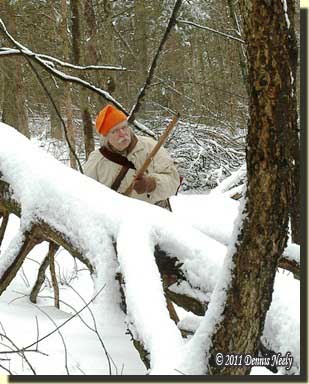
A traditional woodsman pausing behind a snow-covered deadfall.So my first piece of advice is to trash the “schedule mentality.” To clarify, I do not mean leave your watch at home, but rather work to achieve a mental attitude that cleanses the mind of time dependence. In Jonathan Alder’s case, after Tom Springer killed the buck, Alder did not say, “Hurry up, Tom, I’ve got to be…” The pair skinned and cut up the deer and camped for the night.

Now returning to that December still-hunt, the length of a pause or the number of steps taken between pauses was not fixed, and never is. I have no set rhythm to my ramble, but rather, I weigh each moment and the results of each movement as it occurs, just as that first deer, the cautious one, took its time to assess the security of its circumstance. The point of that deer’s care and concern was to detect danger before it escalated into life or death importance; the purpose of my action was to overcome the deer’s natural defenses without being discovered.

On most still-hunts, I try to progress at a slower pace than the deer, and that pace varies based on the cover, weather conditions, time of day and a host of other factors, some location specific, learned by trial and error. My thought is to allow the deer to move into my immediate area, rather than me into its. That is not always the case, especially with bedded whitetails, but on that morning, two deer passed into and through my area, and a third, the spike did likewise.

If I was stand hunting or hidden in a people box, I would never have seen the spike; by choosing to still-hunt, I happened upon the young buck in the same manner Tanner discovered the ducks, the 200 elk or the moose. Experience taught me to drop to my knees, to reduce my upright human shape to a bump, and experience dictated that the best course was to sit a spell and wait on the buck, once he crossed to my side of the swamp. He never came my way, but had I moved, I would have spooked him. And when he didn’t follow the north trails, I did as Tanner had done: “I followed up the animal…”

Give traditional black powder hunting a try, be safe and may God bless you.
Posted in Deer Hunts, Skills | Tagged , , , , , , , | 2 Comments

The familiar words came easy…

A cold fall rain turned to blowing snow. The lingering fall slipped away in two days’ time. Soft ground froze firm. A thin layer of white carpeted the glade. Except for the crows and a blue jay or two, silence reigned over the forest and fen. 1795 ebbed.

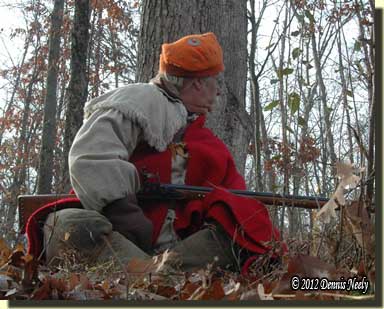
With an hour remaining in the day, my moccasins stalked a hidden knoll, a place I hadn’t visited in several years. It is here the main ridge veers west. The little knoll rises up as if God had no place to pile the dirt when he bent the ridge so sharp. The red cedar trees grow tight. In summer, the upper boughs block the sun, offering cooling shadows, but when the sun takes its shortest path, this spot becomes dark and subdued, even with a snowy coat. When I came upon a doe’s abandoned bed, I pulled the scarlet trade blanket snug and weaseled between four cedars. I sat with a dainty breath of wind to my face.

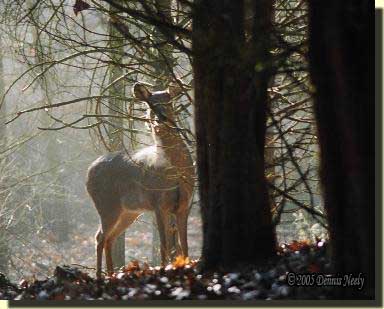
A doe questions a traditional woodsman's shape.Before me, the hill fell steep into a bowl where a woodsman’s scent swirls, even on a calm night; the bowl is an almost impenetrable fortress filled with snorts and stomps and waving flags. Here and there a glimpse of snow peaked through the tangled limbs, but only enough to warn of movement, not enough to know what moved. To my left, faint trails crisscrossed the hillside, weaving over the ridge, curving north and angling south. One path passed beside me, not ten paces distant, holding three sets of whitetail tracks.

Right at dark a single deer wandered in from the west, slow and lazy, but still cautious. This deer was but a shape; without the white background, it was all but invisible. It sniffed the ground and lingered at an intersection of two trails. The young deer found my moccasin prints and nuzzled the snow as if wiping them away. I dumped the firelock’s pan and eased the hammer down. The evening’s hunt was over, but a wilderness challenge was just beginning.

It has never been my habit to intentionally educate a deer, especially a young one. It is my belief that when a deer ventures close the true test of a woodsman’s skill is to allow that deer to pass without detecting the hunter’s presence. This is easier said than done, knowing the wind often is the betrayer, but nonetheless, a key part of becoming a wilderness tenant is to traverse the glade with the same sagacity as the deer, the wild turkeys or the chipmunks.

Minutes passed like idle hours, then this deer walked a few steps east until all I could see was a rump and tail. It came back, pawed the ground and took several steps north, in my direction. Ten paces distant it stopped and stared, jockeying its head from side to side, up and down. I felt wind on my cheeks. I squinted and breathed through my mouth, directing a chilly fog down against my black silk neck scarf with my upper lip. Satisfied, the deer took two more hesitant steps before turning back to the trails’ intersection.

I glanced down, and to my eyes, the scarlet blanket looked to be a deep charcoal gray. It was getting harder and harder to see the deer; movement was its betrayer. From its head shape and actions, I suspected this was a button buck, and I did not want to risk spooking it by standing up and walking out, so I just sat quiet and waited.

After several minutes, the young whitetail’s manner changed. It kept its head up and I think it looked from side to side several times. It glared my way, then began to descend the hill into the bowl and out of sight. I sat for a while, before getting to my feet and stalking straight away. Unseen branches slapped my face and clawed at the blanket. I chuckled. I had not stalked out this late at night in a long time. It was like an early morning still hunt before dawn, but in reverse.

My moccasins found the wagon path and followed the two ruts south. My course paused at the last tree, a three trunked oddity, at the bottom of the hill where the road curves around the big swamp. My eyes surveyed the swamp and white oak island. The sky was clear, the air crisp. A first quarter moon hung low over the far tree line. A bright star glowed close by. I could not move. My lips uttered a prayer of thanksgiving for the blessings of the fall as I watched that star. Christmas was but two days away, and the familiar words came easy…

“And there were in the same country shepherds, abiding in the field, keeping watch over their flock by night. And, lo, the angel of the Lord came upon them, and the glory of the Lord shone round about them; and they were sore afraid. And the angel said unto them, Fear not: for, behold, I bring you good tidings of great joy, which shall be to all people. For unto you is born this day in the city of David a Savior, which is Christ the Lord.” (New Testament, Luke 2: 8 – 11)

May the peace of the Christmas season be always with you, be safe and may God bless you.
Posted in Deer Hunts, General | Tagged , , , , , , , | 3 Comments

Two Unexpected Arrivals

Morning dawned without a sunrise; night succumbed to a hazy, dull gray. In due time, a roosted wild turkey, treed to the north, uttered a hushed putt. Another bird, perched high in a leafless red oak across the narrows, whispered a purr. Other turkeys joined in the tree talk, all in subdued, almost inaudible tones. For over an hour, the bird’s quiet banter offered the only sign of life in the glade.

That day, in the Year of our Lord, 1795, a thin fog wandered through the big swamp’s poison sumac patches, scattered elders and amber sedge grass. The air smelled moist and heavy, too fall-like for mid-December. A cool butterfly wind caressed my right cheek. Yet, a minute or two later the same breath nuzzled the hair at my left temple. The fluky breeze pushed the wispy fog to and fro, leading me to believe a cold rainstorm was not far off.

A house wren flitted to a bottom branch of the left-most of two tall red cedar trees that stood guard at the fen’s cut bank. In a few moments the little bird dropped to a purple raspberry loop; the fragile switch never moved. On the ground, I watched the wren rustle one oak leaf at a time, but I could detect nary a sound. I glanced uphill, checking the middle trail for deer, and when I looked back the wren was gone.

Before first light, a still-hunt brought me to a keg-sized oak with a thick grape vine growing from its root. My left shoulder pressed against the oak’s trunk, my back rested against the vine. To the south, the dead branches of an old cedar tree, three paces distant, blocked meandering whitetails from discovering my presence; downwind, only the trade gun’s muzzle was visible.

When I first arrived at this lair, I brushed away the rotting duff with my left moccasin, then scraped the soft topsoil back and forth to fill the air with a hint of fresh turned earth to mask my deadly scent. Crossing trails emerged from the swamp on either side of the two cedar trees, but on that morning a deer had yet to use one of those trails. In the distance, I saw a doe come down the hill, pause at the swamp’s edge, then disappear in the canary grass and poison sumac.

“Caw, caw, caw, caw, caw, caw…” Two crows started a ruckus at the wagon trail on the ridge crest. One blue jay joined in, then two, then three as more crows flew over the big swamp from the east.

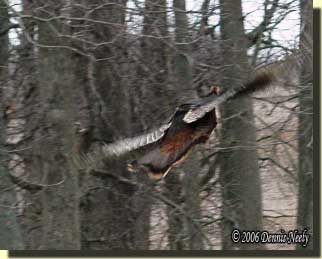
A wild turkey hen flies straight away.“Ark, ark, ark, ark, ark…” Still roosted, the turkey in the oak straight across the narrows clucked a long strain, then stopped mid-cluck. After the crows took their melee to the west, I turned my attention back to the crossing trails. The turkey gave two crisp “arks.” Big wings flapped. The bird coasted across the swamp, arcing closer to the ground with each wing beat, and thumped down in the leaves a mere 15 paces to my left.

I peered around the oak; the young hen stretched her neck and eyed the unexpected woodsman. My right thumb pushed the frizzen up. “Old Turkey Feathers” rolled. Gunpowder spilled from the pan. The hammer eased down as the muzzle inched for the hen’s eye. Missing a chance at a fine buck was a nonexistent possibility.

Two other wild turkeys yelped from uphill, near the fallen cedars. With the roll of that hill, I knew they could see the flustered hen and she could see their heads; I wasn’t surprised when she ran for safety. That pristine wilderness moment sprinted away, as well. With my heart racing, I realized I had watched over the shouldered trade gun’s browned barrel. In 18th-century terms, a head shot presented an improbable challenge, but hitting the body with the death sphere was not.

The firelock’s hammer clicked to half-cock. With my thumb over the horn’s spout, gunpowder again trickled into the Northwest gun’s pan. Once settled, I reached inside the linen hunting shirt, pulled out the leather envelope and untied the thong that held the flap closed. The brass lead holder scribbled across the folded page devoted to that morning’s hunt, recording the unexpected hen’s arrival with the same intensity of her wing beats. As I wrote, a squeaky set of clucks and putts came from the ground, not far from the tall oak. “Will another fly this way? Sounds like one in the swamp, walking to the poplars,” I scrawled.

A single deer walked off the south island and disappeared in the elders and red willows. I saw it leave the swamp and walk uphill, and as I concentrated on that deer the squeaky, sporadic turkey calls became a steady string of louder clucks followed by silence: “Ark, ark, ark, ark, ark…”  When I heard two sharp “arks” like I had not ten minutes before, I dumped the pan’s charge and eased the hammer down.

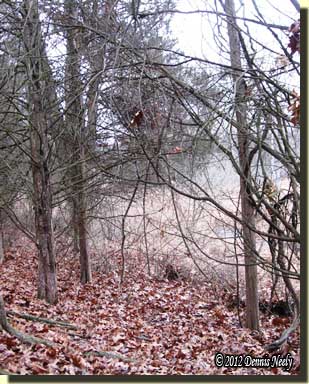
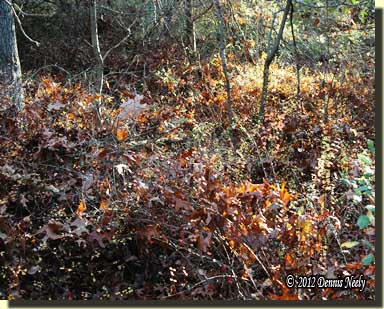
A leaf-covered patch of ground beside the big swamp.

Both birds landed in the same clearing. My alter ego chose to continue the unfolding scenario, rather than return to the 21st century and take a picture of the young jake.

The smoothbore’s tarnished brass buttplate was almost to my shoulder when the bird cackled. Big wings flapped. The muzzle picked up the gray blur as it left the far cedars. It flew straight at me. I thought it would land to the right of the cedars where the crossing trail exits the swamp, but a quick bank and three wing beats charted a course to where the hen landed. The turtle sight raced through the bird’s body when it was still behind the left cedar. In hindsight, I realized my mind said “NOW!” after the bird emerged, at the moment the muzzle passed the beak.

A young jake with a reddish head and stubby beard landed with more grace than the hen, 13 paces distant. Like the hen, he stretched his neck high, but this time the turtle sight grasped an unknowing eye. I took time to line up the sight just left of the barrel flat’s center, making certain the lead ball would hit the mark. “NOW!” The jake took two steps, then paused. “NOW!” My nose twitched from the imagined stench of spent gunpowder. Two more steps. A bird putted once uphill.  The jake stretched tall again and “Old Turkey Feathers” unleashed a final death sphere through time’s portal.

A Difference of Hunting Philosophy

As I sat recording the young jake’s imagined demise in my journal, I couldn’t help but recall a conversation I overheard a few days earlier. Two thirty-something, camo-clad hunters window shopped in the ice fishing section of the local outfitters, commiserating about this year’s lack of deer. The one fellow said he gave up at Thanksgiving while the other was going to try “once more” during the muzzleloader season.

The frustration and disappointment were clear from their comments. They talked about what must be a substantial investment in new scopes, tree stands and such, but what stuck with me was the mutual feeling that deer hunting wasn’t fun—the entire season was “a bust.” These men were caught up in the hype of record-book bucks, gizmos and gadgets, the fodder of today’s mainstream hunting philosophy. I politely suggested the circumstance afforded a great opportunity to try traditional hunting, either with longbows or black powder arms. The “quitter” smirked, the other fellow laughed.

I saw two deer that morning, yet that deer hunt is more memorable than most that result in venison for the family dinner table. The difference is attributable to the unique nature of the traditional black powder hunting philosophy and the emphasis that it places on re-living America’s hunting heritage in an authentic manner. On that morn I felt blessed to experience not one, but two pristine moments, points in time when an unmistakable kinship with an old woodsman’s experience emerges in a forest happenstance that knows not the boundaries of time nor place.

Today’s game regulations and wildlife management practices break time into specific seasons allotted to each game species. Michigan’s modern turkey season ends as the firearms deer season begins. On that 21st-century day, wild turkeys were out of season, but on that December morning in 1795, the hen and the jake were fair game for an ecstatic time traveler.

The 21st-century game regulations intruded on my 18th-century hunt for only a second or two, the time it took to dump the pan and set the hammer down, the 2012 legal version of an unloaded flintlock. The modern me, the persona charged with abiding by today’s game laws, had no intention of dispatching a death messenger at either turkey, but the historical me felt a compelling need to “feed the family”.

With each trip to the glade I try to anticipate the expected and/or unexpected appearance of game. I think through each possibility and evaluate whether or not I am prepared to take a clean and humane shot. During turkey season, both spring and fall, I often consider how I would react to a roosted bird landing within the Northwest gun’s effective range. That circumstance has become somewhat of an obsession with me, I think because it has never happened.

I reflected on the hen’s unexpected arrival as I wrote, realizing that I was ill prepared for the long-awaited scenario as it actually happened. To add insult to injury, the hen was out of season, and the trade gun was loaded with a round ball, but sometimes wilderness classroom lessons are taught “out of order.”

To a degree, I felt confident of a head shot during turkey season when “Old Turkey Feathers” would be loaded with the death bees. The circumstance wasn’t optimal, but at 15 paces the cylinder bore’s swarm would have allowed an acceptable margin for error. The round ball load got me thinking about the difficulty of the challenge within the confines of this scenario. In the hen’s circumstance, the best shot was a body shot, and that held the unacceptable potential for damaging valuable meat.

When he visited the woodland grocery store, I knew Meshach Browning hunted with a rifle and seemed to prefer the head shot when taking his turkeys:

“…I would stop and shoot off their heads. I thus kept on till I had shot off the heads of nine young turkeys…” (Browning, 122)

John Tanner, on the other hand, hunted with a smoothbore, and he carried both shot and round ball:

“As I was one day going to look at my traps, I found some ducks in a pond, and taking the ball out of my gun, I put in some shot, and began to creep up to them…” (Tanner, 60)

On that day, at least, Tanner was in the woods with his smoothbore loaded with a round ball. Since his narrative touches mostly on taking large game, this is not surprising, but another occasion raises a stickier question:

“…Geese were flying over, and I raised my gun and shot one…” (Ibid, 135)

Did Tanner shoot the flying goose with a round ball, or was he loaded with shot? He didn’t elaborate, and we will never know. His words leave the impression that he traveled loaded with a ball. He was regarded as an excellent hunter and marksman by the Ojibwa. For me, these few words raise a host of questions, some will forever remain mysteries.

In today’s world shooting a round ball at flying turkeys, geese or other waterfowl is unsafe, unethical, and illegal. Modern game regulations, both state and federal, specify shot sizes, shot composition and specifically prohibit the use of round balls. Traditional hunters, as responsible stewards of our natural resources, must abide by these restrictions.

As much as I wish to satisfy my curiosity, to know if my shooting skills are capable of taking down a flying turkey like the young jake coasting past the cedar, I am left with an unanswerable “what if,” an 18th-century scenario that cannot be duplicated or tested on the range—it’s just not safe.

When I reflected on the young jake, as opposed to the hen, I came to different conclusions about my alter ego’s ability to feed his family. The historical me was prepared; the jake did not know he was in danger and thus my alter ego was able to take three, well-aimed, “imagined” shots at close range.

Again, it was never my intent to shoot at the jake, only incorporate him as a chance bit player in my historical simulation. In addition, Michigan game regulations state that wild turkeys can only be hunted with shot, so the round ball is out during a regular turkey season, too.  But, as I noted in my journal, duplicating those three shots with a paper target, either on the range or while sitting against the grape vine, hidden behind the oak, is safe and doable, and will, to some extent, satisfy my curiosity with respect to the three head shots. I’m looking forward to it.

This brings me back to the two hunters in the outdoor store. One of the striking differences between modern hunting philosophy and traditional hunting philosophy is the traditionalist’s perspective on time spent in the field: every second is important, rather than those few fleeting moments when a deer or turkey or goose is downed. This difference is profound.

For those two, at least, no trophy taken equated to no fun, no enjoyment. But for the traditional woodsman dealing with the same lack of whitetails, the next instant might mark the beginning of an unforgettable 18th-century moment like the unexpected arrival of wild turkeys in the midst of a muzzleloading deer hunt. And that is what hunting is supposed to be about.

Give traditional black powder hunting a try, be safe and may God bless you.
Posted in Deer Hunts, Scenarios | Tagged , , , , , , , | 1 Comment

“An unfortunate soul died…”

A roosted hen turkey fidgeted overhead. A starry night sky, grayed by a full moon that hung 3 o’clock high over the western horizon, backlit the bird’s sleek black shape. Bony legs stepped sideways. Skeleton-like toes flexed as they gripped a forearm-sized limb. The turkey’s skinny neck stretched; its head turned to the right. The bird uttered a soft, quick cluck. A half-dozen trees to the north, another turkey putted a slow and quiet answer. Yet another joined in.

Partly-damped leaves whimpered under my buffalo-hide moccasins. Despite stalking into the midst of a roosted flock I held to the trail that came close to my objective: a modest oak, ten paces from the west edge of the big swamp, forty or so paces downwind of the narrows. My moccasins left the trail and stepped between two twisted grape vine trunks, suspended from separate trees like a ship’s mooring ropes.

My left shoulder brushed a vine. The movement must have wiggled branches above, because an unnerved wild turkey took flight with a cackle, flapping hard then coasting to a tall oak on the far side of the big swamp. Five footfalls later I cleared the leaves from beneath my oak, shouldered a trade blanket and sat cross-legged with a butterfly’s breath of breeze in my face. From my lair I could view four crossing trails and also watch the lower paths on the hill I had just descended.

As first light arrived, the turkeys began putting, clucking and chirping in soft, mellow tones as if they were invisible in the leafless tree tops. Turkey sounds surrounded my oak, but nary a deer moved about. Now and then big wings thrashed; one bird thumped hard in the leaves, 40 paces behind, I estimated. With no deer chasing about, I amused himself with the bronze fowls.

The wild turkey behind me began an incessant series of yelps, most were five screechy “arks” in duration, separated by three or four seconds. Across the swamp, not far from the hollow raccoon tree, another turkey sung a similar chorus in competition with the first. A third joined to the south and then a fourth to the west. Birds started gliding from their roosts. Immersed in the moment, I found the experience fascinating and frustrating, all at the same time.

Surprised by sudden musket fire.“BOOM!…BOOM!…BOOM! BOOM! BOOM! BOOM! BOOM! BOOM! BOOM!”

“Ambush!” I thought, surprised by the sudden musket blasts; my heart began racing. The thunderous roar echoed in the river bottom, south to north. “Nine shots; near the lily pad flats on the river,” I guessed. My thumb pressed hard on the Northwest gun’s hammer as I looked uphill, in the general direction of the clamor. Our party had no hunters in that area; I wondered just long enough for everyone to reload.

“BOOM!…BOOM! BOOM! BOOM! BOOM! BOOM! BOOM! BOOM!”

“A defensive shot and then a volley of seven. An unfortunate soul died, no doubt,” I said in a bewildered whisper. In the silence that followed, I started wondering why the musket blasts were not steadier with a bit of spacing. “Had they not alternated fire, one shooting and reloading while another reserved fire?” I whispered.

Slipping Deep into Character

I make it to that oak about once a season. My habit is to never sit in the same area for seven days—the old does know and keep a vigilant watch. On a normal morning the four trails are a busy thoroughfare, but with the scarcity of white-tailed deer, I only hoped to see one or two does cross on that crisp November morn.

My moccasins danced over time’s threshold before I ever left the wagon trail and started downhill—it was 1795, as it had been throughout that season. After I discovered the first roosted turkey the hunt’s complexion changed, a chance to hone a rare woodland skill, to pass among a flock of turkeys with scaring them to flight was the new test.

Looking up at a wild turkey hen silhouetted against a gray, starry sky cemented my mind in the long ago, in the Old Northwest Territory, about a half mile east of the River Raisin. Mesmerized by the circumstance, I slipped deep into character, intent more on outwitting the turkeys than seeing deer, much less taking a shot at a fine buck. To my delight, the bird overhead stayed put after first light, offering a soft purr or a gentle cluck, now and then.

The River Raisin's first bend after the lily-pad flats.With only two days remaining in the fall waterfowl season, duck hunters floated the River Raisin. Their first volley caught me by surprise, but in hindsight what really surprised me was my period-correct reaction. After the second shot, I thought “Ambush!” and began pinpointing the blasts in relation to the river’s geography. My heart pounded and I felt my right thumb press hard on “Old Turkey Feathers’” hammer.

In less than the time it takes a good traditional woodsman to reload a smoking trade gun, I heard the second volley, maybe a hundred yards farther downriver. A second or so hesitation separated the first shot from the last seven; my 18th-century mindset interpreted the delay as a defensive shot, followed by a killing volley. “An unfortunate soul died,” was all I could think of, primed, perhaps, by reading of an unforgettable sequence of events in John Tanner’s journal a few weeks before.

“Ais-ainse, the Ojibbeway chief, returned one evening from a successful hunt, having killed two elks…the following morning, his wife with her young son, started out to dry the meat. They had proceeded a great distance from the lodge when the lad first discovered the Sioux party, at no great distance…The old woman drew her knife, and cutting the belt which bound the boy’s blanket to his body, told him to run for home with all his strength. She then, with her knife in her hand, ran to meet the approaching war-party. The boy heard many guns, and the old woman was no more heard of…” (Tanner, 159)

In the next skirmish, a favorite son of Ais-ainse, the Little Clam, was killed, scalped and stripped of his “medal.” The Sioux warriors taunted the Ojibwa with the scalp and medal, which enraged Little Clam who attacked the Sioux. Hearing the shots and being told of what was happening, Ta-bush-shish gave one of his fine horses to Be-na and the two Ojibwa warriors rode off to help Little Clam. Ta-bush-shish and Be-na found the trail of the Sioux, and came upon them as they rested around a freshly kindled fire.

“…not thinking this a favourable opportunity to fire, Ta-bush-shish and Be-na went forward on the route they knew the party would pursue, and laid themselves down in the snow. It was now night, but not very dark. When the Sioux began to move…Ta-bush-shish and Be-na rose up together, and fired upon them, and the latter, as he had been instructed to, instantly fled. When at a considerable distance, and finding he was not pursued, he stopped to listen, and for great part of the night heard now and then a gun, and sometimes the shrill and solitary sah-sah-kwi of Ta-bush-shish, shifting from place to place. At last many guns discharged at the same moment; then the shouts and whoops of the Sioux at the fall of their enemy; then all was silent, and he [Be-na] returned home.” (Ibid, 160-161)

When I read this last passage, I remember thinking how the shots surrounding the death of Little Clam’s wife and that of Ta-bush-shish were not consistent with what I had read regarding the wilderness practice of reserving fire when engaged with an enemy. At the same time, I considered the emotional frenzy the Sioux warriors must have experienced upon cornering Ta-bush-shish in the night.

In early March of 1765, a pack train of “Indian goods” destined for Fort Pitt was waylaid and then “attacked” in the western Pennsylvania backcountry. The passage from James Smith’s narrative that describes this incident is often cited as the proper “order of fire” for woodland engagements, and thus the source of my questioning the timing of the musket blasts that morning:

“When I beheld this, and found that Mr. Duffield would not compel them to store up their goods, I collected ten of my old warriors, that I had formerly disciplined in the Indian way, went off privately, after night, and encamped in the woods. The next day, as usual, we blacked and painted, and waylayed them near Sidelong Hill. I scattered my men about forty rods along the side of the road and ordered every two to take a tree, and about eight or ten rod between each couple, with orders to keep a reserve fire, one not to fire until his comrade had loaded his gun—by this means we kept up a constant, slow fire, upon them from front to rear…” (Smith, 123)

My response that morning has been the source of a number of reflections and cogitations, mostly when I sit in the woods. On the one hand, I am thrilled that I was that engrossed in my characterization to have such thoughts, and on the other, I question the period-correctness of those thoughts. It is only natural; it is what we do as conscientious living historians and traditional black powder hunters.

I have come to realize the sudden surprise of the situation triggered the chain reaction of thought within my characterization and that the profound silence that followed the second volley from the duck hunters was the emotional catalyst that pushed me to the 18th-century conclusion that “an unfortunate soul died”—funny how the mind works.

In addition, I now realize that my thinking has been too narrow when it comes to believing all woodland skirmishes mirrored James Smith’s words that an ambush would be marked by reserved fire. To a degree, the story of Little Clam’s wife and the demise of Ta-bush-shish disprove the rigidity of those beliefs. That might be the case with a disciplined persona based on devotion to Robert Rogers’ tutelage, but for a common Great Lakes hunter that is not the case, but such is the path of the traditional woodsman…

Give traditional black powder hunting a try, be safe and may God bless you.
Posted in Deer Hunts, Persona, Scenarios | Tagged , , , , , , , | 3 Comments

An Unmistakable Badge

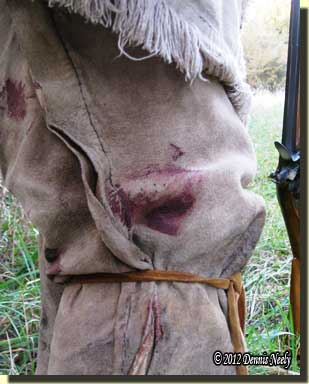
Red splotches on a leather leggin.A fine buck’s fresh blood stained the leggin’s top. Dark burgundy-colored spots, flung in a tussle with a young tom turkey a few days earlier, dotted the front of my linen hunting shirt. Reddish-brown blotches marked the shirt’s dirty hem-fringe. Assorted splashes, splatters and smears offered quiet testament to a host of fox squirrels, green-headed mallards and a cottontail rabbit brought to the table.

A resolute silence embraced the forest on that calm and peaceful evening of 1795. Not long before, my worn-out buffalo-hide moccasins stepped from the wagon trail’s west rut and bid farewell to future tribulations, those of November, in the Year of our Lord 2012.

A leaning red oak, a fallen poplar with hunks of its frayed bark suspended by wispy fibers, two dead and bare cedar trees and a thick tangle of rotting limbs, twigs and branches afforded respite in the Old Northwest Territory. I sat cross-legged on a wool blanket roll. My left shoulder touched the leaning oak’s rough bark. Charged with a ball, the trade gun rested across my leggins.

To my right, a gray squirrel whined and chirped in a not-so-far-off tree. Before me, down the hill’s steep west slope, the huckleberry swamp looked hazy and drab and impenetrable. Behind, over the ridge, a wild turkey chattered an emphatic protest that I interpreted as “How dare you get in my way!” On the leaning oak’s far side the yellow sun’s upper half peeked from behind the distant tree line. Overhead, the evening sky looked plain and ordinary, more grayish-white than ethereal blue, dashing hopes of a vivid orange and lavender sunset.

Looking down, I watched a small, cream-colored spider struggle to make its legs move as it climbed toward the fresh blood stain on my right leggin. The spider’s path seemed to weave from one stain to another, each earned from an honest attempt to relive the 18th-century hunter’s life. Some evenings, the splendor of God’s smallest creatures brings a humble woodsman the greatest joy. In the solitude of my wilderness Eden, little happenings such as this tend to rekindle fond memories, whether of that day’s hunt or ones from long ago.

A Period-Correct Bloodstain

My son-in-law discovered the fresh blood on the leggin top after we dragged his buck from the woods. He was upset when he first saw the smear and apologized, offering to wash it off as he cleaned his hands with a handy wipe.

“Don’t give it another thought,” I said, “that stain is ‘period-correct,’ the unmistakable badge of a successful chase.” That was the first time my grandson, who is six, sat with his father in the deer woods.

The morning proved memorable in many ways. I will not look upon that blood stain, at least as long as it lasts, without thinking of a father and son standing side by side as they gazed at a downed, eight-point buck. Unfortunately, I have a propensity to wade into heavy wet grass, a habit that often soaks my leggins and the thighs of my fustian breeches. I do so in pursuit of deer, most times without conscious thought as to the consequences. I fear that in the heat of a chase those bloodstains will be washed away, and that disappoints me.

Now, my son-in-law is a modern hunter, so the bloodstain was not period-correct with respect to the methodology used to take the buck. Yet, as I sat watching the cream-colored spider navigate from stain to stain, I realized the dried, red blotch emphasized a point, a pet peeve of mine, if you will. For you see, I make no apologies for the bloodstains on my 18th-century clothing, just as John Tanner or Meshach Browning or Daniel Boone made none for theirs.

Traversing muddy swamps, downing game, skinning, cutting up and packing out the meat and hide were all part of a messy business. The rips and tears, the dirt and mud, the blood and fat of a robust woodland chase contributed to the impression left by an 18th-century woodsman’s distinctive dress. Yet many of the old journals make no mention of the stains and smudges of the hunter’s profession, perhaps because the badges of a forest pursuit were too common to warrant the expense of ink and paper.

When the Englishman, Nicholas Cresswell, described the appearance of his traveling companions, he alluded to the condition of their hunting shirts, but left out the specifics:

“…I believe there is but two pairs of Breeches in the company, one belonging to Mr. Tilling and the other to myself. The rest wear breechclouts, leggings and hunting shirts, which have never been washed only by the rain since they were made.” (Cresswell, 83-84)

A story of Daniel Boone’s “courting,” attributed to Dr. R. C. Prunty, the son-in-law of Nathan Boone, goes a bit further and matches more the condition of an experienced woodsman’s hunting shirt:

“To show that Col. Daniel Boone was a man of mirth, I will relate that it was a custom when he was courting to bring a deer, and Dress it before his lady-love; and by so doing he got blood and grease on his hunting shirt. While putting it [the venison] away, he courted Miss Rebecca Bryan. Soon dinner was ready, and Boone drank milk out of a wooden bowl, while the girls stood behind and laughed at the untidy appearance of his hunting shirt. He said nothing, but holding up the bowl, addressed it in a half comical way: ‘You, like my hunting shirt—have missed many a good washing.’”(Baker, 165, citing: Draper: 6 S 17)

Tolerating a Difference in Philosophy

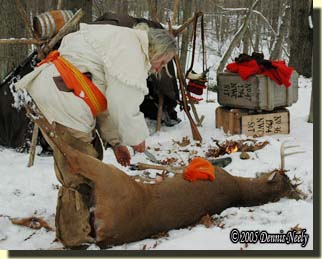
An 8-point buck in a winter camp.I say “experienced woodsman,” to make my point: traditional black powder hunters are experienced woodsman, as opposed to living historians who are portraying a hunter—there is a huge difference.

My intent is not to demean any living historian, discount their dedication to an authentic interpretation or devalue their contribution to our understanding of America’s history, but of late there seems to be a divide developing among those who enjoy living history. Within the past year, I have been taken to task by several respected members of the living history profession/hobby for the “unnecessary” inclusion of actual hunts in my writings or during my presentations.

Last March, a gentleman who engages and captivates most audiences with his first-person French voyageur/hunter impression, circa 1750, suggested a cleaning concoction that would “remove those blood stains and make your clothing more presentable to the public.”

On another occasion, I found myself assailed by five re-enactors who looked like they just stepped out of a carefully crafted vignette at The Henry Ford or the Michigan Historical Museum. Their outfits were impeccably tailored, hand-sewn and aged to perfection, right down to the Frankenstein stitches that repaired a supposed tear in the flap of a brain-tanned shot pouch.

In their case, I suffered a stern admonition to stop writing about killing game. I was told in no uncertain terms that traditional hunting had little place in the living history community, and further, that my writings were not consistent with historical documentation. A little taken aback, I explained that the tales are based on first-person experiences derived from a series of living history simulations designed to re-create the life of a woodland hunter in the late 18th-century. The stories report the results of my attempts to duplicate, to the best of my ability and within the confines of the game laws and accepted conservation practices, the journal entries and narratives of my personal hunter heroes.

As an aside, I discovered that between the two fellows, they had fired only a couple dozen round balls from their Bess’ in twenty-plus years of portraying British fort hunters; none of the three women had ever fired or loaded a muzzleloader, and from their facial expressions and general reaction, none ever will.

The point I wish to make is that traditional black powder hunters are living historians, and as such, we chose to follow our living history simulations to the ultimate conclusion, just as our hunter heroes did, the taking of wild game. From the perspective of learning about and reliving a past time, little difference exists between the hunter bringing fresh venison to the table and an authentically dressed lady laboring at an open hearth to produce a loaf of bread for the table. The personas are different, but the results are the same.

Thus, I do not wish to admonish or criticize the living historian who portrays a hunter, but has never fired a live round at fur or feather, or does not know what it is like to feel a deer’s inner warmth gush forth on a cold and snowy December morning. Rather than tell someone they must stop writing in a given way, stop expressing the voice of their historical experience, I prefer to embrace the fact that there are many paths to unlocking the mysteries of yesteryear.

The path I choose is to expend an honest effort to put wild game on the family dinner table, and that endeavor includes the dirt and grime and bloodstains earned in a fair-chase pursuit. If someone disagrees with the traditional black powder hunting philosophy, then all that I can ask is that he or she tolerate my approach to living history, just as I tolerate and respect a living historian’s  choice not to take game or to enter the glade with a Brown Bess charged only with gunpowder.  For you see, I make no apologies for the bloodstains on my 18th-century clothing, just as John Tanner or Meshach Browning or Daniel Boone made none for theirs.

Give traditional black powder hunting a try, be safe and may God bless you.
Posted in Clothing & Accoutrements, Deer Hunts, Worth thinking about... | Tagged , , , , , , , | 8 Comments

Returning with but little meat…

Fall slipped away. Three days of intermittent rain and brisk gusts stripped all but the white oaks of their leaves. Overnight the wind subsided, somewhat. An hour after first light, lacy white clouds drifted west, pushed by a chilly northeast breeze. The air smelled empty and cold like it does on an ordinary day in late December.

“Caaww…caaww,” a crow called in a raspy voice, not far distant. “Caaww…caaww,” another answered from the hill that overlooked the river bottom, well to the west. The black demons seemed oblivious to my presence as they hollered back and forth. Neither bird left its perch. Such was that late October morning in 1795, three hills east of the River Raisin in the Old Northwest Territory.

A dozen steps down the hill’s east slope, my elk moccasins struck a familiar deer trail and headed south. Curled leaves covered the earthen ribbon that in most years would be a foot wide, churned up with track upon track, but on that sojourn the path was devoid of any sign of whitetail traffic. Ahead, the sun streaked through the cedar boughs, adding an angelic glow to the barren tree branches. Yet, despite the warming rays, a feeling of desperation lurked in the shadows.

The stalk’s pace slowed just below a small knob’s crest. Over this small hill squirrels often played in the thick understory. I stood for the longest time beside a large red cedar tree, a place I often sit when pursuing deer at midday.  The crow sat high atop a dead oak, one of a dozen or so killed by a disease or insect infestation some years back. Nothing was out and about, other than the crow: “…caaww…caaww…caaww…”

The crow finally tired of our game. In a while I worked my way to the bottom of a high-ridged bowl that the sunlight had not yet reached. When a blue jay screamed across the nasty thicket, I again paused, thinking that perhaps I might sit, but I moved on, choosing the lower trail around the thicket.

A patch of thigh-deep barberries hid the deer trail.Two dozen footfalls later, I waded through thigh-deep barberries. Brown oak leaves covered the prickly bushes; red, oblong berries festooned the branches. I waded through not because it was easier, but because that is where the trail led. I’m stubborn about that, sometimes. I chose this trail because it was low, hid my advance and afforded a clear view under the outer bushes in the nasty thicket. On the one hand I was looking for squirrels or turkeys in the dry thicket, and on the other, the modern me, tagging along in a distant mindset, was looking for EHD deer carcasses—the reason for the lack of whitetail sign.

The sun had not yet found this course, either. In the deep shadow of the high ridge I realized that my nose felt cold and my fingertips tingled. I had not brought mitts, thinking the morning warmer than it was, but I became distracted watching several robins flit about in the bush tops of the nasty thicket. Thoughts of discomfort disappeared.

Circling east, and after passing the monarch oak, I noticed the wind had become strong enough to jostle the sedge grass that grows just south of the isthmus. Now and again a leaf fell, angling earthward with the breeze. At the top of the little rise, at the forked oak where I once shot a fine buck, I sat and waited in vain for a squirrel to emerge or a wild turkey to pass.

A Story of Abundance

Game is scarce this year. During seasons like this I often sit and try to ascertain the reason. It’s not uncommon to recall Mary Browning’s request of Meshach for turkeys for supper:

“About this time, Mary’s eldest sister paid us a visit; and as she arrived at one o’clock in the day, Mary asked me to bring home some young turkeys for supper…Into the glades I went, where I soon saw three or four old turkeys, with perhaps thirty or forty young ones. I sent Watch [Browning’s dog] after them, but they flew into the low white-oak trees; and when I would walk fast, as if I was going past them, they would sit as still as they could, for me to pass on; but after walking twelve or fifteen steps, I would stop and shoot off their heads. I thus kept on till I had shot off the heads of nine young turkeys, and I don’t believe I was more than an hour away from home.” (Browning, 122)

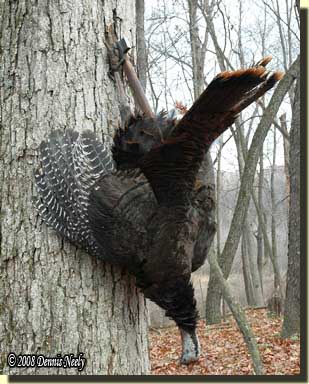
A wild turkey suspended from a belt ax buried in an oak tree.I marvel at the abundance of game and Browning’s marksmanship while “shopping at the local grocery.” On the one hand, Browning’s confidence and matter of fact telling of this tale suggests a common, everyday occurrence, and on the other, I wonder if it was that common, why did he include in his narrative? Yet in the latter case, Browning seems to dispel any thoughts of his feats being out of the ordinary:

“I continued till fall hunting bees and shooting turkeys, and as many deer as I wanted. In September old Mrs. McMullen visited us, arriving in the afternoon; and Mary said to me that she wanted some fresh venison, as she knew her mother was very fond of it; whereupon I took my dog and gun, and set out for an evening hunt…” (Ibid, 122-123)

Now, as luck would have it, Browning’s dog, Gunner, jumped a panther from a rocky crevice and the tale takes a shift as Meshach tells the story of besting the beast. He ends the panther hunt by saying:

“This fight postponed my deer hunt, and Mary had to wait the luck of another day…” (Ibid, 124)

Please indulge me as I continue this tale as I cannot in good conscience or fairness to Browning’s prowess fail to report the events that followed. The next morning Browning sets out to fulfill his wife’s request and comes upon “an uncommon big buck.”  A stalk ensues that ends in the buck’s demise. I could stop there, but I find the tale’s ending noteworthy and at the same time frustrating, because I no longer possess Meshach’s physical stamina:

“I then skinned him; and taking the saddle, skin, head, and horns, I carried them up a high mountain, and was never more fatigued in my life, than when I got home with my load—the saddle weighing eighty-seven pounds, the head and horns nineteen pounds, and the skin eleven pounds [117 pounds, total]. I believe that was as good a deer as I ever killed in my life, although I have killed larger animals; but he was so fat, and the venison was so tender, that I thought it was fully equal to, if not better, than any I had ever eaten; and Mary and her mother had as much of the best venison as they could wish for.” (Ibid, 124-125)

A Story of Frequent Want

Of late, I have been spending a lot of time studying John Tanner’s narrative. In contrast to Browning’s, Tanner’s life story depicts a constant struggle to survive and subsist.

“We now, as the weather became severe, began to grow poor, Wa-me-gon-a-biew and myself being unable to kill as much game as we wanted. He was seventeen years of age, and I thirteen [about 1793], and game was not plentiful. As the weather became more and more cold, we removed from the trading house and set up our lodge in the woods that we might get wood easier. Here my brother and myself had to exert ourselves to the utmost to avoid starving. We used to hunt two or three days’ distance from home, and often returned with but little meat.” (Tanner, 23)

Tanner’s narrative contains a myriad of stories such as this one, and on many occasions, Tanner or the other hunters return with meat in time to stave off starvation. And in some unfortunate circumstances, the Ojibwa narrowly miss acquiring the food that they needed:

“…I went on with the women to Skut-tah-waw-wo-ne-gun, (the dry carrying place,) where we had appointed to wait for him [Waw-be-be-nais-sa]. We had been here one day when Wa-me-gon-a-biew arrived with a load of meat; but Waw-be-be-nais-sa did not come, though his little children had that day been compelled to eat their moccasins.” (Ibid, 58)

In so many instances, I do not know when the opportunity to time travel will present itself. Often an hour or so simply materializes at the end of a busy day, and when that happens, I try to take advantage of those opportunities. But there are also times set aside for traditional black powder hunting, and whenever possible, I try to limit my food consumption, sometimes fasting, the day before a planned hunt. After following this practice for many years, I believe hunger makes a better hunter.

Tanner’s plight is not uncommon among 18th-century journalists. At some time or other, most fur trade posts dealt with dwindling or non-existent food supplies. Some lamented, as Tanner did, that “…game was not plentiful,” and many times the posts’ hunters were not successful, for whatever reason. But beyond the gathering of wealth through the accumulation of packs of peltry is the realization that both the hunters and the post inhabitants must eat if they hope to see the coming spring.

From the living historian’s perspective, the goal of any traditional black powder hunt is to re-create the circumstances of a chosen historical time period. Over the years, I have come to believe these re-creations should include an honest attempt to duplicate an authentic condition of one’s stomach, as well as one’s clothing, accoutrements or forest surroundings.

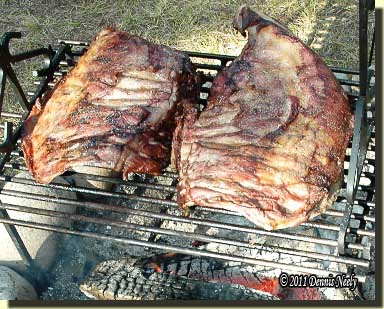
Two racks of venison ribs cooking over red-hot coals.A year ago I participated in a traditional hunting camp. On Friday evening, the camp menu included roast venison ribs, and during the meal one of the other traditional hunters expressed concern that I was not eating very much. I responded, “I’m fine.”

A month or so later I got thinking about that conversation and realized I was unconsciously limiting my food intake. In hindsight, I feel bad that I had not shared my reasoning with the other living historians in camp. Not that I was hiding my motivations, rather I simply gave it no thought at the time.

One result of this year’s EHD outbreak is a drastically reduced deer population. In addition, the drought that spawned the midge that carries the infection also seems to have limited the squirrel and rabbit populations, as well. Yet, the aftermath has a silver lining that perhaps only a living historian can recognize: “game is not plentiful.” This unfortunate circumstance prepares the 18th-century stage for what I hope will be a series of true-to-life adventures, complete with incessant growls from a hungry, but period-correct stomach.

And as I study John Tanner’s journal entries, my conviction that hunger is a tremendous motivating force in any traditional hunt is only strengthened. For many woodsmen, hunger and starvation were the way of the forest.

Give traditional black powder hunting a try, be safe and may God bless you.

Posted in Living History, Squirrel Hunts, Turkey Hunts | Tagged , , , , , , , | 2 Comments