A Wild Turkey is Worth a Dozen Squirrels

Silence echoed in the glade. My moccasins crept along the ridge’s west slope, downhill enough to avoid detection from the east. The air smelled moist. A butterfly breeze jostled leaves, but not enough to raise even a telltale whisper. Dark shadows embraced the saplings in the River Raisin’s mucky bottomlands. Sunlight bathed the marsh grass and cattails that kissed the river’s bank. Now and again I caught a glimpse of the dark ribbon that flowed northeast.
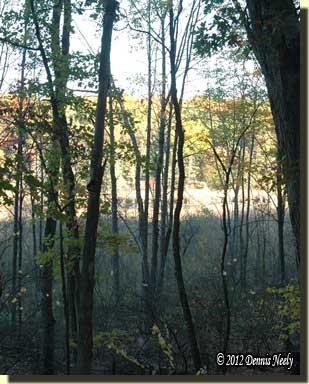
Shadows shroud the River Raisin's bottomland while the morning sun lights the river.It was plenty early on that October morn in 1795, the new day dawned young, fresh and cool. High up in the forest’s canopy red and yellow and gold and burgundy leaves fluttered as if waving “goodbye.” Light green grass carpeted the ground awaiting fall’s calico blanket. My moccasins stalked slow, an indication of conscious stealth more than caution. My eyes scanned the limbs and branches for an industrious squirrel, but saw none. As I progressed, I took note that the hills and valleys were devoid of deer, either bedded or just passing through to the river bottom’s security. Scrapes and rubs proved non-existent, too, a foreboding sign that a long, meatless winter loomed.

In time, my course came upon three downed red oaks, their tops tangled and intertwined for eternity. I sat upon a keg-sized branch and leaned back into the fork of two thick limbs. I gazed upon the little valley, watched the treetops and waited to hear or see a plump fox squirrel. I began to wonder if I had moved too fast or been too visible. I thought of John Tanner’s resolution to become more cautious, to move slower and work for the best possible shot. Without conscious thought I kept repeating “I now made a change in my manner.” This phrase is my reminder to exercise care and forethought in my passage through the glade.

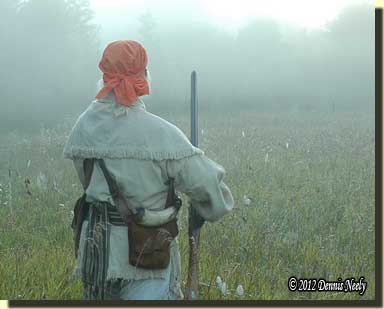
As I sat pondering my own woodland manner, I thought I detected a soft cluck: “Arrrkk.” The second cluck whisked away any doubt. My right hand left the Northwest gun’s wrist, inched upward over my chest, beside my neck and to my head. As I tugged the orange head scarf off, I wadded it in my palm in a desperate attempt to make the color vanish; slow and easy, I tucked it out of sight, inside my linen hunting shirt. In my estimation, a wild turkey is worth a dozen squirrels.

Assessing the Influence of ‘The Falcon’

“…I now made a change in my manner of hunting which contributed much towards the skill I finally acquired. I resolved that I would, whenever it was possible, even at the expense of the greatest exertions, get every animal I should kill at. When I came to look upon it as necessary that I should kill every animal I shot at, I became more cautious in my approaches, and more careful never to fire until my prospect of being able to kill was good…” (Tanner, 123)

The pages are coming loose in my copy of The Falcon, the narrative of John Tanner. At least two dozen sticky-note passage markers, in a myriad of colors that denote different times of study, protrude from the book’s edge; eight or nine stick up from the top. On the pages themselves the yellow highlighter has all but faded into oblivion; the red flair pen underlining is still clear, as are the notes scribbled in the margins, again displaying a variety of colors and penmanship. I cannot fathom how anyone can read a book without marking key passages in some way. The only book I do not treat this way is my Bible, but even there, I have an inexpensive, soft cover version with highlighting and sticky notes.

The passage quoted sports a pale yellow sticky note, faded highlighting that has been refreshed at least once, red pen underlining and a prominent red star in the margin, all placed during my first reading of Tanner’s narrative. Over the years I’ve come to call this excerpt the “change in my manner” quote. I’ve shared it in a number of essays, blog posts, and on several occasions, built an entire teaching session around the traditional hunting wisdom hidden in Tanner’s words.

But on that fine October morn the ‘change in my manner’ quote spurred my thoughts in a different direction, inspiring me to take action on an idea that has intrigued me for several years: the creation of a new persona influenced largely on Tanner’s narrative.
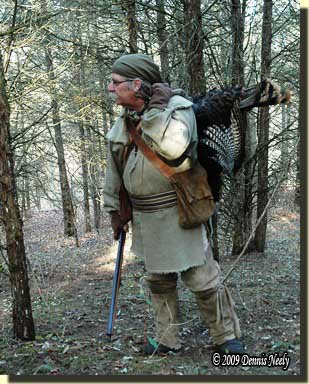
My alter ego with a wild turkey slung over his shoulder.As I reflected, I realized that I have refined and tweaked the same persona for three decades. In my early years on the traditional hunting trail, I followed the unwritten edict, at least for that era, that a persona must be a fictional character, rather than an emulation of a once-living hunter hero. I believe that philosophy was born out of limited documentation that all but required an amalgamation of first person source material to create a viable living history persona. But times have changed and so has common practice.

As I sat with my back against the barkless oak limbs, I recalled the advice I gave several guests at the recent Woods-N-Water News Outdoor Weekend. One fellow’s question about how to begin creating a persona required a lengthy answer. The impromptu seminar grew, and soon a dozen people stood in a semi-circle around me. Everyone got into the conversation, and at one point I responded: “Build your persona around a geographical location, time period and station in life that interests you. This is supposed to be fun, so have fun with your persona.” I decided I needed to heed my own advice.

The time never seemed right, and certainly, now is not a good time with all that is on my plate, and yet, now is as good a time as any. With some forethought and planning, yesterday I began re-reading and outlining John Tanner’s narrative. I have no idea how long this project will take, and it really doesn’t matter.

I didn’t make it through the second page before I came to the conclusion that I cannot achieve the results I expect with sticky notes, highlighters and margin scribblings. I stopped and started over, entering key passages in a searchable database for future reference. On the one hand, the typing in of important quotations takes more time, and on the other, I find I tend to remember the specifics when I linger and study the sentences and the messages they contain.

As it stands now, I do not wish to create an exacting first-person impression of The Falcon. My goal is to glean enough information about a favorite hunter hero to re-create a reasonable facsimile to experiment with in my wilderness classroom. By studying Tanner in-depth, I hope to gain a greater understanding of his life circumstance, the material culture that surrounded him and to gain a different perspective into the methodology employed by an 18th-century woodsman.

My first session with John Tanner lasted a quick three hours. I made it through the introduction and the start of his abduction. In that brief encounter, I felt a renewed vigor wash over me. I felt compelled to read more, to learn more and above all, I experienced a haunting desire to lay down The Falcon’s narrative and rush through time’s portal, to journey back to the Old Northwest Territory. And yes, I had fun.

So, start a living history project you’ve put off, be safe and may God bless you.
Posted in Persona, Research, Squirrel Hunts | Tagged , , , , , , , | 2 Comments

The Search for Lost Companions

“Friday 24th [February, 1804]…I am very Uneasy about [Joseph] Boisvert and [Jean] Connor. It is now nineteen Days since they left for the fond du Lac, expecting that it would take Twelve Days To make The trip. They carried one fawn-skin of rice almost full for provisions to the fond du Lac. I wish I could find some savages To send with [Gardant] Smith. I don’t know what to Think, whether they are lost either going or returning…” (Curot, 443)

Mosquitoes flew from clumped grass. The wispy insects hovered and drifted in the afternoon’s gentle breeze, but made no attempt to land on my hands or face. At the edge of the clearing, my soft elk moccasins struck a well-used doe trail, the one that led to the east side of the spring-fed watering hole. Clad in linen and leather, I kept to the shadows, amongst the tall cedar trees, out of sight.

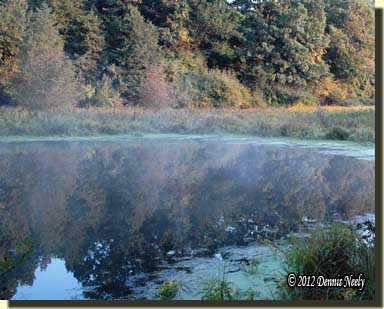
Trees on the far bank reflect on the small pond's surface.“Jay! Jay! Jay! Jay!…” Blue jays screamed from a distant oak; to the south, other jays chimed in. Even from their lofty perches, I doubted the ruckus had anything to do with a traditional woodsman making his way through the understory, searching for signs left by two tardy hunting companions.

My moccasins skirted a patch of milkweed, now nothing but dry, brittle stems. A sudden gush of crushed wild mint filled the air. A few footfalls later I walked around a bushy wild rose with long green tentacles festooned with a thousand razor sharp hooks. A short while after that my course gave distance to a bald-faced hornets’ nest, tucked head-high within the boughs of a modest cedar tree. It was a pleasant fall afternoon, in the Year of our Lord, 1795.

At the southeast corner of the small pond, my nose caught the first smell of death. Without conscious thought, I dropped to my knees in the tangled canary grass and spent the next few minutes surveying the swamp while sniffing the air. The westerly breeze toyed with my senses, first bringing the pungent stench, then whisking it away. All manner of atrocities filled my imagination.

As if stalking a magnificent stag, I proceeded to cross the swamp, following a familiar trail. Pearly-white clam shells, opened skyward and cleaned of their inhabitants, littered the mucky bank. The putrid, greasy smell of rotting flesh grew stronger with each moccasin step until it became almost unbearable. My heart pounded with trepidation as my eyes inched through the grass and raspberry patches along the bank. When I saw the dead doe, relief flushed over my being as I gasped for fresh air.

Epizootic Hemorrhagic Disease (EHD)

Thirty or so counties in Michigan’s Lower Peninsula are currently experiencing an outbreak of epizootic hemorrhagic disease. Unfortunately, the North-Forty is impacted by this horrific epidemic.

EHD is a devastating viral disease found in wild ruminants (mammals that have an internal, stomach-like organ known as a rumen and who chew a “cud”) like white-tailed deer. The infection is fast-acting, coming on within seven days of exposure; usually within two days of the onset the infected deer is dead. The infection is transmitted by a tiny, biting fly called a “midge,” and there is no known treatment or method for controlling EHD, other than a hard frost or freeze that kills the midge.

For the victim, there is an immediate loss of appetite accompanied by a loss of the fear of man. The deer grow weak; the pulse and respiration rate increase, the animal starts salivating, and a fever sets in. To relieve the fever, the animals seek water to reduce body temperature, which is why many EHD deer are found in or near water. Excessive hemorrhaging characterizes an infected deer. Veterinarians tell us EHD does not affect humans.

Beyond a Fair-Chase Hunt

One of the three key elements of any traditional black powder hunt is a dedication to fair-chase ethics. The cornerstone of fair-chase hunting is a steadfast commitment to respecting the game that frequents any history-based scenario, and an integral part of that respect is a deep feeling of responsibility for and dedication to the general welfare of all woodland creatures. A prime example of this respect was displayed last June when a newborn fawn was discovered at Station #3 during the Traditional Muzzleloading Association’s “Old Northwest Frolic.”

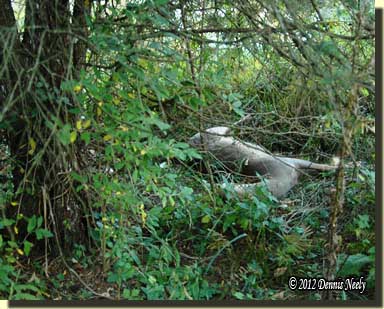
A young white-tailed deer laying dead a few feet from a pond.Finding the first dead doe on the North-Forty radically changed the fall’s priorities; traditional squirrel hunting seemed of little importance. Like most folks, I have limited hours to devote to hunting. When the health and well-being of the whitetails that frequent my 18th-century Eden came into question, the allocation of those hours shifted.

With the discovery of each new carcass, the feelings of utter helplessness intensified. I have come to dread gazing into the dulled, brown eyes of an infected doe as she lays a few feet away, but there is nothing man can do to stop the spread of this horrible disease, or the inevitable outcome. And in a strange way, stumbling upon another carcass fuels an overpowering need to look further, to expend time that simply doesn’t exist. The veterinarians are quick to say “EHD does not affect humans,” but although that is true in a physical sense, it does not address the mental anguish of those who accept stewardship of these beautiful animals.

A “Different” Hunting Scenario

The first night I started walking the big swamp, my mind slipped into the 1790s, out of habit, I suppose. I had on grungy jeans, a green denim shirt, leather hiking boots and I wore my blaze orange National Muzzle Loading Rifle Association ball cap—a far cry from 18th-century linen and leather. In hindsight, I believe the emotional intensity, and yes, distress, of searching for EHD deer, not wanting to find them but wanting to know, allowed my mind to do what it does on most sojourns—travel back to my favorite bygone era. And to be perfectly honest, sometimes time travel becomes a safe haven from the tribulations of 21st-century existence.

As I followed the crossing trail at the south edge of the watering hole, the same path followed a few days later on that September afternoon, my mind recalled Michel Curot’s concern for his men. I couldn’t remember Boisvert’s or Connor’s name; I had to look up the passage when I returned home, but I knew the gist of the words and I thought I had a sense of the emotions. With each footfall through the brittle sedge grass, my mind fleshed out a stark woodland lesson plan for my wilderness classroom: a nerve wracking quest for overdue hunting companions.

In pondering the thoughts of that first evening, I realized that here is a “different” type of hunting scenario, one that centers on the harsh reality of 18th-century life. Years ago, when I chose the path to yesteryear, I did so with a burning desire to gain firsthand answers to one specific question: “What was it really like to hunt, survive and live in the Old Northwest Territory?”

Sometimes those answers are not the answers that we want to hear, for death walked but an arm’s length away from most of our hunter heroes. Hidden in Curot’s “…I don’t know what to Think…” is the strong possibility that either Boisvert or Connor or both would never return to the trading post. Such was the fate of so many 18th-century folks, including John Tanner whose final chapter is unknown.

So many times my hunting scenarios focus on a passage from an old journal that relates a hunting adventure. In the past I have tended to skim over the “unpleasantries,” not because I am not willing to face the gruesome facts of woodland life, but rather because I have so few hours to devote to traditional hunting—I simply must choose the scenarios that fit the time allotted. Yet, there is a silver lining to every dark cloud.

I am told that the stench of human decomposition is different from that of an animal; fortunately I do not have firsthand knowledge to share. Once immersed in this type of historical scenario, regardless of geographical region, time period or circumstance, the slightest whiff of death triggers an emotional trepidation that fears the worst. I experienced such trepidation on that pleasant afternoon in 1795, and therein lies the worth of pursuing such a scenario, for it offers a few fleeting seconds of oneness with the fears, the heartbreaks, the horrors of our hunter heroes.

Give traditional black powder hunting a try, be safe and may God bless you.
Posted in Living History, Scenarios, Scouts | Tagged , , , , , , , | 2 Comments

The Answer is Not Simple

A fallen red oak tree blocked the trail.A fallen red oak blocked the trail. Spring’s broad, lush leaves hung curled, brown and brittle. After stepping over the trunk, worn-out elk moccasins continued through the shadows. Blue jays screamed high atop a far hill, but not for me. Small, fragile acorns, stunted from the summer’s long drought, littered the earthen path, and now and again crunched. Overhead, a gentle northwest breeze rustled the forest’s dense foliage.

The trail forked at the end of the isthmus, the one that separates the nasty thicket from the huckleberry swamp. After a long consideration, I chose to climb the steep hill, at least as far as the four oaks that I usually favor. With a dozen paces to go, I leaned against a young sapling, then slid down and sat cross-legged with my back against that tree. I sought not game, but rather the solace, tranquility and peace that often marks my version of the Old Northwest Territory, not far from the headwaters of the River Raisin, on that late September morn, in 1795.

Old Turkey Feathers, a 30-plus-year veteran of history-based sojourns, rested across my leather-clad thighs. The Northwest gun’s bore was empty, the squirrels safe, because my alter ego had but a few precious minutes allotted to serious time travel—such is life these days.

I closed my eyes and listened to the wind, the chipping sparrows and a doe snorting somewhere up the rise from the water hole at the north end of the huckleberry swamp. My soul drifted in Paradise. An acorn thumped down, beneath a thick oak, three trees beyond the clump of four. I felt a brief splash of warming sunlight, and smelled the aroma of rotting leaves, brushed aside by my left moccasin before I sat. Another acorn struck, and as I opened my eyes, I spied the gray streak of a third. One by one, I surveyed the oak’s upper branches, limbs and twigs.

“Chkk, chkk, chkk, chkk.” A fox squirrel barked, but I could not find it. My right thumb wobbled the firelock’s hammer from side to side, itching to pull it to full cock.

“Chkk, chkk, chkk,” the little critter teased.

My trigger finger began rocking the frizzen on its stiff spring, and when I tired of that pastime, my thumb again fiddled with the loose hammer.

“Chkk, chkk, chkk, chkk,” echoed in the glade, every minute or so until wailing sirens in the settlement tugged my alter ego over time’s threshold. With a deep sigh, I slid the folded journal page that recounted that morning’s brief adventure into its buckskin pouch. As I was about to tuck the brass lead holder into the pouch, the fox squirrel spiraled down the tree. My fingers slipped the page from the leather envelope and continued scribbling.

I turned a bit to my right to gain a better view, only to have a different squirrel chastise me from behind. Six paces distant and not more than four trade gun lengths up, a fox squirrel hung upside down, chattering non-stop. I eased my head toward the tree. My eyes looked up. Instead of cream-colored underbelly fur, this young rascal had all black. He was clearly a fox squirrel, but like some I have seen on the North-Forty, anywhere tan fur should be, black fur was. But alas, I had stayed too long in the Old Northwest Territory.

The Authenticity of Well-Worn

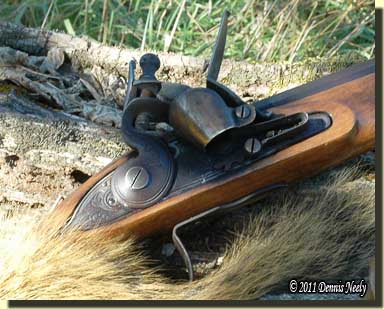
Somewhere in the midst of searching for the fox squirrel, I became aware that I was unconsciously fiddling with the hammer on Old Turkey Feathers’ lock. The hammer “wobbles” when at half or full cock. I try to keep reminding myself that a flint lock is a machine, a machine with multiple moving parts that needs constant attention, a machine upon which I depend for food.

At least once a year the entire gun gets torn down and given a judicious cleaning, which includes complete dis-assembly of the lock.  I peen the backside of the hammer to remedy the situation, but by nature a trade gun lock is large, the mainspring is forceful and the end result is a constant wearing pressure on somewhat delicate components. The repeated smashing of an inch-and-an-eighth English flint against a stout frizzen exacts a heavy toll.

If the mainspring is removed, the tail of the lock gripped in my fingers and the lock shaken, it rattles like an old log chain—sometimes parts actually fall off. The few friends who have witnessed this all smile politely, pause for a respectable moment and ask, “Why don’t you just replace that lock?” For me, the answer is not simple.

The lock is nothing fancy. It was an imported Lott lock that came with the parts kit when I first built the Northwest gun, back in the late 1970s. When the first lock began showing serious signs of wear, the answer was simple: I dickered for a new one from a trader in the first room at the Kalamazoo Living History Show ™. I think we settled on $50 for that lock. In the years that followed, I acquired a third frizzen, frizzen spring, mainspring and other assorted parts in a similar manner, all stored in a little cloth sack in the muzzleloading cabinet.

The “third” lock is a combination of “best parts” from the two locks and spare parts, and it is worn out now, too. Five years ago my daughters bought a new lock for the trade gun for Christmas. I have almost re-mortised and re-fitted the new lock on several occasions. Most times, I say I need the gun for an upcoming hunt, and with that excuse, I put off the conversion. In truth, I’m concerned the new lock will change the character of Old Turkey Feathers, and once converted, there will be no going back.

In the post, “Overcoming Denial Takes Time”, I wrote about the impression left from a combination of clothing and accoutrements that show varying states of wear and tear. For a seasoned traditional black powder hunter, a brand new trade gun is just as out of place as one that is antiqued to perfection and looks two centuries old. The wear and tear on Old Turkey Feathers makes it look a dozen or so years old. As I sat against that oak surveying the branches and limbs, I reasoned that Old Turkey Feathers just wouldn’t be Old Turkey Feathers with a new lock.

I got to chuckling when I thought about the loose hammer, Alexander Henry and the condition of his lock on a December hunt after the fall of Fort Michilimackinac in 1763.

“Desirous of killing one of them [“red deer”] for food, I hid myself in the bushes, and on a large one coming near, presented my piece, which missed fire on account of the priming having been wetted. The animals walked along without taking the least alarm; and having reloaded my gun, I followed them and presented a second time. But now a disaster of the heaviest kind had befallen me; for on attempting to fire I found that I had lost the cock. I had previously lost the screw by which it was fastened to the lock; and to prevent this from being lost also I had tied it in its place with a leather string; the lock, to prevent its catching in the bows, I had carried under my molton coat.” (Armour, Attack…, 88)

And as woodland thoughts go, I got to wondering about the availability of parts on the frontier, away from a fort or trading post. Perhaps a partial answer lies in the widespread availability of trade guns within the fur trade as noted by Charles E. Hanson, Jr. in his book, The Northwest Gun:

“These guns were so universally used by the Indians that tribal gun repair men evidently became necessary. A large cache of seventeenth century gun parts was found some years ago in New York state. There is a similar but smaller assortment of flintlock parts in the collections of the Nebraska State Historical Society which were flintlock parts excavated from a Pawnee Indian village site of about 1820-1845.” (Hanson, 2)

But I have limits in my quest for authenticity. Like John Tanner, the Falcon, on more than one occasion I have found myself without a death messenger in my pouch, but unlike Tanner, I would never load my lock screws:

“I went to hunt with only three balls in my pouch, and finding a large buck moose, I fired at him rather hastily, and missed him twice in succession. The third time I hit but did not kill him, only wounding him in the shoulder. I pursued, and at length over took him, but having no balls, I took the screws out of my gun, tying the lock on with a string, and it was not till after I had shot three of them into him that he fell.” (Tanner, 105)

So the answer is not as simple as it might seem. Old Turkey Feathers’ wobbly hammer is period-correct, and beyond that, it is an integral part of that particular Northwest gun’s charm and mystique. If nothing else, the wobbly hammer is also a good indication that Old Turkey Feathers needs her yearly cleaning.

Give traditional black powder hunting a try, be safe and may God bless you.
Posted in Clothing & Accoutrements, Muzzleloaders, Persona, Squirrel Hunts | Tagged , , , , , , , | Comments Off on The Answer is Not Simple

The Coyotes Taught a Valuable Lesson

Cortland apples browned beside sizzling venison steaks. Not long before, dusk’s long shadows had succumbed to night’s darkness. A stick held a chunk of meat firm to the kettle’s bottom while the butcher knife sliced. The smell of the evening’s campfires mixed with the sweetness of drying corn and night’s cool dampness. Muscles ached from a hard day’s hunt.

Halfway through the meager meal, the butcher knife cleaved a long sliver from a dry twig. The sliver’s tip caught fire from a glowing coal, then lit the half-burned candle’s wick. The lantern’s iron bail clattered as I closed the wooden door and hung the lantern from a wrought hook, the one David Long forged. Before I could return to supper, a ruckus arose on the east edge of the camp as a hunter returned with a fine doe. I set the kettle to the side of the fire as all in camp paused to gather ‘round the fortunate woodsman.

In great detail, the hunter told how the doe browsed closer and closer to his lair. He held his hands arched above his head as he described the bull elk that stood on the hill, well out of rifle range. When the doe stepped in a small opening, this seasoned woodsman boasted of how his firelock never hesitated and how he heard the death messenger hit. The doe ran but a short distance, he said.

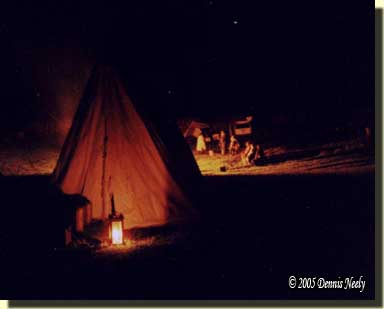
The wedge tent with the council fire behind.In due time, the tales subsided. I walked up the hill to my wedge tent, slid the brass kettle back into the coals and sat cross-legged beside the little fire. I supped as the stars came out, in the tranquility of an 18th-century Paradise. When the kettle was empty, I rinsed it with water and turned it upside down on a nearby kindling split.

I thought of turning in, but I saw a hunter with a lantern move to the center of the camp; the lantern came to rest on the ground at the council fire. In the afternoon, two of the women in camp tented dried branches against an old rotted stump. They hauled leaves bundled in a half blanket and stuffed the leaves in the base of the pyramid. After three quick strikes and a little coaxing, tinder flamed. With care, the man shoved the flame into the leaves and in no time a roaring fire lit the dozen or so lodges as sparks showered high in the darkness, floated and then vanished.

Like moths hovering near a flame, the hunters milled about the council fire, some with jugs and some without. In a fashion, everyone sat around the burning stump telling of their adventures that day, and in the past. Some told of the elk, others spoke of seeing the few buffalo that roamed the wooded hills near the camp, and one fellow talked of harrowing pursuits in the great mountains far to the west of the Mississippi.

Tired and weary, I walked up the hill to my wedge tent and slipped into a cold blanket. Hooting and hollering woke me from time to time and then I fell into a deep, restful sleep. A few hours before daybreak I awoke to a whiny yipping; I thought some of the hangers-on were funning with the Captain.

As my head cleared, I realized coyotes were yipping to the north of the canvas village. I counted at least three voices and thought a fourth was trailing behind. The pack skirted the waterhole just down the hill, then with a mix of barks and yips the coyotes looped around the smoking council fire pit and passed my wedge.

In an instant, I threw the four-point blanket to the side, got to my feet and parted the tent’s flaps, but I could not see the varmints, despite the moonlight. Angry voices and vulgar curses filled the camp, but in time subsided. I stood in the cold, listening as the pack zigzagged south. A bit shivery, I cuddled back into my blankets. I don’t remember falling to sleep, only waking to the ke-honks of low-flying geese at first light.

Deciding What Constitutes “Loaded”

Breakfast conversation centered on the coyotes’ late night foray. I found tracks in the sand, eight feet from my lodge; the coyotes entered the standing corn to the south, which explained why I wasn’t able to see them. The bold invasion turned out to be a highlight of the weekend. The incident is one that I point to when discussing one of my favorite passages from Joseph Doddridge’s writings:

“The whole business of the hunter consists of a succession of intrigues…If he succeeded in killing a deer, he skinned it and hung it up out of the reach of the wolves, and immediately resumed the chase till the close of the evening, when he bent his course towards his camp; when arrived there he kindled up his fire, and together with his fellow hunter cooked his supper. The supper finished, the adventures of the day furnished the tales for the evening” (Doddridge, 101).

Normally, I would talk about the living history significance of re-creating an 18th-century hunting camp, but there is a darker side to this story that needs to be told and heeded. First, most folks in this group did not know each other. News of the hunting camp came from handbills, limited print advertising and word of mouth. If I recall, I think the assemblage of hunters hailed from four different states: Illinois, Indiana, Ohio and Michigan. I was specifically invited to attend by the “Captain” who organized the hunt/shoot/rendezvous with hopes that I would write a feature story or two about the event. As it turned out, I traveled the farthest, over 450 miles.

The Captain had a printed set of “camp rules,” which he gave to each participant upon arrival. These rules were heavy to the shooting side of the gathering, but still emphasized safety. Hidden toward the end of the list was a reminder to keep gunpowder away from the open fires and that no “loaded” guns were allowed in camp.

In the afternoon of the first day, the names of all registered participants went into a bowl and one lucky hunter won a deer hunt on the landowner’s hunting preserve. The rest of us followed a trail to an old gravel pit for a fine woodswalk, which ended just before the supper hour. We all returned to camp with muzzleloaders to clean, and when the lucky hunter returned with his fallow deer, his arm was empty, too.

Within the camp were four fellows who had hunted together before. These hunters were seasoned woodsmen, and since they knew each other, they pitched their tents side-by-side on the north edge of the camp and dug a common fire pit. At the council fire that cool Saturday evening, one of the four declared that “they would be ready if the coyotes dared run through camp, again.” Another hunter asked what that meant and was quickly told “We’re loaded and primed for coyote!”

With a little prodding, the Captain reiterated that there were no “loaded” arms allowed in camp. After further questioning, he stated “barrels must be empty and uncharged.” He told the four if any of them had a charge in the barrel, they needed to pull it. “We’re not loaded, yet,” was the group response. A couple hours later, I headed up the hill to bed, not giving the statements anymore thought.

As I nursed a small fire for breakfast, the hunter camped to the west of me exclaimed something to the effect of “Hey, look at that,” as he pointed to the north camp. I swung around in time to see two of the hunters standing in front of their tents with their rifles in hand, dumping priming powder from the pans. My neighbor was on his feet, marching fast to the Captain’s lodge before the offenders re-entered their tents. In a few moments my neighbor returned shaking his head in disgust.

It seems that after the rest of the camp turned in, the four coaxed the Captain into allowing them to keep their rifles charged, but unprimed. After breakfast, my neighbor and I both started breaking camp. We left a little before noon; neither of us stayed for the afternoon’s shoot or the awards ceremony.

A typical traditional black powder hunting camp in Michigan.I retell this story from time to time to make a point: it is imperative that all members of a hunting camp, modern or traditional, agree on a few necessary safety rules and then enforce those rules. I shudder every time I think about those coyotes returning on that Saturday night, and then I thank God they didn’t.

There are no set hunting camp standards that I am aware of. Over the years I have been fortunate to participate in many traditional black powder hunting camps. In general, muzzleloaders with a charge in the barrel must be unprimed or uncapped with the touch hole or nipple plugged or covered before the arm is brought into camp. “Charged and unprimed/uncapped” guns are allowed in camp during the day as an accommodation to hunters as they come and go from the field. In some camps an area is designated for storing these guns. Again, in general, at the end of the day, the muzzleloader must be discharged and kept overnight in camp with an uncharged barrel, preferably stowed in a case. If the gun has been discharged in the course of the pursuit, it needs to be cleaned and tended to, anyway.

Again, when setting up a traditional black powder hunting camp, insist that all participants agree on a few necessary safety rules and then enforce those rules.

Give traditional black powder hunting a try, be safe, and may God bless you.

Posted in General, Hunting Camps, Safety | Tagged , , , , , , , | Comments Off on The Coyotes Taught a Valuable Lesson

The Answer is Always the Same…

Yellow flowers blanket the fen.Petite yellow flowers blanketed the fen. Lavender colored milkweed blossoms dotted the swamp’s edges, and pale-yellow bumps tipped mullein stalks like fresh-kindled flames on a night hunter’s torch. As I sat beneath the spreading boughs of an old red cedar tree, a red-tailed hawk swooped to a lofty perch. It was late August, in the Year of our Lord, 1795.

The hawk appeared older, fuller bodied with an abundance of ruffled feathers. It preened and fluffed and then, as if turning into a war bird, its feathers settled into the sleek look of armor. I watched a single, light-colored feather drift to the northeast in the calm morning air. I smelled the milkweed and what I supposed was the scent of the small yellow flowers. I felt the warmth of a rising sun on my skin. My forehead perspired.

Sometime after the feather disappeared in the cedar boughs of the far bank, a long-legged spider crawled upon my hunt-stained buckskin leggins and made its way to the wedding bands of the Northwest gun’s barrel. For some reason, the little creature preferred the browned steel barrel to the varnished forestock. Time and again it zigzagged from side to side on the barrel, testing the feel of the wood, but it never choose to leave the barrel. I tipped the muzzle against a few blades of grass and the spider took the hint. When the hawk turned his back to me, I arose, slung the bedroll over my shoulder and slipped into the shadows.

A dozen trees to the north of where I had rested, my elk moccasins plied a doe trail that wandered west, up and over a modest hill. Songbirds flitted about: sparrows, a cardinal, a yellow finch and a robin or two. None spoke. In the distance a fox squirrel chattered, and to my right a field mouse scurried through a gap between the dried oak leaves of last summer, disturbed a day or two earlier by scratching wild turkeys.

In time, the morning’s course paused overlooking the nasty thicket. Down the hill, at the edge of the drought-dry thicket, a barkless oak stood. Two-thirds up the old tree’s trunk, a scraggly branch jutted straight out, and on that branch, calm and peaceful, a fox squirrel lay, looking right at me. It was thirty-some feet up and I knelt on the ground, yet we saw eye to eye. I chuckled. The squirrel’s front paws fidgeted, but it did not flee. I quietly retired to the sanctity of my 18th-century Eden.

A Matter of Perspective

The Woods-N-Water News Outdoor Weekend is a few days away. A common question at the outdoor shows we attend is “Do you ever hunt with a modern gun or using modern clothes?” and the answer is always the same: “No.” I don’t own a full set of modern hunting clothes and haven’t for almost 30 years now. My father and mother’s shotguns are in the gun safe, along with the Lefever Nitro Special 12-gauge double I hunted with in high school, but they’re value is sentimental.

As I explain at the shows, if you were to call and say, “Denny, come over tomorrow and let’s hunt pheasants, or turkeys, or squirrels, or whatever,” I’d show up with Old Turkey Feathers, the proper projectiles and fixings, and dressed in my 1790s clothing. From time to time, these statements draw a raised eyebrow or two, but the answer simply boils down to this is the hunting arm, clothing and accoutrements that I have the most confidence in.

When I assist a modern hunter in the “conversion” to a traditional black powder hunting experience, the biggest obstacle is the confidence building: first, in the muzzleloading arm, second, in the accoutrements and loading process, and third, in the development of the personal hunting skills necessary to get close enough to effect a clean, humane shot. After all, we all want to achieve success, allowing that each person’s definition of success varies, and most often, “acceptable success” relies heavily on the taking of wild game.

But one’s confidence in modern tackle also works against the newcomer to traditional hunting. The prospective convert’s dependency on a tree stand or “people box,” as my wife Tami calls them, a zeroed-in, scoped firearm, bow or crossbow and the latest camo clothing, slathered with chemical wonder scents, either undermine the learning process or hamper it. In addition, the “high-tech” nature of today’s hunting methodology creates a feeling among modern hunters that they no longer need to develop solid woodland hunting skills, and for many folks, improved “success” rates seem to support this hypothesis.

Choosing to follow any given hunting philosophy, modern or traditional, is just that, a choice. For a hunter schooled in modern methodology, there is a definite learning curve to traditional hunting, for assembling the gear typical of a chosen era, for acquiring sufficient knowledge and for attaining a skill level that fosters a meaningful, history-based hunting scenario. But the steepness of the curve is dependent on the willingness of the student to embrace a different and exciting outdoor philosophy.

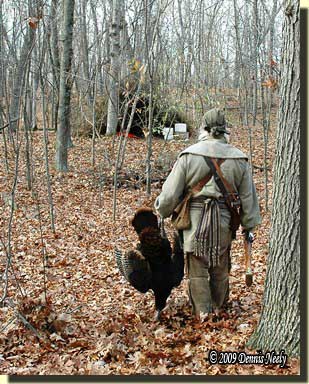
The traditional woodsman returning to a fall turkey camp.Perhaps the greatest stumbling block is accepting the “limitations” traditional hunters place on each woodland scenario, at least, that is what many newcomers seem to get hung up on. In hindsight, I don’t give those limitations much thought anymore, and I don’t believe I ever did. When I first started down the traditional path, giving up modern trappings to engage in a hunt centered in 1795 appeared to be the only way to gain understanding into what it was like to hunt, live and survive in the Old Northwest Territory. The choice was mine, and the restrictions were a part of that choice.

Hopefully, at some point along the trail, the joy, the exhilaration, the mystique of wanting to become one with history, if only for a few fleeting seconds, takes hold as it did for me. There is a certain aura that surrounds the old flintlock, the linen and wool, and the horn and shooting pouch. Wrapping myself in the trappings of the 18th century free my mind and allow my thoughts to wander back to my beloved 1790s. Whether sitting watching a red-tailed hawk or stalking to the next rise the historical atmosphere that I choose to create, that I choose to embrace, makes each second spent in the glade unforgettable. The taking of game is an added bonus. The real treasure is each precious second spent in another time, in another place. But there again, that’s the way I’ve chosen to hunt and how I define success.

As I try to convey to show guests, I am searching for “pristine moments,” points in time when I can’t tell the difference between the 21st century and the 18th century, points in time where my feelings, emotions and impressions match those written in a long-forgotten woodsman’s journal.

And glancing back at the last 35 years, I feel I have taken as many wild critters with Old Turkey Feathers as I would have with a modern shotgun, maybe a wee bit more because I have concentrated my efforts on one gun. It didn’t start out that good, but practice and experience remedied that circumstance. With a few exceptions, the tales that I chose to tell are not those of triumphing over a noble stag or a wary gobbler, but rather I choose to relate the epic of traversing the hills and valleys along the way.

A few shows ago a fellow reworded the question, asking how many wild turkeys I had taken using a modern shotgun. “None,” I replied without hesitation. A bit startled, he asked, “How many with your muzzleloader?”

“I don’t know, maybe nine or ten?” I answered without thinking. The gentleman’s questions continued, as he shook his head, baffled that anyone would willingly choose to hunt in an 18th-century style all the time.

“If you were to call and say, ‘Denny, come over tomorrow and let’s hunt turkeys,’” I started to explain…

After the fellow left, Tami tugged at my sleeve. “You’ve taken more turkeys than that since we’ve been married,” she said. “And look at all the ones you’ve got pictures of in the album, to say nothing of the early ones that you didn’t get pictures of, or the first birds you’ve helped everyone else with.” And she was right, but as a traditional woodsman that’s not how I define success.

Give traditional black powder hunting a try, be safe and may God bless you.
Posted in General | Tagged , , , , , , , | 8 Comments

The 21st-Century’s Exacting Toll

Rolling fog shrouded the cedar tree line.White-flowered Queen Anne’s lace dotted the prairie. Dew clung to hundreds of spider webs. A misty, boiling fog shrouded the near tree line as morning’s long shadows blanketed the small grassy opening. The August air smelled cool and damp, yet with a hint of sweetness. Sandhill cranes chortled to the south; over my left shoulder a lone male cardinal whit-sued beside one of the big swamp’s muddy fords.

The Northwest trade gun’s breech was barren; in 1794 it would have been charged and ready, awaiting only the crash of a sharp English flint. The purpose of that morning’s jaunt was a brief excursion into the Old Northwest Territory of long ago.

My buckskin-clad knees knelt in a patch of golden rod, barely budded and not yet yellow. A fox squirrel chattered on the far side of the swamp, sequestered somewhere high in a red oak. Sweat damped my headscarf. The linen hunting shirt’s soft weave tickled my sides, and I adjusted the leather-sheathed butcher knife tucked in the woven sash that held the shirt tight about my waist. Despite my best efforts, I could not overpower time’s shackles.

Easing back on my elk moccasins, I contemplated sitting a spell. Thoughts of life’s burdens filled my head, and I chose to press on in hopes that continuing the morning’s jaunt might aid my time travel. Dew soaked my hunt-stained leggins. Water splashed as my moccasins stalked across the tiny prairie following no set course other than reaching the cedar grove’s west boundary.

Halfway across the prairie, a spotted fawn appeared between two small cedar trees on the knoll to the north. It hadn’t noticed me, so I knelt again, grounding the trade gun and resting the cool barrel against my right shoulder. A second fawn stepped out, walked past the first and melted into the underbrush. The first fawn scampered after the second. As I stood and moved on, I realized the mystique of the Old Northwest Territory still eluded my pursuit.

At the grove’s edge, I leaned against a cherry sapling and alternated glances from my back trail to the dark recesses of the tight-packed cedars. As I cradled the smoothbore a wild turkey’s gray head popped up, not far from the two maples that grow in the midst of the red cedar trees. I squinted. The hen’s head stretched tall as she eyed the ground about her. She did not seem alarmed, and I wondered if she had spotted my headscarf’s orange color through the leaves.

One by one six or seven half-grown poults passed behind the hen. Acting more like adults than chicks, it seemed obvious that their “scurrying days” were at an end, a sure sign fall was not too distant. Controlling my breathing, I stood motionless and watched as the poults pecked and scratched along the trail and out of sight. In a few minutes the hen retreated; I settled to the ground and eased my back against the cherry’s rough bark.

Thoughts of work and family and unexpected responsibilities thwarted my best attempts to return to my 18th-century playground. I had traveled maybe two hundred paces and spent thirty of life’s precious minutes. The fog, Sandhills, squirrels, dewy cobwebs, fawns and wild turkeys set a magnificent 18th-century stage, yet I failed to open time’s portal, to trod upon the bridge between centuries. Sometimes the 21st century exacts a frustrating toll.

The Untold Story of Measured Compromise

On the one hand, mid-summer is the “off season” for traditional black powder hunting, and on the other, a pleasant summer’s morning offers a prime opportunity to venture afield and engage in a trek or scout based on one’s chosen time period.

As I noted in the story, Old Turkey Feathers remained unloaded for this adventure. That is not to say that a traditional woodsman might wish to stop for a little marksmanship check, but I knew my before-work time travel was limited and the scout would be short. And traditional hunters must also comply with all game regulations, which in some states, limits carrying a loaded arm out of season.

From time to time I speak of “measured compromise” as a means to overcome the inevitable intrusions associated with 18th-century simulations set on a 21st-century stage. The essence of the principle is to nurture a mental attitude that weighs, or measures, the importance of each intrusion, then seeks a suitable solution, or compromise, that minimizes a situation’s impact on the historical integrity of the simulation.

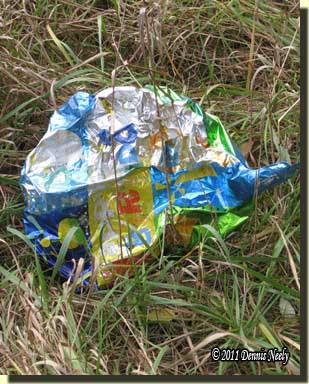
A rumpled, deflated Mylar balloon resting on the grass.With practice, a crushed soda can or a deflated Mylar birthday balloon encountered in the heat of a traditional black powder hunting scenario become invisible to the living historian. They still physically exist beside the trail or tangled in a tree’s limbs, but they mentally do not exist in the historical reality of the Old Northwest Territory.

Most often, my comments or scribblings address the successes of applying measured compromise, but there are times when, no matter how hard a person tries, the attempt fails. That early-August morning is a case in point, and it demonstrates the importance the mind plays in each sojourn.

The intent of the outing was to start the day with that fresh, renewed vitality just a few minutes outdoors gives the soul, and I came away with that feeling. Rare is the morning or evening when a quick, ten-minute walk fails to charge my batteries for the tribulations daily life presents. But as always, one of the purposes of these scouts is to allow the mind to slip away to 1794, and even with my best effort, that didn’t happen.

And therein lays the untold story of measured compromise and the role the mind plays in shutting out all elements that don’t belong in a given historical simulation. It is the mind which must suspend disbelief and render the modern world’s markers invisible. It is the mind that must first believe time travel is possible. And it is the mind that ultimately recognizes the relationship between “what is” and “what was” and establishes that deep feeling of kinship between the living historian and the woodsmen of old. The mind is the gatekeeper for history’s portal. But, as it was on that August morn, the mind must be able to free itself of the perceived enormity of today’s responsibilities and demands, and when it cannot, thoughts of modern existence overpower those of 18th-century woodland life. In such circumstances time travel becomes impossible.

This phenomenon is nothing to be ashamed of; it is quite common among living historians and traditional black powder hunters. I share this story in hopes other traditional hunters might realize that all historical simulations are not successful and that time’s threshold is not always crossed. That does not mean a troubled soul cannot attain that comforting feeling of peace the outdoors offers. It only means it was not possible to travel back to one’s 18th-century Eden at that particular moment. Perhaps on the next outing…

Give traditional black powder hunting a try, be safe and may God bless you.
Posted in Living History, Scenarios, Scouts | Tagged , , , , , , , | 5 Comments

Waiting on the Wind…

A French Canadian voyageur at Fort Michilimackinac.White waves rolled on a stiff northwest wind. The air smelled damp, heavy with the mist of water roiling over the rock-strewn shoal. Between the clouds, the noonday sun mapped the strait’s depths, separating the shallows from the cold abyss with graduating shades of watery tan, forest green and deep navy blue. As I recall, it was early August, about 1770. I was a lad of twenty, and it was my first visit to the fort at Michilimackinac.

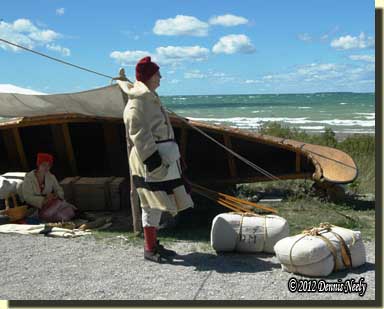
The fort’s water gates were open and unguarded, which perplexed me. Outside a Canot du Nord rested on its gunnel with a tarp staked firm and stretched tight over the hull, providing shelter from the wind. A voyageur in a white capote gazed out across the lake, longing for the paddle, but the wind pressed constant, shy of a howl.

Even within the palisades rattails blew in my eyes, to say nothing of the fine sands of Lake Michigan. I stepped behind a trader’s house and pulled the black silk headscarf lower, hoping at the least to control the unruly wisps of hair. As I stood, the white capped waves filled the fort with a rattling, tympanic rumble; and all the while the British Red Ensign snapped and popped just below the gold ball atop the pine flagpole in the middle of the parade ground.

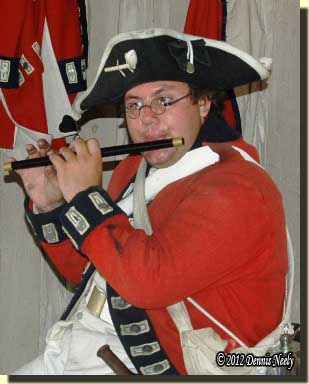
A British soldier from the King's 8th plays the fife.I remember hearing a fife’s melody coming from within the guardhouse. A British soldier, a member of the King’s 8th and a veteran of three winters at Michilimackinac, sat on the far corner of a bunk with the wooden fife to his lips, serenading no one in particular. He glanced at the door where I stood, nodded and returned to his leisure.

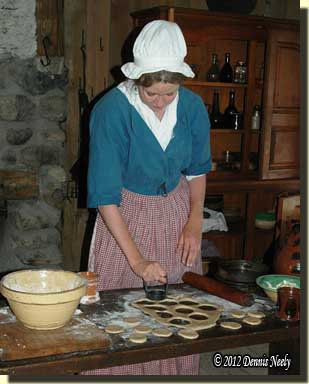
Around the corner I dallied at the Church of St. Anne. Finding the sanctuary empty, I slipped into the last pew, prayed for a moment and reflected on the sights I had seen thus far on that journey. In due time, the smell of pastries attracted me to the north door of what was called Langlade’s house. On a table in front of the hearth, a young woman had just cut circles from fresh-made dough. I startled her when I spoke. She was preparing the blackberries for the tarts’ centers and dropped one on the floor. The conversation was short, for the other hunter found me and told me his business at the fort was done and that we must leave. We spent that night and the next day in the forest to the west, waiting on the wind.

Memories of Fort Michilimackinac

Memories created at Colonial Michilimackinac have a special place in my heart and the stories of my alter ego. I remember visiting the fort as a youngster as it was being re-constructed, based on the archeological record; the Mackinac Bridge was new then, too. I recall thinking how cool it was to be able to dress up like a Red Coat and fire those big flintlock muskets. Little did I know what the future held for me.

In a way, the fort’s history represents a bit of a problem for my persona, a hunter from the lower Great Lakes in the 1790s: the fort was relocated to Mackinac Island in 1780 and the remaining palisades and building parts that were not moved were burned—nothing of Fort Michilimackinac existed in 1790.

As traditional black powder hunters, we often get so embroiled in re-creating a single chase recounted in an old journal that we fail to see the need for adding depth to our character’s life. On a number of occasions I have concentrated on one historical day, only to be disappointed with the results of that sojourn. Upon reflection I have come to the conclusion that those particular efforts were more two dimensional than three dimensional. True, the main purpose of traditional hunting is to put food on the table and to do so in a period-correct manner, but the richness of the portrayal is dependent upon the diversity of 18th-century moments that our persona experiences along the way.

In the last few years, my woodland pursuits have centered on the time just before and just after the Battle of Fallen Timbers (August, 1794): fall of 1793 to spring of 1796. There is no special reason or significance for this choice; it is just a point on my journey back in time. But I have also put more emphasis on “back story,” what happened in my persona’s life in the years leading up to a given hunt.

A recent trip to Mackinaw City included a mandatory stop at Colonial Michilimackinac, primarily to see the construction progress on the new “Southwest Rowhouse.” Each summer, I have stood in that area of the fort and talked with archeologists excavating the remains of this structure. Seeing it take shape is a natural extension of that process, and I can’t wait to walk through the old rowhouse.

Whether in period-correct clothing or “civilian garb,” I never fail to feel a sense of belonging when I enter the fort. I suppose that is a part of time travel, feeling right at home when surrounded by 18th-century stimuli. But my fort impressions are much different from those of the other tourists. Just passing among the buildings creates memories.

Eighteen-century woman cutting dough for blackberry tarts.On this last visit the wind, waves and constant whipping of the British Red Ensign created a pristine moment. Andrew’s playing of the fife and Madeline’s pleasant smile as she prepared blackberry tarts added depth to the experience for me. As a living historian, it was my task to place these pristine moments within a proper context.

The Mackinac State Parks Commission presents the fort as it existed in the late 1770s, and because my persona was born in 1750, I would have been in my twenties then. As a hunter who supplied meat for General Washington’s soldiers during the American War for Independence, I would have been considered a spy had I visited the fort in the later years of that decade.

As I approached the water gate, one of the first impressions of the wind and waves was that Lake Michigan was not safe for canoe travel. The voyageurs’ canoe, upturned in the sand with the canvas tarp flapping, reinforced that impression, along with the roar of the surf, the sand blown in my eyes and the flag’s almost rhythmic slapping. I thought about George Nelson, the fifteen-year-old clerk of the XY Company who offered his perspective on navigating the Great Lakes and its tributaries in a birch bark canoe:

“On the 3d May, I walked by the lower road to Lachine. There I found a number of people in all the hurly-burly of business. Six large Bark-Canoes were fitted up with their lading for the “Grand Portage,” ten men each & two “Guides,” and so deeply loaded that the least movement made them swing, requiring no little care and management in the old experienced hands to steady them—often I thought we should upset.” (Nelson, 34)

Like all visits to Colonial Michilimackinac, I came away with a campfire tale that fleshes out my persona’s youth: a simple trip to the British fort and a wind too treacherous to tempt.

Give traditional black powder hunting a try,  be safe and may God bless you.
Posted in General, Living History, Persona | Tagged , , , , , , | 1 Comment

Content in My Invisibility

Raindrops plopped on canoe shaped leaves, yellowish and faded. As the droplets struck, small dust clouds arose from old hoof prints on an earthen doe trail. Hook-shaped turkey leavings, dry, hard and brittle, rested here and there along the path. Mid-November, in the Year of our Lord, 1797, saw little moisture.

My buffalo-hide moccasins stalked a high knob. The red cedar trees grew tight, so tight only the very top boughs were green. This was a spot known only by the deer and the wild turkeys, and from the looks of two sandy piles, maybe the woodchucks, too. I hunched in half as I followed the trail, and even then scraggly dead branches tugged and clawed at my linen hunting shirt and buckskin leggins. In another dozen steps, I held the high ground.

The bedroll dropped with an almost imperceptible “whoosh,” and as I sat, raindrops pitter-pattered all around in a syncopated melody that stood out against the background rush of the evening’s gentle drizzle. The air smelled of the late-August moisture that always tempers July’s scorching drought. Blue jays flew into the tangle from behind, from the east, jaying in a half-hearted attempt to warn the forest of a mystery intruder that they somehow lost track of. Within a few moments the alarms crescendoed to a deafening din. I lost count at eleven blue jays, but none screamed close to that hidden knob.

A seven point buck standing and watching his back trail.I found that knob many years ago when the trees were not as thick, and then for some reason, I abandoned it. In the fall of 1795, I rediscovered it as I trailed behind a seven-pointer. Not quite to the hill’s crest, the young buck froze and tested the air for the longest time. On that day, I dropped to my knees, then sat on my heels as the creature sifted through the fluky, unpredictable winds of the knob’s west slope.

In the days that followed, I worked the deer trails that crisscrossed below the knob, paying special attention to the breeze. On one occasion, perplexed as the seven-pointer once was, I walked to a spreading cedar tree that grew on the knob’s crown, hacked a sitting area from within its lower branches and sat down with intentions of sifting out the wind currents. To my surprise, I found that the wind always rose straight up. As I scribbled notes on a parchment page, I speculated as to whether this was the haunt countless old bucks disappeared to, old monarchs that slipped away whenever I ventured through the slight valley below.

As I sat in the drizzle that evening, a cow’s knee proved unnecessary, but I tucked “Old Turkey Feathers’” lock up under my right arm, just to be sure. A doe and summer fawn passed from south to north, and in a while three older does skirted the knob from north to south. At dusk a few wild turkeys navigated the various byways, all converging on a tall, roost oak that stood behind me and to my left. I counted seven birds at fly-up. I sat against that cedar for the rest of the evening, content in my invisibility, but I never saw a sage old buck.

Overlooking the Future

In “…a hundred howling wolves…,” I wrote about reading Darius Cook’s narrative, Six Months Among Indians, Wolves and Wild Animals, in the Winter of 1839 and 1840. Cook was a newspaper man who worked at the Pontiac Courier, the Kalamazoo Gazette and the Detroit Free Press after venturing to the Michigan Territory in 1836.

In November of 1839, Dr. Starkweather prescribed a remedy for Cook’s continued poor health:

“You want fresh air and exercise. Go live with the Indians, sleep in their wigwams on a bed of leaves, hunt in the forests, live as they live, and the chances are you will recover. Pure air, rarefied by the trees in the forest, will do any man good.” (Cook, 16)

Darius Cook took the doctor’s advice and enlisted a hunting companion, James Rhodes. The pair wintered in the wilderness, a little over three miles from the headwaters of the Rabbit River in northeast Allegan County. Being a journalist by trade, Cook wrote about his adventures. I shied away from the book for some time, because of the date—a full generation after my chosen time period.

Many years ago I was taken to task by a respected traditional hunter for not “narrowing my research’s focus” and “relying on materials beyond your persona’s time period.” I took the dressing down to heart and concentrated my efforts on 18th-century documentation. For a while I avoided all journals and narratives that dealt with happenings beyond the century’s last decade, but I found it difficult to assimilate the life experiences of individuals whose lives spanned into the 19th-century. It was as if they all had died on January 1, 1801.

All too often I hear those same words spoken to a novice traditional black powder hunter who is trying his or her darnedest to be period-correct. But the graybeards’ advice needs to be put in context. Certainly, each living historian owes an obligation to observers to concentrate on documenting his or her portrayal based on solid primary sources relative to a chosen time period, geographical location and station in life.

Six Months Among Indians, Wolves and Wild Animals… is set in a specific time period (the winter of 1839 to 1840), in a specific geographical location (Allegan County, Michigan) and with the specific perspective of a unique station in life (newspaperman and journalist).

Yet, there is another interesting facet to Cook’s narrative, and those of other future inhabitants of our living history playgrounds, that supports reading and researching beyond one’s era. Although his personal adventures are set forty-plus years after those of my persona, the  hunting habits and practices Cook, Rhodes and their forest companions engaged in are the same as, or very similar to, those documented for the late 18th-century. I have come to embrace this “continuity of standard practice,” because it reinforces and validates many of the trial and error lessons I have learned in the wilderness classroom.

And, as so often happens, I was researching a different topic when I came upon the following hunting story of Cook’s:

“It was in March; our venison was getting low; the Captain left us to go to the upper traps and he was not expected home that night. About thirty rods from the lodge poles had been placed in the crotches of trees, forming a scaffold about twenty feet high over a deer runway. Thither we went just before sunset and took our station on the poles, keeping a watch both ways. We had not been there long before a monster black bear made his appearance. It was the first we had seen. He moved along on the trail slowly, looking first one way, then another. It is evident he smelt our tracks for when he came under us he stopped and in a moment a bullet broke through his skull. He whirled around several times while we were reloading. It was evident he had his death wound, but another shot cut his throat and he died in ten minutes. Here was another dilemma. He would weight near three hundred pounds and to leave him there would be food for the wolves in an hour. A large fire was built, we went to the lodge, procured torches and went for Mr. Chambers. He readily hastened to our assistance and we dragged him into the lodge amid the terrific tumult of wolves and owls. Mr. Chambers returned and we retired for the night.” (Ibid, 73)

I share this tale, because such stories point out the fact that the hunting practices we engage in are not all that different today than they were in the past. In essence, Cook’s evening hunt is much like the one my alter ego engaged in. The details of the resulting story know no bounds of time or place or station in life. The only governing context for this story is our own knowledge of the who, when and where recorded in the pages of an old hunter’s narrative.

Give traditional black powder hunting a try, be safe and may God bless you.
Posted in Bear Hunt, Research, Worth thinking about... | Tagged , , , , , , | 2 Comments