“Snapshot Saturday”
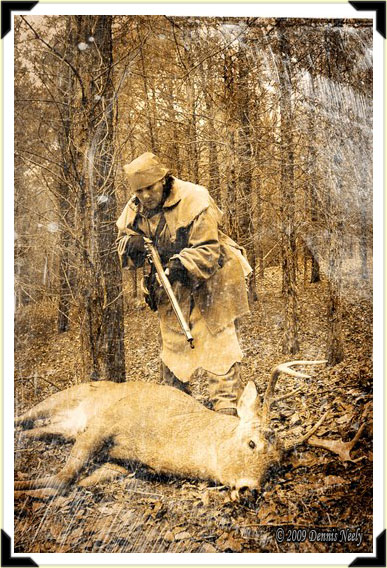
Presented as a 19th-century daguerreotype-style image, a lady of the woods approaches a fine buck with caution. Old Northwest Territory near the headwaters of the River Raisin, 1790s.
Presented as a 19th-century daguerreotype-style image, a lady of the woods approaches a fine buck with caution. Old Northwest Territory near the headwaters of the River Raisin, 1790s.
Alert ears appeared, then twitched. Beyond the red oak, in the midst of the tangled autumn olive bushes, a doe walked on the closest trail. A skinny, gangly-legged fawn followed with its head down, sniffing, exploring. The pair stopped short of the dark oak trunk and browsed. The fawn pawed at the leaves, all brown with a light dusting of fresh snow.
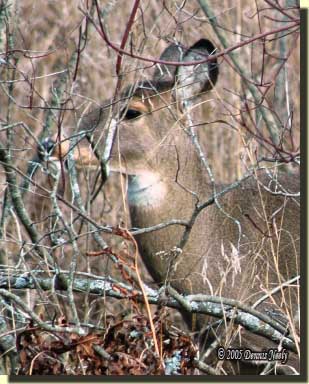 In a few minutes, the mother and daughter moved on, passing within 15 paces of the cedar tree I sat by. If they chose the west fork, they would soon get wind of my deathly presence. Instead, they took the right fork and ambled downhill, out of sight in the thick brush. They came and went without making a sound, even when the fawn nuzzled under some disturbed leaves.
Uphill, a deer’s front legs took two steps, then paused just in front of two cedar trunks, growing side by side. A fold of the scarlet four-point blanket sheltered my right cheek from the morning cold. I turned for a better look, watching, waiting. A mature, barren head dropped to the ground, then rose up quick and stared straight ahead. The doe stood rigid and stiff-legged, like a statue. I smiled. I recognized that behavior.
Just over my right shoulder, two cedar trees lay sprawled on the ground. Sharing a common root ball, the two cedars toppled years ago in an ice storm. All that remained was a labyrinth of grey, thumb-sized branches protruding from the dead trunks, yet enough to form a hefty curtain.
As I concentrated on the doe, I saw the tip of an autumn olive branch shake over the downed cedars. Greenish-yellow, fish-shaped leaves scattered as the intermittent rubbing grew more violent. I breathed into the blanket folds, slow and deliberate, not wishing to send a telltale message downwind to the new arrival.
I felt safe and frustrated, all at the same time. The brushy location that I chose for my own protection was now protecting a buck, a descent one judging from the size of the quivering autumn olive. I glanced at the doe and then back to the left to make sure I was not being watched.
Satisfied, I began to turn to the right, using the cedar trunk I was sitting against as an additional shield. I pulled up my left knee and rested my left elbow on it to support the Northwest gun’s forestock. The autumn olive stopped moving. “A clean kill, or a clean miss. Your will, O Lord,” I prayed in silence.
Here and there my eyes caught movement behind the two cedar’s obscuring curtain. A creamy-white crown sporting eight antler points, spread an inch or so past the buck’s ears, drifted along the top edge of the dead branches. I couldn’t see a head, let alone a body. He walked to another cedar with the bark stripped away; the sapwood still had a shine to it. He stood broadside at what later proved to be 14 paces, protected by the entangled armor of the two ice-toppled cedars.
The buck rubbed three times on the stripped cedar, then turned north and walked uphill. All I saw was a tail, wide hams and stout hind legs. A tail is never a good target. Sandhill cranes called all around and a fox squirrel bounded from a craggy box elder that grew between the doe and my cedar haven. Despite the doe’s demeanor, I thought perhaps the buck might walk away.
At about 25 paces he turned southwest, setting a true course for the doe. She fidgeted, then took two steps and stood still. The trade gun’s English flint clicked to attention. The turtle sight moved to the slim opening behind the doe. The buck kept plodding along with its head hung low to the ground and its nose stuck out.
The doe took two nervous steps, then with two more she vanished in the thick brush. The buck passed behind a half dozen cedar trees, never offering a chance, but I knew that would be the case. The turtle sight waited at the north side of the opening as the creamy-white tines wove in and out of the tight-packed cedars. But the buck never appeared.
Instead, a tail flicked and that big rump veered uphill, then took a sharp left. As they almost always do, the buck paused where the doe once stood—not in the opening, rather three paces beyond, behind the two cedar trunks that shared a common root. The buck’s left front leg showed to the left of the cedars, his left hind leg lingered to the right. The two cedars formed an impenetrable palisade; there was no chance for a shot…
Brush hunting has its advantages and its disadvantages. In simplified terms, I see more deer in heavy cover, especially mature bucks, but the nature of such habitat restricts opportunities for a clean, humane kill.
As a traditional black powder hunter, I must limit my alter egos to living within the parameters of late-18th-century life near the headwaters of the River Raisin in the Old Northwest Territory. Based on my reading of many old journals and narratives, I strive to become a tenant of the forest, to come and go as the other woodland creatures do, utilizing the natural cover to my best advantage. The greatest tribute a woodsman can be paid is to go unnoticed, not only by his peers, but also by the critters of the forest. With that goal in mind, I spend a fair amount of each sojourn still-hunting, but I take a stand with equal regularity.
If, during the course of a still-hunt, I happen upon an intended quarry, I take a knee to reduce my human profile, survey the situation and wait for an opportunity for a clean and humane shot to present itself. On the other hand, when I have a choice, I take great care in selecting an ambush location. Such was the case that morning.
I do not invade a deer’s sacred havens, because that drives a deer from his home territory. But the thick tangles a wary whitetail travels after the first few days of hunting season are a different story.
The two fallen cedars are hidden on a little knob on the eastern face of a long ridge. After the trees’ demise, when twigs and dried needles clung to the branches, I sat within a hole chopped in the cedars’ boughs. In recent years, I found the powder-keg-sized cedar afforded the same protections. Judicious pruning with a trade ax allows me to sit with my back against the trunk while dead lower branches break up my outline on either side.
The tight-packed cedar trees that cover that slope bend the wind in a south-to-north direction along the ridge’s contours, and on occasion, that particular tree is “scent neutral,” somehow directing my scent upward and/or minimizing it, rather than carrying it down the hill. This seems to happen when a light rain or snow is falling. I think the branches, the thick cover and the moisture absorb the offending odor—being wrapped in a smoky, wool trade blanket helps, too.
With my back to the cedar and facing south, I have a series of openings straight ahead, the longest two being 35 paces. To the east, the hill falls off limiting me to 25 paces at best. The sighting distance to the northeast is 30 paces, 18 or so paces behind, and the two downed cedar trees block any shot to the northwest. There are three 15 to 20 pace lanes due west, and the one opening that reaches up to the two cedars, about 35 paces distant.
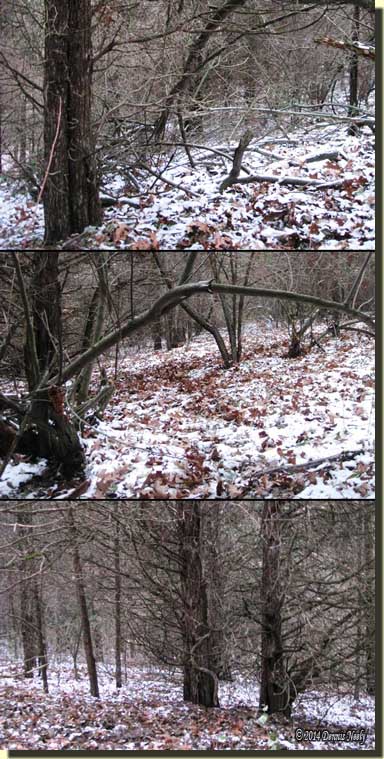
Three views from a different brushy paradise. Top: A doe trail is to the right of the cedar, 15 paces out. To the left of the cedar is a fair-sized opening with a clear shot out to 35 paces. Center: Two slim lanes straight ahead are each 25 paces long. Two trails cross within that distance. To the left, the tree blocks my shape and offers no opportunities. Bottom: Typical cover in semi-dense brush. The maximum distance on either side of the two cedars is 20 paces. A major trail is just 10 paces beyond the two cedar trees, and I think, worth suffering through the site’s limitations.
Taking into account that I am comfortable unleashing a death sphere from “Old Turkey Feathers” out to 65 or so paces, some observers might consider the big cedar tree quite limiting. And in a technical sense, this is true. The longest available shot is half of the smoothbore’s effective distance, and the average is much less, but there are three major tradeoffs that tip the balance in favor of this lair, and others like it.
First, that knob is a crossing point within semi-dense cover, and the only effective way to hunt it is to be situated close to the middle of the thoroughfare. From past experience, the lay of that hillside does not allow any clear shots at deer crisscrossing the little rise.
In the early years of my time traveling exploits, I skirted that knob on numerous occasions only to walk away shaking my head in total frustration; on average, I was busted seven times out of ten. Plus, the wind currents that work for the woodsman at that tree, work against any other location that overlooks the knob.
Second, the same habitat that protects the deer also protects the traditional woodsman. This is true of almost all heavy-cover locations. The hunter is most vulnerable approaching the thicket, but once inside a sense of relief and invincibility washes over one’s persona, assuming an alter ego exercises sufficient care in using the natural cover to maximum advantage. Being well-concealed, controlling unnecessary motion and avoiding eye contact leaves detectable scent as the only major betraying factor.
Third, and perhaps most important, a deer can pass through the area without ever knowing it is in imminent danger. This requires a little luck, as occurred on that morning. But the end result is the 8-pointer came within 14 paces of probable death and continued on without an inkling of the fate that awaited him.
Granted, the entangled armor prevented me from finalizing my intent, but at the same time, other than some residual scent that lingered on into the night, the buck did not experience an educational event that would preclude him from returning to that knob. As a traditional woodsman, this is a huge benefit that outweighs not getting a shot. And that is why I will often tell people, “I am a brush hunter.”
Wade into the thicket, be safe and may God bless you.
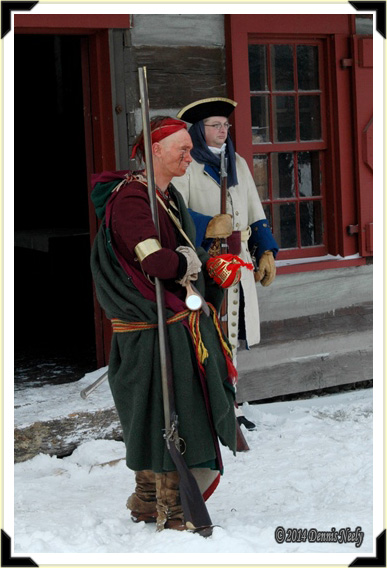
Niiswi-Ahsawaankatin (Jesse Hart), a Miami Warrior, stands in the late-January cold waiting to ask Monsieur Horrigan, the post trader at Fort Miami, to cut down his long-barreled French fusil bucanier. New France, Fort Miami (Historic Fort Wayne), 1754.
Buffalo-hide moccasins crested the ridge. Despite a sense of urgency, the still-hunt progressed with the caution reserved for the stalk of a mighty stag. A lengthy pause allowed a contented grey squirrel ample time to scruff about in the brittle oak leaves, not eight-paces distant. Unaware, the creature scampered to a white oak and spiraled upward. Barely an hour of daylight remained on that pleasant Wednesday afternoon, the first week of November in the Year of our Lord, 1798.
Twenty or so paces down the slope another squirrel drew a pause from the gray-haired woodsman. An additional twenty paces below, a downed treetop offered promising refuge. A gray squirrel ran along the lair’s upper branch, and just beyond, a plump fox squirrel scrounged for acorns on the forest floor.
The squirrels of the lower hillside, four in all, showed little concern as dusty, trail-worn moccasins whispered around the two lower branches. A bedroll slowly descended into the top’s hallowed shadows. With a steadying hand on the upper branch, the returned captive sat. Ribbon-festooned, blue wool leggins crossed and the Northwest gun came to rest on the hunter’s lap.
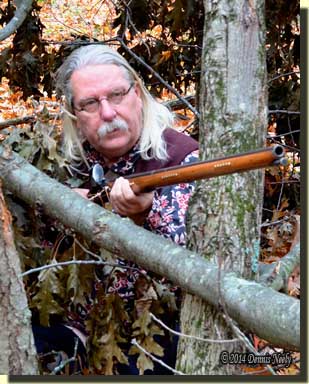 A chipping sparrow visited next. It perched on one of the dead branches of a scraggly cedar, three trees to the south, and began to serenade. A grey squirrel frolicked in the crunchy leaves, down at the swamp’s edge. Autumn olive sprigs grew thick with more green, fish-shaped leaves clinging than in falls past. A sharp twig fiddled, then clawed at the loose hair atop my head. The twig tangled and dared me to pull the hair free. My fingers broke the pest. The sparrow continued to sing.
Two blue jays and a crimson cardinal offered pleasing utterances, now and again. I thought better of the peaceful serenity, eased a bit to my right and moved the smoothbore’s muzzle over the branch in front of me, pointing it downhill at the white oak with spreading, stately limbs.
The distinctive sound of scratched-up leaves drew my attention. A wild turkey walked from the sedge grass, following a doe trail that angled back into the golden tamaracks, halfway across the swamp. Anxious to reach a roosting tree, the bird traveled south at a brisk pace.
“Old Turkey Feathers’” sharp English flint snapped to attention when the reddish head passed behind the white oak. “A clean kill, or a clean miss. Your will, O Lord,” I prayed in silence.
Almost shouldered, the trade gun halted when the young jake reappeared. Then the wild turkey hesitated, stopping quick in its tracks. Arteries pulsed. My back tensed. Breaths became slow and deliberate. A thick autumn olive whisked away any opportunity that might exist. One minute became two, then three.
The bronze bird never turned its head or looked about. It took a step, then angled closer. I didn’t move, patient to let it come uphill more, knowing I didn’t have a clear line of sight for another dozen or so paces. A half-dozen steps later its head went behind a powder-keg-sized hickory trunk that lined up with a big cedar tree.
The Northwest gun’s tarnished brass butt plate pressed hard against the unbuttoned wool weskit. The turkey kept pace. I estimated three steps to the only clear shot, just to the right of the bushy autumn olive. The turtle sight held tight to his brown eye. An 18th-century moment of truth was upon us…
I find it hard to fathom allotting the time to hunt for an entire day, but John Tanner or Jonathan Alder lived under different circumstances than we do today. Lately, there seems to be an abundance of folks touting the improvements of our technologically advanced lifestyle. I find it best to only shake my head and choose not to agree in silence.
Many years ago, I possessed more time to journey back to my beloved 1790s. For the life of me, I don’t know what I did back then to make that happen. In reflection, I worked long hours and had similar family responsibilities, or so it appears. I still work long hours and of late, I’ve spent spare evening minutes finishing the wool leggins, sewing on a new linen shirt, researching an Ojibwe-style winter hood and fretting about cutting out and completing a wool trade shirt before the days get into the mid-20s.
Like everyone else, I wish I could stumble upon the secret, but when I get thinking about it, I’m reminded of the psalm that says “…like olive plants your children around your table…” (Psalm 128:3) Our family has grown and the once adequate dining room table (when it doesn’t have my work files stacked on it) cannot hold us all. What a blessing!
My good hunting companion, Darrel, suggests it is simply the progression of years, but I refuse to accept “old age,” as he calls it, as a reason. Besides, his voice always has a telling grin about it, so I suspect he is just egging me on.
Either way, time is limited for seeking out pristine moments to share with our hunter heroes. The last couple of years, I find myself eager to don my backcountry clothes when only an hour or two pops up. With that in mind, I keep my kit laid out on the bed in the guest room and I can transform from ugly caterpillar to my version of an 18th-century butterfly in less than ten minutes.
On that evening, I had an hour and twenty minutes before dark set in, which included dressing and traveling. Even with that tight constraint, I engaged in a serious stalk of the downed tree top. I thought that at the least I could sit for thirty minutes and walk out by moonlight, which I so often do.
Coming so close to the first grey squirrel was a tremendous traditional black powder hunting experience. Zigzagging down the slope without disrupting the other squirrels, blue jays and cardinal heaped on more joy and personal satisfaction. Moving “Old Turkey Feathers’” muzzle over the branch in light of the soothing solitude of that evening represented the positive hope of getting another chance and maybe bagging a wild turkey.
In all, the time line from parked pickup to standing over a dead fowl spanned no more than 35 minutes. I did not need a whole day or an afternoon dedicated to romping in my historical Eden; an hour and twenty minutes proved more than sufficient, climaxing with a pristine18th-century moment I shall never forget…
 One step…two steps…
“Kla-whoosh-BOOM!” A yellow tongue of fire belched from the smoothbore’s muzzle before I gave conscious thought to releasing the death bees. In hindsight, I realize I never heard the thunder. Years of 18th-century experience ruled that instant, as I’m sure it must have for John Tanner or Jonathan Alder.
Leaning right, I peered under the rolling cloud of thick, white sulfurous stench. Outstretched black and gray feathers flailed against the leaves. I gained my feet and picked the shortest path around the autumn olives to the bottom of the hill.
A buffalo-hide moccasin anchored the young jake’s motionless purple legs. I looked about to make sure an intruder did not hear the shot, for the Northwest gun was empty. In due time I knelt over the lifeless wild turkey that gave its life to feed my family, and I gave thanks to God for a clean kill and a positive answer to my constant supplication.
Give traditional black powder hunting a try, be safe and may God bless you.
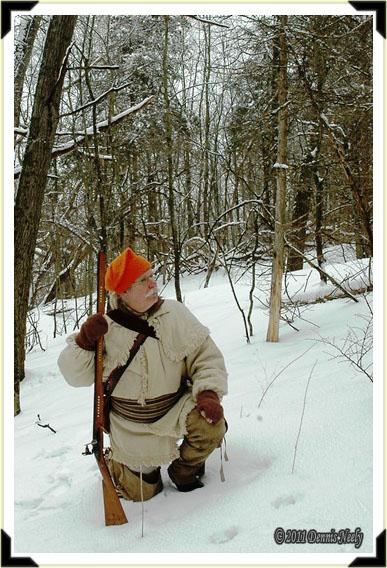
On a crisp January afternoon, a traditional woodsman kneels in the snow, remaining motionless. A fox squirrel chattered in a nearby red oak, attracting the hunter’s attention. Old Northwest Territory, near the headwaters of the River Raisin, 1794.
A whittled twig pegged the Northwest gun’s touchhole. The worm spiraled on the hickory wiping stick. The wire coil bounced when it hit the oak-leaf wad. A hollow scraping sound followed the natural wad to the muzzle. With a rattling clatter, the wiping stick slid down the bore. The worm twisted into the packed lead shot. I withdrew the rod and leaned it against a nearby red oak trunk.
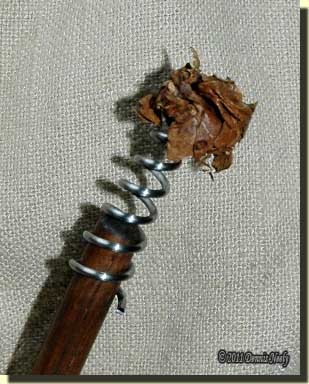 After loosening the shot, the load of #5 shot rolled into my left palm. I leaned “Old Turkey Feathers” against the tree and began dribbling the shot back into the shot pouch. With much reluctance, I left 1798 and walked to the pickup, tossed the lead shot pouch on the front seat and picked up the buckskin pouch that held the #4 bismuth shot.
As if on cue, the shadowy-shape of deer emerged from western tree line, maybe thirty paces distant. I shook my head and chuckled as the charger of bismuth shot rattled down the bore. As an experiment, I reused the pulled oak-leaf wad. The wiping stick’s brass tip tamped it firm; I shook the barrel to make sure the load would not dislodge.
Returning to mid-October, in the Year of our Lord, 1798, was not difficult. I crossed time’s threshold somewhere down the hill and around the bend. My buffalo hide moccasins skirted the clearing, whisked into the cedar trees, then turned south, following a seldom-used doe trail. My wool leggins avoided the raspberry tangle’s sharp claws. Another hard right and a quick duck under two big cedar trees brought me to the water’s edge. A long, fallen cedar bough that touched the calm water offered sufficient shelter. I glanced first north, then west.
“Cheeri-leee, Cheeri-leee.” A robin chirped, somewhere near the west edge of the clearing. In a moment, the morning’s first rays lit the oaks and maples that lined the far bank. Well to the north a wild turkey uttered a garbled gobble. Nine crows cawed over the swamp, winging west to seek out a fracas with an owl or hawk.
The turkey gobbled again, or at least tried to. The notes seemed malformed, mushy and juvenile. My alter ego pondered the calls’ timidity and soon came to the conclusion this was a spring bird practicing for what lay after the harsh winter, should he survive.
A south wind began to rustle the dry, brown oak leaves that still hung fast. The breeze sent ripples racing across the water’s surface. A blue jay’s warning cries broke the sanctity of the morning’s solitude: “Jay! Jay! Jay! Jay! Jay!”
The young gobbler answered, “Gob-ob-ol-ow-ach-obl!” Off in the swamp, a bit east of the south island, a second bird responded, sounding just as pitiful as the first. In due time the wind pushed the clouds north and the sky cleared to a pale blue. The sun grew brighter and warmer as it rose above the tree line—promising for wild turkeys, but discouraging for any chance at a low-flying mallard or wood duck.
As a traditional black powder hunter, my historical research centers on the simple pursuits of 18th-century woodsmen, alluded to in sketchy journal passages. Rare is the account that offers step-by-step instructions. True, some such writings exist, but for the most part the musings of most hunter heroes fail to linger on the particulars. That is both a blessing and a curse.
One aspect of this research, at least from my perspective, is to determine what items were available to a trading post hunter in the Lower Great Lakes region, near the headwaters of the River Raisin in the decade that spanned the 1790s. Understanding what was available helps establish the material limitations that I must abide by if I wish to re-create a traditional, 18th-century hunt with any semblance of authenticity.
Yet, a certain amount of latitude must be given to the old journals and documents as to time, place and station in life. For example, the journal of Francois Victor Malhiot addresses the North West Company clerk’s dealings from July of 1804 to June of 1805, south of Lake Superior. That is not 1798, on the banks of the River Raisin, several days west of Lake Erie, but his writings are representative of North West Company inventories and practices.
In Malhiot’s journal, he makes several references to “wormers,” or tapered spirals of wire also called “gun worms” or “worms.” Malhiot’s records value a dozen wormers at one “plu,” or prime beaver pelt. His ledger sheets break down the gifting of wormers to the “savages,” one or two at a time (Malhiot, 221 & fold out ledger pages).
Likewise, the 1777 account inventory of the contents of a Montreal canoe sent to David McCrea at Michilimackinac contains an entry for “1/2 Gro [gross] gun worms,” packed in bale number 3. (Armour, At the Crossroads, 200) Other inventories and clerks’ journals include references to gun worms. I doubt anyone will argue the authenticity of a trading post hunter in the Lower Great Lakes of 1798 having access to or using a gun worm.
Adding a researched accoutrement to a living historian’s shot pouch is only a fraction of the equation, again, from the traditional hunter’s perspective. I could stop there and pull out the gun worm to show interested on-lookers what was available and likely carried by a late-18th-century woodsman, but learning how to use the gun worm and incorporating it into a real history-based hunt is another matter.
I hunted wild turkeys the day before that mid-October duck watch in 1798. “Old Turkey Feathers” held a heavy charge of 3Fg black powder and a comparable measure of #5 lead shot.
That morning was overcast. I changed my mind and decided to hunt waterfowl instead of turkeys. To comply with modern game laws, I had to change the load to non-toxic bismuth shot. I never gave pulling the oak-leaf wad with a gun worm a second thought. I’ve been using a worm for about four years now. As I changed the load, I made a point of leaving the lead shot pouch in the truck, again to comply with waterfowl hunting regulations.
In addition, I had set aside the pulled wad, because I wanted to see if it could be reused with satisfactory results. It can; I killed a wild turkey with that load a couple of days later, but that is a story for another post.
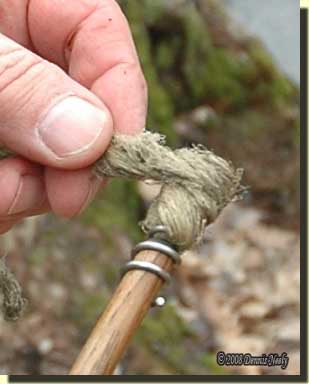 I also use a gun worm wrapped with tow to clean my Northwest gun and I have come to prefer the water-tow-swab method. But there is one aspect of the gun worm that I can’t seem to master or figure out: pulling a round ball.
In the last few years I have concentrated on using natural wadding in the smoothbore with a bare death sphere. The accuracy is not as good as a patched round ball, but it is acceptable. I am still working on loads and learning at the range, but from time to time I have had necessity to pull a round ball held in place with natural wadding, and my results have been less than consistent or successful.
Now this may not seem that important, but for me it is. I am driven by an addictive compulsion to match as closely as I can the writings of my hunter heroes, to learn their methods and incorporate those practices in my traditional hunts.
John Tanner is responsible for perpetuating my frustrations, or at least one of his passages is:
“As I was one day going to look at my traps, I found some ducks in a pond, and taking the ball out of my gun, I put in some shot, and began to creep up to them. As I was crawling cautiously through the bushes, a bear started up near me, and ran into a white pine tree almost over my head. I hastily threw a ball into my gun and fired; but the gun burst about midway of the barrel, and all the upper half of it was carried away. The bear was apparently untouched, but he ran up higher into the tree. I loaded what was left of my gun, and taking aim the second time, brought him to the ground” (Tanner, 60).
The “…taking the ball out of my gun,” statement is the one that is giving me sleepless nights. To prevent a short-started ball and burst my own gun barrel, I always tamp the round ball either on the powder charge or on a leaf wad over the powder and then add a leaf wad over the ball. The worm pulls the over-the-ball wad with no problem, but most times it will not dislodge the ball itself, especially if the barrel is fouled.
Jonathan Alder speaks of unbreeching a barrel to remove a wet load (Alder, 132), but that is not the circumstance described in Tanner’s tale. Tanner says he took the ball out with an air of confidence that implies, at least to me, “Hey, I do this every day!” And for me, that is the curse of this particular passage, but at some future time I expect that will change, too.
Give traditional black powder hunting a try, be safe and may God bless you.
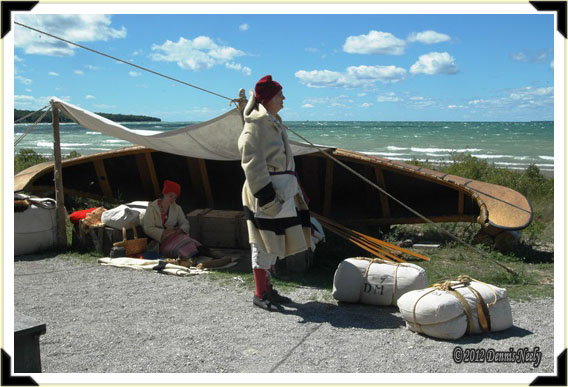
Pushed by a stiff wind, whitecaps roll on Lake Michigan just outside the water gate at Fort Michilimackinac. A French Canadian voyageur watches the choppy water, waiting for calmer seas and a chance to shove off.
A fox squirrel chattered, up on the ridge and to the southwest. Yellow maple leaves spun and rocked and tumbled. Sunlight bathed the tree tops; shadows carpeted the forest floor. The night’s chill lingered. Melted frost pitter-patted from the old red oak, for that matter, from all the trees on the hillside.
High up, winging hard, a lone crow cawed steady as it journeyed to the east. Down the hill a chipmunk scurried over and around and upon a grey, rotted stump. Leaf-shadows whipped to and fro on the sunlit trunk of an arching red oak. A gentle gust intensified the shower of cold, wet silvery drips and fall-colored leaves.
Farther down the trail that followed the nasty thicket’s dense edge, a bushy tail flicked on the backside of a clumped maple. Beyond the sedge-grass-filled swamp hole and partway up the knoll a grey squirrel spiraled earthward. And to the left, twenty or so paces up the slope, a third tail teased. Such was the mystique and splendor of that morn, late in October of 1798, two ridges east of the River Raisin in the Old Northwest Territory.
Pulling the green wool blanket about my body, I settled to the ground and eased back against the old red oak. A blue jay wandered by, then perched on a bobbing twig, not too far away. I smiled as the jay canted its head side to side, trying to make sense of my humble being, or so I surmised.
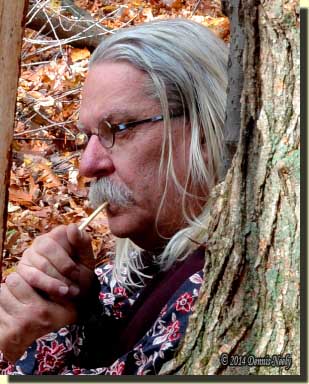 My eyes watched the two fox squirrels, somewhat straight ahead. But my glances longed for a glimpse of a wild turkey, pecking its way along the nasty thicket’s west-side trail. Leaf fragments and a smattering of dirt clung to my new wool leggins. The hand-dyed silk ribbons blended with the leaves, which surprised me and eased my concern. I fought the urge to brush the damp earth off the left knee, hoping for a natural stain.
Old Turkey Feathers rested on my lap as I sat cross-legged. A healthy swarm of death bees awaited an opportunity to strike. When the blue jay flew off, I pulled my journal from my pouch and began scribbling in earnest. I thought better of that, reached into my shot pouch and retrieved the single wing bone. Drawing in air, I uttered a series of seven even clucks, soft and muffled in tone.
I tucked the bone back in the pouch and returned to scribbling. After each sentence I paused to gander about. Recording the scene before me became a different sort of still-hunt: write and pause, write and pause…
The fall hunting seasons are in full swing here in Michigan. When a time-traveling opportunity presents itself it is often difficult to decide what to hunt. The ducks and geese are uncooperative; I have yet to see a mallard or wood duck aloft anywhere near the watering hole. Into November the flight ducks will change that. Blue jays, cardinals and robins somehow seem to think they can take the place of an iridescent green-headed drake with cupped wings. And is usually the case, the fox and grey squirrels frolic about when my desires focus on wild turkeys, and vice versa.
The other morning a whimsical fancy overtook Msko-waagosh as he sat in ambush along a doe trail favored by two gobblers. Concealed in the midst of a tree top, surrounded by chattering fox squirrels, the returned captive felt an overwhelming need to feed his hungry family. In a fit of 18th-century exuberance, the Red Fox jumped to his feet. With one swift motion he dumped his prime, wiped the pan clean and lowered the firelock’s hammer. After looking about, the woodsman headed upwind with his mind set on “killing deer.”
To begin to explain this strange behavior, let me start a few days before. I was rummaging through captive narratives in search of references to shelters. Early on in John Tanner’s journal I stopped to read a passage that dealt with an elk hunt:
“In a few days, I went again with Waw-be-be-nais-sa to hunt elks. We discovered some in the prairie, but crawling up behind a little inequality of surface which enabled us to conceal ourselves, we came within a short distance. There was a very large and fat buck which I wished to shoot, but Waw-be-be-nais-sa said, ‘not so, my brother, lest you should fail to kill him. As he is the best in the herd I will shoot him, and you may try to kill one of the smaller ones.’ So I told him that I would shoot at one that was lying down. We fired together, but he missed and I killed. The herd ran off, and I pursued without waiting to butcher, or even to examine the one I had killed. I continued to chase all day, and before night had killed two more…” (Tanner, 65-66)
As with many of Tanner’s stories, there is more intrigue involved with this episode, but the essence of the story is that Tanner killed three elk within the course of one day’s pursuit. The challenge contained within that passage kept eating at me until it grew into an almost uncontrollable, delightful 18th-century compulsion.
Now I have played this game on occasion, based on other journal entries that fit the trading-post hunter persona, but this was the first time for Msko-waagosh. As a traditional black powder hunter, my forays back to the 1790s are shaped to some extent by 21s-century game laws. “Old Turkey Feathers” is always unloaded and there is no intent to actually shoot a deer, they are simply bit players on the living historian’s stage, teachers in the wilderness classroom.
The rules of hunter ethics apply in this game, just as they do under actual hunting conditions. The pursuit must be 100-percent fair-chase, the deer must be within the hunter’s effective distance and the “supposed shot,” taken at a standing deer, must possess a high probability of a quick and humane kill. In addition, only one deer from a group may be considered “dead,” based on the assumption that the others fled at the muzzle’s blast.
Time was limited that morning; a little over an hour remained. Down through the dip and up over the rise I came upon a mature doe, about 40 yards distant. She had no idea a traditional woodsman had crested the hill and lurked behind the fallen, barkless oaks. With her head down, scrounging for acorns, I heard the Northwest gun’s thunderous roar echo through my mind. I felt the recoil, and I believed I detected the sulfurous odor of spent gunpowder.
I slipped away as there was no reason to disturb the “dead” doe. As Tanner did, “I pursued with out waiting to butcher…” My buffalo-hide moccasins angled west. As I paused behind an oak tree, a spotless, spring fawn wandered over the hill and into the valley. She moved at a steady pace. Her frame offered little meat, so I chose not to “take” her and watched her pass by.
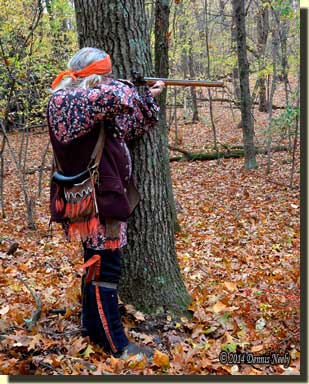 My course pressed south as I circled back to the place of that morning’s beginning. Again, as my shoulder leaned against a tree trunk, a mature doe walked into a small clearing, maybe 30 yards away. When her head was down, I eased back a step and steadied my left hand against the oak. I whispered, “BOOM.” Knowing there was little time left, my mind wasn’t into this “shot.” I imagined the doe ran a bit, then dropped.
I wasn’t as fortunate as Tanner. I downed two big does, not three elk. The outbreak of epizootic hemorrhagic disease in 2012 has made such bit players scarce, at least for now. But that makes little difference, because that day’s living history scenario was nothing more than an 18th-century game, a different sort of still-hunt.
Give traditional black powder hunting a try, be safe and may God bless you.