“Snapshot Saturday”
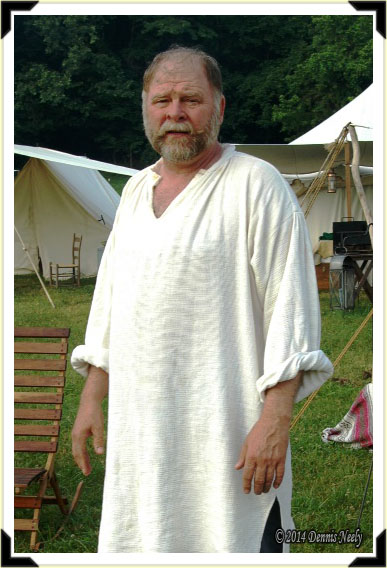
“Did I tell you about the bear hunt?” traditional hunter Don Hulvey asked before he had breakfast. Curly Gostomski Primitive Campground, on the National Muzzle Loading Rifle Association’s home grounds, Friendship, Indiana.
“Did I tell you about the bear hunt?” traditional hunter Don Hulvey asked before he had breakfast. Curly Gostomski Primitive Campground, on the National Muzzle Loading Rifle Association’s home grounds, Friendship, Indiana.

Crackling and popping in hot bacon grease, eggs fry in a cast iron skillet over an open camp fire. Old Northwest Territory, Laughery Creek, north of the Ohio, 1790.
A cloud line angled southwest to northeast. To the northwest, the sky was clear and deep blue. Overhead the moon’s last quarter shone bright through a break in the dark grey clouds. The canoe slipped silent into blackish water. A ragged ash paddle cut the glassy surface. Water dripped…the paddle pulled, then hooked…water dripped…the paddle pulled, then hooked…
Imitation mallard hens and drakes began their pre-dawn swim in the ripples as the canoe circled in front of an ice-damaged red cedar tree, the one that looks like a feathery arm reaching out to the water’s edge. The cloud line crept to the west. A marsh hawk kited above, flew higher, then swooped down, coming to rest on the topmost branch of tall red oak that showed no fall color.
The canoe’s bow nudged the mucky bank, wedging firm. Ahead and a bit to the right a deer’s haunch hid motionless behind a clump of cedar trees overgrown with wild grapes. What few leaves remained on the vine’s tangled web were pale yellow with noticeable, brown, curled edges.
 The deer’s tail twitched. A pesky mosquito buzzed about my right ear. I swatted it. With no time to waste, I stepped ashore. The deer turned to face me. Young and slim, ears forward and head half down, the whitetail watched as I dragged the little vessel through a sparse stand of golden-rod stems. A damp-sounding snap and a couple of pops did not seem to bother the deer. I pulled the canoe into a nearby clump of cedar trees, but did not roll it over.
My buffalo hide moccasins whispered along a short trail that led back to the watering hole and the security of the cedar tree’s feathery arm. I stepped among its boughs and glanced on the water. Overhead the moon’s silvery brilliance dimmed as morning’s first light filled the cloudy heavens. My gaze rested on the western tree line, in the direction of the River Raisin, in hopes of glimpsing a few mallards or maybe some geese seeking a friendly puddle.
From the get-go I knew I had an hour at most. Setting out decoys, caching the canoe, retrieving the decoys and securing the canoe take a fair amount of time, but I understood that some 18th-century time was better than none at all.
Handling modern decoys is akin to Richard Collier finding the fateful penny in his pocket, especially when the morning duck chase was measured in minutes. In hindsight, I suppose I tried too hard; my mind never traveled back, but that didn’t really matter. I never saw nor heard a duck or goose. Two Sandhill cranes flew east from the river. To the north, near the narrows in the big swamp, a raspy old hen turkey barked out orders to her brood. A blue jay worked hard at instigating a ruckus. And a little doe stalked downwind of me. I think it was the same one that watched me beach the canoe.
As I waited, surrounded by the majesty of the moment, my mind began to cogitate. I got to thinking about the moon and its phases, then the months of the year and the seasons. One might say a wilderness classroom lesson took shape beside those still waters.
My thoughts took me back to when my maternal grandmother organized one of her nature walks in her back yard. We went tree by tree, having to name each as we wandered down to the garden. In the fall, we had to match the fallen leaves to each tree. She recounted that as a little girl naming the trees was a game the children played on the walk to school. Sometimes the game switched to naming the song birds, sometimes the flowers, sometimes the bugs.
Now I’m pretty good at identifying trees, and descent with birds and mammals. My wild flower knowledge leaves a lot to be desired and so does my recognition of creepy-crawlies, beyond the basic “spider” or “ant” description, of course. As it happened that morning, I scribbled “last quarter” in my journal. That looks impressive, but I only knew that because I observed the full moon a week before, which for me is kind of like cheating—I could hear grandmother scold me.
Normally, if you flipped up a flashcard with an image of the moon, I couldn’t tell you if it was a “waxing” crescent or a “waning” crescent—waxing comes before the full moon and waning after. The same holds true for the first quarter and the last quarter. As a point of reference, the waxing phases appear on the right and the waning phases appear on the left. An 18th-century woodsman would know that, and that realization upset me.
As a dedicated living historian, I spend a lot of time researching historical records to find obscure snippets that will “flesh out” my persona and bring him to life in another time—we all do. The goal is always an authentic portrayal, an honest impression, and as a traditional hunter, I go out of my way to re-create the simple pursuits a hunter hero included in his journal in hopes of experiencing a few seconds of kinship with that individual.
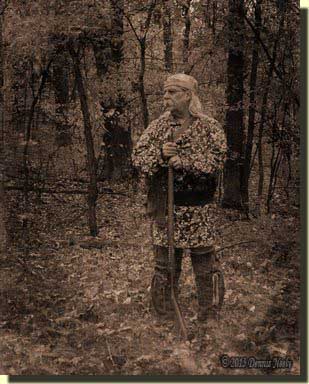 It hurts when you hear Meshach Browning, Josiah Hunt, Jonathan Alder, James Smith and John Tanner all scoffing at you at the same time. Having been in this hobby for a long time, I understand the imagined heckling is a part of the ongoing learning process, a part of defining still another wilderness lesson.
On a different front, with respect to the new persona I have been developing over the past two or so years, I have been a regular Wednesday-night attendee of the Ojibwe Language Webinars offered by Isadore Toulouse through the “Online Anishinaabemowin” site.
That is a tale for another time, but as I chastised my trading post hunter persona for not being able to identify simple moon phases, I expanded my thoughts to include the new alter ego. If an individual was raised by an Ojibwe family, he not only would know the moon phases, but the months and seasons of the year, both in English and Anishinaabemowin. Again, I heard my own grandmother scolding.
The immensity of that concept hurts my head, but in a good way, I think. This is just one more challenge associated with a true and honest impression. To a greater extent, this is not book-learning but rather practical experience gained by immersing one’s self in a characterization while engaging in a woodland pursuit.
After all, my hunter heroes spent a great deal of time outdoors, and even the most inept of the lot would have forgotten more than I know. That’s humbling and frustrating. On the one hand, I can’t begin to devote the hours to my historical Eden that I would like, yet on the other hand, this represents an expansion in understanding the totality of living an 18th-century life in the Old Northwest Territory.
And to think, this whole line of thought evolved from my desire to seek a few minutes of duck hunting beside a friendly puddle…
Slip back to the 18th century, be safe and may God bless you.

As gentle waves kissed the sandy shore of Lake Michigan, an orange sun set over the palisades at Fort Michilimackinac.
A decent-sized doe scrambled to her feet. The startled whitetail stared to the right, looking downwind over its shoulder. Broad, fully-open ears flipped front to back. The tip of her tail twitched a bit, but it appeared she thought better of that. She stood shoulder-deep in the midst of the upturned boughs of an old juniper bush, not ten paces from the scrape. The rich, fresh-pawed earth told the rest of the tale.
Raindrops fell from churning, grey clouds. Just a few at first, then enough to instrument a steady patter on dry, yellowing leaves. The doe bounded over the knoll, ducked behind several clumps of autumn olive, then walked to the trail that headed to the southeast. When she stopped glancing back, my moccasins whispered off in the other direction.
The ridge’s east slope leveled out. The trees thinned, and the grass grew thicker. The brass kettle’s iron bail creaked a bit as it swung free, but the noise mattered little for the steady din of the afternoon drizzle muffled a humble woodsman’s advance. Much to my relief that stand of stinging nettles was still green, perhaps not as lush as in July. I placed the kettle in the grass, donned an old pair of deerskin mittens and began slashing with the butcher knife.
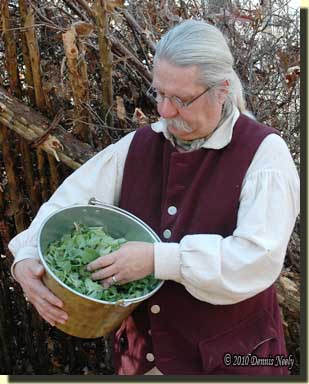
A couple of years ago I experimented with boiling wild mint leaves to make a period-correct dye bath. DO NOT TOUCH STINGING NETTLES WITH BARE HANDS.
With a quick motion, the left mitten stripped the lower leaves from the stalk. Some missed the kettle and came to rest on the grass. A swift cut with the knife severed the stalk, then two or three judicious cuts divided up the bushier tops. I grew careless with experience. A couple of leaves brushed my cheek after I grabbed a stem. The leaves were now wet and much to my relief, did not sting. I began to doubt if the foliage would make a usable dye bath.
I pressed on, my human existence soothed by the rain’s melody. I compressed the kettle’s contents about the time a lone Canada goose winged overhead. I looked up; it looked down. I went back to work, and in the distance, I heard the goose ke-honk as it approached the River Raisin. My mind wandered, imagining all manner of simple pursuits that were but days away, over time’s threshold, a few footfalls distant in the Old Northwest Territory of the late 18th-century.
The fall is upon me with the urgency of avoiding a herd of bison stampeding in the night. As always in my traditional pursuits, there is more that I wish to do than time to do it. Choices must be made and priorities assigned.
The ground under the walnut tree at the bottom of the hill is green with fresh-fallen walnuts. I set time aside to gather a kettle or two. I keep a five-gallon pail of walnut hull dye in the basement, and the one I have is old and weak.
I’m not big on dying everything the same color, because I don’t believe that was done in the 1790s, especially among the Native Americans, which is the historical foundation driving the returned captive persona. But the walnut dye bath is great for adding a bit of age to an artifact in conjunction with other methods, and it is time to replenish the vat.
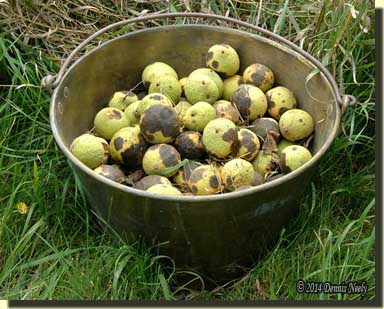 Once home, I filled a five-gallon plastic pail with hulled walnuts and added enough rainwater to cover the firm, green skins. This is not the course I had hoped to take; I wanted to build a fire in the woods and boil the hulls in the brass kettle as it was done long ago. But modern time constraints lead to necessary compromises, at least if I want to get the job done.
Alas, an historical boiling will have to wait for another day. So, as I winterize the rolling stock and start closing up for the colder months, I will set a kettle to boiling on top of the plumber’s pot burner. By following this course, I can tend the dye pot and work on another project at the same time.
After collecting the walnuts, I headed back to the ridge. Heavy grey clouds were rolling in and the air felt damp and heavy. I knew I would get wet, but I’ve wanted to try dying with stinging nettles for some time. I understand the leaves and stems produce a decent shade of green.
My trading-post alter ego owns a fine, hand-sewn, natural-colored linen hunting shirt. I first tried dying it with a bath made from wild mint. The dye produced a gorgeous light green, but it washed out. I studied the lone surviving recipe and tried again with a different mordant, but the results were the same.
I next dabbled with wild grapes. The wine color was stupendous and seemed to hold, but with time it turned a dingy grey, then faded away in the sun. I re-dyed the garment with the grapes using stag-horn sumac as a mordant, but the results were the same. The next lesson in the wilderness classroom will be the stinging nettles.
A couple of chunks of Osage orange heartwood await their turn in the dye bath, too. The shavings produce a rich yellow, which will look good on the Osnaburg trade shirt I hand-sewed a few years ago. But that may have to wait a week or two, because waterfowl season is right around the corner.
Trapping season starts a few days after the waterfowl opener. I pulled my traps out and hung them in the rain in preparation for getting them ready to go—like I need another time-consuming project. I go over each trap to make sure it is working properly, before dying and sealing them.
John Tanner talked about his trap line and on a number of occasions spoke about owning or buying traps:
“My mother gave me three traps, and instructed me how to set them by the aid of a string tied around the spring, as I was not yet able to set them with my hands as the Indians did. I set my three traps, and on the following morning found beavers in two of them…” (Tanner, 31)
“…we paid him his credit [a trader at Rainy Lake who extended to Tanner ‘…credit for one hundred and twenty beaver skins…’] and had twenty beaver skins left. With these I bought four traps, for which I paid five skins each…” (Ibid, 57)
A number of years ago I had a chance to buy a few old Victor double long-spring coyote traps. At the time, I wanted to re-work at least one of the traps to make it look more “hand-forged.” I still don’t think I have time to do that, but if the weather holds, I would like to set it in a traditional manner, as Tanner might have, and include the set in my predator trap line.
To that end, I pulled one of the old Victor long-springs out and tossed it on the pile with the modern traps. Out of curiosity, I tried to set the trap, but my hands aren’t strong enough. I’m wondering now if I can, “by the aid of a string tied around the spring,” set the trap. This is yet another wilderness classroom lesson taking shape.
Give traditional black powder hunting a try, be safe and may God bless you.
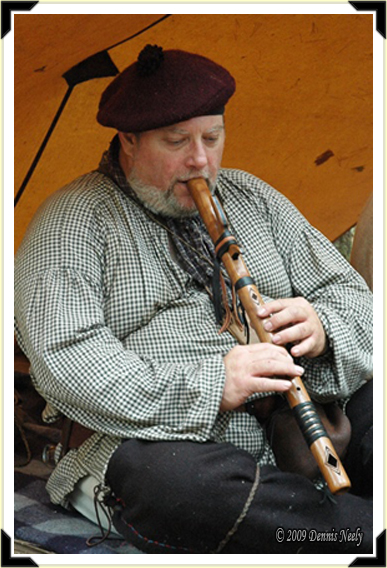
Early on a late-September afternoon at the “2009 Geezer Scout,” held in the state forest at Marl Lake, Charlie Brown began to play his Native American flute. His joyous melody filled the camp and surrounding forest with angelic tones. Charlie Brown passed away on September 21, 2014. He was a Scotsman and a devoted living historian, and the Geezers have asked his friends to “raise a dram of good malt whiskey” in his honor. Please include Charlie and his family in your prayers.
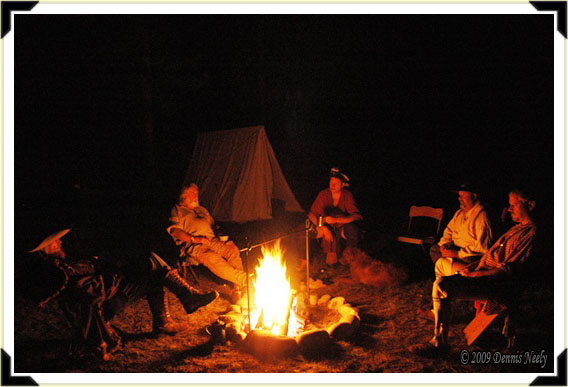
“…The supper finished, the adventures of the day furnished the tales for the evening. The spike buck, the two and three pronged buck, the doe and barren doe, figured through their anecdotes with great advantage…” (Doddridge, 101) Swamp Hollow, Old Northwest Territory.
Tiny silver orbs festooned the tickle grass. Looking like a cloud on earth, the expanse shimmered in the morning’s soft light. Keeping to the shadows, my elk moccasins skirted the tickle grass for fear of defacing God’s magnificent artwork. It was late September in the Year of our Lord, 1796.
“Jay! Jay! Jay! Jay! Jay!” A blue jay screamed. A ridge distant, the woodland sentinel was not announcing my presence to the tenants of the forest, but rather warning of some other concern. It struck me that this was the first blue jay I’ve heard in quite some time; I paused to listen, to enjoy, to ponder.
That Wednesday’s air felt cool and refreshing; it smelled sweet, a pleasant mix of drying field corn, fresh-cut hay and wild mint. In due time my moccasins whispered on as my course veered from the edge of the open prairie into the hardwoods. Sunlight filtered through the treetops and created a mosaic of light and dark splotches on the tree trunks, the understory bushes and the wispy green grass that awaits the arrival of a myriad of colored leaves.
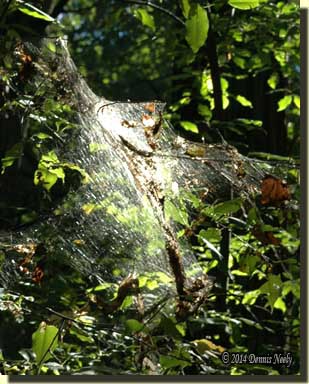 A ways down the east face of the hill, an abandoned, silky, worms’ nest caught my attention. A brilliant spear of light illuminated the nest, beckoning me to come closer. Crows cawed in the distance. I left the doe trail and stalked the glowing web. A squirrel chattered farther east. I stood for the longest time, glancing at the nest, checking my back trail and trying to decide where to wander next.
A bit later, as I approached the edge of a small clearing, I happened upon what appeared to be a buff-colored branch, standing tall in a sunlit clump of dark-green grass. I stopped. I told myself, “the branch does not belong.” Minutes ticked away, and in that time I attempted to make sense of the unknown shape that reflected the sun’s rays. Then a young fox squirrel turned about and bounced to the clearing’s far boundary, satisfied that the linen and leather clad woodsman posed no threat.
As I watched and waited, a grey head popped up at the crest of the next hill. Two smaller heads, not as tall or as large, bobbed up and down in the wild turkey’s typical herky-jerk fashion. The hen’s head remained upright, then stretched a bit skyward while its progeny pecked away. In an instant, I found the roles reversed: I was now “the branch that does not belong,” and the hen was the forest tenant trying to make sense of the circumstance.
My heartbeats grew stronger as the matriarch tried to assess the situation’s potential danger. It turned its head side-to-side with measured caution, then it started the “bob-and-weave” that so often precedes the dreaded three “Putts.” My leather leggins felt warm, as did my right hand; my dark-flowered, ruffled shirt felt cool and so did my ankles and moccasins. With great skepticism my mind argued that the sun and shadows worked to my advantage.
The hen’s neck seemed to relax. It dropped its head like the youngsters and soon all three were popping up and down. Then I saw the sun reflect off bronze back feathers, and the grey heads disappeared. Again I waited and watched. A tad later, where the birds last stood, I found the leaves disturbed and the remnants of scratching and thrown dirt. Overhead a string of eight geese winged in silence and once again I pondered which way to go.
In September, finding time to venture back to yesteryear is always difficult. Preparation and attendance at the Woods N Water News Outdoor Weekend, the National Championship Shoot at the home grounds of the National Muzzle Loading Rifle Association in Friendship, Indiana, and a host of other one-day or weekend functions burns up the better part of the month. This year was no exception.
The month slid by like an otter slipping down a snowy bank, but perhaps with not as much grace. Looking back, I’m surprised at how much I did accomplish in the time allotted. I came out of the month with a lot of positives, more than ever before, to say nothing of feeling a renewed sense of energy with respect to traditional black powder hunting. But those feelings are tempered with disappointed when it comes to what didn’t get attended to, especially the writing obligations.
That morning, the only sojourn to my beloved 1790s in quite a while, took a Herculean effort. I forced myself to take a baby step; I simply couldn’t tolerate being away from the North-Forty any longer. I could only squeak out about an hour, but what a glorious fifty minutes I had frolicking in my 18th-century Paradise. Just donning the rudimentary belongings of Msko-waagosh proved exhilarating. “Old Turkey Feathers” remained empty, because the emphasis of that time traveling episode centered on reconnecting with the glade, pure and simple.
Throughout the month, two related, underlying threads permeated many of my conversations with others in the black powder/outdoor community: an expression of frustration with the increasing demands of the modern world and the inordinate time required to successfully address even the simplest of tasks.
There were other conversations of equal importance, most upbeat and positive. Yet, in both cases, the end result is that these two thieves leave little time for living historians to romp in the long ago. And what is most troubling is the clear growth in the ranks of those who “can’t find time for the woods, anymore…”
As I wandered the ridge, I found myself reflecting on some of those conversations. It is apparent that a stark difference exists between the mental attitude of those who can’t find time, and those who do: the latter make time, sometimes with great effort. So often I get caught up in explaining the need for developing a proper 18th-century mental attitude with regards to my living history pursuits, but I now realize I must also encourage others to develop a proper 21st-century mindset to facilitate one’s time-traveling addiction.
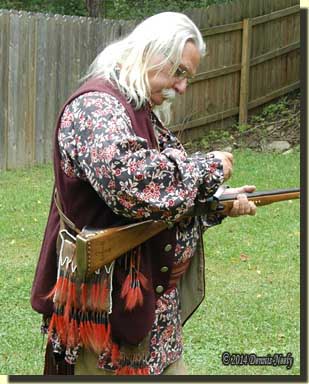 Near the end of that morning’s adventure, I breathed a sigh and scribbled in my journal: “what I deem important, the world deems frivolous. But with the Grace of God, I control my own destiny!” After all, I am the one who says “Yes” when the answer should be “No,” for whatever reason.
I have little doubt that setting aside fifty minutes extended my workday, but the victory, small as it is, was well worth the effort. When I returned to my office and embarked on the next scheduled task, I paused for a few moments and resurrected a work habit abandoned months ago: I started playing the sound track from “The Last of the Mohicans.” I can’t say that I accomplished more, or produced a better work product, but I felt at ease and more content with the world, such as it is.
As the weather cools, the urge to return to my forest haven increases. Finding the minutes, and hopefully hours, will take a Herculean effort, just as that morning’s ramble did, but I must. For the immediate future, the daunting challenge is to beat the world at its own game, to slot a smidgeon of time traveling here and dash there amongst the 21st-century’s false priorities. So often in my 18th-century world I stand still, pondering which way to go. That practice has served me well, and on that September morning in 1796 I resolved to take heed, to stand in the here and now and to ponder which way to go.
Take time to chart your course back to yesteryear, be safe and may God bless you.