“I Let the Deer Pick Them…”

Water gurgled in the gravelly cut. Two solid days of heavy, November rain filled the swamps. The thicker of the two, the south swamp, appeared higher than the sparser swale hole to the north. A thigh-deep cut crossed the mounded base of Fox Hill, connecting the two, and when the south swamp’s water grew deep, it trickled through the cut and out into the other.
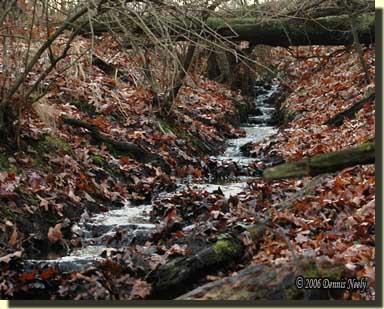
Rain run-off gurgles through the gravelly cut.On that afternoon, on Thanksgiving Day, in the Year of our Lord, 1794, the constant gurgling tweaked my curiosity. After looking about, I rose, checked the prime and cradled the Northwest gun. A dozen or so footfalls later I peered over the bank. The little creek’s total distance was all of twenty paces. To the right, a few trade gun lengths from the delta, a miniature rapids not three moccasins wide rolled pebbles northward. Yellow sand spilled over black silt as the water fanned out, then pooled.

The air was cold, crisp and smelled of impending snow. Wet oak leaves perfumed the forest. My buffalo-hide moccasins stalked the three red oak trunks that shared a common root. The rolled-and-bound trade blanket, tucked to the back of the cleared-out nest, looked inviting. Once again I sat on the bedroll and leaned back against the middle tree, half-hidden in the little cove created by the trunks.

Comfortable, I sat motionless; only my eyes moved, surveying the various deer trails. A trail followed the base of each side of Fox Hill. Two crossed over, fifty or so paces uphill. Two approached from the east, and several led from the south swamp’s tangle, converging back to my left. Most afternoons, at least in cold weather, whitetails on their way to an evening frolic choose the north-most path, which veers past the three oaks, a good fifteen paces distant. A gentle breeze pushed out of the northwest, turning the oaks into a prime ambush site.

About forty minutes before last light, a fast-walking doe with its tail curled over its back appeared on the path at the base of the south face. She angled northeast, paused broadside on the hill’s crest, then continued on. I began to squint a good ways before she reached the cut. In a few moments, she slowed a bit as she passed my lair. I thought of the sweet juice running from a fresh-bit apple; she scampered on and disappeared.

A light snow began to fall. Not long after an older doe and her two yearlings meandered along the north, hill-base trail. The three browsed their way east. Twenty minutes later they passed the three oaks, but they never hesitated or displayed any inkling of concern. My eyelids felt tired and dry from squinting for so long.

With great reluctance, I soon found it necessary to get to my feet. I slung the bedroll over my shoulder and snuggled the Northwest gun’s lock up into the shelter of my right arm pit. I supposed enough light remained to return to the wagon road without stumbling over unseen roots and branches in the dark. I offered a prayer of thanks for a bountiful day, even though I trudged homeward empty handed.

A Lot of Soul Searching…

Thirty-plus seasons ago, when I first chose the path to yesteryear, I spotted a group of does bedded near the cut at the base of Fox Hill. That was during mid-November. Not wishing to disturb them, I jotted a mental note and continued on with that day’s still-hunt. The same scenario played out several times over the next couple of years, and each time the doe or does bedded with their rumps to the prevailing wind, facing uphill. The only time a doe faced east was when she was with a larger group.

In February, at the Michigan Deer and Turkey Expo, a gentleman who is also a traditional black powder hunter spent a fair amount of time at our camp display. As one might expect, the discussions wandered hinter and yon. We talked about using natural cover instead of tree stands and “people boxes,” as Tami calls them. The topic shifted, and the question was raised: “How do you pick your deer stand locations?”

Well, the eyebrows shot up and the mouth came open when I answered: “A lot of the times, I let the deer pick them.” I was dead serious, although I must admit that response sounds a bit smart-alecky.

For me, one of the great learning experiences of participating in outdoor shows is the guest questions. Clarence Moore, my high school math teacher, taught me that “no question is unimportant,” and you hear everything, but always asked in earnest. Yet, sometimes the simplest query requires deep thought and probing introspection.

At my very first Woods-N-Water News Outdoor Weekend in Imlay City, I hemmed and hawed when asked “How do you pick your deer stand locations?” The soul searching lasted well into the December muzzleloading deer season, then I realized that one of the answers was “I let the deer pick them…”

Learning in the Wilderness Classroom

The whole purpose behind the notion of viewing the glade as a wilderness classroom is learning. Eighteenth-century learning takes hard work, demands careful observation and requires a change in one’s perspective with respect to the outdoor endeavors in general. A keen sense of kid-like curiosity helps, too.

On a cold, snowy December morning, I sat with my back to a wild cherry tree, a favorite deer hunting stand when the wind is out of the south. I pondered that tree’s girth, and how it had grown over the last twenty or so years, then I recalled the first time I sat there.
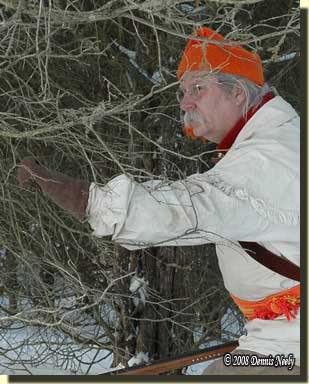
From behind a cedar tree, the traditional woodsman watches the does in the meadow.It was mid-November. I was still-hunting the crest of a ridge when I spied a mature doe bedded a pace or two from the cherry—sixty paces distant. A pleasant breeze pushed soft from the south. The air carried the sweet smell of drying corn. The sun was almost touching the western tree line. As I so often do, I knelt to study the situation, to begin a serendipitous lesson. My legs cramped. I rolled back on my rump and sat cross-legged in the middle of a doe trail.

I don’t remember how long I sat, but it was a while. The whole time I watched the doe, studied her movements and mannerisms—hard work and observation. Before sunset, the doe got up, stretched and shook. She walked down the hill’s steep north face, struck a trail and headed west. I got to my feet, stretched, but didn’t shake.

When the still-hunt reached her bed, I stood for the longest time, just trying to determine why she chose that spot to bed down. Curiosity drove me to look further, to delve deeper. I dropped to my knees and surveyed all about. That spot afforded a commanding view of the hillside and a half dozen trails, in essence, the four points of the compass. I began to understand the woodland wisdom behind her choice.

As before, when my legs started cramping I sat in her bed. With only a few minutes of shootable light left, I glimpsed movement to the west. A broken-rack six-point, a scrawny first-year buck, appeared and headed in my general direction. I chose not to shoot, but rather to study and learn.

And here is a prime example of the need for a change in perspective. The vast majority of today’s hunters would have taken the first shot available, but I did not. I observed that buck until the light grew dim. All the while, he had no inkling death lurked so close. Although I could not shoot, the real prize was discovering the fine eight-point buck that followed in the little buck’s wake. Had I shot the first buck, I would not have known about the second one—a valuable lesson learned.

A few days later I returned to that spot and sat with my back to the cherry tree, and needless to say, that bed beside the wild cherry became a favorite lair. The same holds true for the three oaks at the base of Fox Hill, and a host of other hiding places—all picked by bedded does.

Do what the whitetails do, be safe and may God bless you.

Posted in Deer Hunts, Skills | Tagged , , , , , , , , , , | 2 Comments

Streaming Fireworks

“Snapshot Saturday”

A fireworks shell exploding in all its glory.

Posted in Snapshot Saturday | Comments Off on Streaming Fireworks

A Kentucky Barbecue…

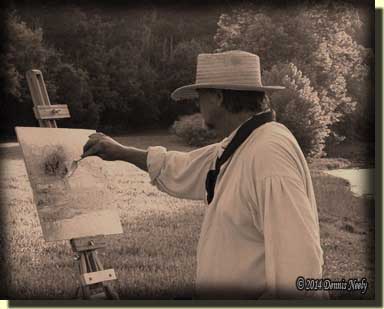
Living historian Lon Brauer painting in 19th-century clothing.

Open air painter Lon Brauer working on the banks of Laughery Creek at Friendship, Indiana.

The writings of John James Audubon, the great ornithologist, painter and writer, offer a unique view of early 19th-century backwoods society. In Delineations of American Society and Character, Audubon described in vivid detail the Fourth of July celebration at Beargrass Creek. In his words:

“Beargrass Creek, which is one of the many beautiful streams of the highly cultivated and happy State of Kentucky, meanders through a deeply shaded growth of majestic beech woods…The spot on which I witnessed the celebration of an anniversary of the glorious Proclamation of our Independence is situated on its banks, near the city of Louisville…” (Audubon, 241)

“…The whole neighborhood joined with one consent. No personal invitation was required where every one was welcomed by his neighbor, and from the governor to the guider of the plough all met with light hearts and merry faces…” (Ibid)

“…Now the waggons were seen slowly moving along under their load of provisions, which had been prepared for the common benefit…In a word, Kentucky, the land of abundance, had supplied a feast for her children…” (242)

“…Columns of smoke from the newly kindled fires rose above the trees; fifty cooks or more moved to and fro as they plied their trade; waiters of all qualities were disposing the dishes, the glasses, and the punch-bowls, amid vases filled with rich wines. “Old Monongahela” filled many a barrel for the crowd…” (Ibid)

“…In a short time the ground was alive with merriment. A great wooden cannon, bound with iron hoops, was now crammed with home-made powder; fire was conveyed to it by means of a train, and as the explosion burst forth, thousands of hearty huzzas mingled with its echoes. From the most learned a good oration fell in proud and gladdening words on every ear, and although it probably did not equal the eloquence of a Clay, an Everett, a Webster, or a Preston, it served to remind every Kentuckian present of the glorious name, the patriotism, the courage, and the virtue, of our immortal Washington. Fifes and drums sounded the march which had ever led him to glory; and as they changed to our celebrated “Yankee Doodle,” the air again rang with acclamations.” (243)

“…However, as Kentuckians are neither slow nor long at their meals, all were in a few minutes replenished, and after a few more draughts from the bowl, they joined the ladies and prepared for the dance.

“Double lines of a hundred fair ones extended along the ground in the most shady part of the woods, while here and there smaller groups awaited the merry trills of reels and cotillons. A burst of music from violins, clarionets, and bugles, gave the welcome notice, and presently the whole assemblage seemed to be gracefully moving through the air. The “hunting shirts” now joined in the dance, their fringed skirts keeping time with the gowns of the ladies…” (243-244)

“…During each interval of rest, refreshments of all sorts were handed round, and while the fair one cooled her lips with the grateful juice of the melon, the hunter of Kentucky quenched his thirst with ample draughts of well-tempered punch…” (244)

“…You would have been pleased to see those who did not join the dance, shooting at distant marks with their heavy rifles, or watch how they shewed off the superior speed of their high bred “old Virginia” horses, while others recounted their hunting-exploits, and at intervals made the woods ring with their bursts of laughter… (Ibid)

“…But now the sun has declined, and the shades of evening creep over the scene. Large fires are lighted in the woods, casting long shadows of the living columns far along the trodden ground, and flaring on the happy groups, loath to separate. In the still clear sky, began to sparkle the distant lamps of heaven. One might have thought that Nature herself smiled on the joy of her children. Supper now appeared on the tables, and after all had again refreshed themselves, preparations were made for departures… (244-245)

“…the glorious Proclamation of our Independence…”

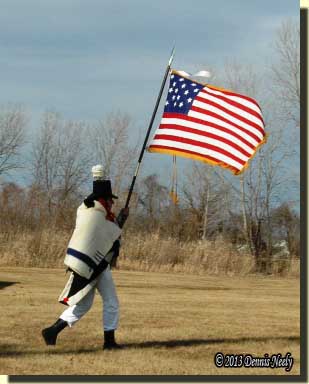
A member of Lacroix's militia caries an 1812 American flag into battle.

Lacroix’s Militia advancing the colors at the Battle of Frenchtown, late-January, 1813. “Remember the Raisin!”

At Christmas or at Easter, Christians embrace and reflect upon the words of the Scriptures. So often we hear “the reason for the season” intermixed in quiet conversations. As a Christian, I return to the story of the Nativity or the Passion to reconnect with the very foundation of my existence, which in today’s society runs counter to the tenants espoused by those who wish to control us.

For the same reason, on this July 4th, we should all take a few minutes and read the Declaration of Independence in its entirety and encourage all our family members and acquaintances to do the same, especially the list of grievances. After reflecting upon Audubon’s description of the 19th-century Kentucky barbeque Fourth of July celebration at Beargrass Creek, one might find it enlightening to read again the list of grievances, replacing “He” with “Our Government.”

“The Declaration of Independence: In Congress, July 4, 1776″

“The unanimous Declaration of the thirteen united States of America,

“When in the Course of human events, it becomes necessary for one people to dissolve the political bands which have connected them with another, and to assume among the powers of the earth, the separate and equal station to which the Laws of Nature and of Nature’s God entitle them, a decent respect to the opinions of mankind requires that they should declare the causes which impel them to the separation.

“We hold these truths to be self-evident, that all men are created equal, that they are endowed by their Creator with certain unalienable Rights, that among these are Life, Liberty and the pursuit of Happiness.–That to secure these rights, Governments are instituted among Men, deriving their just powers from the consent of the governed, –That whenever any Form of Government becomes destructive of these ends, it is the Right of the People to alter or to abolish it, and to institute new Government, laying its foundation on such principles and organizing its powers in such form, as to them shall seem most likely to effect their Safety and Happiness. Prudence, indeed, will dictate that Governments long established should not be changed for light and transient causes; and accordingly all experience hath shewn, that mankind are more disposed to suffer, while evils are sufferable, than to right themselves by abolishing the forms to which they are accustomed. But when a long train of abuses and usurpations, pursuing invariably the same Object evinces a design to reduce them under absolute Despotism, it is their right, it is their duty, to throw off such Government, and to provide new Guards for their future security…” (Bragdon, 734)

May God have mercy on us…

Posted in Worth thinking about... | Tagged , , , , , , , , , , | 4 Comments

In Need of Mending

A crow cawed from the far side of the nasty thicket. Another answered from the ridge that overlooked the River Raisin’s bottomlands, well to the west. The first cawed twice; the second cawed twice. The first crow uttered a pitiful, drawn-out squawk that sounded nothing like a crow’s caw. The second cawed twice, sharp and crisp in tone.

A black-capped chickadee landed on the tip of a barren sprig, two trade-gun lengths to the right. The twig bobbed up and down. The nasty thicket crow cawed once. The chickadee canted its head. The ridge crow cawed twice. The two black demons hollered back and forth for a good ten minutes. Neither seemed interested in venturing to meet the other. The chickadee moved on after a half-dozen banters. It wasn’t wasting its day sitting still.

A tradtional woodsman sitting against an oak tree, watching for fox squirrels.On that cold, late-October morn in 1794, the fox squirrels stayed in their abodes, at least on the west hillside that overlooked the nasty thicket. It didn’t take a traditional woodsman long to agree that the chickadee’s choice was the best option. After looking about, I rose to my feet, stretched out stiff muscles, then checked the prime on “Old Turkey Feathers,” my Northwest trade gun.

Lazy white clouds drifted west, pushed by a cold, northeast wind. The acidic fragrance of fallen oak leaves mixed with a telltale dampness, hinging that a cold rain might arrive before nightfall. Now and again the bright sun poked through, offering a fleeting few moments of welcomed warmth. Only the white oaks still held their leaves. The forest looked ready for the first winter snow.

My wool-lined moccasins struck off to the south, following a doe trail that in past years was churned-up earth, littered with track upon track. Yellow and burgundy and brown leaves laid undisturbed on the trace. Disease had riddled the deer herd. Squirrels, ducks and a wild turkey provided that fall’s table fare.

Up and over a knoll, the broken top of a dead oak obstructed my course. With little mind, I stepped over the largest branch, as was usually my habit. I paused and stood amongst the three main limbs and tangled branches. I pondered about lingering for a while within the top’s shelter. Instead, I turned to my left to take a last look at my back trail.

But I misjudged my proximity to the limb I had stepped over, and in truth, I had shuffled about a bit more than I thought. My left thigh bumped hard into the unmoving, barkless branch that exceeded the size of a three-gallon wine keg. I felt a knife-like pain in the side of my thigh and a tug on my knee breeches as I jerked away. The sharp, spear-like break of an unseen twig scratched my skin and tore the knee breech’s coarse-woven fabric. I spread the cloth; the scratched needed no attention. Disgusted with myself, I stepped out of the tree top with greater care.

The still-hunt continued, and as I skulked along the doe trail, the fingers of my left hand rubbed the scratch and fidgeted with the tear that would need mending that evening.

An Evolving Notion of “Relative Age”

At the end of April I added a topic to the “Basics” section of this website that dealt with artificially aging clothing and accoutrements. “A Progression of Age and Use” generated a fair amount of comments and observations, to say nothing of sparking a few discussions on the topic.

A week ago, while donning the knee breeches I wore that day in 1794, I spied the patch, which triggered a fond memory of how the tear came about. I rubbed my leg as I wondered if now might be a good time to share a change in my perspective on what once was a pet peeve—artificial aging.

Traditional black powder hunters take their living history portrayals a step farther than most individuals who time travel: they pursue wild game in a period-correct manner, and with a little luck, feed their family with the meat of their simple pursuits. One side effect of these exploits is the natural wear and tear the garments, black powder arms and accoutrements receive in the field—to say nothing of one’s body.

Depending on the woodsman (that term includes the ladies, as well), the amount of time spent in the glade, and the harshness of the terrain, I feel historically-correct aging accumulates at a faster rate for traditional hunters than for most living historians, and there are exceptions, of course. But the question that has been bothering me since I first considered aging the split pouch is, “Is the natural process fast enough?”

The returned native captive turns to look for the source of a sound.My bumbling around with a new persona based on an amalgamation of John Tanner, Jonathan Alder and James Smith’s lives brought to light the fact that all of my clothing and most of my accoutrements are “store-bought new.” After coming to that realization, I saw no choice but to add some aging, in moderation.

The purpose for aging the split pouch was to attempt to put forth “an honest and truthful impression” of those three hunter heroes. I had a hard time reconciling “honest and truthful” with “faking age” and a “false representation” of actual use. Despite my misgivings, I found myself forced into taking a deeper look at the progression of age displayed by my entire kit. As so often happens, I mulled over this dilemma while sitting with my back against a favorite red oak tree, and in the end my attitude changed with regard to the need for aging.

When I addressed the split pouch, I used John Tanner to explain the emerging notion of “relative age.” Tanner’s narrative speaks of hunting dawn to dusk, and sometimes into the night. In addition, one might infer from his writings that he slept in some of his basic clothing—his shirt and breechclout, for example. Seven days multiplied by 24 hours per day yields 168 hours of wear per week of Tanner’s life.

By comparison, I started wearing the ruffled shirt on every outing when in my returned native captive persona. By the end of the firearms deer season, if you asked me, I would have said I wore that shirt “mid-September through November,” “all fall” or perhaps “half the hunting season.” To my mind, those eleven calendar weeks amounted to “half a year,” because as a passionate hunter I equate the entire hunting season to a year.

In more quantitative terms, I logged about 200 hours of 1790-era hunting during that time period. Now, assuming Tanner slept in his shirt, one might divide the 200 hours by 24 hours which amounts to a little over eight days of actual 18th-century, field wear and tear time. In relation to John Tanner’s wilderness life, the shirt was a little over a week old. That made sense, and although the revelation was a bit surprising, I accepted it, reasoning the idea is best compared to dog years versus people years.

But the quandary did not end there. Shortly after coming to the “eight days in Tanner’s life” realization I found myself addressing the aging of the split pouch. Being an item made of buckskin, the split pouch should have a longer expected life than a cotton or linen shirt. So obvious questions arose: “Where was the pouch in its expected lifespan?” and “How much visible wear would it have had?”

Those questions began to haunt me, because there seemed to be no reasonable answers, at least none that satisfied me. Then, in the middle of spring turkey season, as I sat against that oak tree, my mind began calculating how much hunting time the ruffled shirt needed to equal a month, then six months, then a year’s worth of wear in the context of a John Tanner year—in essence, the shirt’s relative age.

By comparison, if his shirt lasted a year it would see 8,760 hours of wilderness service (365 days multiplied by 24 hours per day). If, in a full September to March hunting season, I was fortunate enough to log 400 hours of time afield, my ruffled shirt would need just shy of 22 full traditional black powder hunting seasons to re-create the wear and tear his shirt received in one year.

The result of all these mental gymnastics is a reformulation of my opinions and attitudes toward artificial aging. There is no question that I have a lot of cogitating to do on this subject, and no doubt, more words will flow on the topic. For now, suffice it to say I have come to accept artificial aging as a needed and necessary tool in putting forth an honest and truthful impression of 18th-century life.

Moderation is the watchword, however. In addition to the questions above, I now ask myself: “Does the application contribute to the impression, or will it detract from the portrayal,” “Does it blend the individual items of material culture together to re-create a believable image,” and above all, “If I could travel back to 1794, would I arrive unnoticed among the likes of John Tanner, Jonathan Alder and James Smith?”

For now, let me just finish by reiterating that never-satisfied truth that my persona is always in need of mending…

Consider your persona in 18th-century time, be safe and may God bless you.
Posted in Clothing & Accoutrements, Persona, Squirrel Hunts | Tagged , , , , , , , , , | 1 Comment

Who Needs Camo?

“Snapshot Saturday”

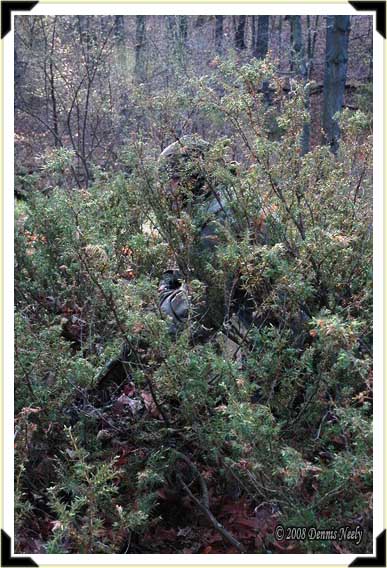
A traditional hunter concealed by a hemlock bush.

Late one morning Tamara Neely concealed herself in a hemlock bush on top of a small knoll. She waited for a tom turkey to answer a few seductive clucks from the wing bone call, but a gobbler never obliged her. Sometime in the early 1790s in the Old Northwest Territory, two ridges east of the River Raisin.

Posted in Snapshot Saturday, Turkey Hunts | Tagged , , , , , , , , , , | Comments Off on Who Needs Camo?

Correcting a Rumor

At times, unsubstantiated rumors can cause more damage than the best-funded anti-gun campaigns.

Recently Tami and I spent a few days at the National Muzzle Loading Rifle Association’s National Spring Shoot. On Sunday evening, June 15th, 2014, emergency vehicle sirens approached the Walter Cline Range from the west. Rescue vehicles and police cars whizzed by and turned into the main entrance at the Friendship Flea Market, which is a private concern that has no affiliation with the NMLRA.

Moments later, two fire trucks from the Friendship Volunteer Fire Department, Inc. slowed down, entered the NMLRA grounds, passed the trap range and waited for instructions, not far from a back access drive to the flea market—and that is where I believe the confusion began.

You see, this past weekend we were told all about the “shooting at Friendship,” in great detail. I am not going to repeat the rumor as it was told to Tami and I for fear of perpetuating a falsehood that is damaging to the NMLRA’s safety record and reputation. Rather, I would like to follow a sage attorney’s advice from many years ago and testify to what I witnessed. And please keep in mind that my perspective is a bit biased as I served as a Deputy Fire Chief for almost ten years.

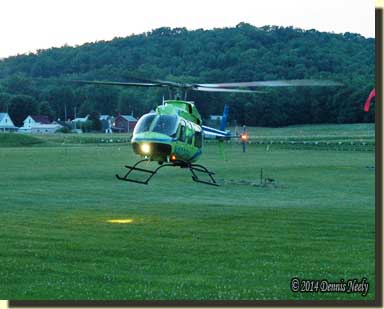
StatFlight medical helicopter landing on the silhouette range.The report that I overheard on a security officer’s radio was that an individual had been accidentally shot somewhere on the flea market grounds and needed to be evacuated by StatFlight helicopter. Now in today’s world, fire departments pre-plan for possible emergency situations, and such preparedness was evident by the actions of both the FVFD and the staff at the NMLRA.

Within five minutes, three FVFD emergency vehicles approached the silhouette range, secured a flat, grassy area and prepared for the helicopter’s arrival. Not long after, the helicopter broke over the tree line beyond the Rand House, circled the grounds once and then set down slowly on the range. The medical staff exited the chopper and met the ambulance as it transported the patient to the temporary helipad. Then, after the medical staff stabilized the patient, the helicopter lifted off and he was on his way to the hospital.

On Tuesday, June 17th, the Osgood Journal correctly reported the incident on page 10:

Gun accident sends Sunman man to hospital”

“Police responded to an accidental gunshot injury at the Friendship campground Sunday. According to the Ripley County Sheriff’s Office, Darrin Brown, 36, Sunman, was taken by air care to UC Hospital for an accidental self-inflicted gunshot wound at 8:17 p.m.

“The injury from the 9 millimeter handgun was to the inner thigh, and police said he did not have life threatening injuries. Brown was camping in the large campground by the flea market.”

The National Muzzle Loading Rifle Association and its members work hard to promote safe practices in all venues of this great pastime. Beyond that, the NMLRA is dedicated to providing a safe environment for their guests while at the Walter Cline Range and obviously willing to offer their facilities and manpower to help their neighbors, as well. Mr. Brown received the same prompt, professional medical attention one might expect in any metropolitan area in America, perhaps better.

Before I step off my soapbox I would like to point out that, as traditional hunters and black powder shooting sports enthusiasts, each and every one of us needs to make sure we have the facts straight before we repeat them. In this case, the erroneous information plays right into the hands of the gun-control crowd. So if in your travels someone shares a wild story about the “shooting at Friendship” that does not match the facts reported by the Osgood Journal, please step forward, speak up and set the record straight.

Be safe and may God bless you.

Posted in Worth thinking about... | Comments Off on Correcting a Rumor

“Venison in a Snow Storm”

“Snapshot Saturday”

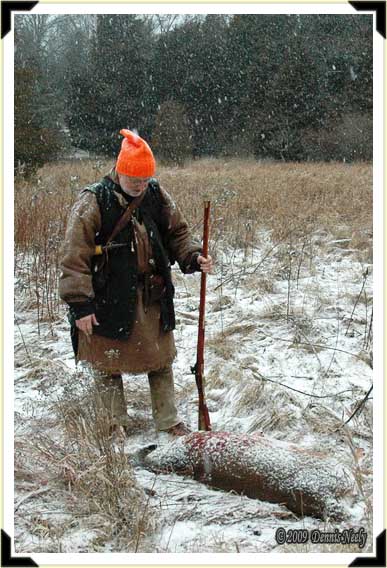
Jon Hollenbeck standing over a fresh-killed doe.

A French post hunter, Jon Hollenbeck, stands over a fine doe, taken in the midst of a snow squall. New France, three hard days travel west of Fort Ponchartrain du Detroit, near the headwaters of La Riviere aux Raisins, 1755.

Posted in Snapshot Saturday | Tagged , , , , , , , , , , | Comments Off on “Venison in a Snow Storm”

Making Common Choices

An owl hooted early. A wild turkey uttered several soft clucks below its roost tree, somewhere near the sinkhole, not far from the nasty thicket. A misplaced robin twittered as it perched on a dead cedar branch, a few trade gun lengths distant. Within ten minutes the hillside grew quiet and chilling cold. Thanksgiving of 1795 was but a day or two away as a humble woodsman huddled in a single four-point blanket.

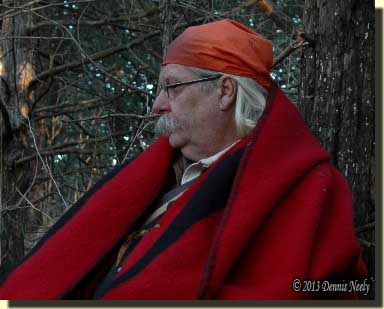
A lavender tint backlit the western tree line. Now and again an involuntary shiver twitched a shoulder or snaked up and down the spine. The historical me, the returned captive, struggled with the cold. When he looked to the south, or to the north, warm moist breath fogged frigid brass-rimmed spectacles. A last minute still-hunt offered the possibility of warmth, but instead he adjusted a wool fold over his left ear, the one that doesn’t hear so well. Remaining seated with his back against a scrawny red cedar trunk seemed best.

A traditional woodsman sitting wrapped in a trade blanket.A muffled crunch broke the silence. A second followed, then another. Not twenty paces distant, just on the other side of a smooth-barked maple, a young buck walked uphill. Only its hind legs rustled the leaves, and then not as much as a cautious chipmunk’s advance.

With his head hung low, the buck glanced north, then south. The evening light faded fast as the buck stopped and sniffed the cool, clean-smelling air. Much to my relief, he stood upwind, but the breeze was but a butterfly’s breath. A maple sapling covered his midsection. I counted six small points, then started counting ribs. My thumb eased up on the cock’s jaw screw, but I still subconsciously prayed, “A clean kill, or a clean miss. Your will, O Lord.”

I squinted to avoid eye contact; my upper lip directed my breath down to keep the spectacles clear. The buck took two or three steps. Two cedar trees that grew from a common root blocked his eye. His chest and vitals teased, appealing for the unleashing of the death messenger, but I resisted the temptation.

Four more hoof-falls brought the unsuspecting whitetail even with my lair. He licked his black nose, bobbed it to scent the air, then laid his ears back with a relaxed motion. His head turned slow to the north, then back to the south. Overcome with oblivious miscalculation, his gaze never fell upon my alter ego’s countenance, never comprehended his deathly shape. Minutes ticked away. The security of night’s blackness crept closer. He shook his head, then chose the northerly path. I sat and watched his rump disappear in the darkness.

Period-Correct Cold Weather

Traditional black powder hunting places a varying emphasis on three elements: the traditions or history of a chosen time period, a black powder arm appropriate to that era and fair-chase hunting that mirrors the practices gleaned from researching the chosen time period.

On that particular November evening, I found myself immersed in the late-18th century, 1795, to be exact. My entire deer season focused on that year as I worked on developing the new “returned captive” persona. The fall hunting seasons were cold, an ominous precursor to the winter. Within any traditional hunt, the three elements shift in importance as the circumstances change, but last year, dealing with the cold seemed to constantly overshadow both the Northwest trade gun and the hunt itself.

One of the goals of any traditional black powder hunt is for the participant to become as authentic as possible in his or her portrayal. A living historian can never achieve 100-percent authenticity; I believe that is impossible, given that our historical simulations are just that, re-creations on a 21st-century stage. But after accepting that caveat, we can all strive to get as close as possible.

Recreating the new returned captive persona began with research based on primary documentation. I spent a lot of time reading and rereading the narratives of James Smith, Jonathan Alder and my favorite, John Tanner in an attempt to learn what they wore and what they used. I studied (and still am studying) late 18th-century drawings, sketches and paintings and spent a fair amount of time looking for existing examples of specific accoutrements.

I chose to begin the portrayal with items “borrowed” from the muzzleloading closet that come close to those described in the narratives, seen in illustrations and displayed in museums. I feel writing about this process might help other traditional black powder hunters formulate their thinking as they wander down the path to yesteryear. I have also found that putting the choices into words helps me examine each item within the context of someone who grew up among the Ojibwe but returned to the settlements in later life.

Yet there is an inherent danger in posting pictures and stories as an alter ego takes shape—the vitriolic criticism of the work in progress as not being authentic or period-correct. That is a risk I willingly take, for it is a given when one seeks the knowledge sequestered in the wilderness classroom.

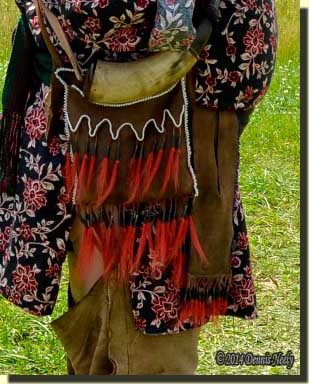
A shot pouch and split pouch showing Ojibwe and Odawa influence.As it is, or should be, with any persona, the choices made try to adhere to what is accepted as “average” or “common” for a given characterization. In addition, an item should be accessible and at the same time, within the financial means of the person owning or acquiring it. For example, a decorated split pouch might be available to a backcountry ranger from a small settlement, but not practical because of the cost in deerskins. But for someone who is living or has lived among the people making the pouch, the Ojibwe or Odawa, the pouch is readily available and the cost is minimal.

To start out, the new persona adhered to middle of the road choices: center-seam moccasins, buckskin or wool leggins, a breechclout, one or two trade shirts, a wool sash or leather belt, a butcher knife, a tomahawk, shot bag, horn, Northwest gun and a four-point trade blanket. The original plan was to develop the persona as I explored this new path to the 1790s, but as I bounded along that path, overcome with a childlike glee, I bumped into an unexpected obstacle—period-correct, common as the sun rises, cold weather.

From mid-October on, my wilderness classroom lessons centered on surviving that day’s cold. The new historical me failed even the earliest lessons—he couldn’t stay out for more than four hours when the temperature reached 34 degrees. With each outing, a combination of tolerance and understanding slowly pushed the limit lower.

By that late November deer hunt in 1795, 24 degrees was all I could stand without considering striking off on a still-hunt to build up body heat. I am thankful I chose to “tough it out” that evening, because having a white-tailed deer venture within sixteen paces is a huge boost to a traditional hunter’s persona development.

A month later I experienced a similar situation, this time sitting through a snow storm for four hours. The temperature that morning was 18 degrees. I consider that a tremendous accomplishment in persona development, because I learned how to survive in the Old Northwest Territory by adhering to common, middle of the road choices.

Give traditional black powder hunting a try, be safe and may God bless you.
Posted in Clothing & Accoutrements, Deer Hunts, Persona | Tagged , , , , , , , , , , , | Comments Off on Making Common Choices