“Forging the Long Lake Ax”

“Snapshot Saturday”

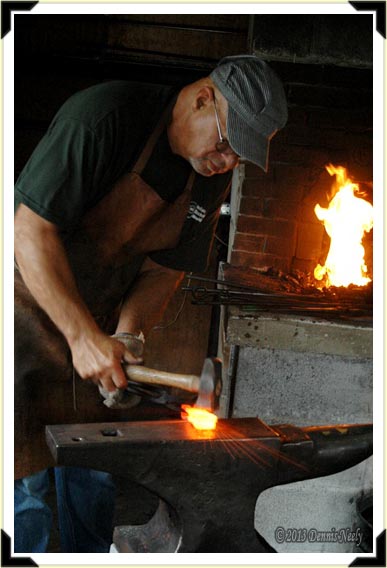
A blacksmith forges steel into an ax.

John Cummins studied the picture of the ax head found at Long Lake, near Hastings, Michigan. He wrote the dimensions on his chalk board and did some calculations. With great care and anticipation, he set about forging an exact replica in the blacksmith shop on the home grounds of the National Muzzle Loading Rifle Association at Friendship, Indiana.

Posted in Clothing & Accoutrements, Snapshot Saturday | Tagged , , , , , , , , , , , , , | 2 Comments

Saving Hours of Rummaging

Leaves rustled. A wild turkey offered a weak gobble, muffled in the River Raisin’s bottoms. A gray squirrel materialized, bounded once and commenced digging. Leaves and pieces of leaves flew along with tiny scrapings of earth. The squirrel’s nose burrowed beneath the layered, brown skeletons of the summer prior, then emerged with a mold-encrusted acorn.

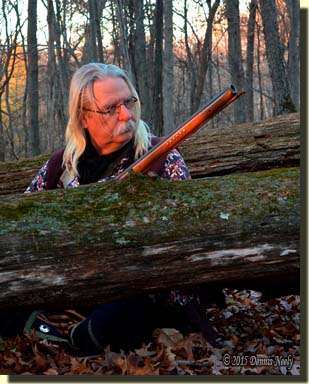
A traditional woodsman watches from behind a mossy log.This forest tenant ran by the downed red oak top, passing three trade-gun lengths distant. It leaped to a standing oak, clenching the tree waist high, measured on a tall British ranger. Spiraling upward, silvery tail flicking and twitching, the gray squirrel circled around the trunk, then perched on a stubby branch, rotted and broken off years before. On that warm, pleasant morning in May of 1795, that squirrel partook of a fine breakfast.

For the second time that morning, the returned captive woodsman reached into his shot pouch and retrieved a single wing bone. He cupped the round end in his hands, placed the flatter end to his lips and sent a sharp, snappy “arrkk” in the direction of the river bottom.

“Gob-obl-obl-obl-obl-obl!”

Again, the tom turkey sounded weak and perhaps uninterested. The utterance emanated from the same location: the fallen trees at the sedge grass cove. Either the bird had not moved or another took his place.

Chipping sparrows, two cardinals, a handful of chickadees, and a wandering robin filled the glade with hushed, but joyous music and merriment. Now and again a crow cawed from the hardwoods on the far side of the River Raisin. Several geese jabbered at the sand shallows. And in time, a red tailed hawk circled overhead.

Msko-waagosh sat motionless. His dark brown eyes panned right-to-left, then left-to-right. The woodsman who spent his youth among the Ojibwe centered his attention on the little knoll and the dip to the northeast. If the tom came looking for the mysterious hen, he would pass over the knoll or stroll through that valley…

A Hunter Hero’s Material Culture Outline

The creation of any history-based portrayal, whether founded on an actual person who lived in a chosen time period or a fictional character built from the life stories of two or more individuals, starts with gathering and analyzing first-person accounts.

First and foremost, my research centers on hunting tales, harrowing or mundane. When I read an article in one of the living history magazines or peruse a new 18th-century book, I spend a fair amount of time scrounging through the bibliography. Any books that cover 1790 to 1800, or as in Mi-ki-naak’s case 1763, garner my attention. Some I already have in my library, others go on the infamous “Dad’s book list,” a wish list that gets run through the online booksellers every now and again.

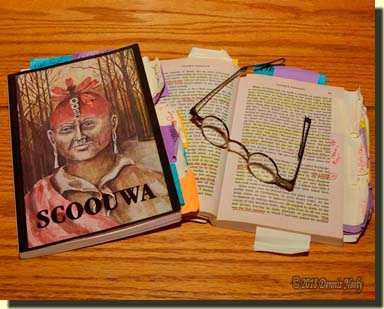
SCOOUWA: James Smith’s Indian Captivity Narrative, sits on top of shelved books, along with the missives of John Tanner, Jonathan Alder, Mary Jemison and anthologies of captive narratives edited by Frederick Drimmer and Colin G. Calloway. These books have been my “go to” research sources in the last few years for the returned captive persona of Msko-waagosh, the Red Fox.

Research books showing sticky notes, highlighting and margin notes.Yellow, purple, blue and orange sticky notes, most with notations, protrude from page edges. This indexing system is fine, if I can remember which author wrote what—which is not that often. Early on in this journey to yesteryear, I highlighted passages in yellow, underlined important phrases in red and penciled notes in the page margins. I added the sticky notes, which act like file tabs. A few thousand sticky notes later I still spent hours rummaging through tabs to find two or three sentences that stuck to the cobwebs of my mind.

One evening, in the midst of an exasperating quest, Miss Tami, the ever efficient business system analyst, suggested I establish a searchable data base. The first choice was MS Access.  This program worked great for short passages, but anything over a half-dozen words became cumbersome. I tried just keywords, but some historical statements lost too much meaning when reduced to two or three words. I had the same results with MS Excel, too. Even the cyber version of the wilderness classroom can be cruel at times.

One technical aspect of my writing process includes the occasional word search using the “Find” tool under “Editing” on the MS Word tool bar. A week or so after the data base failures, in the midst of scribbling a manuscript draft, I needed to find a passage. As I typed two words, the “Eureka!” light came on.

I stopped working on the manuscript, opened a new document and saved it as “John Tanner Material Culture” in the “Msko-waagosh” file within the “Persona Development” file. Fingers flew on keys. A page number followed the crux of a highlighted passage:

“…drawing his tomahawk…” (5)

“…had some blankets and provisions concealed… (5)

“…gave me a pair of moccasins…” (6)

“…put them in a small kettle…” (7)

“…mukkuks of sugar…” (9)

I paused about twenty pages into Tanner’s narrative, The Falcon… I opened “Find” and started testing. This outlining system worked and required no more set-up time than MS Access or MS Excel.

Two or three evenings each week are devoted to research, depending upon how tired my eyes are. Instead of reading, the next few nights I banged keys with great delight. The highlighting and sticky notes helped, but I found myself skimming the text—rereading Tanner’s life story. The skimming discovered passages missed in prior readings. Of course, those phrases made it into the outline. Eleven typed pages later, 280 pages were reduced to a searchable document, complete with page references.

James Smith’s narrative, SCOOUWA… was next. Smith’s writing style required longer passages for the outline, because his sentences were more detailed, many including an additional explanation:

“…I saw Russel’s Seven Sermons…brought from the field of battle…” (26)

Outlining a hunter hero’s writings removes the words that are necessary to move the narrative along in a smooth, cohesive manner. For a living historian studying the material culture of a given place, time period and station in life, the great revelation of cutting to the basics is the amazing list of resources, accoutrements and daily items available to the individual who currently sits on the examining table.

One page in the outline might cover twenty to fifty pages in the hunter hero’s narrative. Spread out over that many pages, the items appear sparse and sometimes unrelated. Put in outline form, those same pages compress. To some degree, each outline page represents a shopping list of goods the original writer once possessed or that were commonly owned or used by those around him or her.

A general picture develops when passages follow each other in close order. “Breech-clout,” “powder, bullets, flints,” “a pair of scissors,” “silver bands,” “new ruffled shirt,” “garters dressed with beads,” “leggins…with ribbons,” “a pipe,” “tomahawk,” and “flint and steel” become golden nuggets when viewed back-to-back. The context of each passage must be taken into account, as well as other passages that refer to these items. And of course, the commonality of usage is best confirmed when compared to other authors of that era.

But the significance of any outline is this compression of thought, hunting experiences or material objects. The initial investment of time to set up the outline pays great benefits when creating a new persona or tweaking an existing historical portrayal. A word search finds the passages pertinent to a given topic in short order, saving hours of rummaging through sticky notes or thoughts scribbled in margins.

Give traditional black powder hunting a try, be safe and may God bless you.

Posted in Persona, Research, Turkey Hunts | Tagged , , , , , , , , , , , , , , | Comments Off on Saving Hours of Rummaging

“Unexpected Ambush”

“Snapshot Saturday”

"A trading post hunter shoots a wild turkey

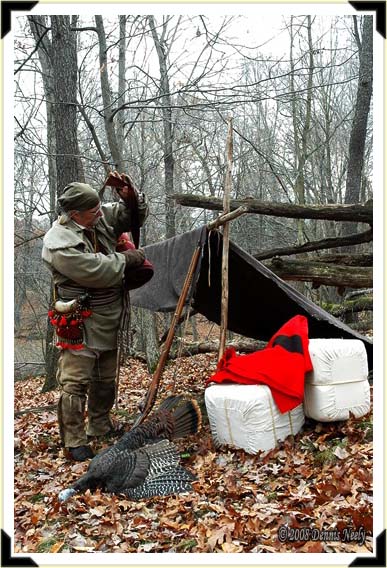
A raspy-mouthed hen turkey clucked just ahead of a trading post hunter. The woodsman stopped, then sat on a steep side hill. The old hen kept walking. At twenty paces the bird came into view in the tangled underbrush. The Northwest trade gun roared…Old Northwest Territory, east of the River Raisin, in the Year of our Lord, 1795…

Posted in Snapshot Saturday, Turkey Hunts | Tagged , , , , , , , , , , , | Comments Off on “Unexpected Ambush”

Not Worth the Risk

Thursday, 3 November 1763

Quick glances proved fruitless. Somewhere overhead little claws scratched bark. A different fox squirrel chattered in a distant slender oak. A yellow poplar leaf whip-sawed earthward. Gnats flitted about. The air smelled warm, damp and fall-like. The tarnished-brass lead-holder scribbled across a sunlit page. “An honest mistake…,” this passage began.

Daylight streamed through the forest. Mi-ki-naak, the Snapping Turtle, removed the fusil from his wigwam and leaned the battered, long-barreled smoothbore against the abode’s weathered canvas. He returned to the inside, retrieved his horn and shot pouch from a rumpled trade blanket, and once outside, slung them over his shoulder and pushed them back upon his right hip. A blue jay swooped low, then rose up and perched on a shag-bark hickory branch.

As his left hand reached for the French fusil, his right hand flipped up the shot pouch’s deerskin flap. Nimble fingers explored the front, then wandered to the back of the soft cavern. They felt the shot bag, pushed the wing bone aside, stepped over the gun worm,skirted two sharp flints, walked along the iron turn screw and passed around the burning glass—but found no brass powder measure.
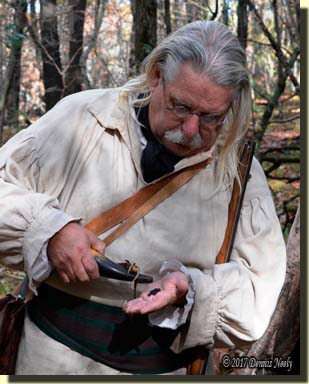
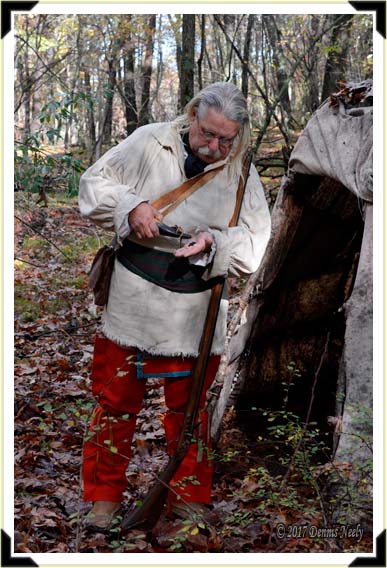
A traditional woodsman measures out gunpowder in the palm of his hand.

Although “palming powder” might be period-correct, test results prove a powder measure should always be used. Palming powder is unreliable and unsafe.

With the butt grounded beside a moccasin, the woodsman’s left arm pinched the fusil’s muzzle against his left side. The walnut stopper dangled from the horn’s spout as black gunpowder collected in his left palm, fingers outstretched, the hand slapping flat. His thumb and index finger replaced the stopper, taking care not to spill the precious granules.

Mi-ki-naak cupped his hand, funneling the powder down the clean barrel. He reached inside the canvas and picked up two dry oak leaves from a little pile; morning dew damped the leaves outside the wigwam. He broke the stems from the leaves and rolled them into a ball about the size of the death sphere. The hickory ramrod tamped the wadding tight on the powder.

His fingers ventured into the pouch and found the bag of shot. Teeth gripped the stopper and like the gunpowder, his right hand poured shot into his left palm, approximating the same volume as the powder. The death bees buzzed down the barrel. A single leaf wad followed.

Loaded and primed, the woodsman who spent his youth among the Ojibwe, struck off to the northeast in search of wild turkeys. The blue jay watched in silence…

Another Wilderness Classroom Lesson

Trial and error is a powerful educational tool. Mistakes have always been my main method for learning, including that day in November, 1763.

After four seasons, Msko-waagosh, the Red Fox, is still evolving as a persona. I am getting comfortable with this alter ego, but as with any living history project, the process of re-creating a character portrayal takes time, a lot of patience and a heap of personal introspection and self-critique.

Mi-ki-naak was a new persona, and this was his first official outing. I expected problems and oversights, and I wasn’t disappointed. As I so often do, I scribbled notes on a separate, folded page tucked in the back of the leather envelope I call my journal. This page is always there, and acts as a quick reference to lessons learned or future laboratory work in the wilderness classroom.

The shot pouch and horn planned for Mi-ki-naak are not completed. That is a huge frustration, but there is nothing I can, or could, do about it. Family has to come first, even though I consider my three personas close relatives. Heaven knows I’ve shed a lot of blood over the first two, and the third should be no different.

For that first outing, I used a shot pouch and horn that I send along with the French fusil when I loan it out. Neither are used or pictured in any of my work, so they were unique to the Snapping Turtle, for now. When I set the bag up the night before that wild turkey chase, I failed to include a powder measure. I’ve done that before, most often after a shooting competition, and my response to that oversight is to “palm the powder.” Self-critique questioned that choice.

Palming Powder

Palming black powder as a form of measuring a charge is a difficult topic. Safety must be first and foremost for the traditional black powder hunter—no exceptions. From the outset, I want to make it clear that I am not advocating palming powder, and in today’s living history environment, there is no reason to undertake palming black powder as an everyday measuring practice.

I have several trade good inventories that I rely on for my 1790-era personas. These inventories mention kegs of black powder and describe the sale of “gunpowder” by the “handful.”  Several of the clerks’ journals imply a measuring cup was used instead of a trader’s hand. I don’t believe any of the lists include a powder measure for loading a smoothbore.

Likewise, I don’t recall any mention of using a powder measure in the journals of my hunter heroes. I am told there are accounts of riflemen using a measure, but again, my emphasis is on smoothbores. The question then arises, “What did John Tanner, Jonathan Alder, James Smith and other returned captives use to determine a correct powder charge?”

Some modern living historians have postulated that powder was simply poured into one’s hand and measured by sight—thus the term “palming powder.” I have had a number of long conversations with noted researchers who believe this was the method of choice for loading a smoothbore in the backcountry.

Again, I have never seen this practice described in a primary journal entry regarding a smoothbore. That doesn’t mean it wasn’t done, or that I just haven’t read the right journal.

I suspect the idea of palming powder can be traced back to John James Audubon’s writings. He writes of Daniel Boon [sic] “Barking off squirrels,” and when he describes Boone’s loading method he fails to tell the reader how Boone “measured” his powder:

“The gun was wiped, the powder measured, the ball patched with six-hundred-thread linen, and the charge sent home with a hickory rod…” (Audubon, 61)

In a later story about raccoon hunting in Kentucky, Audubon is more specific on how “the bold Kentuckian” (he does not say this is Boone) measured his powder:

“He blows through his rifle [this is not considered a safe practice], to ascertain that it is clear, examines his flint, and thrusts a feather into the touch-hole. To a leathern bag swung at his side is attached a powder-horn; his sheathed knife is there also; below hangs a narrow strip of home-spun linen. He takes from his bag a bullet, pulls with his teeth the wooden stopper from his powder-horn, lays the ball on one hand, and with the other pours the powder upon it until it is just overtopped. Raising the horn to his mouth, he again closes it with the stopper, and restores it to its place. He introduces the powder into the tube; springs the box of his gun, greases the ‘patch’ over with some melted tallow, or damps it; then places it on the honeycombed muzzle of his piece. The bullet is placed on the patch over the bore, and pressed with the handle of his knife, which now trims the edges of the linen. The elastic hickory rod, held with both hands, smoothly pushes the ball to its bed: once, twice, thrice has it rebounded. The rifle leaps as it were into the hunter’s arms, the feather is drawn from the touch-hole, the powder fills the pan, which is closed. ‘Now I’m ready,’ cries the woodsman…” (Ibid, 282 – 283)

In the 1930s, during the revival of interest in black powder arms and the birth of the National Muzzle Loading Rifle Association, this passage was cited as historical proof of how to load a muzzleloader. As Audubon would say, “dear reader,” I include the entire passage for those traditional black powder hunters who insist on using a smoothbore with deep scratches in an otherwise pristine bore…

By simple repetition, this passage stating one historical observation became accepted practice. Sam Fadala penned a chapter on “Black Powder Fact and Fancy” in his book, The Complete Black Powder Handbook. Fadala’s test results from “Rule 16” debunk the myth:

“…But you never know until you try; so I tried. The variations of powder charge were tremendous, of course. A cupped hand hid part of the ball, producing an undernourished load and a ball held flat in the hand required a lot of black powder to cover it. In some cases, charges were extremely heavy. The only thing you will get from pouring powder over a ball resting in the palm of your hand is a dirty hand.” (Fadala, 74)

Testing a Theory

One of the basic tenants of the wilderness classroom concept is that any living historian should be able to duplicate a lesson plan and achieve the same or similar results over and over. With that in mind, I started testing.

The first question that arose dealt with powder granulation. Even today, when safety is the big issue, folks fail to mention what granulation they are using. Different granulations burn at different rates and produce different pressures; the finer the granule size the faster the burn and the greater the pressure. Burn rates and pressures vary from manufacture to manufacture, too. Thus, 3Fg Goex, being a finer powder, will result in about 25 percent more pressure than the same volume of 2Fg Goex.

Up through the 1990s, 2Fg was the standard powder granulation for smoothbores. In recent years, more traditional hunters have switched to 3Fg for a cleaner burn and less fouling. (Please note that switching to a finer powder or a different manufacture requires adjustments in the measured charge to allow for the greater pressure.) Therefore, knowing what “a proper pile” of black powder looks like in the palm of a hunter’s hand depends on which granulation that person is using.

In theory, given two piles of powder that look the same, one of each granulation measuring 65 grains, the pile of 3Fg will produce the equivalent pressure to 81 grains of 2Fg (65 x 1.25). The implications for safety are immediately evident; make a mistake on gauging “a proper pile,” and you risk exceeding the allowable pressures of a specific muzzleloading arm.

In practice, I found it almost impossible to cast two piles of equal size with the two granulations. The 2Fg powder, being a larger granule, had a tendency to spread out more, but left the impression that the pile was smaller. On my first try with the 2Fg, what I would call “a modest pile” measured 110 grains. That was a scary revelation.

The first test involved the ball in the palm theory. One of the traditional hunters I consulted emphasized keeping the palm as flat as possible. His experiments noted that cupping the palm resulted in erratic results, which mirrored Fadala’s findings. But as Fadala wrote, I had to try.

The first half dozen tries using 2Fg Goex powder in a cupped palm showed a variation from 65 grains to 110 grains. I stopped there and opted to spend my time with the flat palm tests. The flat palm was the method I used on that morning. I should note that I pulled that load after the hunt. I palmed 64 grains of 3Fg powder and 80 grains of #5 lead shot. The load was within the acceptable limits of the fusil, which patterns best with a third more shot than 3Fg powder by volume.
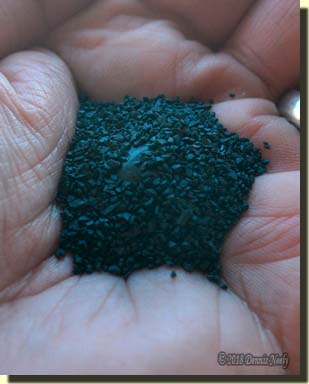
A trade gun ball covered with 2Fg Goex black powder.The flat palm test using 2Fg included 20 attempts, ten one day and ten another. The data showed a low of 85 grains, a high of 115 grains and an average of 95 grains. The maximum charge of 2Fg I’ve ever used in “Old Turkey Feathers” is 85 grains, so this test exceeded my limits and raised red flags concerning safety.

The same test (10 + 10 samples), following the same procedures, with 3Fg produced a low of 70 grains, a high of 85 grains and an average of 75 grains. The low of 70 grains of 3Fg Goex is the upper limit for Old Turkey Feathers, the equivalent in 2Fg being about 88 grains (70 x 1.25).

In reviewing the data, I noted that the 2Fg equivalent for the average (75 x 1.25 = 93.75) and the high (85 x 1.25 = 106.25) are real close to the test data for 2Fg. And again, this raises huge red flags regarding safety. I don’t have an explanation for this similarity, other than the observation that 2Fg creates a different pile shape than 3Fg, which I attribute to granule size/shape.

The next set of tests involved pouring powder only into a flat, open palm: that is, palming a consistent powder charge. The ultimate goal was to palm 65 grains of 3Fg and the equivalent in 2Fg (65 x 1.25 = 81.25), which is the best patterning charge in the fusil and Old Turkey Feathers.
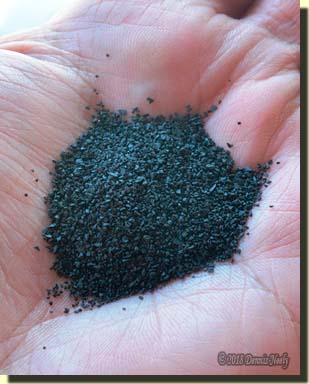
A pile of 3Fg Goex black powder in the palm of a hand.As a guide, I dumped a brass measure, set at 82 grains, of 2Fg Goex into my left palm. This classroom experiment included the same 10 + 10 sampling to allow for different perceptions on different days. The first few tries cast over 100 grains in the pile, but after a few more tries the average dropped into the mid-80 grain range. The final data recorded a low of 82 grains, a high of 112 grains and an average of 89 grains. For the most part, all attempts fell over the self-imposed 85 grain limitation.

A sample brass measure of 65 grains of 3Fg Goex was used as a guide. The 3Fg results (10 + 10 sample) fell closer to the desired optimum load with a low of 58 grains, high of 75 grains and an average of 64 grains. The data included a 70, 74 and 75 grain cast; all others were 68 grains or below. Thus, 15 percent of the attempts exceeded the maximum desired charge. The low charge converted to 73 grains 2Fg equivalent (58 x 1.25), which is sufficient to kill a turkey at the effective distance of 28 paces.

Old Turkey Feathers is more forgiving than the fusil de chasse. I have a concern with the wider variation in the 3Fg tests, and lacking pattern-board experience, I need to withhold judgement on those limits with respect to the fusil. There would be no appreciable change in pattern with Old Turkey Feathers, other than the lowest attempt might tighten the pattern some.

Conclusion

I think it is important to point out that these tests dealt with one variable: powder charge. If a traditional woodsman left his or her measure home as a matter of everyday practice, a second variable would be added to the equation: palming a shot charge.

The same goal exists in this instance, and that is measuring a consistent load, time after time. The shot column affects pressures, too. A light load reduces pressure as compared to a “standard load,” and a heavy load increases pressure. Overestimate the powder charge and do likewise with the shot, and a recipe for a period-correct, catastrophic woodland disaster manifests itself.

As already stated, the first three tests exceeded the maximum load that is acceptable to me. The pour-powder-over-a-ball-in-your-palm method is unsafe. Thus, my tests confirm the findings of others. Likewise, palming 2Fg produced similar erratic loads, most of which exceeded the same safe load requirement. The last test fell within limits, but, like the other tests, showed a tremendous variation, as Fadala put it.

The goal of any hunting load is safety first, and all four tests failed. None can guarantee safe loading in the field, none.

Further, the goal of any traditional black powder hunt is to produce consistent patterns that kill game in a clean, humane manner. There is an implied responsibility in this regard for all hunters, traditional and/or modern. We owe that to the wild birds and animals we pursue. Setting safety issues aside, none of these methods guarantees a consistent, effective load, none.

On that November morning, I forgot my powder measure. When I palmed the powder and shot, I tried to error on the side of a lighter load. I don’t like to hunt with the grim reaper as a companion. In reality, I hit the optimum load, which is not what I thought I was doing. Thus, that attempt failed, in my opinion.

The conclusion produced by this wilderness classroom lesson is simple: carry a powder measure and use it. The practice may not be period-correct, but it is so universal that it is overlooked by all but the staunchest thread-counter. The consequences are not worth the risk.

Give traditional black powder hunting a try, be safe and may God bless you.
Posted in Research, Safety, Wilderness Classroom, Worth thinking about... | Tagged , , , , , , , , , , , , | Comments Off on Not Worth the Risk

“Mi-ki-naak measuring powder”

“Snapshot Saturday”

Standing outside his wigwam, a traditional woodsman measures powder with his hand.

Mi-ki-naak poured gunpowder into the palm of his outstretched hand as he loaded for a wild turkey hunt. When the little pile of black granules reached the appropriate size, the returned white captive poured the charge down the barrel and seated two dry oak leaves, rolled into a ball, firm over the powder. Duck shot followed with another oak leaf rammed tight. East of the River Raisin in the Year of our Lord, 1763…

Posted in Hunting Camps, Snapshot Saturday, Turkey Hunts | Tagged , , , , , , , , , , , , , , | 4 Comments

“Morning Hunt’s End”

“Snapshot Saturday”

A traditional woodsman taking off his bedroll after returning to camp.

A trading post hunter removes his bedroll at the tiny station camp that overlooked a huckleberry swamp. Within sight of the River Raisin in the Old Northwest Territory, in the Year of our Lord, 1797…

Posted in Snapshot Saturday, Turkey Hunts | Tagged , , , , , , , , , , , , | Comments Off on “Morning Hunt’s End”

Referencing the fall of 1763…

Fall’s melody played upon the treetops. Yellow maple leaves fluttered earthward. A single wing bone touched pursed lips. Two kissing breaths passed up the hollow tube. “Arrkk…arrkk.” Two abrupt clucks drifted on the gentle breeze of a early-November morning. Greenish-yellow poplar leaves flapped like the wings of a wood duck that does not wish to take flight. The forest floor was not yet arrayed with gold and red patches—the weather being too mild.

Several robins frolicked at the west edge of the grassy clearing, three trees distant. Bugs flew in and out of sunlight spears. A fox squirrel chattered somewhere on the tiny opening’s far side. Another fox squirrel uttered a soft, pitiful bark close by, but where?

A gust carried the aroma of a warm and damp hayfield, laced with a mystic hint of angle worms. Lazy minutes ticked by. Across the clearing, a fox squirrel hiked up a tall, slender red oak, the one beside the forked wild cherry. A lone drag on the wing bone sent out another quiet “Arrkk…”

Little claws scratched bark, but again, their direction remained undetectable. The squirrel sounded near, but the muffled noises seemed to come from the south, then the north. Experienced eyes scanned the treetops, searching for a wisp of cinnamon-colored hair—more as an exercise than from desire. Wild turkey was the meal of choice that day, in the Year of our Lord, 1763.

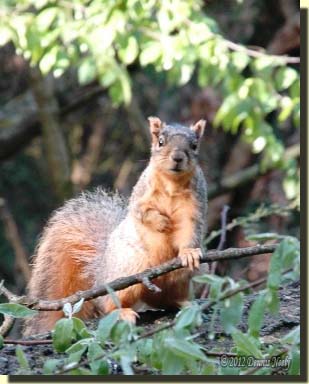
A startled fox squirrel studies a traditional woodsman.The far squirrel jumped to another oak branch, spiraled around that limb and came to rest on a rotted stub. It basked in sunlight and chattered away. Four or five scratches later a plump fox squirrel plopped onto the oak leaves beside the tree that hid a backcountry woodsman.

As it happened, this forest tenant’s crinkling nose ended up inches from the forestock of a worn fusil de chasse. Dark eyes grew big. A bushy tail flipped and twitched. The returned white captive squinted, but remained motionless. The startled fox squirrel turned to its left, bounded under an autumn olive bush, then scampered into the clearing.

In time, Mi-ki-naak, who spent his youth among the Ojibwe, got to his feet, surveyed the area, and still-hunted to the north, staying to the shadows while skirting the clearing. The Snapping Turtle’s moccasins followed the doe trail beside the huckleberry swamp.

A red oak, encircled with stunted, half-browsed scrub oaks looked like a fine location for the next try at garnering a hen turkey’s attention. Coon leavings, some fresh and some old, eliminated that tree as a possible fortification. His course moved east, then veered south until he came to two maples that grew a foot apart.

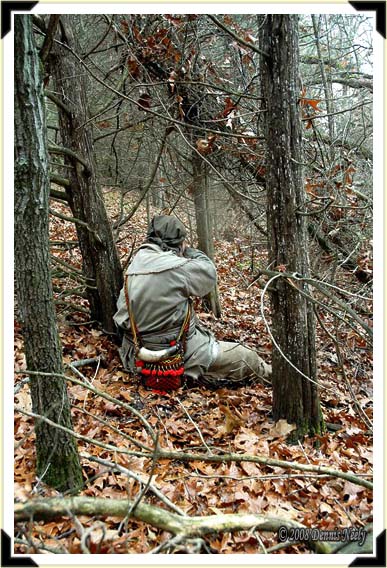
The sun was beyond noon-high. A couple hours remained before the planned rendezvous with Lt. Lang of Joseph Hopkins’ ranger company. Mi-ki-naak unbound a trade blanket, pulled it about his shoulders and sat cross-legged with is body between the two tree trunks. The long-barreled fusil pointed to the south, the direction he hoped a bird might come from.

Fifteen or so minutes ticked away. “Arrkk…arrkk.” The wing bone’s submissive clucks appeared to stay within the bounds of the wooded hillside. To the north, a fox squirrel chattered. Another answered to the south. A bronze-feathered turkey never clucked and never came to investigate…

Introducing Mi-ki-naak, the Snapping Turtle

On that early November morning, a new being set his moccasins upon the North-Forty’s soft earth: Mi-ki-naak, the Snapping Turtle. This was an alter ego’s first excursion to 1763, a first attempt at time traveling to Lt. Lang’s historical destination.

The vast majority of my traditional black powder hunts have been solitary adventures. I am no stranger to period station camps with multiple participants or engaging in a fair-chase hunt with other like-minded individuals.

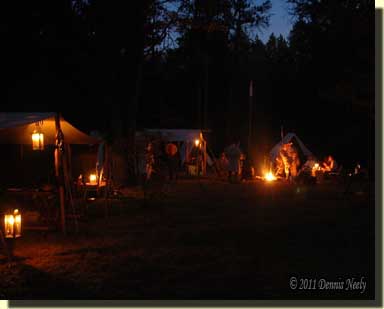
Traditional hunters gathered around a campfire.For example, memories from the camp in the pines at Swamp Hollow will always be dear to me. The sight of a breakfast fire’s smoke hanging in the tree tops, the smell of a clay pipe lit with a glowing ember, the taste of goose breast seared in bear fat or a full moon beaming down on the ghostly shapes laughing around a dancing fire are among the reveries of this glorious pastime that match those described by Joseph Doddridge.

On that occasion, and a few others at Swamp Hollow, a half-dozen canvas shelters held traditional hunters from 1750 to 1840—a 90 year span. The disparity of time periods didn’t seem to matter to any of us. The subject never came up in campfire discussions. I only became aware of the potential historical conflict in hindsight, after the creation of Msko-waagosh, the Red Fox—the returned white captive from the mid-1790s.

“Measured compromise” usually assesses the impact of a modern intrusion upon any given historical simulation and applies an acceptable solution that makes the transgression almost transparent within the confines of the chosen scenario. One of the goals for a traditional hunter is to nurture a mindset that applies measured compromise without conscious thought—except in cases of impending danger. I suppose that is why the differences never became an issue. Perhaps the awe of the moment overpowered the trespass.

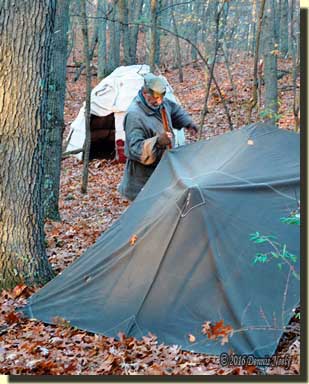
Lt. Lang returns to his camp.A couple of years ago Lt. Lang erected a temporary shelter in the same woodland bowl where Msko-waagosh’s wigwam sits. As that day’s wild turkey chases drew to a close, both personages “returned to camp.” The two time travelers talked about a variety of subjects and shared stories of that day’s simple pursuits. The time warp between 1790 and 1763 yanked me from my 18th-century Eden like a low flying airplane buzzing geese on the River Raisin.

My first inclination was to remain the same character, only thirty years younger. That notion did not fit with the backstory developed for Msko-waagosh. Next I considered a new character name and a swap-out of the Northwest trade gun for a French fusil de chasse. Change the date and you’re good.

A morning deer chase in late November left the Red Fox straddling time’s threshold with most of his body in 1790 and one leg in 1763—Ouch! That test in the wilderness classroom proved the hypothesis flawed and solidified the only reasonable choice: create a new character—do the research and get the portrayal right.

Like the creation of Msko-waagosh, the development of this new persona had to begin from the ground up. For any traditional black powder hunting portrayal, the fictional character must fit within the primary documentation for a person in a chosen geographical location, station in life and time period. I started scribbling down notes and ideas and stuffing them in a file marked “New Persona.”

Lt. Lang centers his ranger persona within a few months of the later part of 1763, scouting and hunting out of Fort Detroit after Pontiac’s Siege.  At the least, my new alter ego had to share that time and location with Lang’s character. This newbie’s exploits might include a year or so before or after the fall of 1763, but when he shared the glade with Lt. Lang, the day and month had to match that of the British ranger. Therefore, the focus time period became the fall of 1763.

James Smith’s captive narrative, Scoouwa, offered the first guidance along with other firsthand accounts, such as The Siege of Detroit in 1763; The Journal of Pontiac’s Conspiracy and John Rutherfurd’s Narrative of a Captivity. Other works followed, shedding light on the material culture of white captives adopted by the Ojibwe during the French and Indian War.

Serious family obligations limited time, but by that November turkey hunt this new persona had an Ojibwe name, Mi-ki-naak, madder-red leggins and a breechclout of the same material. A borrowed trade shirt, an appropriated, natural linen outer shirt, a black silk neck scarf and a green sash fleshed out the meager basics.

A butcher knife and tomahawk that were not associated with any persona “will work for now.” A loaner deerskin shot pouch and powder horn had to “make do.” The fusil de chasse required range practice time, and is a bit different than “Old Turkey Feathers,” but still serviceable for putting meat on the table.

The history and research are not complete, and never will be. That said, Lt. Lang and Mi-ki-naak plied the woods together, seeking wild turkeys and fresh venison. Neither happened, but the scribblings in the Snapping Turtle’s journal pages and those of Lt. Lang all reference the fall of 1763…

Give traditional black powder hunting a try, be safe and may God bless you.
Posted in Living History, Persona, Turkey Hunts | Tagged , , , , , , , , , , , , , | 5 Comments

“Waiting on a Companion”

“Snapshot Saturday”

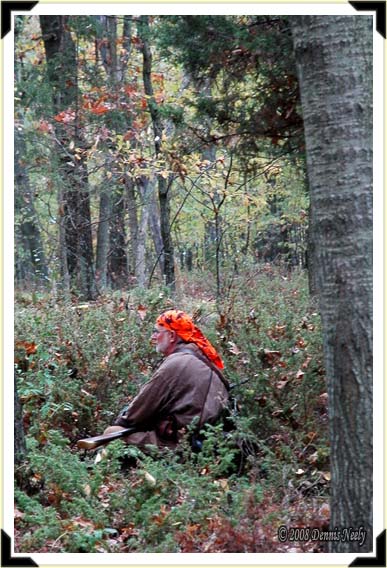
A French woodsman sits in a patch of hemlocks.

A French hunter (Jon Hollenbeck) from Fort Pontchartrain du Detroit sits within a patch of hemlock bushes as he waits for his hunting companion to return. New France, mid-October in the Year of our Lord, 1755…

Posted in Uncategorized | Tagged , , , , , , , , , , , , | Comments Off on “Waiting on a Companion”