“Snow Writing Time”

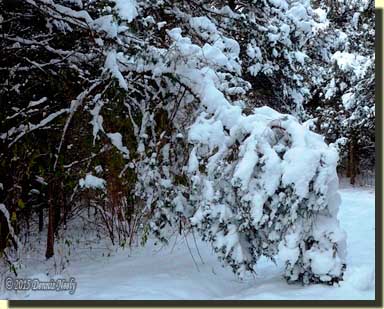
Three doe beds, melted down to bare earth, resided six paces distant. Late in the night, the trio took rest under a large red cedar tree, east of the ridge crest. From their vantage point the hillside dropped off to a steep slope that flattened out among the big oaks at the edge of the swamp. Snow covered the ground. A steady southeast wind dislodged white clumps from the oak limbs and cedar boughs. Christmas was but a few days away, in the Year of our Lord, 1795.

Two powder-keg-sized box elder trees shared a common root next to an older cedar tree, offering sufficient mass to block a humble woodsman’s deathly shape. The box elder lair overlooked the rolling hill that grew up from the swamp’s narrows, and at the same time, provided the same view the three whitetails shared.

Snow-covered sedge grass betrayed the approach of a doe and her summer fawn. The older deer followed the trail that passed next to an ice-split cedar tree. The younger lingered in the swamp. The chosen trail angled north. The matriarch paused, evaporating within the brownish-gray tangle of dead lower cedar branches and leafless autumn olive bushes. A half-dozen steps defined her location, only to be lost when she stopped again.

The skittish fawn walked from the swamp and disappeared in a like manner. A few hoof-falls here, then a few there told of their progress along the trail. The later whitetail kept looking back to the swamp crossing. Perhaps a fine buck trailed?

In due time, the white tip of a flicking tail was all that remained visible. The imagined stag never materialized. Sunlight crept down the trees on the ridge crest. When the warmth hung head-high over the doe beds, cold fingers pulled a brass lead-holder and a folded paper from the split pouch’s back side…

“…the ground is still white,” the lead scribbled on the page. “The crimson blanket’s outer layer is pulled up over my shoulders. The edge is up around my ears. The inner layer is wrapped about my bare thighs and wool leggins. The late-December air is cold. I am breathing down to avoid fogging my spectacles. Two does just passed. It is ‘snow writing time.’

“When I discovered three doe beds, I paused at the double box elder and cedar. An inkling suggested I sit a while, rather than still-hunt down to the narrows. That choice proved prudent, for not long after two does wandered the trail downwind of where I intended to sit. They passed without knowing death lurked so close, which would not have been the case had I continued on.

“I have killed two wild turkeys and a nice buck off this tree. It is the last morning of buck season. Chances are slim. The bucks only venture out after dark, and have been like that since late October. Frustrating, but now it is time to reflect on the fall and prepare for the Christmas celebration…”

The True Meaning of Christmas
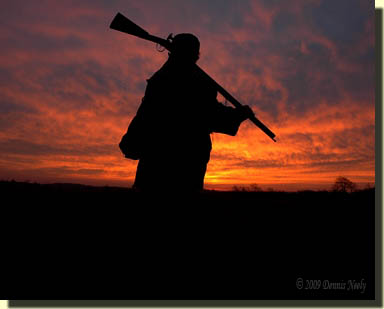
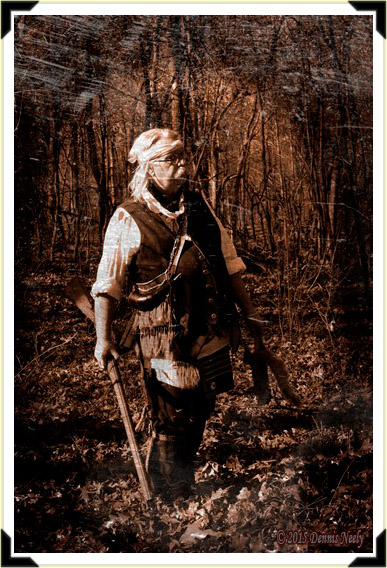
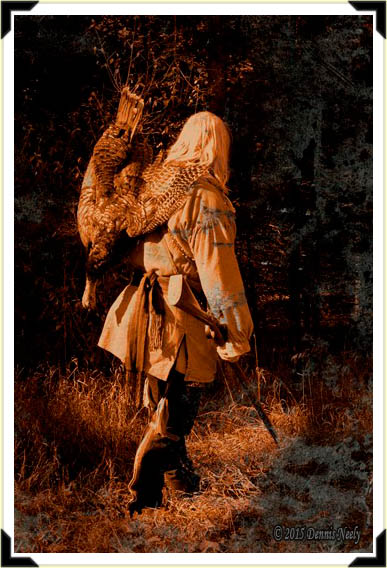
A 18th-century woodsman walks into the woods at sunrise.The last few days of deer season are a time of reflection for me. The effects of the epizootic hemorrhagic disease (EHD) outbreak in 2012 are still manifesting themselves—some in ways never imagined. The disease wiped out the older does, the mentors of the herd, and changed the behavioral patterns of the survivors. As a result, the bucks are nocturnal, hiding in the cattail swamps by day and coming out well after dark.

Taking a doe is still not a consideration, so Msko waagosh’s deer season ended without fresh venison. Journal entries in the waning days reflect a time of thanksgiving for blessings received and lessons learned. That said, the fall scribblings are filled with an abundance of 18th-century adventures and exploits just waiting to flow upon the printed page.

And there is always a touch of frustration for the living history projects and dreams that are still uncompleted or unfulfilled. The one that weighs the heaviest is failing to complete the wigwam before the heavy snowfall of late November. I wore out another pair of moccasins, too, but on the other hand I did so spending more hours in the field than past years.

For me, the reflections and introspections always end with an up swelling of hope for the weeks and months ahead. I suppose this is due to the muzzleloading deer season falling in Advent and the impending celebration of the birth of Christ. And on that morning, in the midst of what I call “snow writing time,” I laid the lead holder aside and reflected on the true story of Christmas…

“And there were in the same country shepherds, abiding in the field, keeping watch over their flock by night. And, lo, the angel of the Lord came upon them, and the glory of the Lord shone round about them; and they were sore afraid. And the angel said unto them, Fear not: for, behold, I bring you good tidings of great joy, which shall be to all people. For unto you is born this day in the city of David a Savior, which is Christ the Lord…” (New Testament, Luke 2: 8 – 11)

May the peace of the Christmas season be always with you, be safe and may God bless you.
Posted in Deer Hunts, Worth thinking about... | Tagged , , , , , , , , , , , | 2 Comments

“A Lost Love”

“Snapshot Saturday”

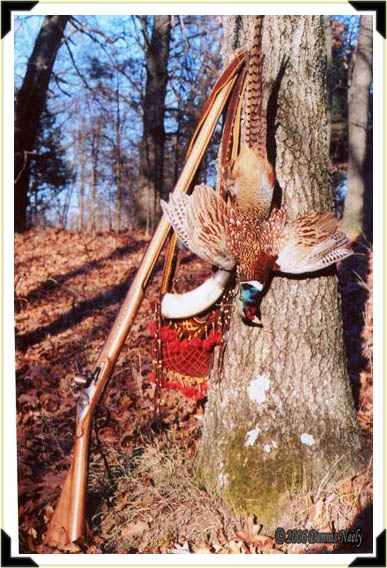
A ring-necked pheasant and a Northwest trade gun.

Ring-necked pheasants, fox squirrels and cottontail rabbits occupied my youth. When the Old Northwest Territory called, back in the late 1970s, a rooster pheasant was one of the first conquests of “Old Turkey Feathers.” Now all that remains are memories of a lost love…

Posted in Pheasant Hunts, Snapshot Saturday | Tagged , , , , , , , , , , , | Comments Off on “A Lost Love”

The “Movement Seminar…”

Tree tops huffed. Lingering white oak leaves rustled. Yellowed, pointed autumn olive leaves blew about. Red and lavender streaked the eastern tree line that blustery November morn in 1795.

Buffalo-hide moccasins stalked north, in the lee of the wind, off the ridge crest. A young doe stood in the shadows where the cedar trees give way to the hardwoods on the hill’s western slope. Thirty paces or so distant, the young whitetail did not realize danger lurked so near. Ten paces beyond her an older doe faced away. She, too, had no inkling as to the state of her jeopardy. But a few calculated steps to the east put the ridge’s rolling crown between the deer and the backwoodsman who stalked on.

Farther down the ridge, three wild turkeys perched high in a good-sized red oak. The trio fidgeted as the thinner branches swayed, engulfed in the pre-dawn murk. Not a single “putt” or “cluck” came from those three as death’s dark shape passed.

Beyond the turkeys’ vision, up from the tangled wreck of a once magnificent outward-spreading oak, the woodsman paused for what he thought was a buck’s guttural grunt. Two steps to his right shrouded the woodland tenant in the boughs of a red cedar tree. A thumb traced anxious circles on the jaw screw of the Northwest gun.

Seconds flowed into minutes. Eyes only surveyed the glade’s graying depths, but saw nary a hair. Then a modest gust rubbed a barkless, leaning spire against a living partner. The resulting guttural creak, sounding somewhat like a fiddler’s bow dragged across a dry cornstalk, brought a smile to the woodsman’s face and a whispered admonition: “Old ears!”

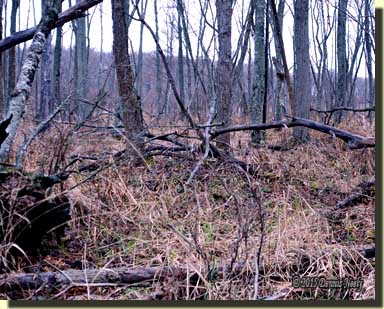
Not long after, frost-damped moccasins circled downwind of a moss-covered, half-rotted tree top. The remnants of a dead autumn olive bush scattered the tree top’s center with an abundance of brittle branches. A leather-clad toe scuffed away layers of brown oak leaves near the skeleton’s shattered butt end. The wool bedroll, guided in place by a portage collar’s broad forehead strap, settled in the nest. The woodsman took a knee, then sat cross-legged with the smooth-bored trade gun resting on his blue wool leggins.

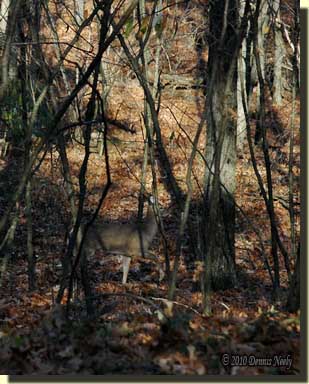
A white-tailed doe standing in the forest's shadows.A blue jay flitted to a nearby hickory tree. A single gossamer thread, strung between an autumn olive sprig and a cherry sapling’s lowest branch, flickered, vanished, then shimmered again. An oak twig with a head-sized cluster of brown leaves hung from an unseen branch and rocked side to side with little regularity. A gray grapevine, anchored to a maple’s upper-most limbs, swung in the wind, appearing, disappearing, then appearing again from behind the tree’s trunk. And off to the left a hunk of bark, discarded from a lifeless oak, sprawled across some brush as it imitated a fine buck’s back.

Fox and gray squirrels came and went as did a few sparrows and the occasional irritable blue jay. But the brown, pointed ear did not belong. That white-tailed deer was a forest tenant in good standing, but the movement of her ear did not belong in the woodland setting that surrounded the tree top and thus betrayed her arrival.

A snout, a dark eye, an ear twitch, patches of fur and finally a shoulder passed through viewing spaces in the underbrush’s tangled web. Legs walked behind a broad cedar tree, then the mature doe’s body emerged from behind one of the glade’s many curtains. She plodded with modest caution: head up, looking about, ears checking, nose testing. With the wind at her rump, she had no inkling that death watched but twenty paces distant…

Another “Teachable Moment…”

“Limit your own movements,” I whispered to the young man, “but spend your first few minutes studying the subtle movements that belong in this area.” I tapped him on the shoulder, whispered “Good Luck!” and started a steady stalk back up the hill and over the ridge.

The young man had never killed a deer before. His unsuccessful attempts spanned several seasons dotted with a smattering of “close, but not quites.” His plight came to light from a casual conversation and eventually led to him sitting in a prime location on the North-Forty. Usually I will sit with a hunter new to the property, but he wanted to take a deer on his own so I respected his request. I sat him in an area that offered safe shooting in all directions out to about sixty yards. In a non-period-correct manner we exchanged texts when I was clear of any potential danger. Even in the dark, the path uphill was easy; all I had to do was follow the glowing enthusiasm splashed on the cedars.

Later, the young man said he had a chance at a first-year seven point, but I think the buck caught him off guard, stepped in the open then angled away too quick. He never shouldered his shotgun. “I never saw him, then he stood there,” I think he lamented. We were walking south along the big ridge at that moment. We had time, so I sat him down just off the ridge and started another “movement seminar.”

Any given plot of ground, forest or fen, 18th-century or modern, is characterized by constant movement. Some movements “belong” and some do not. One of the secrets of blending into any historical simulation, becoming one with both Nature and the long ago, is learning what movement belongs and what does not.

This process applies to both still-hunting and taking a stand, as I did that morning. I often tell traditional hunters to think of their effective distance, the maximum distance where they can consistently place a humane, killing shot, as the hem of an invisible, huge hooped skirt. Take a step forward and the front of the skirt advances two or so feet, and likewise the back follows. One step to the side swishes the skirt sidewise, and so on.

When a hunter takes a stand, his or her effective distance, the hooped skirt, becomes stationary. If “Old Turkey Feathers” harbors a death sphere, the effective distance is one dimension, buckshot is another and duck shot, still another. It’s important to note that the hooped skirt hem concept evolves into a dome with a load of death bees; rather than being bound to the terrain, the effective distance applies to flying fowls overhead and is governed by the resulting pattern’s limitations.

River Raisin bottom lands.As I settled in, I reminded myself of my effective distance markers, paced off two decades ago when the tree top first tumbled to earth. After noting physical changes to the hillside since my visit the fall prior, I started assessing all discernible movements: the blue jay, spider web, suspended oak twig, swinging grape vine and a host of other “normal” flicks and flutters.

The primary concern is evaluating and mentally cataloging each movement. It sometimes takes a half-dozen glances before I “overlook” these little teasers, but once established, subconscious acceptance frees my mind to concentrate on movement that does not belong. And I never look for a whole deer, always parts or pieces: a pointed ear, a snout, an eye, patches of fur or lower leg.

Depending upon a location’s physical attributes, my eyes are not bounded by the effective distance. After the initial assessment, the process continues to the visible limits of a given area—the sooner a quarry is spotted the better.

The same methodology applies to a still-hunt. Although the importance is often overlooked, the pauses give the woodsman time to evaluate the forest, to catalog the motion-makers that belong and look for movements that don’t belong. A single step or two forward changes the angle of perception. A tree or underbrush might block a flagging leaf. Two more steps and the leaf’s action takes on a whole different dimension. The still-hunt’s pauses help compensate for such changes. There is, after all, a reason why a doe or buck or wild turkey pauses on its journey through the glade.

Give traditional black powder hunting a try, be safe and may God bless you.
Posted in Deer Hunts, Skills | Tagged , , , , , , , , , , , | 1 Comment

“Cold Feet”

“Snapshot Saturday”

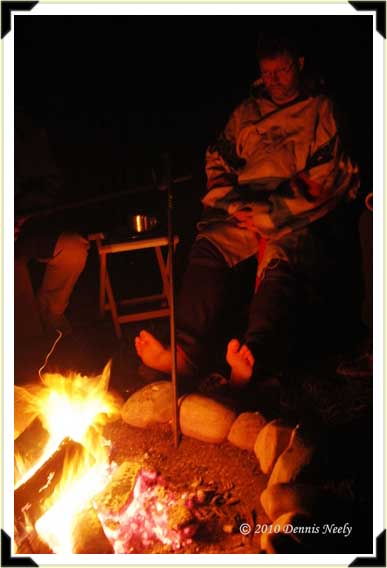
A traditional woodsman warming his feet by the fire.

Dancing flames warmed cold, tired feet as weary hunters shared the adventures of the day. Joseph Brown, deep in the forest of the Old Northwest Territory.

Posted in Snapshot Saturday, Squirrel Hunts | Tagged , , , , , , , , , , , , | 6 Comments

“Morning Fox Squirrel”

“Snapshot Saturday”

Daguerreotype of traditional hunter with a fox squirrel

On a bright fall morn, ‘Old Turkey Feathers,’ a battered Northwest trade gun, brought a plump fox squirrel to the table. Another chattering squirrel caught the woodsman’s attention and drew him deeper into the forest. A daguerreotype image captured the moment, two ridges east of the River Raisin, Old Northwest Territory, 1795.

Posted in Snapshot Saturday, Squirrel Hunts | Tagged , , , , , , , , , , | Comments Off on “Morning Fox Squirrel”

“…but seven balls left…”

“…I had but seven balls left, but as there was no trader near, I could not at present get any more. With those seven I killed twenty moose and elk…” (Tanner, 115)

A heavy snow bends a young cedar to the ground.Wet snow lined even the dead cedar branches just above the ground. The tops of numerous young red cedar trees, the ones with full crowns and thin trunks, touched the storm’s white leavings. Not a single burgundy bough escaped the frosty deluge; all hung heavy, fighting back with all the strength they could muster. Off to the north, a loud snap told a different story, one of a wilderness struggle ended.

Buffalo-hide moccasins made nary a sound in the foot-deep snow. A blue-striped, four-point trade blanket sheltered the Northwest gun’s flint lock and protected the pan’s precious gunpowder. A corner of the folded wool blanket left a streak to the right of the footprints. At the crest of the hill, the woodsman’s course veered east.

Three evergreens down the slope, a broad cedar’s trunk bore tomahawk scars. Years before a few swift strikes trimmed a hole in the dead, lower branches and smoothed the trunk as a comfortable back rest. A moccasin pushed away the white carpet down to the cedar-needle duff.

About an hour after first light, gentle gusts began dislodging white clumps. Inner branches broke up the snow, showering sparkling ice crystals on the white trade blanket’s wrinkles and folds. Then, to the left, a patch of fur moved behind the dense covering that draped and weighed down the underbrush.

A brown eye appeared, an ear twitched and in a few moments, a foreleg flexed, but all vanished. The stubby shape of the deer’s snout and head, at least the parts that were visible now and again, were those of a first-year whitetail. “Not worthy of one of the death spheres.” The whispered words drifted west.

Twenty paces downhill, the summer foliage and resulting shade of three red oak trees held the autumn olive at bay, creating a modest opening that extended to the trail at the edge of the big swamp. The Northwest gun, protected by the trade blanket, remained at rest across blue-wool leggins as the doe stepped into that clearing. What appeared to be her sibling followed. Both stopped. The first licked her nose, then raised it to test the air. Although not showing signs of alarm, the two turned back.

A History-Based Habit

The opening of Michigan’s firearms deer season marks a transition point for this traditional black powder hunter. With a wild turkey awaiting Thanksgiving dinner and a few squirrels in the freezer, the simple pursuit of white-tailed deer takes historical precedence.

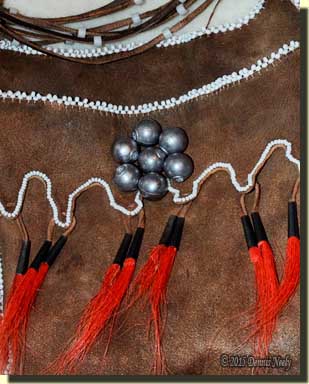
The day before the opener is always a time of reflection and a prayer for blessings received. “Old Turkey Feathers’” bore gets a thorough washing; after scrubbing, the lock is oiled; and a sharp English flint, tightened with a firm hand, is a must. The shot pouch demands attention, too. Anxious fingers dig out the leather shot bag, half-filled with turkey shot, and set it aside. Then the ritual counting out of seven hand-cast round balls begins.

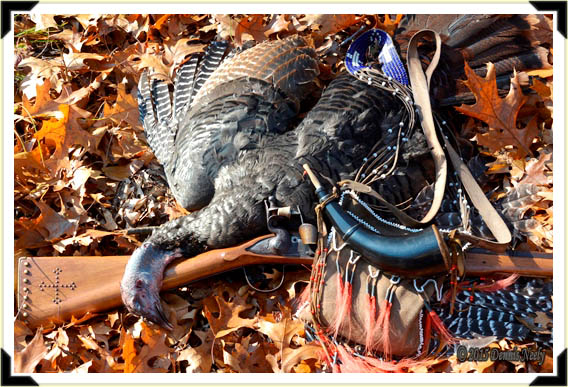
Seven trade gun balls on an Odawa-style shot pouch.An outbreak of epizootic hemorrhagic disease (EHD) in the late summer of 2012 decimated our local deer herd. The effects proved to be far-reaching and have impacted my traditional hunts in ways never imagined. When the severity of the outbreak hit home, adjacent landowners agreed not to harvest does until the herd rebounds. Those two does were never in danger, merely a beautiful interlude in a snowy 18th-century Paradise.

My returned Native captive persona, Msko waagosh, the Red Fox, came to life during that fall deer season. Yes, he still hunted deer with the same burning passion as any normal deer season, even though unleashing the death sphere was out of the question.

The words of John Tanner, Jonathan Alder and James Smith, among other captives, became Msko waagosh’s guiding light, Tanner especially. The day before that ill-fated deer season began in 2012, the Red Fox counted out seven round balls—one for the bore and six for the pouch—in keeping with the restriction listed in Tanner’s narrative.

I do not see taking twenty deer with seven round balls as a possibility. The hunting load used in Old Turkey Feathers, coupled with my habit of selecting situations that present close-in shots usually results in the loss of the round ball. Over the years, I doubt if I have recover ten percent of the round balls from the deer I have killed. The ones I have are kept in a bag in the muzzleloading cabinet, at least that’s where I last remember seeing them, but that’s another story.

Counting out one’s death spheres sounds like a trivial point, but it is details like this, based on the words of a long-dead hunter hero, that assist in crossing time’s threshold, returning to a beloved bygone era and engaging in a living history scenario that is as authentic as possible.

A couple of mornings before, I sat on the west side of that same ridge. Light snow fell, the precursor of November’s first accumulation. Waterfowl hunters blasted away on the River Raisin, out beyond the bottoms and the sedge grass, near the lily-pad flats. Four shooters, hidden in an ugly blind that scars the river’s natural beauty, unloaded their guns, twelve shots in all.

“British!” I thought as I pulled the brass lead holder and a folded journal page from the split pouch that hung over my sash. The knife-sharpened lead scratched across the paper, recording the noteworthy event in 1790 terms.

A short while later a muzzle blast rang out from the river’s far side, partway up the wooded hill. A second, third and fourth moved south to north as a modern deer hunter gave immediate pursuit. “The battle is now a chase,” I scribbled.

Over the course of the next half hour, this impatient hunter fired eleven shots, from the sounds in all directions. I have no way of knowing if he secured his deer, I certainly hope so. This circumstance is all too common.

A few years ago a young man was sent my way for advice. He had killed a couple of deer, but both required a long chase. He emptied his pockets of shells, and for the second, had to borrow two slugs from his dad. I asked him to describe the facts surrounding the initial shots he’d taken. He went into detail for five deer, all beyond eighty yards.

After listening carefully, I recommended he go to the range for some practice. I told him to find out what the maximum distance was where he could place all of his shots in a six-inch circle. Next, I suggested he chamber one shell in his scoped slug gun and keep the rest in his pocket. And finally, I told him to pick a stand that offered shots within his range-determined maximum distance. A polite smile crossed his face, he offered a half-hearted “Thank you,” and walked away.

In following up with his father, I learned the shells for practicing at a range were “too expensive;” the one shell in the chamber suggestion “was stupid;” and the idea of sitting in a downed tree top in the woods instead of in the people box at the edge of the cornfield “was unrealistic.”

At about the seventh or eighth muzzle blast on the far side of the River Raisin, my thoughts drifted to that young man. I worried more about the deer that happened to cross his path than his hunting success.

“It is hard to keep one’s mind anchored in November of 1795,” I wrote, “with such a furious chase occurring so close…as for myself, I have but seven balls left…”

Give traditional black powder hunting a try, be safe and may God bless you.
Posted in Deer Hunts, Persona, Scenarios | Tagged , , , , , , , , , , , , | 2 Comments

“A Long Walk Back”

“Snapshot Saturday”

A Daguerrotype of an 18th-century turkey hunter.

Hoping time’s portal is a long distance off, a traditional woodsman leaves the tiny clearing and plunges back into the cedar grove. A Daguerreotype image. Old Northwest Territory, 1795.

Posted in Snapshot Saturday, Turkey Hunts | Tagged , , , , , , , , , , | 2 Comments

“Wednesday’s Blessing”

“Snapshot Saturday”

A fine young jake turkey.

“Old Turkey Feathers,” a venerable Northwest trade gun, rose to the shoulder in one swift motion. A big hen and a few other birds flew. The commotion surprised a young jake that pecked unconcerned at the frosted alfalfa. The smoothbore’s turtle sight followed the wild turkey’s head up… Old Northwest Territory, 1795.

Posted in Snapshot Saturday, Turkey Hunts | Tagged , , , , , , , , , | Comments Off on “Wednesday’s Blessing”