A Strange Mix of Frustration and Elation

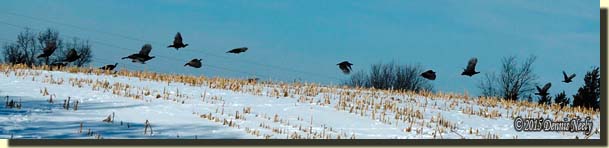
Five Canada geese winged northwest. Silent, the black-necked grey ghosts flew in a lopsided wedge, three birds to the right, one to the left. Stroking hard and steady, the geese left little doubt as to their destination: the lily-pad flats, or thereabouts, on the River Raisin. I didn’t bother to look down, but rather peered through the cornstalks.
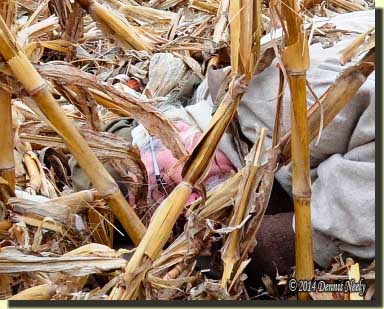
A traditional woodsman peering out from behind a cornstalk.My head again rested on my right arm as I lay in my lair. Upon arriving on the cultivated knoll, I found two corn rows where a dozen or so stalks fell to the south. The toe of an elk-hide moccasin weaseled under the tawny-gold fodder. A few minutes of careful placement and rearranging fashioned the stalks into a fine cocoon for that evening’s ambush. It was the tenth day of November, 1798.

That sojourn was the fourth or fifth outing for a new-sewn, linen over shirt. As I breathed, a stalk slid off my left shoulder and fell against my bare cheek. I felt exposed to all creatures above, and whispered out loud that the fabric’s natural color might be visible to incoming geese, but I had little choice. The results of that hunt, plus a few others, helped convince me to dye the frock a dried-mustard yellow.

A chortling hoard of Sandhill cranes flushed from the hayfield of a homestead to the southeast. I laid still, fought the urge to roll over and just listened. It sounded like the cranes started to the west, turned about, then headed east. They grew silent, too, then all to once they appeared over my wool-clad legs, about as high as the five geese, following the same general course to the river.

In a while, five geese winged in from the northeast, the last place I expected. I first saw them over the top of my silver-rimmed spectacles, and although they seemed fuzzy, I thought they might settle down on the knoll. They didn’t.

A single goose came from the river, low over the cedar trees on the west boundary of the meadow. I noticed two does munching in the grassy field, but gave them no mind. The lone goose swung south. I lost sight of it over my legs. I looked down. I caught sight of it at my eyebrows, then it circled out front of me, swung south and again disappeared.

My left hand grasped the Northwest gun’s barrel about at the wedding bands. My right hand slid as far along the stock as my head would allow. I thought I heard the big bird’s wings, then saw it about forty-paces distant, much lower, but still flapping, not coasting. Again it swung south, and I started wondering how I should sit up if the goose landed to my back or even with my head. But alas, the moment of truth never arrived.

Seven more geese came over, fast and high up. The hourglass warned that the hunt must end. With no birds in sight, I scrambled to my feet, brushed off the dirt and adjusted my sash and shirt. I took one last look at the lair to make sure a necessity did not fall from my shot pouch. Satisfied, I struck off in a fast walk to the closest corner of the cedar grove.

I made the biggest cedar about the time I heard distant goose music. Frustration flooded over me as my deathly shape melted between two cedar trees. I counted nine in the first group that passed overhead, wings cupped and gliding straight for the knoll. Five, maybe six, came next, then…I don’t remember how many. The evening ended with a strange mix of frustration and elation, feelings I had not experienced in quite some time.

A Return to Goose Hunting

Thinking back, it’s been about six years since I hunted hard for Canada geese. A part of that hiatus is the current necessity of hunting over decoys. Gazing out over a dozen plastic goose bodies tends to derail an 18th-century mindset, no matter how hard a traditional woodsman tries to block it out. Another contributing factor is a generous fall wild turkey hunting season and a fair amount of bronze beauties.
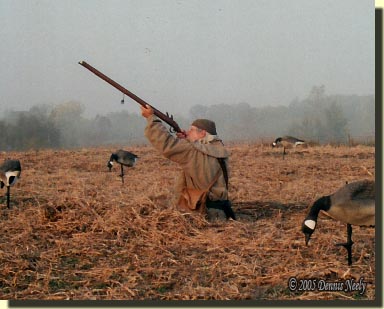
A traditional woodsman sits up in a soy bean field adn takes aim.

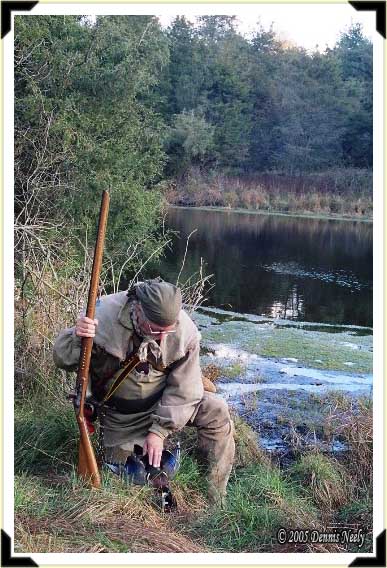
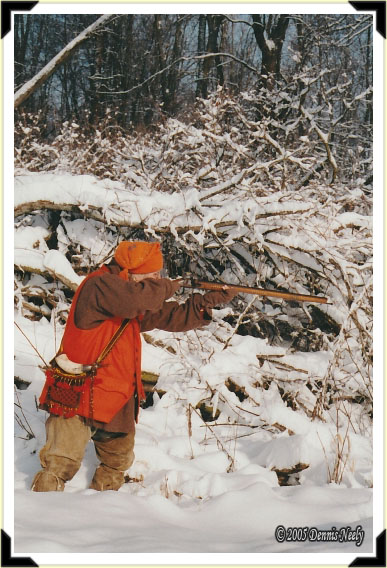
Covered in soy bean stubble, a trading post hunter for the North West Company sat up and took aim at a wild goose. Later that morning a pair of wood ducks dropped into the decoys and the drake did not leave.

This past fall I vowed to take my new persona waterfowl hunting more often, and I did, despite an absence of local ducks. Msko-waagosh, the Red Fox, bagged his first fall turkey, and that good fortune freed up additional hours for chasing ducks and geese.

This new historical characterization relies heavily on John Tanner’s journal, along with the journals of other returned native captives and fur trade company clerks. On at least one occasion Tanner writes about hunting ducks:

“As I was one day going to look at my traps, I found some ducks in a pond, and taking the ball out of my gun, I put in some shot, and began to creep up to them…” (Tanner, 60)

In John Sayer’s Snake River Journal: 1804-1805, Sayer speaks of hiring a native hunter, which dovetails with Msko-waagosh’s simple pursuits:

October 2, 1804: “…this forenoon, the Outarde brot me a Small Deer. [I] gave him 1 Gal: HWines and engaged him as my Hunter for the Winter. he being accounted the best of all the Indian [hunters] of this Department…” (Birk, 36)

October 11, 1804: …my Hunter brot: the Meat of 2 Deers & 60 fine fat Ducks.” (Ibid, 37)

October 26, 1804: …my Hunter gave me 11 large Ducks 3 Geese… (Ibid, 38)

Now today’s traditional black powder hunter must realize hunting ducks in the 18th century and in an 18th-century-manner on a 21st-century stage are two different undertakings, the latter demanding a heavy dose of measured compromise.

The cornfields on the North-Forty were down, but not picked by hand—a big green machine did that. The stalks were not gathered and fed to a few head of cattle, either. In addition, 21st-century Federal waterfowl regulations play an important part. “Old Turkey Feathers,” my Northwest trade gun, held a hefty charge of #2 Bismuth non-toxic shot. When the sun set a half hour before dark, “shooting hours” were over; thus the veiled reference to the “hourglass” in my journal. And on that pleasant evening, as I watched from the cedars, I swear I saw a goose land with a tattered copy of the waterfowl rules rolled up and clenched in a black webbed foot.

Perusing Common Modern Practices

When establishing the parameters of a traditional hunting scenario, I now and again consult the common practices of the modern hunting community. For me, this opens the possibility of learning a new technique or changing my perspective in a manner that is still consistent with the tales recounted in the old literature. This habit also adds insight into how “educated” the modern critters are.

Likewise, I hope my 1790s writings offer moderns historical techniques that might work for them. A case in point is the use of wing bone turkey calls. I field a fair amount of questions about the calls at the outdoor shows, enough so that I always have the calls close at hand. In addition, I keep a single wing bone in my right weskit pocket. When the question arises, I pull out the wing bone and draw a cluck or two, to the astonishment of the modern woodsman—and sometimes call makers in other booths.

Before I took to the cornfield, I spent an evening looking through YouTube videos about goose hunting, decoy layouts and goose calling/vocalization. As always, I learned a lot!

First, a person needs a minimum of two dozen flocked decoys (four to six dozen is recommended), the kind that stand shoulder high on a white-tailed deer, to have any hope of bringing a goose close. Decoy placement is critical, too, marked out as “Xs” and “Os” in complicated schematics that would draw an envious gasp from any NFL coach. The geese that landed after hours must have missed seeing that one, because their ground formation looked hap-hazard.

Next, one needs a portable, pod-like ground blind, “mudded up” and adorned with state-of-the-art imitation foliage. Some companies displayed the latest in camouflage clothing patterns, “field tested” and “time-honored,” but no one explains how the geese can possibly see the hunter when he or she is closed up in a fiberglass coffin.

Many experts suggested their version of the “right” goose gun, chambered for 6-inch plastic suppositories sporting a double Nitro charge below a triple dip of kryptonite death bees, and equipped with a Rambo-inspired choke tube that marshals a uniform swarm out to 100 yards. As I watched, I thought perhaps that effective range was due to the intimidating size or the daunting number of the decoys, but I might have that wrong?

And much to my consternation, I learned that if someone wants to get real serious about goose hunting, “obsessed” might be a better word, that individual needs a 24-foot, tandem-axle, aluminum-clad “goose trailer” outfitted with neat shelves, wire-hoop hangers and plastic storage tubs. Oh, and a ¾-ton 4 by 4 pickup equipped with jumbo-mudder tires that can haul the trailer to the remote corner of a cornfield.

I mean no disrespect with the above comments; traditional woodsmen seem pretty comical and more than a bit daft to the uninitiated, too. All kidding aside, when it comes to hunting methodology, I don’t believe I have ever felt as inadequate or as uninformed as I did that night. The extent to which today’s geese are hunted, the sophistication of the techniques used and the mimicking of their vocalizations, surely educate the birds and thus put the traditional hunter at a severe disadvantage.

But so what? I still kept trying, and yes, on some of the hunts I used a few “1990-era” goose shells placed behind my back where they didn’t detract from my 18th-century visions. I hope that I might construct a couple of Native-American-style goose decoys from cattails later this summer; that project is at least scribbled on my “to-do” list. And I might add that I set out the decoys in the same hap-hazard manner that I observed that first night—no “Xs” and “Os.”

I ached a lot from lying on the ground, but I always arose with a broad smile on my face. More times than not the geese dropped into the cornfield after the sand was gone from the hourglass’ upper globe.

Yet I came close on a number of occasions, three of which I simply blew a great chance by not sitting up and just taking a shot. I was trying too hard to make sure the goose was within my effective range, to hunt in a respectful manner, and I misjudged the moment of truth. And in hindsight, those efforts provided way more elation than frustration.

Give traditional black powder hunting a try, be safe and may God bless you.
Posted in Goose Hunts, Wilderness Classroom, Worth thinking about... | Tagged , , , , , , , , , , , , | 1 Comment

“Rabbit!”

“Snapshot Saturday”

A traditional woodsman taking aim at a fleeing cottontail rabbit.

A cottontail rabbit burst from his snowy form. The Northwest gun’s sharp English flint snapped to attention. The turtle sight chased the bounding grey streak… Old Northwest Territory, in the Year of our Lord, 1792.

Posted in Rabbit Hunts, Snapshot Saturday | Tagged , , , , , , , , , , , | Comments Off on “Rabbit!”

Speak Up, Promote and Educate

A muffled yelp broke the silence. Light sprinkles pitter-patted. The leaves, the cedar boughs, the barren twigs overhead were all damp, yet that December morn, in the Year of our Lord, 1797, dawned pleasant and serene.

A thick-branched autumn olive obstructed my shape, but also broke up my view to the right. To the left, two keg-sized oaks offered similar comfort. Heads down, a doe and a summer fawn plodded on the trail that stitched back and forth across the isthmus between the nasty thicket and the huckleberry swamp.

The air smelled cool and damp, warm enough that I could not see my breath. The sprinkles grew to a steady drizzle. Drips formed on the tips of the cedar boughs that sheltered my linen and leather clad being. The Northwest gun rested across my lap, the lock with its precious prime hid beneath my right elbow, under a layer of scarlet wool blanket.

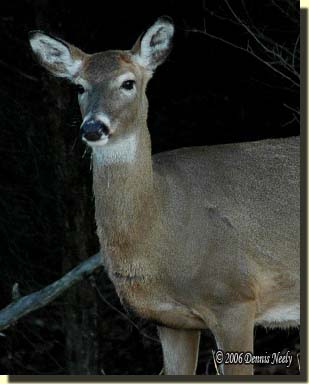
An older white-tailed doe watching the forest.The wild turkey clucked three times, closer, on the ridge’s uppermost trail, a bit to the south. The smaller whitetail pawed the leaves, its dam stood watch, spending more time surveying its back trail than the hillside ahead. The hen uttered a sharp putt. As in the spring, a melodious gobble echoed throughout the glade. “To the north, at the edge of the cedars, beside the doe trail,” I whispered as I kept an eye on the isthmus trail.

Every so often the gobbling turkey offered up a hushed “click” as it walked to the south, following that upper trail, a few paces down from the ridge crest. I dared not turn around and gawk. Whether a long-bearded gobbler or a jake with an infantile stub of a paint brush, I could not say. Only my eyes moved, and then no more than need be.

Another doe’s ears perked up at the farthest visible end of the isthmus path. From the last sound, the gobbler lurked just over my left shoulder, still stalking south. The doe broke into the little clearing, then sidestepped the open scrape. Two younger deer scampered after, frolicking as if trying to catch up. They ran ahead.

With the appearance, the summer fawn perked up, then turned to the west. The three youngsters rendezvoused. The first older doe looked south, the second north. The first doe took the lead, and the others followed, single file. I watched until they were out of sight. The clicking bronze ghost was well down the ridge by then. I had to struggle to hear him, then all went silent again.

In a few minutes, a blue jay started jaying behind me, not loud and frantic, but steady and consistent like they do when they want to hear themselves. I realized my muscles were tensed. After a couple of deep breaths I eased back against the cedar’s trunk.

“POP!”

I knew that sound, and my heart sank. Over the ridge and down the hill another hunter sat nestled in the boughs of two downed cedar trees, or so I thought. “Jay! Jay! Jay! Jay!” the blue-crested watchman’s alarm came as expected.

“POP!”

The drizzle became a steady rain. My head turned slowly left, then right in anticipation of a buck crossing over the ridge, seeking sanctuary in the huckleberry swamp’s impenetrable tangle. But creamy-white tines never broke into view. In about ten minutes, I heard the pitiful imitation of a bobwhite’s whistle. I whistled back, got to my feet and prepared to leave.

A Question of Reliability

“My muzzleloader won’t fire,” my youthful companion said.

“Did you snap caps before you loaded?” I asked.

“No, should I?” he said as he furrowed his eyebrows and scrunched his nose. At that moment, I think he remembered my comments from the night before.

This brief exchange is becoming all too familiar, enough so that I fear mishandling the first load in a clean, black powder arm might be hurting the use of traditional-styled front-loading guns for “muzzleloader only” hunting seasons. The concern for modern hunters in the midst of a discussion about period-correct pursuits might seem misplaced, but many seasoned traditional black powder hunters entered through that door.

Over the last couple of years, variations of this conversation have become commonplace at the outdoor shows we attend. We just returned from displaying at the Michigan Field & Stream/Outdoor Life Deer & Turkey Expo held at the Summit Sports Complex in Dimondale. Some guests have never seen or spoken to a traditional black powder hunter, and on the other end of the spectrum, some have enjoyed the pastime for 30-plus years. So, as one might expect, questions and comments cover a broad range of topics.

Partway through Saturday, I realized I made a mistake by not keeping track of the number of questions or comments related to “misfires.” We talk with so many people that I can’t remember who asked what, but the gentleman that left just prior to that revelation was typical.

This particular guest is an avid inline advocate now. He started with a .50-caliber percussion Hawken-style rifle from a recognized manufacturer. The gun was purchased by his father in the late 1970s or early 1980s for Michigan’s muzzle-loading deer season. The father killed several deer with his Hawken rifle. The rifle spent a while in the back corner of the father’s gun safe before being passed down to his son.

The tale of woe began with two snapped caps on a “trophy 10-point buck.” “The gun went off after the buck was gone,” the 50-something gentleman said with an air of disgust. “The same thing happened the next season. Those guns are totally unreliable. That’s when I bought my (brand name) inline.”

“Did you snap caps before you loaded?” I asked…

Most people store their muzzleloaders barrel-up in a gun safe. Due to the corrosive nature of black powder, or black powder substitutes, many folks use ample oil after a thorough cleaning. With time, the oil makes its way to the breech: in percussion guns it settles in the flash channel, and in flintlocks it rests on the breech plug and sometimes finds its way to the touch hole. This problem seems worst with guns used once a year for a December deer season.

But managing the first shot is just as important as paying attention to how the fifth shot is handled with four “10s” on the paper. And in both situations, the caveats remain the same: each gun is different, and the user must spend range time to determine what works best in a particular muzzleloader.

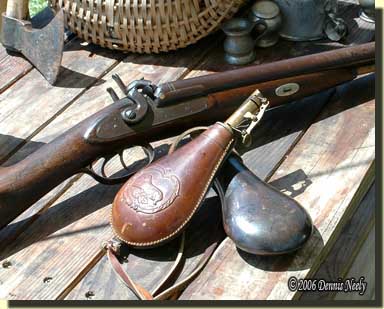
An original Mortimer double-barreled shotgun with powder and shot flasks.At the show, I explained to the woeful hunter that the normal pre-loading sequence is to wipe the excess oil from the bore with a dry patch or two, depending on the gun. For percussion ignition systems like his dad’s rifle, I told him to find a safe location (a designated “blow-out” area at a range), point the muzzle down a few inches from a blade of grass and fire caps until the cleared bore utters a distinctive, hollow-sounding “thunk” and the blade of grass moves. The best and most consistent accuracy often comes after firing a fouling shot, followed by a spit patch wiping. After that the bore and flash channel are ready for the first loading.

“I didn’t do any of that,” the fellow said, tipping his camo baseball cap back on his head.

“That’s why the gun fired on the third cap,” I said. “The first two burned the oil out, and I’ll bet the discharge sounded weak and punky.”

“I think it did,” he said. “I was too upset to pay much attention. I know it did on the second buck.”

“Your black powder charge sucked up the excess oil at the breech, leaving you with less than a full charge to burn.”

“No one ever told me,” he said.

Before I move on, I feel compelled to discuss flintlocks, too. A patch or two is needed to wipe the excess oil from the bore. I like to let a second patch sit on the breech plug for a dozen or so seconds to soak up whatever oil collected there. And as an aside, in humid conditions, like shooting at the National Muzzle Loading Rifle Association’s primitive range at Friendship, it is not unusual to have a “little worm” of black goo slither from “Old Turkey Feathers’” touch hole after sitting out a relay or two—again, it all depends on the particular bore’s nuances.

A quick inspection of the touch hole will tell if it is plugged or not. If there is any question, a priming wire or vent-hole pick will settle the issue. Some hunters leave a tooth pick, whittled peg or quill in the touch hole to eliminate oil build up.

A number of traditional hunters I know like to burn a pan of powder. Afterwards, they wipe the pan and frizzen with a dry patch. “Old Turkey Feathers” doesn’t need that, but it does require a fouling shot—the first round ball never hits point of aim. When the “thirty-point buck” stands 30 paces distant is the wrong time to wonder where the death sphere will hit.

Now all of this knowledge should come from repeated range experience, but in our instant gratification world, that doesn’t happen—especially with modern hunters trying to get a few extra hours of woods time. Unfortunately, for so many it is “load and go,” and the end result is that unmistakable “POP!” of a cap.

And that is where we, as traditional black powder hunters, must step forward as defenders of, and ambassadors for, the arms of our forefathers. Who better to explain why a traditional-styled muzzleloader failed to fire? The words need to be offered with kindness, respect and understanding, for no one knowingly loads a muzzleloader’s first shot with failure on his or her mind. To the contrary, each hunter expects the cap to snap, the muzzle to belch fire and thunder, and the trophy 10-point buck to fall over dead. But when that doesn’t happen, the traditional-styled gun’s perceived lack of reliability is confirmed and they become converts and disciples of the inlines.

The natural inclination is to keep quiet, to keep to ourselves, but our silence is hurting the sport and worse, I believe we are inadvertently putting our foot against the very door that opened up this glorious pastime to so many.

Speak up, promote, and educate, be safe and may God bless you.
Posted in Deer Hunts, Muzzleloaders | Tagged , , , , , , , , , , , | 5 Comments

“A Finished Arrow Head”

“Snapshot Saturday”

Traditional archer Norm Blaker showing a finished arrow head.

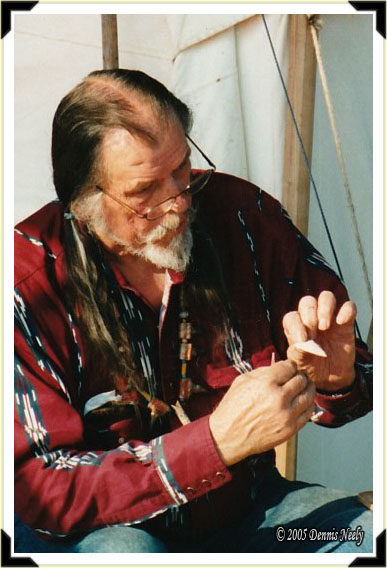
Norm Blaker, a renowned traditional archer and black powder hunter, explains a flint knapping technique to a fellow knapper at the Woods-N-Water News Outdoor Weekend held in Imlay City, Michigan. Norm’s traditional hunting exploits are as spellbinding as those told by 18th-century woodsmen.

Posted in Snapshot Saturday, Wilderness Classroom | Tagged , , , , , , , , , , | Comments Off on “A Finished Arrow Head”

“Morning Wood Duck”

“Snapshot Saturday”

A traditional woodsman retrieving a wood duck drake.

A trading post hunter retrieved a colorful wood duck drake. Beside still waters in the Old Northwest Territory, in the Year of our Lord, 1792.

Posted in Duck hunts, Snapshot Saturday | Tagged , , , , , , , , , , , | 2 Comments

“…the less I really know”

Two hens walked straight away. The pair stayed in the dirt path; their actions seemed unnatural, reluctant. Crisp putts hung in the still cold air. The two wild turkeys hugged the windrowed snow pile filled with uprooted cornstalks as they returned to the main flock. One by one, bluish heads popped up. I counted nineteen in all, including a couple with red heads and decent beards.

At the far end of the strung-out flock, one of the bigger birds stepped over the snowy barrier and started walking fast on the ice-crusted accumulation. Others followed, single file. As if required to pass through some imaginary door, the bronze birds made their way to the spot where the bold one jumped the bank and ran into the corn stubble. Forty paces from that portal, almost at the crest of the hill, the turkeys took flight, again, one after the other.

Wild turkeys taking flight over a snow-covered cornfield.It was not my intent to spook the turkeys, but I had little choice as I returned to the pickup. They were feeding on the only open ground, a makeshift road plowed at the edge of the cornfield by a subcontractor for the power company. On purpose, I ventured back to the North-Forty at noon, thinking the field would be void of wild creatures. I was wrong.

A ways down the wagon trail a plump fox squirrel jumped from the back of an oak trunk, rolled once on the snow and ran west in the left rut. At the shag-bark hickory, another fox squirrel joined the parade. A third followed, again from behind another hickory. I laughed at the foolishness.

Across the sand bridge and up over the rise, I discovered two more fox squirrels enjoying the sunny, but cold February afternoon. I started to wonder if a squirrel hunt wasn’t a better use of my time. I saw four more before the truck came to a halt.

Testing a “Buck & Ball” Load

Eighteen inches of fluffy snow made accessing the range all but impossible. Three days after the snow, the work crew cleared off a staging area for the line work in what we call “the first right of way,” adjacent to the big woods. I found a suitable snow pile just down the hill and propped up a cardboard target sporting a cartoonish outline of a coyote. I counted back thirty-five paces and scuffed a mark on the dirty ice.

Coyote predation has become a big problem in our area. To combat the invasion, I run a predator trap line from mid-October into December, depending on weather. With November’s weather more like late-December, I got frozen out early this year. Calling is the second best choice.

Jeff Wacker, my neighbor to the north, has been doing some coyote hunting. We talk on a regular basis and had planned to hunt the North-Forty until the snow made it difficult to get back in. Jeff uses a modern rifle with a scope, but I don’t own one—once again, “Old Turkey Feathers” is my “go-to gun.”

Years back, I had an opportunity to do some bobcat hunting north and east of Grayling, here in Michigan. I worked up a satisfactory load of #3 buckshot and felt comfortable with the performance out to thirty paces. I’ve used that same load a couple of times on coyote hunts, but never had a coyote venture that close.

Although the cover we plan on hunting is dense, I would feel better if I had a little more range. Loading with a round ball is a possibility, but after 45 yards a coyote’s vitals get mighty small for consistent shot placement on my part. As I mulled over the options, I got thinking about a compromise, perhaps a buck and ball load?

I made a few phone calls to other traditional black powder hunters, but only one person had ever shot a buck and ball, and that was during a novelty shoot. No one had any credible practical information on this 18th-century load. As is always my habit, I checked my research files, then went looking for other sources of information.

The “suggested” buck and ball loads involve loading the ball first and then the buckshot. If no wadding is used between the powder and projectiles, as in the case of a paper cartridge, the ball is supposed to create a better seal. From an historical perspective, I found no primary “how-to” documentation, and none of the speculative sources offered sample targets or range results.

Competitive quail walk and sporting clays experience taught me that a “split,” “spreader” or “duplex” load, a load divided by a card placed within the shot column, creates a wider pattern. Although not allowed by at a lot of ranges, the duplex load works great on close in targets such as rabbit discs and low-flying, over-the-head clays.

In essence the back shot column blows through the front column, spreading the front column in a shorter distance. From my own testing, I discovered the intermediate card placement is critical in maintaining a uniform, yet broad pattern. I feared the same would happen with the buckshot over ball loading sequence, the ball would blow through the buckshot spreading it farther. That would be fine for warfare, but not good when the end result was killing a coyote at a fair distance.

A couple of years back, another traditional hunter sent me an x-ray image of a 1769 Short Land Pattern Brown Bess retrieved from a revolutionary-war-era shipwreck off St. Augustine, Florida. The musket’s buck and ball load has the buckshot loaded first with the ball over top, which is more consistent with my shot patterning experience.

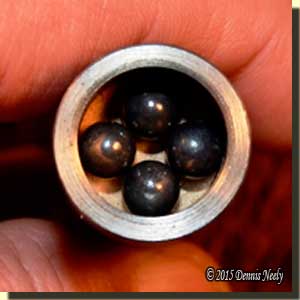
Four #3 buckshot resting on a card in the trade gun's muzzle.Since I felt like I was flying by the seat of my pants, safety became the first concern as I did not want to overload the trade gun or create a “short-started” load. To start, I checked my notes from the bobcat load, which included 24 pellets, weighing a total of 560 grains. I wrote that four pellets fit in a layer, so to remain tight and uniform, the pellet count needed to be a multiple of four.

Next I weighed a normal turkey load, which scaled out at 571 grains. Although my notes didn’t show it, I wondered if I used the same rationale for the bobcat load? Old Turkey Feathers prefers a .610 round ball, which weighs 345 grains. Using 560 grains as the maximum load left 215 grains, or enough room for nine #3 buckshot. With four pellets to a layer, the test load was a .610 round ball and eight #3 buckshot.

At the makeshift range, I measured out 60 grains of 3Fg Goex (equivalent to 75 grains of 2Fg) black powder, added leaf wadding over the powder and counted out eight #3 pellets. I rammed a minimum amount of wadding over the buckshot, dropped the ball down the barrel and wadded the ball tight. [Note, I am not making load recommendations here, because every smoothbore is different. I am only reporting the load I used in my trade gun.]

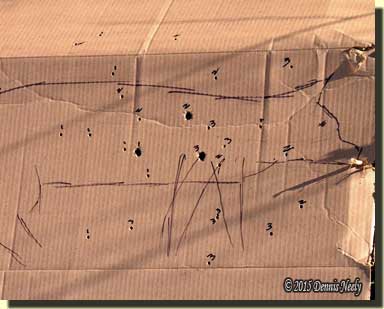
The cardboard coyote target with the first three shots marked.Three shots later the cardboard coyote had three musket balls and twelve buckshot in the chest and body area. At 45 paces only one musket ball hit the coyote; the other two passed under the would-be predator. The pellet pattern opened up with six hits. The last three shots and the buckshot pattern were still consistent, but about five inches low.

A bare ball group is usually more open and hits a little lower than a patched grouping, all loading elements remaining equal. A light patch should raise the balls into the kill zone, and I expect tighten the ball grouping. I don’t know what effect, if any, a patched ball will have on the buckshot pattern.

Looking at the results makes me wonder how a heavy-patched .575 round ball (285 grains) over twelve #3 buckshot (280 grains) might perform. Perhaps a balanced projectile column would put more pellets in the kill zone. The general idea is to still kill the coyote at 45 paces if the round ball misses.

Aside from having a lot of fun and gaining new knowledge, I view the buck and ball test results with mixed feelings. At best, regardless of load type, the farthest effective distance of the Northwest gun on coyotes is 45 paces—with a round ball, due to my shooting ability, and with the buck and ball the limiting factor is the gun/load’s performance.

More range time and experimentation in the wilderness classroom is necessary. I want to test a patched round ball and the balanced load using the .575 death sphere. Plus, I feel the buckshot over ball load needs a fair airing. Other than establishing the basic limitations of the trade gun on coyotes, I came away with more questions than I started with. But like so many aspects of living history and traditional black powder hunting, the deeper I delve into my beloved 1790s the less I really know.

Give traditional black powder hunting a try, be safe and may God bless.

Posted in Research, Varmint Hunts | Tagged , , , , , , , , , , | Comments Off on “…the less I really know”

“A First Gobbler”

“Snapshot Saturday”

A young Dennis Neely with his first wild turkey gobbler.

A dapper young traditional woodsman with his first wild turkey gobbler. A day’s journey west of Lake Huron in the Old Northwest Territory, 1795.

Posted in Snapshot Saturday, Turkey Hunts | Tagged , , , , , , , , , , | 1 Comment

A Necessary Clash of Centuries

Moccasins traversed that path before, hundreds, nay, thousands of times. Down the hill, across the isthmus, around the knoll, beside the sink hole and up the rise is a course followed without much conscious thought.

Leather hunting boots made that trip in my youth, then the double-soled elk moccasins bought with summer work money. Neatly stacked, worn out moccasins, hand-sewn from elk or deerskin, the early ones beaded with yellow, orange or blue pony beads, reside to the left of the middle shelf in the muzzleloading cabinet. Each pair followed that trail, too, who knows how many times?

Leather hiking boots with rubber-cleat soles made the trek that afternoon, the last week of January, in the Year of our Lord, 2015. Thread-bare Carhartt® overalls, unzipped below the knee, flapped and flopped, scattering snow every-which-way. A humming mass of yellow and black steel, flexing rubber and shiny tinted glass trailed behind like a reluctant coonhound bitten one too many times.

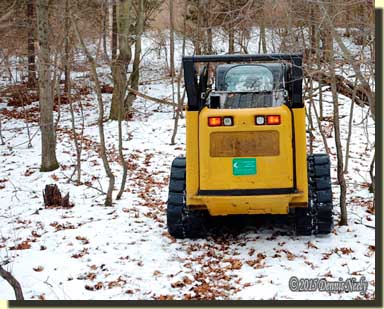
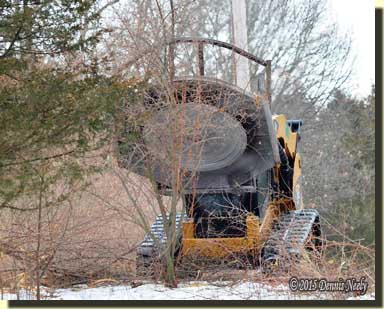
A Caterpillar 299C Multi-Terrain track loader following the deer trail.The beast angled down the hill, slipping sideways once or twice. It rumbled around the last red oak, then over the isthmus. The left track hugged a doe trail, upturned oak leaves a foot wide in ankle-deep snow. The two buckteeth of the Davco brush cutter disappeared under a thigh-sized oak limb, one I always stepped over, raised up, then eased it out of the path with nary a hint it had been touched. Six or so paces ahead it crackled and snapped over a smaller branch, fallen from the same tree.

At the three maples, the beast jerked to the left as the operator, Eric Kruger, made one track brake while the other kept moving. He smiled through the glass, then scowled, showing real concern. Palms facing, my mittened hands rose and fell twice, showing the preferred trail through the hardwoods. He nodded agreement.

Twenty-four paces ahead, the hideous squeal of the beast’s backup alarm sent a curious fox squirrel scampering for safety on the far hillside. I smiled, and Eric crumpled his eyebrows, oblivious to the squirrel, questioning why I saw humor in the moment. I scrunched my nose up, smiled and shook my head. He shrugged.

About where the oak is down at the northeast edge of the sinkhole the monster’s long, curved mustard-yellow arms raised the black cutter from knee high to chest high. Chopped twigs and long cream-colored cuttings littered the top of the mower deck.

Not far from the tree line my hands again showed the correct path. Eric nodded and I took a dozen steps to the north. When he passed I leaned against one of the last oaks. The brush cutter paused just after it entered the power line right of way. The diesel engine whined and the hydraulic motor started the big cutter disk rotating.

In a minute or so, Eric raised the black deck head-high, advanced half a machine length and settled the whirring blades onto a good-sized autumn olive. The engine never flinched. Forearm-sized chunks flew. Unseen wooden sticks drummed on heavy steel guards with a sickening certainty as the beast ground the bush’s barren skeleton to sawdust, followed by a final puff of dirty snow.

A Major Power Line Repair

The last two weeks have been pretty hectic on the North-Forty, well, before that even. A 46,000-volt electric transmission line runs diagonal through the property. The line, which was built in 1955, is up for maintenance again, and this time several of the poles need replacement.

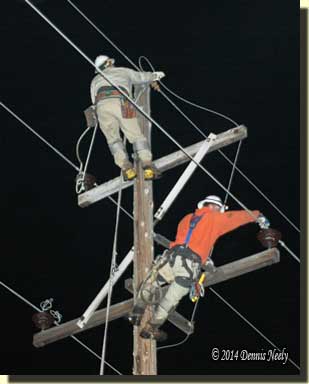
Two linemen climb a pole to begin replacing it.One, pole 1533, was changed out last May, just after midnight. The line was “de-energized” for the worker’s safety, and multiple crews replaced about ten poles simultaneously along a five mile stretch that Sunday morning.

The original plan included replacing pole 1534, about ten yards from the edge of the River Raisin, but the swamp was too wet and that attempt was scrubbed. The revised schedule calls for building a “temporary work road” to the pole this February by laying crane mats edge to edge out to 1534, approximately 680 feet across the Raisin’s treacherous bottomlands.

The work plan is quite complicated and required forestry preparation prior to mat delivery. The second morning the forestry crew was on site, I got a call from Eric Kruger. The Caterpillar 299C multi-terrain track loader couldn’t navigate a steep slope, necessitating 4 to 6 hours of additional hand cutting. He wondered if there was anyway the brush cutter could go “cross country” and get to the right of way. I said, “Yes,” but not before considering the ramifications of his request. The only possible access to that location was through one of my favorite 18th-century haunts.

I take pleasure in telling people the North-Forty has had little intrusion since it was first surveyed by Hervey Parke in 1815. Some of the oaks and hickories on the property were saplings when Parke’s crew passed by, lopping the Old Northwest Territory into mile-wide sections for Revolutionary War pension payments. I suspect the adventuresome times of the 1790s were still considered recent history back then. I explained that to Eric and his work partner, Rudy Martinez.

But being a steward of such a parcel can sometimes be a burdensome load, especially when the absolute necessities of modern society clash with life two-plus centuries removed. Under my watch, the guiding principle has always been to allow a minimum of intrusion. There used to be a sign on the front gate at the National Muzzle Loading Rifle Association’s Walter Cline Range at Friendship, Indiana, that read: “Take nothing but memories, leave nothing but footprints.” Although a bit simplistic, it is not all that far off from my property management philosophy.

Old woven-wire fences delineate the North-Forty’s boundaries. A rutted two-track that resembles a well-used wagon trail provides necessary access and then there is the power line. I don’t allow “people boxes,” as Tami calls them, tree stands or other such encumbrances. We have a whimsical face on one red oak tree along the road to delight the young grandchildren, and there might be one or two other transgressions.

But for the most part, there are no outward indicators of time or place. Living historians spend so much effort surrounding themselves with the period-correct trappings of a bygone era, why not expend the same degree of effort to maintain a period-correct stage upon which to live out the past?

Eric wanted to tie pink fluorescent tape to the trees that led to the right of way, citing company safety rules. I drew the line there. I told him to follow me or cut the brush by hand. “Leave nothing but track marks in the snow,” I said, then I started walking down the hill.

By the time I got to the isthmus I felt like I was betraying an old friend. The steady hum of the turbocharged diesel engine sounded ominous. I heard whine echo from the hillside across the nasty thicket, sounding of labor pains. When the brush cutter’s buck teeth slipped under the limb, I started to feel queasy, like I made a serious mistake, one that I would have to live with for years to come.

I kept glancing at the Cat’s back trail, but it was hard to see in the snow. It ran over a couple of autumn olives along the way, but I didn’t give them any mind—I have no love for autumn olives. Then Eric backed up; the shrieking alarm sounded like a red-tailed hawk on steroids. I saw the squirrel run for the trees, and I still wondered if I made the right decision. At the sink hole, the cutter’s guard skinned up two cherry saplings, but no more than the other buck rubs beside the trail.

The Davco brush cutter raised to begin cutting an autumn olive bush.It took ten minutes to traverse the trail. Twenty minutes of grinding, chopping and puffing snow later the Cat 299C headed back for the two-track. Eric got there long before I did. As I walked the trail back, I wondered what I would see, or rather hoped not to see, in the spring.

On the Sunday following, 18 inches of fluffy snow erased any evidence of the beast’s traumatic journey. For now, at least, the footprints are gone and all that remains are memories of a necessary clash between centuries. But now it is time for the next phase of this odyssey to begin…

Venture back to yesteryear, be safe and may God bless you.
Posted in General, Worth thinking about... | Tagged , , , , , , , , , , , | 2 Comments