“Msko-waagosh ndizhnikaas”

Snowflakes cling to the trade blanket’s crimson nap. The woolen shell is more white than red. The black stripe is a pale gray, a nothingness hue that matches the firmament. The Northwest gun’s lock nestles against my right elbow, tucked safe under the blanket’s folds. Now and again an icy crystal bites a cheek or the side of my nose or wends its way behind my spectacles and stings an eye. Yet here I sit, cross-legged, huddled in a folded trade blanket, enduring joyous discomfort deep in the Old Northwest Territory.
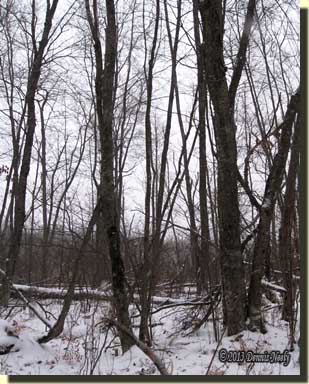
Snow covers the River Raisin's bottomland.Wedge after wedge of geese ke-honk overhead, winging northward. Before me the reed grasses sway, maybe forty-paces distant, at the edge of the River Raisin’s bottomlands. Behind me a tree pops from the late-December cold. Goose music fills the empty glade, orchestrated by who knows how many geese loafing upon the Raisin’s frigid waters. “Twenty-four, twenty-five, twenty-six,” I count with a frosty whisper as they glide above, tree-top high.

To the left, a dead white ash leans with the fibrous remnants of its bark hanging, twirling, rocking side-to-side in the wind. I jump at the loud bang of a popping tree, beyond, by the old yellow birch. More geese set their wings; this flock is silent. I have not glimpsed a deer in three days. New-fallen snow fills any tracks I happen upon. Winter came early to the headwaters of the River Raisin, and I hunger from a lack of fresh venison.

Brown hair flashed, close to the ground in the elder bushes that kiss the tawny swamp grasses. A cottontail rabbit hopped twice more. I glance right, then left along the last deer trail in the bottoms. I long to see the rabbit again; such is the desolation of December.

An Unexpected Vision

As I watched, I felt my body begin to drift, lulled by the constant ke-honking of the geese and the mesmerizing beauty of the falling snow. My right arm adjusted the Northwest gun on my lap. I let my mind wander. Then I felt the weight of an empty brass kettle in my right hand…

Ziibi Ikwe, River Woman, my adoptive Ojibwe mother, sent me for water. It was warm and pleasant. The leaves had turned and the grasses began to yellow. I walked up the dirt path that angled through the forest’s underbrush, up over a slight knoll, then down to the river. Just over the crest of the knoll, I spotted the back of a cottontail rabbit, half hidden in a grassy form.

I don’t know what possessed me, but I stopped and looked about. A broken branch, stout and heavy and club-like, rested beside the trail, almost beside my moccasin. I slowly bent forward, set the kettle down and grasped the branch. I used a thick oak trunk to conceal my approach. The rabbit didn’t move. After much contemplation, I sprung up and forward with a mighty bound and brought the club down hard across the rabbit’s neck.

I stood amazed, then grabbed the rabbit by its hind legs and carried it back to the lodge. An elder, Migizi Miigwan, Eagle Feather, laughed and called out to River Woman. With much animation he told how he saw me walk towards the river, then look about. He thought I might try to run off or escape. He grew concerned when he saw me bend over and disappear.

When he saw the branch in my hand he said his concern turned to curiosity. He told how I stalked to the tree, then waited for the longest time. He said I pounced like the red fox leaps upon its prey. “He shall be known as Msko-waagosh, the Red Fox,” Eagle Feather proclaimed as he held the rabbit high and patted me on the back.

Gathering Another Nugget

I often describe traditional black powder hunting as an addictive treasure hunt—an endless search for historical nuggets that help unlock the secrets of long ago. And when I talk about creating a persona, I compare that persona to a vessel that contains all the nuggets gathered through years of research and countless wilderness classroom lessons.

As I have mentioned before, when I found myself returning time and again to the writings of John Tanner, Jonathan Alder and James Smith, I decided to create a returned white captive persona. In essence, I consciously embarked on a new and exciting treasure hunt with an almost empty vessel, save for the prior knowledge I had accumulated about Tanner, Alder and Smith.

A common thread that flows through many of the “captive narratives,” is the Native American name given to an adopted captive. James Smith writes:

“They called me by my Indian name, which was Scoouwa, repeatedly…” (Smith, 54)

And John Tanner writes:

“By this family I was named Shaw-shaw-wa ne-ba-se (the Falcon), which name I retained while I remained among the Indians.” (Tanner, 15)

Being influenced by Tanner’s story, I thought from the outset that the new historical me should have an Ojibwe name. I sought the advice of other living historians, including readers of this web site, and I received a large number of suggestions, but none seemed to fit the persona, at least as I perceived him. And much to my surprise, “red” kept coming up in the ideas of others, attributed to my habit of hunting in a crimson trade blanket.
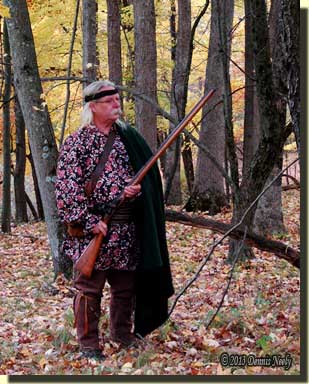
The returned Native captive starts a turkey hunt.Not wishing to force the issue, I set the notion aside and moved on to other aspects of this infant persona’s development. The fall hunting seasons rolled around and occupied most of my time. The onset of an early winter pushed surviving the cold to the forefront of my wilderness classroom lessons, and then in late December I found myself sitting in the barren river bottom, immersed in a pristine 18th-century moment.

John Tanner spoke of visions and dreams, and I don’t know how better to characterize the few fleeting moments that I experienced that morning. I had reached a tolerable degree of cold, the geese just kept coming and their honking overwhelmed all other woodland sounds. The falling snow, the swirling wind, the popping trees and then the rabbit ushered my mind into historical oblivion.

Then a conglomeration of nuggets blended into a tale that seemed real. A few days earlier I came across the name of “River Woman” while researching. I wrote that name down on a slip of paper and dropped into the blue folder that kept odds and ends that might prove important as I fleshed out the native captive persona. I glanced at another scrap of paper that had “Eagle Feather” scribbled on it. A day or so before the hunt, I read through a short passage in Jonathan Alder’s journal that told about his first escape attempt:

“They now ventured to call on me to do some little duties and the white man told me to take the brass kettle and go to the branch [Scioto River] and fetch some water…So when I got to the branch, I dropped the kettle and ran up a hill about one hundred yards from the stream and crawled into a hollow tree… (Alder, 40-41)

The mind is a powerful mixing bowl. I felt the weight of Alder’s brass kettle in my hand. I pictured a rolling hill and over that a sandy spot along the River Raisin. Ziibi Ikwe entered the picture, as did the rabbit that hopped in the elder bushes forty paces in front of me. The frustration of not bagging any game that fall manifested itself in the stout branch. I imagined pouncing on that rabbit and then that phrase mulled over and over in my mind: “like a red fox leaps on its prey.”

About noon I got to my feet and shook the snow off the blanket. The geese had flown west an hour earlier; the River Raisin’s bottomland was a quiet as a granite tomb. I shivered as I plodded back to the island, then east into the big woods. All the while I kept whispering, “like a red fox leaps on its prey…like a red fox leaps on its prey…”

The following February, in the midst of an Online Anishinaabemowin Webinar, my alter ego gained another nugget. The instructor, Isadore Toulouse, was talking about the proper way to say one’s name in the Ojibwe language. Isadore glanced at the chat window, then responded to the questions. When he got to mine he said:

“Msko-waagosh ndizhnikaas, I am called Red Fox.”

Give traditional black powder hunting a try, be safe and may God bless you.
Posted in Deer Hunts, Persona | Tagged , , , , , , , , , , , | Comments Off on “Msko-waagosh ndizhnikaas”

Trees Don’t Grow Bigger…

Darkness ebbed to an overcast calm. Wool-lined winter moccasins stepped and paused eastward—the object of that crisp November morning’s still-hunt was the nasty thicket in hopes of bringing fresh venison to the pot. Thanksgiving of 1795 was a week off.

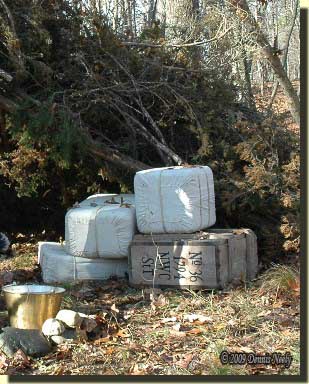
Three bales and a crate sit beside a brush shelter.An overwhelming urge to sit, to stay put, washed over my being, forty or so paces from the cedar-brush shelter. The premonition made little sense. The campsite was in plain sight. Only a doe-ear’s worth of the red, four-point trade blanket, rolled and carefully tucked behind the oak tree that supported the lean-to’s angled ridgepole, remained in view. Canvas-covered bales and the last crate of trade goods sat to the right of the fire pit. Obedient to the inner voice, I sat cross-legged, facing northeast, with my back to a hefty red oak trunk.

“BOOM!…BOOM!”

Sounding closer than they were, the two muzzle blasts echoed out over the River Raisin. A healthy concern marched to the fore. “Two to one” I thought as I peered around the oak and surveyed the forest to the west. I saw nothing, but did not expect to, at least not right then. My left hand brushed away more damp oak leaves, and in a moment, my hips scooched into the new nest from which I could observe the hill crest that created the little valley sequestering the station camp.

Beyond, the hill fell away into the river’s bottomlands, forming a long, natural boundary between the treacherous swamps that bordered the Raisin’s course and the higher ground of the hardwoods. If the hunters took a deer, they would return to the river and not venture east. But there was always the chance that they missed or might follow a wounded whitetail. Perhaps they were British rangers from Fort Detroit? The prudent choice was to sit and wait and see.

In a matter of minutes, the cautious ears of a yearling doe bobbed along, south to north, just over the ridge and in line with the leaning white oak. When the deer reached the sassafras, she turned east, crossed over the ridge and dropped into the valley. She paid little mind to the campsite and eventually meandered in the direction of the huckleberry swamp.

I kept a keen eye on the ridge crest, and in due time an older doe and two yearlings came wandering over the hill, not far from where I spied the first doe. The three chose a different trail, passing behind the shelter, then upwind of my lair, maybe twenty paces distant. I sat motionless and watched their progress through squinted eyes. I did not shoot, yet these three occupied my attention.

The trio walked over the hill, in the direction of the isthmus that separates the nasty thicket. I grew concerned, because watching the deer consumed more minutes than expected; I had not surveyed the western ridge in some time. I turned back slow. My gaze lingered on a tree top that was down to the north. Again, the inner voice urged caution.

An abundance of brown leaves clung to the black branches, offering protection and a vantage point for any creature that crossed over the hill with intentions of dropping down into the valley. On a number of occasions, I had used that top for cover when returning to the little brush shelter. Through a hole in the middle of the leaves, I saw what appeared to be two identical trees, but unlike trees, they grew bigger the higher I looked. Another deer had slipped in…

Looking for a Whole Deer

As I read through that journal entry, a short conversation with another traditional black powder hunter came to mind. We were on a general scout, a quiet ramble in the woods:

“In the shadows, by the cedar that angles to the left…Do you see the deer?” I whispered.

“No.”

“To the right of the angling cedar, follow each tree up from the ground. The two that grow bigger are the deer’s front legs.”

“Oh, now I see it.”

“Trees don’t grow bigger,” I whispered without thinking.

Last winter, at the Field & Stream Deer and Turkey Expo, a fellow traditional hunter stopped by the 1794 hunting camp display and wanted to talk deer hunting. He said he grew up pheasant hunting and also liked to pursue squirrels and rabbits, but nothing serious. He dabbled with modern deer hunting, but never became too obsessed with that, either.

Then a few years ago the re-enacting bug bit him. He settled on the French & Indian War era; his persona was that of a colonial militiaman. At an historical encampment, the campfire talk turned to deer hunting in a period-correct manner. The thought intrigued him, so last fall he decided to take his alter ego deer hunting.

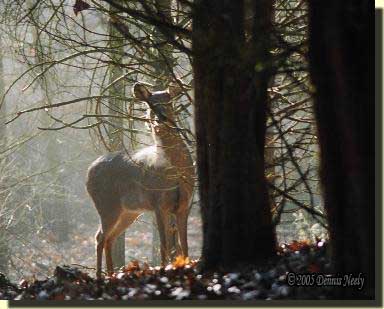
A doe questions a traditional woodsman's shape.He said he saw very few deer and thought his 18th-century clothing was to blame; at least his modern counterparts insisted that was the case. His hunting companions said they spotted plenty of whitetails on the same ground—maybe they did and maybe they didn’t. But after asking a few questions, I discovered he was looking for a whole deer, not individual body parts. I reassured him this is a common mistake.

As a veteran traditional woodsman, I have to constantly remind myself that others might not possess the same level of hunting experience that I do. I was guilty of overlooking that admonition when I quipped “Trees don’t grow bigger” without thinking. Everyone in this pastime is at a different location on the path to yesteryear—some have more woodland experience and some have less.

Being living historians, we sometimes focus too intently on only one of the three elements that are key to any traditional black powder hunt—the historical side. We fuss about the period-correctness of wool versus buckskin for leggins, knee breeches or breechclout, and whether a hunting shirt is “…open before…” or not. And depending on the individual, sometimes the emphasis centers on the black powder arm, often times a new one, at least new to the persona.

Regardless, developing the hunting skills of old comes in a dismal third and that circumstance should not be. The truth of the matter is we all are attempting to emulate bygone souls who possessed an uncanny ability to survive based on a keen understanding of the forest and its creatures. Although the three elements fluctuate in importance throughout the hunt, the traditional side, the chosen black powder arm and the development of one’s hunting abilities must maintain some semblance of balance.

To point this out I often ask, “When was the last time a thirty-point buck stepped out into a clearing, stopped at twenty paces, turned broadside and looked away while you cocked your firelock, tried to calm pounding arteries and keep the front sight on hair?” That question always brings a chuckle, and it’s a cinch no one has to take off their moccasin to keep count.

But in the glade, white-tailed deer or wild turkeys or fox squirrels do not grow to old age exhibiting that type of behavior. They use the cover at hand, because they are, after all, tenants of the forest. At best, only a portion of a critter’s body is visible. Many times a woodsman glimpses eyes and ears. Depending on the situation, sometimes the quarry is not discovered until it is closer, like the deer that slipped behind the downed tree top. A patch of hair, a twitch of a tail or the movement of a hind leg provides the only inkling.

Sometimes the rules of Nature help, like the fact that most trees start with a thick trunk and taper thinner as their height increases. That was not so with the deer that used the tree top to its advantage, or the whitetail that stood in the shadows to the right of the angling cedar. A deer’s legs start small and get larger as they reach the body, and that is why I quipped without thinking, “Trees don’t grow bigger.”

Give traditional black powder hunting a try, be safe and may God bless you.
Posted in Deer Hunts, Skills | Tagged , , , , , , , , , , , | Comments Off on Trees Don’t Grow Bigger…

“Red Quail Down”

“Snapshot Saturday”

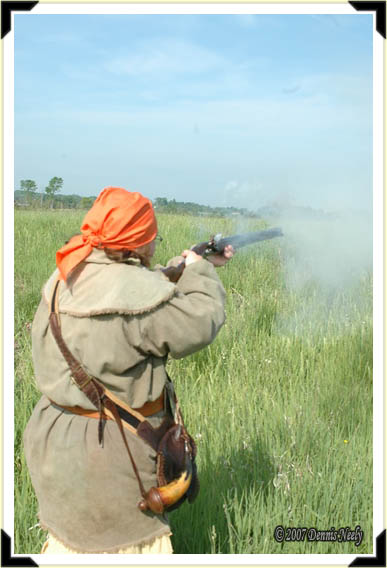
A lady of the woods peers through a smoke cloud from her flintlock.

A lady of the woods looks up after dispatching the death bees from her Chief’s grade trade gun. A hard day’s walk south of the Straits and west of Lake Huron in the Old Northwest Territory.

Posted in Quail Hunts, Snapshot Saturday | Comments Off on “Red Quail Down”

“A Sudden Noise”

“Snapshot Saturday”

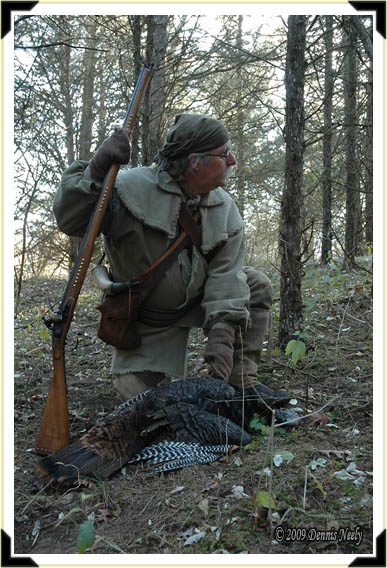
A traditional woodsman tends a downed turkey.

A traditional woodsman tends a downed wild turkey, then looks up when he hears a unfamiliar noise. Two ridges east of the headwaters of the River Raisin, Old Northwest Territory, 1793.

Posted in Snapshot Saturday, Turkey Hunts | Tagged , , , , , , , , , , | Comments Off on “A Sudden Noise”

A Rough and Tumble Woodsman

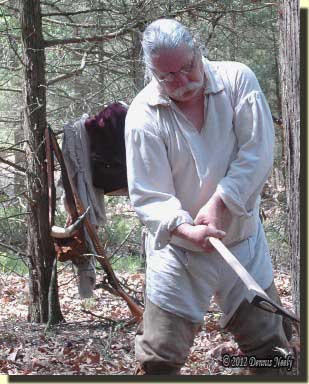
The ax bit hard. Red cedar chips scattered. Sweat spattered. The thud echoed. A quick upward jerk on the straight hickory handle dislodged the silver-edged blade. With a steady stroke, the single-bitted ax drew back, then for an instant, perched high above the woodman’s head, behind his right shoulder. In a blur, the axman’s hips and thighs uncoiled as the blade swung round and bit deeper into the notch. Red cedar chips scattered and the mighty thud echoed.

The Northwest gun is close by as the axman works.Again and again the ax arced on its relentless journey, glistening now and then as the keen edge passed from the shadows into the morning’s brilliant summer sun. Close at hand, the Northwest gun leaned against the nearest cedar tree; the shot pouch and powder horn hung by their leathern straps on a branch sliced short with a butcher knife. With one grab, the woodsman could retrieve all. The linen hunting shirt draped over a different branch, as did the burgundy, wool weskit. If not for the pesky deer flies, the sweat-soaked osnaburg trade shirt would be tossed aside, too.

With my heart pounding and rivers of salty perspiration burning my eyes, I let go of the ax, leaving it buried in the cedar tree. I stepped back and took a deep breath as I glanced about the forest. The pain of pushing too hard, of taking too many swings without resting, radiated up my arms, through my shoulders and griped the base of my back.

Cool water dribbled from the pewter flask, the one father gave me before I left for the backcountry, and eased my thirst. My eyes surveyed the trails to the east, then to the west. My breathing settled and my pulsing arteries tempered. Sandhill cranes chortled on the River Raisin, beyond the two tiny islands that hid in the bottomlands. A bright-colored wood duck circled once, then swooped up into a tall oak tree, not far away. I watched the fowl, and it watched me. I thought of John James Audubon, his gorgeous birds and his sometimes harrowing woodland adventures.

John James Audubon, the Woodsman

Some years ago, I happened to be sitting in a classroom with a number of nature writers. None of these individuals possessed the slightest desire to engage in hunting; a fair number detested the thought; and in a couple of cases, “anti-hunter” would be putting it mildly. By my estimation, most either belonged to the National Audubon Society or were strong supporters of that organization. Everyone in attendance knew I was a traditional black powder hunter.

In the midst of a discussion about Sandhill cranes, Audubon’s name came up, as it had a number of times before. But this time, one writer marveled at how wonderful Audubon’s memory was, and how observant he must have been to be able to paint his birds from life. Another chimed in, expressing similar wonderment.

In today’s world, an understandable disconnect exists between Audubon the ornithologist and painter, and Audubon the woodsman. Without getting into hunter/anti-hunter politics, I tried to let them down as gently as possible. One young lady gasped when she was told Audubon was an accomplished 18th- and 19th-century woodsman and hunter who worked primarily from “gathered specimens.” I stuck to the basics, but continued telling of his travels, how he carried a double-barreled, flintlock shotgun he called “Tear-Jacket” and toted around a 25-pound bag of lead shot, in addition to his other supplies. She left that day’s session clearly in denial.

Even as living historians and traditional hunters, we often fail to look to the writings of John James Audubon for inspiration and knowledge. After working on this year’s Fourth of July post, I thumbed through Delineations of American Scenery and Character. As so often happens, my mind skipped back to a prior woodland experience: the cedar cutting sojourn, the Sandhills on the Raisin and the drake wood duck.

One of my favorite essays in Delineations… is “The Prairie.” The story is filled with intrigue, danger and suspense—not a story a person might associate with the great ornithologist. But beyond the storyline are the intricate details that we, as living historians, so often read over.

“On my return from the Upper Mississippi, I found myself obliged to cross one of the wide Prairies…” (Audubon, 14)

“The weather was fine…My knapsack, my gun, and my dog, were all I had for baggage and company. But, although well moccasined, I moved slowly along, attracted by the brilliancy of the flowers… (Ibid)

“The track which I followed was only an old Indian trace, and as darkness overshadowed the prairie, I felt some desire to reach at least a copse, in which I might lie down to rest…the distant howling of wolves gave me some hope that I should soon arrive at the skirts of some woodland.

“I did so, and almost at the same instant a fire-light attracting my eye, I moved towards it, full of confidence that it proceeded from the camp of some wandering Indians. I was mistaken—I discovered by its glare that it was from the hearth of a small log cabin…” (Ibid)

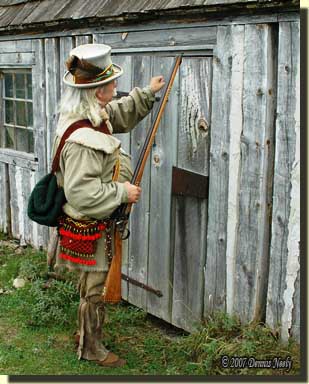
A traditional woodsman knocking on a cabin door.As Audubon approached the cabin, he saw a “tall figure” who turned out to be a woman. He sought lodging for the night. He described her as speaking “gruff, and her attire negligently thrown about her.” He “took a wooden stool, and quietly seated myself by the fire.” (15)

Audubon tells of seeing a young Indian sitting with his head in his hands.

“A long bow rested against the log wall near him, while a quantity of arrows and two or three raccoon skins lay at his feet. He moved not…I addressed him in French, a language not unfrequently partially known to people in that neighborhood.” (Ibid)

The Indian looked up. His face was covered in blood and he pointed to one of his eyes. While shooting at a treed raccoon, the arrow split on the bowstring and sprung back, putting the young man’s right eye out. After looking further, Audubon noted that there was no bed in the cabin.

“…but many large untanned bear and buffalo hides lay piled in the corner. I drew a fine time-piece from my breast, and told the woman that it was late, and that I was fatigued. She had espyed my watch, the richness of which seemed to operate upon her feelings with electric quickness. She told me there was plenty of venison and jerked buffalo meat, and that on removing the ashes I should find a cake…I took off the gold chain that secured it from around my neck…” (Ibid)

Audubon ate venison and fed his dog the same. In due time, the Indian rose and paced back and forth. On one pass, the Indian pinched him hard.

“…His eye met mine; but his look was so forbidding, that it struck a chill into the more nervous part of my system. He again seated himself, drew his butcher-knife from its greasy scabbard, examined its edge…replaced it…taking his tomahawk from his back, filled the pipe of it with tobacco, and sent me expressive glances whenever our hostess chanced to have her back towards us.” (16)

“…I asked the woman for my watch, wound it up, and under pretence of wishing to see how the weather might probably on the morrow, took up my gun, and walked out of the cabin. I slipped a ball into each barrel, scraped the edges of my flints, renewed the primings, and returning to the hut, gave a favourable account of my observations. I took a few bearskins, made a pallet of them, and calling my faithful dog to my side, lay down, with my gun close to my body…” (Ibid)

In due time, Audubon heard voices. “I saw two athletic youths making their entrance, bearing a dead stag on a pole.” The two youths, who turned out to be the woman’s sons, started drinking whiskey and eating. Audubon and the Indian feigned sleep.

“Judge to my astonishment, reader, when I saw this incarnate fiend [the woman] take a large carving-knife, and go to the grindstone to whet its edge…Her task finished, she walked to her reeling sons, and said. ‘There, that’ll soon settle him! Boys, kill yon—–, and then for the watch.’

“I turned, cocked my gun-locks silently, touched my faithful companion, and lay ready to start up and shoot the first who might attempt my life. The moment was fast approaching, and that night might have been my last in this world, had not Providence made preparations for my rescue…The door was suddenly opened, and there entered two stout travelers, each with a long rifle on his shoulder…” (17)

Audubon got to his feet and greeted the travelers. He told them of the plot. Together they tied up the two sons and the mother. The next morning they marched the three, with their arms securely bound, off into the woods.

“…and having used them as Regulators were wont to use such delinquents, we set fire to the cabin, gave all the skins and implements to the young Indian warrior, and proceeded, well pleased, towards the settlements.

“During upwards of twenty-five years, when my wanderings extended to all parts of our country, this was the only time at which my life was in danger…I can only account for this occurrence by supposing that the inhabitants of the cabin were not Americans…” (18)

Although this passage is not dated, it appears to be from the middle of the first quarter of the 19th century—indeed, a completely different set of circumstances when compared to the last quarter of the 18th century. Yet, for the living historian and traditional black powder hunter, Audubon’s essay is filled with hidden treasures from “knapsack” to the Indian’s pipe tomahawk to the accepted rules of frontier hospitality.

And I never read this tale without thinking about the nature writing class, about my classmates’ insistence that Audubon would never harm one of his beloved birds and about the young lady who left that classroom in total denial that her hero was ever a rough and tumble woodsman who owned a double-barreled shotgun named “Tear-Jacket.”

Give traditional black powder hunting a try, be safe and may God bless you.
Posted in Living History, Research | Tagged , , , , , , , , , , , | Comments Off on A Rough and Tumble Woodsman

“A Blankets Warmth”

“Snapshot Saturday”

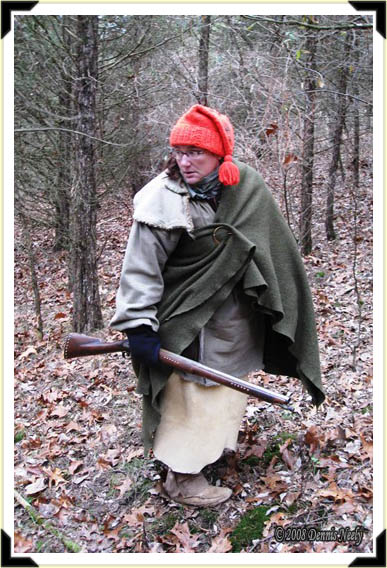
Wrapped in a green trade blanket, a lady of the woods checks her back trail.

Wrapped in a warm, wool trade blanket, a lady of the woods lends a careful eye to her back trail. Old Northwest Territory, not far from the headwaters of the River Raisin, last decade of the 18th century.

Posted in Deer Hunts, Snapshot Saturday | Comments Off on “A Blankets Warmth”

A Dubious Claim to Fame

The Northwest gun’s front sight found a British soldier’s neck. As the death messenger crossed the clearing it would drop, and if true, would strike the Redcoat mid-chest. The black flint lunged. Sparks streamed. Gunpowder flashed. A brilliant yellow tongue thundered from the trade gun’s muzzle. “Kla-whoosh-BOOM!”

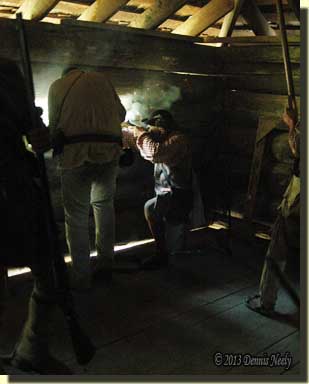
Thick, white, angry murk filled the window. There was no time to feel remorse. I scrambled to my feet and stepped to the right as Jeff Pell knelt and rested his rifled gun on the log sill. In the smoky darkness, gunpowder spilled over the brass measure’s sides. The charge tumbled down the bore. A lead ball followed, rattling in the trade gun’s fouled abyss. A shaking finger shoved a hunk of wadding into the hot muzzle. The wiping stick clattered, then thumped three times.

A woodsman fires through the gun port while others load.“BANG!” Jeff’s rifle cracked. Ned Newhart waited his turn as Jeff got up. He looked at me and mouthed “Got one” as he pulled the plug from his horn and began to reload. The bat that had pestered us took wing. In the same instant a pan flashed in the other gun port: “BANG!” The report aggravated the little demon; it circled once, twice, three times, then flew up to a hand-hewn rafter and crawled out of sight. The sulfurous stench of spent gunpowder, old dust and the pungent smell of sweaty woodsmen tingled my nose as I stepped forward.

“BANG!” Newhart’s rifled gun flashed and fired. As he pulled away, I pushed the Northwest gun’s muzzle through the opening while sprinkling gunpowder in the empty pan. My fingers flipped the frizzen down and pulled the English flint to attention as I knelt. A leather-clad knee rolled on the upraised corner of a warped floor board. I scowled, a part from the knife-like pain, a part from a gnawing concern that Indian allies might be among the British advancing on the fort.

Late that afternoon, in the summer of 1795, Msko-waagosh, the Red Fox, the white captive who once lived among the Ojibwe, entered the fort’s trading house. Thirty round balls and two handfuls of gunpowder cost four deerskins. My alter ego resisted the trader’s insistence on purchasing a new knife, priming wires or gun worms.

As I walked through the doorway and out into the commons, I saw the questioning stares, the suspicious looks. I feared a butcher knife in the back or a swift tomahawk blow to the temple, administered by a fort dweller who thought I was more Indian than white. I chose not to tarry. As I was about to slip away into the forest a disheveled farmer appeared in the clearing, running hard towards the blockhouse yelling, “British! British soldiers!”

Colonel Roberts took charge and perched on the first tread of the blockhouse steps. He was half-dressed, wearing no weskit over his clean, white shirt and faded-green knee breeches. His leather leggins were buttoned and gartered, and a stately, blue-silk scarf was tied about his collar. “Grab your firelocks, horns and pouches,” he ordered, “and head upstairs.” The Colonel looked straight at me, stern and uncertain. I had no choice but to obey.

The Fort Greenville Match

The Fort Greenville Match, Match 656 at the Max Vickery Primitive Range on the home grounds of the National Muzzle Loading Rifle Association, is one of my favorites. Back in the mid-1990s, a group of living historians and competitive shooters wondered if it was possible to re-create the conditions of a fort under attack using live rounds. Ricky Roberts—I elevated him to “Colonel Roberts” for my own living history purposes—was a member of the original group that founded the match, and he oversees it today.

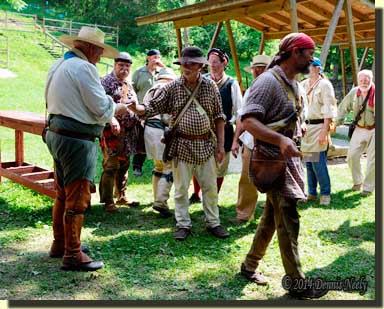
Drawing lots to deterimine the teams for the Fort Greenville Match.In June of 1999 their campfire discussions resulted in the first Fort Greenville Match, named in honor of the signing of the Treaty of Greenville in August of 1795. Match 656 is for flintlocks only and participants must be dressed in period-correct clothing. Team members are drawn by lot to avoid stacking a team. There are three competitors to each team.

After reviewing the safety procedures and the rules for the match, the teams ascend the narrow stairs to the blockhouse’s dimly lit second floor. Ricky usually sets the historical tone of the event by telling everyone to “grab your firelocks, horns and pouches and head upstairs.” Participants get pretty somber by the top step. I try to slip back to 1795.

Shooters start with their guns loaded, but unprimed. An arm can only be primed after the muzzle is through the window and pointed downrange. The match time varies, but this year each relay was five minutes. The idea is to get off as many shots as possible in that time period. This year’s target was a nine-inch round steel silhouette on the grassy hillside, a solid hundred yards from the blockhouse.

In a practical sense, loading fast and rushing to the opening in the log wall is a hindrance; a team’s three shooters must develop a rhythm that fosters an even flow to the window. Several of us shoot smoothbores in the match, and we sometimes draw “looks,” because of that choice. A couple years ago, one of my team members asked Ricky if he could switch to another group, because he didn’t want to be “hampered with a smoothbore shooter” on his team.

Yes, a hundred yards at a nine-inch clangor is a poke for a smoothbore, especially in my case, because I rarely shoot beyond my effective distance of 75-paces. As my neighbor Jeff said recently, “you’ve been loading with ‘compost’ for too long.”

It seemed impractical to take a handful of leaves up the stairs—and I question the historical accuracy of that course of action—so I just dropped the ball down on the powder charge. I added a split-apart wad, tamped firm with the wiping stick, for safety. I knew how that load would group out to 50 paces, but I had no idea what to expect at 100 yards, other than it would shoot low. And to be honest, I focused my expectations more on my new alter ego experiencing a unique 18th-century moment than on winning a medal—my apologies to Jeff and Ned.

A New Experience for Msko-waagosh

When I reached the head of the stairs, I moved to the shadows and leaned against the back wall. My persona’s outward appearance was different from the other fifteen woodsmen who defended the fort that day. I’m working on nurturing a mental attitude that reflects the doubting of one’s allegiances.

Now I must note that Melissa Rosemeyer did not dress as a proper frontier lady. She wore a sweat-stained buckskin dress, a sun-faded brown trade shirt, carried a long knife and possesses a reputation for shooting a rifled gun better than most men. To my knowledge, Msko-waagosh was the only captive who had returned to white society among the lot.

In my mind’s eye, I did not see a black-painted steel clangor, but rather an advancing Redcoat. Somewhere between the second and third shot the thought struck me that there might be Native allies among the attackers. In retrospect, I realize that is a major breakthrough in creating the necessary mindset that must accompany each persona we create.

Five minutes ticked by all too fast. After our relay, I again took a place in the shadows with my back to the log wall. My heart was still pounding. The gunfire commenced, releasing a torrent of historical thoughts that pushed me back over time’s threshold. It took me a few moments to return to the 21st-century after Colonel Roberts hollered “Cease Fire!” for the last time.

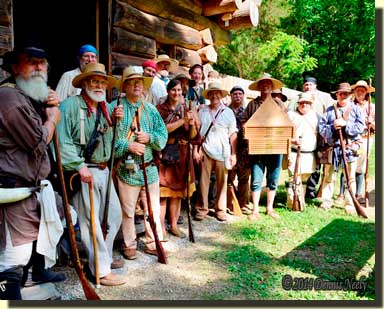
A group photo of the 2014 Fort Greenville particpants.Once downstairs I asked Tami if she had seen any hits from Old Turkey Feathers. In a rather loud, unceremonious voice she announced that she didn’t think I hit the target once. Much to my surprise, Jeff came over and told me our team had six hits. Ricky looked at the score sheet and asked “team three” to come forward. Ned, Jeff and I stepped up to accept the traveling trophy and our gold medals. The fine shooting of Ned Newhart and Jeff Pell carried the team, no thanks to Msko-waagosh.

The Fort Greenville Match was the only shooting match I entered at Friendship this spring. On the walk back to camp, expressing her inimitable wisdom, Tami said, “Well, you entered in one match and your new persona won a gold medal. That’s quite an accomplishment.”

“Well, it’s all a matter of perspective,” Msko-waagosh said. “I entered one match, shot five times, missed the target each time and walked away with a gold medal. That’s a pretty dubious claim to fame.”

Give traditional black powder hunting a try, be safe and may God bless you.
Posted in Living History, Persona | Tagged , , , , , , , , , , , | 6 Comments

“Dwindling Daylight”

“Snapshot Saturday”

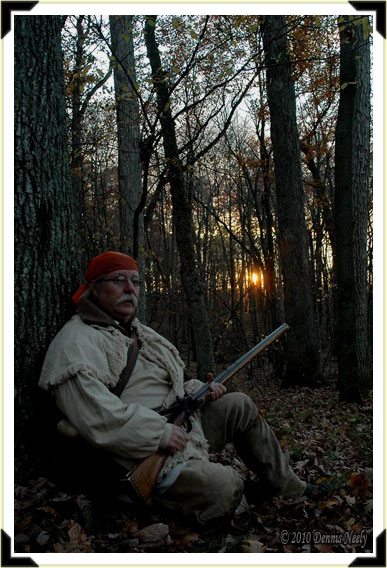
A traditional woodsman sitting with his back against an oak tree.

On a late-October evening, the sun sets over the River Raisin as a traditional woodsman waits for one last chance at a fresh squirrel supper. Old Northwest Territory, 1794.

Posted in Snapshot Saturday, Squirrel Hunts | Tagged , , , , , , , , , , , | Comments Off on “Dwindling Daylight”