-
Recent Posts
Categories
Archives
- November 2020
- October 2020
- September 2020
- August 2020
- July 2020
- June 2020
- May 2020
- April 2020
- April 2019
- March 2019
- February 2019
- January 2019
- December 2018
- November 2018
- October 2018
- September 2018
- August 2018
- July 2018
- June 2018
- May 2018
- April 2018
- March 2018
- February 2018
- January 2018
- December 2017
- November 2017
- October 2017
- September 2017
- August 2017
- July 2017
- June 2017
- May 2017
- April 2017
- March 2017
- February 2017
- January 2017
- December 2016
- November 2016
- October 2016
- September 2016
- August 2016
- July 2016
- June 2016
- May 2016
- April 2016
- March 2016
- February 2016
- January 2016
- December 2015
- November 2015
- October 2015
- September 2015
- August 2015
- July 2015
- June 2015
- May 2015
- April 2015
- March 2015
- February 2015
- January 2015
- December 2014
- November 2014
- October 2014
- September 2014
- August 2014
- July 2014
- June 2014
- May 2014
- April 2014
- March 2014
- February 2014
- January 2014
- December 2013
- November 2013
- October 2013
- September 2013
- August 2013
- July 2013
- June 2013
- May 2013
- April 2013
- March 2013
- February 2013
- January 2013
- December 2012
- November 2012
- October 2012
- September 2012
- August 2012
- July 2012
Blogroll
Forums
General Living History
Historical Sites
Organizations
Artists


“Wandering West”
Posted in Snapshot Saturday
Tagged Dennis Neely, historical trekking, Mountain Man, Native captive, North West trade gun, Northwest trade gun, trade gun, traditional black powder, traditional black powder hunting, traditional blackpowder, traditional blackpowder hunting, Traditional camping, Traditional Woodsman
Comments Off on “Wandering West”
Two Hours Sipping Water
Afternoon sprinkles pitter-patted. Light green autumn olive leaves bounced and bobbed, partly from the raindrops and partly from a slight breeze. The air smelled fresh and clean, a bit unusual for the first week in November. Overhead, the red oaks held all of their leaves, which was a tad unusual, too. Fall’s unseasonable warmth continued. I did not object. If I recall, the year was 1795.
Nothing moved, not even songbirds. My fingers dug around in the leather hunting bag, grasped the pewter flask and pulled it free. I rested it in my lap as I looked downhill, then glanced up at the wagon trail on the ridge. In a few minutes, I unscrewed the cap and took a short swig. The water was warm, as it so often is, from resting in the back of the bag, against my left hip. I caught myself nodding as I thought how pleasing the tepid water would taste on a cold November deer hunt.
With damp lips, I sucked once on the radius-bone call, muffling the cluck in cupped hands. It was the second time I had imitated a wild turkey hen from my ambush among the “five sisters,” five modest-sized red oaks that grew in a cluster on the east face of the big ridge. Three trees lean downhill and two grow uphill with a center space just big enough to conceal a traditional woodsman sitting on a blanket roll.
A doe trail passed a dozen paces in front of the five sisters, and a second angled behind the lair. Some nights the wild turkeys follow those trails on their way to the roost trees, off to the north. For the last week I had been hearing a cluck from that area, often enough that I felt confident the gamble was time well invested. Each evening the soft, single cluck sounded the same, and I thought an older hen might be calling her brood to the roost like Mrs. Schultz used to gather her wayward second graders with an old brass bell.
The summer insects were all but gone, save a few spiders spinning webs that would soon catch an overnight frost. That evening was also unusual, because I slipped the flask in the hunting bag as an afterthought. I still-hunted for an hour or so before sitting at the five sisters; my throat seemed dryer than normal, perhaps because I included the flask. I spent two hours sipping water and never did see a single wild turkey or hear a cluck.
“How Do You Carry Water?”
Not long ago a reader asked. “What do you do for carrying water when you are out and why?” That is a great question, and I thought I might share the answers—plural, because there are several, depending on the circumstances.
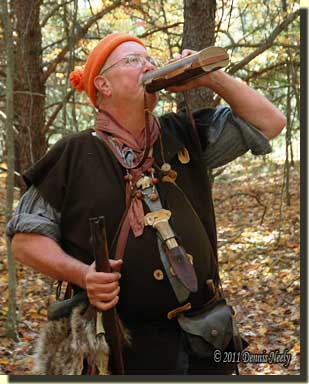
Captain Tom paused for a sip of water in the midst of an 18th-century squirrel hunt in the Old Northwest Territory.
First, I wish to dispel the myth that I spend days on end in the forest while everyone else is at work. As a full time writer, I have a hard time concentrating on hunting or keeping my mind in the 18th century when I know I should be pounding on the keyboard to meet a deadline.Therefore, the majority of hunts you read about in this blog or in the magazines only last for forty minutes and/or up to two hours—basically whatever I can squeak into my schedule.
On this particular afternoon, I was blessed with about three hours and I was able to keep my mind in 1795. When I know I will be afield for less than three hours, I drink about eight to ten ounces of cool water before I venture back to yesteryear. This amount tides me over, and if I need water to wash with, like after dressing a deer, swamp or creek water is usually a short walk away.
Years ago, my son-in-law killed a nice buck. It died in its tracks deep in the woods. After dressing it, I picked up a large handful of wet leaves and scrubbed the blood from my hands. I commented that “wet leaves are Mother Nature’s moist towlettes.” One of my daughters caught the quip on a short video and it became a much-repeated joke at special-occasion family dinners.
For no special reason, three hour pursuits seem to be the point at which my trading post hunter persona starts to carry water, as he did that afternoon. I’m still working on how the returned captive alter ego will carry water and in what.
The trading post hunter persona carries a drinking-water-safe pewter flask that was given to him by his father before he left for the Lower Great Lakes. The bottom of this flask is marked “10 ozs.” and it was manufactured in “Sheffield, England.” This accoutrement has seen many years and is pretty beat up. At best it holds about eight ounces, possibly less, because of the dents—one side is caved in, too.
My first persona was that of a French Canadian voyageur. In the 18th century the voyageurs dipped a wooden cup over the side of the canoe to take a drink. This practice is unsafe today, unless you wish to risk experiencing a severe period-correct illness or death. Because of the common presence of canoe cups in this region, my post hunter persona continued to carry the cup.
Now and again I’m fortunate enough to stay out overnight. In those circumstances I pack a two gallon brass kettle, again lined with food-safe tin. I make a second trip and pack in water, fill the kettle two thirds full and cover it with a linen dish cloth to keep out bugs, leaves and dust. The two gallon kettle allows me to fill the flask for day hunts, plus I can dip water with a wooden canoe cup when in camp. I don’t worry about contaminating the water source by dipping, because it is not shared with other hunters.
Over the years, I have participated in a number of traditional hunting camps where there was a single water source. I like to fill the canoe cup or the flask from the spigot (never contaminate the water by dipping). I don’t own an 18th-century style mug for camp use. I try to keep my kit as simple as I can.
Tami and I use canoe cups at the outdoor shows, so we are drinking in a period-correct manner in front of the show guests, rather than sipping from a fast-food container, and the habit generates a fair number of discussion questions.
For winter excursions, I have tried to wean myself away from “eating fresh snow,” because of the industrial contaminants in this area, the possibility of ingesting unwanted bacteria and who knows what else. I like to tuck the flask inside my linen hunting shirt, against my body, down to the left (being right handed) where the sash holds the shirt closed. The flask doesn’t move about or make a telltale gurgling sound as I stalk and my body heat keeps the water warm, even on the coldest morning.
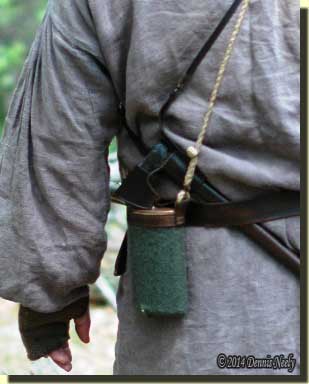
A copper canteen carried by Darrel Lang on a recent turkey hunt. The canteen has a wool and leather sheath.
A number of traditional woodmen carry a small canteen, usually made of copper and again, lined with food-safe tin. Such a container is consistent with their historical research and considered common for a French and Indian War or American War for Independence personas. They range in size from one pint to quart-and-a-half capacity. At most battle re-enactments participants are required to carry at least a pint of water, so living historians who are also traditional hunters use the same accoutrement for both purposes.
On the lighter side, years ago at the Eastern Primitive Rendezvous, both Tami and I found ourselves parched. The only drinking water we could find was sold at the “tavern” in plastic bottles. Neither of us wanted to tote around these artifacts from the future. A few vendors down from the tavern a lady was selling tanned, case-skinned muskrats. I asked if I could handle one, and when she said “yes,” I slipped a water bottle inside.
We walked away with two “somewhat” period-correct water bottle covers. We discovered the hair-on hide kept the water cold for four hours. Now Tami keeps that hide in her basket at some events with a water bottle in it. It freaks people out when you pick up a muskrat and start to drink from its lips. And sometimes we keep one out and sip from it when the kids come by, which always starts a conversation.
The days of safely drinking from a stream, lake or river are gone. As traditional black powder hunters, each of us must make sure our water is safe, which necessitates some type of container. Like any other accoutrement, a water container should reflect a common, historically documented alternative based on a persona’s time period, geographical location and station in life.
In most cases there are multiple opportunities and possibilities. Some might work better than others, so it is best to make an educated choice and then test it under actual hunting conditions in the wilderness classroom. From a traditional woodsman’s perspective, the container needs to carry sufficient water to survive without hampering the pursuit, and only woodland experience can teach a humble hunter the proper balance. What a delight!
Give traditional black powder hunting a try, be safe and may God bless you.
Posted in Clothing & Accoutrements, Safety, Turkey Hunts
Tagged Dennis Neely, historical trekking, Mountain Man, Native captive, North West trade gun, Northwest trade gun, trade gun, traditional black powder, traditional black powder hunting, traditional blackpowder, traditional blackpowder hunting, Traditional camping, Traditional Woodsman
Comments Off on Two Hours Sipping Water
“The Morning’s Blessing”
“Snapshot Saturday”
Posted in Snapshot Saturday
Tagged Dennis Neely, French D Trade Gun, historical trekking, Mountain Man, Native captive, North West trade gun, Northwest trade gun, trade gun, traditional black powder, traditional black powder hunting, traditional blackpowder, traditional blackpowder hunting, Traditional Woodsman
Comments Off on “The Morning’s Blessing”
“Squirrel & Grouse Camp”
“Snapshot Saturday”
Posted in Snapshot Saturday
Tagged Dennis Neely, historical trekking, Mountain Man, Native captive, North West trade gun, Northwest trade gun, trade gun, traditional black powder, traditional black powder hunting, traditional blackpowder, traditional blackpowder hunting, Traditional camping, Traditional Woodsman
1 Comment
Perhaps Jonathan Alder was Right
Wood ducks whistled. The pair winged straight up, flared to the east, dipped low over the maple point, then glided out of sight over the huckleberry swamp. In less than a minute they circled back, sashayed between the oaks, then landed a trade gun’s length apart on an upward angling oak branch, two trees to the north.
As the sun’s rays crested the next knoll, I began to wonder if a humble woodsman’s presence disrupted their 1795 world—perhaps I was sitting at the base of their nesting tree? I pondered moving. I glanced to the north; the birds were still perched. Through the river bottom’s half-leafed trees, I could see the sun illuminating the hardwoods on the River Raisin’s far bank. Dark shadows still drenched my lair.
Four wild turkey toms bantered nonstop from their roost trees shortly after I arrived—all in those hardwoods. There was nary an utterance on my side of the river, not even a sullen cluck from a lost hen. The gobbling stopped when dawn’s first golden spears touched the hardwood’s uppermost branches. Now and again a muffled gobble teased from the ground as the birds moved farther north in search of hens.
My head eased back against the “yellow oak,” named for the bright yellow cast the exposed heartwood gave off when a main branch broke off, splitting the trunk almost to the ground. A dozen winters grayed the trunk. A large, creamy-white shelf fungus grew to my left. A big black ant zigzagged across the protrusion.
The last gobble added to the morning’s frustration. I peered from inside the forest-green, wool trade blanket and counted seven mosquitoes buzzing about, just beyond my spectacles. The wood ducks circled again, whistling as they passed. I took one last look about, scrambled to my feet and folded the blanket lengthwise. With the blanket draped over my left shoulder, I eased into the cedars and moved closer to the huckleberry swamp.
Mosquitoes swarmed about. Each step of my buffalo-hide moccasins raised another dust-like cloud of blood-sucking beasties. A tiger mosquito weaseled its way under the ruffled cuff of my trade shirt and bit the little finger of my right hand, which gripped the Northwest gun. My left hand released the blanket’s edge and swatted the pest, smearing blood on the back of my hand. It took a great effort to fight the urge to move quicker, but haste would not lessen my misery.
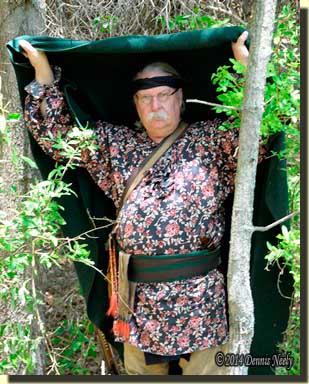
Two thigh-sized young oaks caught my attention. Autumn olive bushes grew about the saplings offering additional natural cover. I leaned the smoothbore against the smaller tree, unfolded the blanket and with my arms spread wide, held it over my head. I folded the blanket about my body, covering it head to moccasins, and sat down.
My right hand retrieved the trade gun and rested it across my lap. My fingers pulled a wing bone call from the shot pouch; I laid it on a white oak leaf to the right. I adjusted the blanket, leaving a narrow slit to see through.
I sat for a short while, as I so often do. Satisfied I had not spooked a bird, I dragged a single, soft cluck on the hunt-polished wing bone. About ten minutes later, I clucked again. I waited, amusing myself by watching three sassy fox squirrels frolic in the two big oaks in front of me. A bit later, I counted 14 mosquitoes jockeying about on the front of the blanket in search of an advantageous position at the feed trough. I wondered how many followed a similar pursuit on my back and sides. Throughout the morning, a tom turkey never answered my amorous requests; a curious hen never investigated; but from the roost gobbles, I expected that.
A New Lesson in the Wilderness Classroom
It seems that winter’s lingering cold upset the wild turkeys’ spring mating rituals at the headwaters of the River Raisin. A dryer than normal March and April aided this woodsman in his simple pursuit, but a few days of heavy rain in mid-May spawned a massive hatch of blood-sucking beasties. Mosquitoes and spring turkey hunting go hand in hand, but the last week or so has been much different—“unbearable” is the word most modern hunters are using to describe this plague.
But mosquitoes or not, a traditional woodsman cannot put food on the table without venturing into the wild and sitting still enough to bring a wary gobbler close in. The current conditions are the worst I have seen in at least the last two decades, so what must a humble time traveler do to survive in the Old Northwest Territory?
In researching historical methods of dealing with mosquitoes, I found a passage in James F. O’Neil II’s first volume of Their Bearing is Noble and Proud. This passage is attributed to a French soldier’s journal about the time of the French and Indian War:
“Mosquitos are the most troublesome pests. They are called stingers and gnats in Europe. To keep them off, it is often necessary to rub lard on the face, hands, and body; the insects sticks to the grease and dies instantly.” (O’Neil II, v. 1, 27)
I know I have other passages marked that describe using bear grease in place of lard, but none offer a solution that fits my persona or my traditional black powder hunts. I am not aware of any herbal remedies, either, but I expect some existed. At any rate, slathering up with lard or bear grease for a two-hour, early morning turkey hunt is impractical, at least for this woodsman’s circumstance.
As I work on the various aspects of my persona, I keep coming back to Jonathan Alder’s admonition to young Tom Springer. After dressing “a large buck” killed by Springer, Alder decided the two should camp out overnight. When his hunting companion lamented that he had not brought a blanket, Alder replied:
“You ought to have thought of this when you started out…You never see an Indian start out without his gun, tomahawk, butcher knife and blanket.” (Alder, 126)
The first morning of the hatch, swarming mosquitoes drove me from the cedar grove—that was a few days before I sat against the yellow tree. Frustration and disgust washed over me. I stood in the adjacent clearing, sorting through my options. My blanket was rolled, bound with a leather portage collar and slung over my shoulder. I was about to walk away, to give in to the blood-sucking beasties and surrender. In a fit of serendipitous inspiration, I remembered the wool trade blanket.
Up until that moment, the rolled trade blanket represented a polite adherence to an age-old statement of wisdom. Yes, at times I considered it an unnecessary historical prop. But suddenly that common trade blanket took on new importance. Perhaps Jonathan Alder was right. I only thought in terms of the blanket’s warmth. I never considered the protective nature of the thick wool weave. Slung on my back was an accoutrement ready for testing in my 18th-century wilderness classroom.
Anticipating the first laboratory experiment, my buffalo-hide moccasins still-hunted to the north with renewed enthusiasm. I stopped at a small stand of cedar trees where wild turkeys sometimes loaf midday. I untied the portage collar’s long tails, rolled out the blanket and wrapped it about my body, covering every inch of exposed skin, save a little narrow slit for observation.
That morning’s temperature was climbing into the 70s, but I felt comfortable. It was hard to sit still and not swat at the buzzing beasties that hovered about my ears. Watching mosquitoes land on the blanket was a bit unnerving; it took a while to accept that they could not bite. Much to my delight, the blanket held the mosquitoes at bay. An occasional valiant explorer flew through the opening and tried to bite my nose or forehead, but I learned a quick puff of breath, carefully directed, usually blew the invader away.
I am not aware of any documentation for using a blanket in this manner. I intend to spend some time perusing through my favorite journals in search of passages dealing with insects. It’s a subject I really haven’t thought about. I’ve just tolerated the discomfort, accepting the little creatures as an integral part of living and surviving in the glade. But this year is very different, and my alter ego is not willing to give up the hunt. Thanks to Jonathan Alder’s admonition, he doesn’t have to.
Give traditional black powder hunting a try, be safe and may God bless you.
Posted in Clothing & Accoutrements, Turkey Hunts, Wilderness Classroom
Tagged Dennis Neely, historical trekking, Mountain Man, Native captive, North West trade gun, trade gun, traditional black powder, traditional black powder hunting, traditional blackpowder, traditional blackpowder hunting, Traditional Woodsman
Comments Off on Perhaps Jonathan Alder was Right
“Unleashing the Death Sphere”
“Snapshot Saturday”
“Final Approach”
“Snapshot Saturday”
Old Lady Gray’s Student
A weak gobble drew hopeful glances. A dozen moccasin steps later, my wife thought she heard a second utterance; older ears failed to discern the joyous sound. Regardless, the tom was well off to the west; somewhere out in the sedge-grass marsh that kissed the River Raisin about at the sand flats.
We walked side by side, each keeping to an earthen rut of the wagon trail. Little clouds of dust rose with each footfall. The early morning sun beat down on our backs. The air was calm; the sky clear; the temperature almost too warm. Fresh turkey tracks in the yellow, sugary sand betrayed a bird’s presence within the last day.
Despite excited hearts, the still-hunt maintained a slow and cautious pace. Our course advanced up the hill and around the bend before slipping off into the cedar trees. Once off the wagon road, there was a greater possibility of walking on to a sneaking tom. With that in mind, Tami kept the “Silver Cross’” muzzle at the ready, pointed ahead, waist high.
We set up our ambush in a clump of tight-growing red cedar trees, just south of a little clearing at the edge of the hardwoods. Tami faced west and I east. Ten minutes passed before I dragged twice on the single wing-bone call; my hands muffled the seductive clucks. “Rustling in the leaves, just over the hill,” my wife whispered a few minutes later.
My right thumb pressed hard on the Northwest gun’s cock screw when I heard the noises. “A gray squirrel,” she whispered with a bit of disappointment in her tone. I glimpsed movement to my right, then saw a plump body with a thick, bushy tail bounding along, unconcerned, not three paces distant.
Switching to the two-piece wing-bone call, I barked out two sharp clucks, imitating those of “Old Lady Gray.” So many years ago, on that warm spring morning, the smoky-gray hen with an anti-hunter attitude marched from the cedar grove, crossed the grassy clearing and stomped up a rolling hill. She clucked twice, crisp and loud like the first two tones of a long yelp.
After a respectable pause, she turned to her right, moved uphill about ten paces and called again. There was a hint of urgency in those two notes, more demanding than seductive. She stood firm for the longest time, then walked south with her typical herky-jerk gait, ending about ten paces from where she stood for the first call. She turned to the far ridge and called twice in the same manner. In a few minutes she returned to the cedar grove.
“I’m going to the south, down back of the hill,” I said. When we fashioned this stand, we agreed on safe boundaries for shooting. “Your shooting area won’t change. I’ll be well behind you,” I assured my apprehensive turkey hunting partner.
A cautious still-hunt ensued; I stalked my next calling location as if it were a fine whitetail buck. Thirty or so paces to the southeast, I settled in against the trunk of a large cedar tree, over the hill and out of sight of my wife. Facing south, I clucked twice, mimicking Old Lady Gray. My eyes surveyed the understory to the east as my mind ticked off an approximation of the smoky-gray’s first pause.
Satisfied a wild turkey was not coming to my entreaties, I scrambled to my feet and circled to the north to another clump of cedars I had spotted while I waited. This time I stopped long enough to call, but I did not tarry, rather I pressed on to a large cedar that grew forty paces to the northeast of Tami’s lair. I sat with my back against the tree, then clucked twice. I dared not return to my original seat for fear of disrupting a silent tom advancing on Old Lady Gray’s student.
Safety First
The first concern of any living history simulation, any traditional black powder hunt, is safety. There are times when we simply cannot duplicate the feats of 18th-century woodsmen, and for those situations, we must apply a healthy dose of “measured compromise,” in essence assessing the consequences of any given action and finding a compromise that neutralizes the unwanted consequences in a safe and legal manner.
Moving about in the midst of a traditional turkey hunt is one of those situations which might create unsafe conditions. The only people who can properly address the safety risk of any circumstance are the people involved, and that also includes unseen hunters or trespassers who are not part of the re-enacting party.
In the case of that morning’s hunt, my wife and I agreed on “shooting lanes” right after we sat down. By sitting back to back, we minimized the safety issues of two hunters shooting from the same stand. On a positive note, any bird that tried to come in from behind Tami was covered, too.
But the hunt’s complexion changed once I got up and moved off to the southeast. By choosing the ambush location with great care, I was able to slip away and keep the crest of the hill between us—in the case of an accidental discharge both of us were safe. The only other concern would be a trespasser, and that risk was minimized (not removed, by any means), because the hunt occurred on private property. Again, I cannot emphasize enough that safety comes first; don’t move about if you might be in danger because of your movements.
Imitating a Tenant of the Forest
“One important pastime of our boys was that of imitating the noise of every bird and beast in the woods. This facility was not merely a pastime, but a very necessary part of education…The imitations of the gobbling and other sounds of wild turkeys often brought those keen eyed and ever watchful tenants of the forest within the reach of the rifle. The bleating of the fawn brought her dam to her death in the same way…” (Doddridge, 122)
The majority of the time I hunt alone. I relish those times when I can hunt with a partner, because it always seems to lend itself to expanding the historical significance of the outing.
When the calling at our ambush did not produce a response, I chose to “imitate” a tenant of the forest I had observed years before: Old Lady Gray. In so doing, I followed Doddridge’s tutelage, and in my opinion, applying such a technique showcases one of the subtle differences between 21st-century hunters and 18th-century woodsmen. Plus, a hidden message in the Doddridge passage is the implication that “our boys” had to observe nature in order to imitate it.
There is no question that hunting the wild turkey on the North-Forty has become more difficult over the last ten years. That increase in difficulty is brought on by modern hunters imitating what they see on the outdoor videos, which in many instances are meant to sell product. A half-hour segment that shows a hunter calling twice, waiting ten minutes, calling twice more, waiting ten minutes…isn’t going to sell many calls, to say nothing of keeping the viewer’s interest. It’s no wonder the birds are call shy.
As living historians, our delight is duplicating the exploits of a long-dead hunter hero. Given the abundance of today’s call-shy wild turkeys, the old ways also hold a possible key to success for those of us who are willing to observe and imitate. Nothing came of my strict adherence to Old Lady Gray’s ritual, other than my wife and I shared a magnificent morning in the forest. But not every outing produced a harrowing 18th-century adventure back then, either.
Yet, I believe patience, observation and careful imitation of the forest tenants will produce results, just as it did long ago. That is why I am proud to consider myself one of Old Lady Gray’s students…
Give traditional black powder hunting a try, be safe and may God bless you.
Posted in Safety, Turkey Hunts, Wilderness Classroom
Tagged Dennis Neely, historical trekking, Mountain Man, Native captive, North West trade gun, Northwest trade gun, trade gun, traditional black powder hunting, traditional blackpowder, traditional blackpowder hunting, Traditional Woodsman
3 Comments