“Snapshot Saturday”
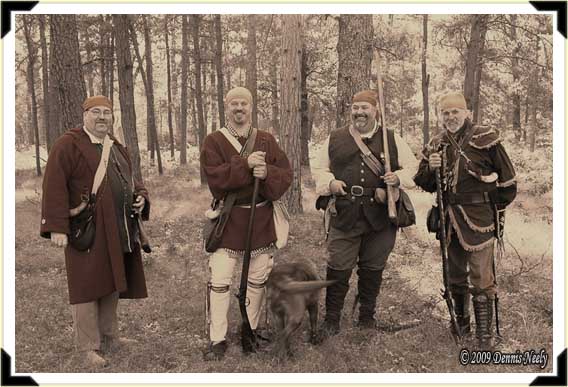
Four traditional woodsmen pause before a morning’s simple pursuits. Left to right: Rick Evans, Jeff Nieman, Radar, Jon Bertolet, Norm Blaker. Swamp Hollow, 1760s.
Four traditional woodsmen pause before a morning’s simple pursuits. Left to right: Rick Evans, Jeff Nieman, Radar, Jon Bertolet, Norm Blaker. Swamp Hollow, 1760s.
A silent black crow passed overhead. Sandhill cranes followed, winging west, chortling as they flew. Frost clung to the prairie grasses and dusted my hunt-stained leggins. The Northwest gun’s muzzle swung to the right as I turned quick. Deep-pink clouds touched the eastern horizon, hinting at a cold rain before midday. Such was the circumstance of that October morning, in the year of our Lord, 1798.
After a few footfalls, my progress stopped. My course veered left five or six paces, followed by a planned about-face. The intent on that cold, fall morning was to unnerve a fine fowl and offer no choice but flight with those unpredictable antics, that erratic dance. My stomach growled and churned. Thoughts of a succulent pheasant, slow-roasted over glowing coals wet my mouth. I could all but taste the butter and melted maple sugar on hot squash, too. Thankfully, the bread was a bit dry.
A strange fragrance, a blend of dry hay and damp, fresh-torn prairie grass, filled the air. A long string of Canada geese gossiped on their way west to the River Raisin. I paused to watch. As I stood, I caught a strong whiff of wood smoke. And then, as if traveling back in time, I felt certain I smelled blackberry tarts baking at the hearth in the trader’s house at Fort Michilimackinac.
I was about twenty at the time, so it had to be 1770. I hunted for a Scotch-Irish trader by the name of O’Neil, supplying fresh venison and wild game for the voyageurs of his brigade. That was my only trip to Fort Michilimackinac.
I remember being surprised when the canoes paddled ashore a short distance from the fort’s water gate, but learned this was to allow time for the voyageurs to wash and don their finery. We arrived to fusils firing, and a raucous melee of barbaric whooping and hollering ensued.
At first I wandered outside the fort’s cedar pickets. In due course I made my way to the land gate. The one blockhouse was unmanned. I climbed the stair and viewed the forest, then the buildings within the palisades. The British soldiers kept to themselves, drilling and doing what soldiers do. I don’t remember who was commandant or their regiment. It didn’t matter.
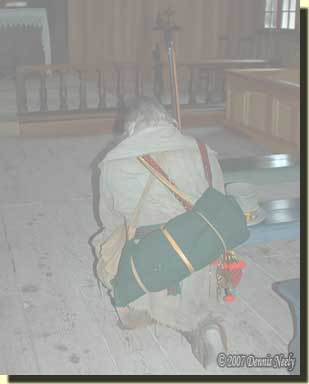 I next found my way to St. Anne’s church. It was abandoned; the priest was not due for another week. I knelt beside one of the green benches that served as pews and prayed. Afterwards, I walked around the gardens and talked with the blacksmith as he banged out a new hinge on his anvil. He was a pleasant fellow, but not prone to conversation.
I avoided the barracks and the guardhouse, then ventured into one of the trading houses. A young woman was baking blackberry tarts. She answered my greeting. We were both shy; she kept looking down at the table as she cut the rolled dough into circles. She dropped one of the crusts on the floor, but what I remember most was the sweet aroma from the hearth. But alas, the eerie screech of a red-tailed hawk brought me back to the reality of 1798.
I mulled over praying at St. Anne’s and how I had been granted God’s blessings for all these years. It was in that moment that I realized I had not offered the Lord the hunter’s prayer. “A clean kill, or a clean miss. Your will, O Lord,” I whispered.
With the adventures of my youth stowed away, I spun about. My blanket-lined moccasins took a few steps to the west, then veered right, into a small patch of barren goldenrod. A brittle stem snapped. My thumb was off the hammer’s jaw screw, resting on the trade gun’s wrist when a frantic flailing burst forth. Red and green and cinnamon streaked straight up. “Kort! Okk okk! Kort! Okk!” the fowl exclaimed.
Frost flew. Leaf shards drifted. Small, downy feathers floated in the rooster’s wake. My thumb fumbled. The sear clicked. The muzzle swung as the Northwest gun’s butt stock slammed into my shoulder. The turtle clawed at the whipping tail, and chased the bird’s open beak.
“Kla-whoosh-BOOM!”
Boiling smoke obscured the fowl. Yet, in an instant I knew the death bees failed their task. I swung too fast, tried too hard to regain the advantage that I frittered away with trivial thoughts of blackberry tarts. The late swarm only changed the rooster’s direction. I watched in frustration as that magnificent bird settled into the sedge grass on the far side of the nameless creek.
A charger of powder tumbled down the trade gun’s bore. Big, wet drops plopped and splashed on the fringed cape of my hunting shirt. The heaven’s opened. I adjusted my course homeward. I arrived soaked and a bit disgusted with myself. Sometimes God answers prayers in ways other than what we think best.
The simple pursuit of wild game in the manner of our 18th-century hunter heroes is the result of a conscious choice. After all, that is what traditional black powder hunters, as true living historians, do; they live in a past time of their own choosing. The degree of immersion in yesteryear is up to the individual re-enactor, too.
At the core of our simulated time traveling is research, the snippets of “what once was” that tease and tantalize and drive us all crazy—and at the same time, become the addictive elixir that keeps us up nights with bedeviling questions that have no answers. To be sure, the dusty journals, diaries and narratives of long ago push us forward in this hobby, but there is also a need for hands-on visitation to places of historical importance.
Here again, there is a choice: living historians can visit as modern tourists, or they can slip into the mindset of an alter ego and view the world in an 18th- or 19th-century context. As an example, in 2010 Tami and I visited Hartwick Pines State Park, just north of Grayling, Michigan.
Like most state parks, the modern visitor center is not conducive to time travel, but I was barely out of sight of the building when my alter ego filled my head with 18th-century thoughts. On that warm August day, I was dressed as a tourist, but my mindset was that of a 1790-era hunter. I saw the pine forest not as an oddity, a must see attraction, but rather as the norm of everyday life, a fond memory to be stored away for future reference.
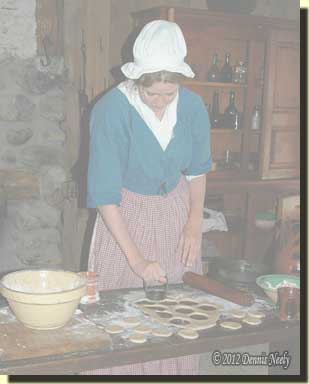 In like fashion, we visit Fort Michilimackinac as often as we can, and as it works out in today’s world that is usually when blackberries are in season. Baking blackberry tarts must be a common activity for the living historians at the fort. We have witnessed it on several occasions, enough times that the smell of baking tarts comes to mind at the darnedest times when I am in character. And this is as it should be, for that is what it means to “flesh out a persona.”
The goal of traditional black powder hunting is to re-live the past. Unfortunately, a lowly traditional woodsman cannot recognize the aroma of fresh blackberry tarts by sniffing the pages of a hunter hero’s reprinted memoirs. One learns that smell by hands-on visitation, by standing close to the young woman cutting out the crusts, by lingering and taking in the hearth’s smoky perfume, by becoming accustomed to the aged fragrance of open, unfinished beams in a reconstructed trader’s house.
Each living historian is at a different location on the path to yesteryear. Some struggle with finding adequate primary documentation sources to establish a believable portrayal, while others work at tweaking a long established persona. In either case, it is important to recognize that the characterizations we put our hearts and souls into must, at some point, become well-rounded persons of the past.
One of the fundamental rules of time is that humans have a cognitive awareness of what is happening at this instant, and most have a recollection of what happened in the past, but no one has any idea what the future, the next few seconds of life, holds. The same should be true for our alter egos.
As living historians, each person is taxed with blocking out the known future, while concentrating on life as it happens, second by second, in a chosen time period. Crossing time’s threshold is hard work and takes a lot of careful preparation, but it is also important to keep in mind that that preparation includes fleshing out a persona’s past experiences—so in the midst of an intense pheasant hunt an older hunter might recall a visit to Fort Michilimackinac when he was twenty years old.
Flashbacks to the past are a common occurrence for most people, some are fond memories and others are unpleasant—both are facts of life. To ingrain prior happenings into a persona’s life experience, a traditional woodsman must nurture a mindset that recognizes these fleshing-out opportunities when they present themselves, regardless of circumstance.
Sometimes those opportunities can be planned ahead, like a visit to Fort Michilimackinac, and sometimes they just happen, as in the case of our spur-of-the-moment side trip to Hartwick Pines. Yet, in both instances, it is snippets from within the entirety of the visit that flesh out one’s character.
Get in touch with your persona’s past, be safe and may God bless you.
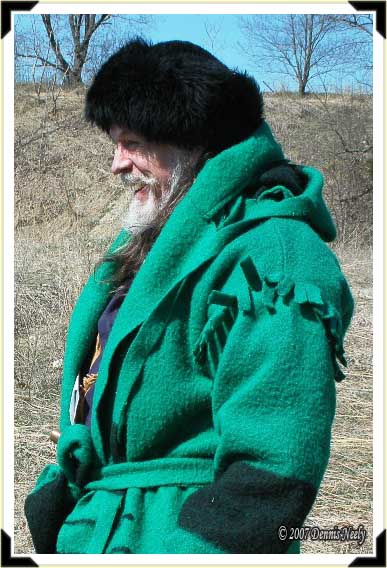
Norm Blaker is a longtime traditional black powder hunter who enjoys a good story and a hearty laugh with friends and acquaintances. Old Northwest Territory, 1790s.
Apprehension lingered after each footfall. An impending sadness lurked in the shadows. Dread stalked tree to tree. Winter moccasins crossed the isthmus that divided the nasty thicket, then angled up the steep, slippery slope. Raspberry switches clawed and tugged at hunt-stained buckskin leggins on that cold, January day in 1797.
The glade smelled damp; half-melted snow patches remained here and there. I gazed straight up. Dark, jutting webs of barren twigs and branches passed to my right and to my left. Beyond, smoky-gray clouds churned and roiled. When my eyes broke over the ridge, I paused, staying concealed behind a red cedar tree. On the crest of the next ridge, to the south a bit in the hardwoods, the brown canoe tarp and the exposed rafter poles of the little lean-to waited.
As I stalked the tiny station camp, the center of my 1796 hunting adventures near the banks of the River Raisin in the Old Northwest Territory, emotions got the best of me. By choice that oak-covered ridge was my wilderness classroom, my laboratory for experimenting in my 18th-century Eden. My only regret was that class was not in session as often as I wanted—time travel can be an elusive partner.
I dumped the Northwest gun’s prime, plugged the touch hole with a whittled sliver and leaned the smoothbore against the shelter’s extended ridgepole. I pulled the blanket roll from my shoulders and thumped it to the ground, just inside the humble abode. After removing my shot bag and horn, I checked the powder horn’s plug and hung them on a main rafter, next to the trade gun, a safe distance from the fire pit.
Reaching over the bedroll, I gathered up some of the dry twigs piled in the lean-to’s back corner. In like fashion, I grabbed two handfuls of brittle oak leaves from under the tarp’s edge. In a matter of minutes the soothing aroma of a fresh kindled fire eased my apprehensions.
 When I stood, I discovered a mature doe walking with the wind at her tail on the top of the next ridge west. The lean-to blocked her approach and kept her from seeing me. I smiled, rested my arms on the ridge pole and enjoyed her magnificent beauty. Over my shoulder, a faint plume of white smoke drifted upward, bothering neither her nor me. The time for deer hunting was long over. “Old Turkey Feathers” was loaded with shot in hopes of bringing a squirrel or rabbit to the camp, but that was not to be. It did not matter.
The purpose of that sojourn was to pack up the tarp and close the station camp before the next winter snowstorm. In addition, the outing represented an earnest and long overdue attempt at christening a new brass kettle, purchased in the spring of 1796. In the months that followed the acquisition, every research project contained a reference to a kettle, be it tin, copper or brass. Each message heaped guilt on a traditional woodsman’s shoulders. I felt ashamed as my fingers broke up some venison jerk and sprinkled dried corn into the warming water, but there is never enough time. Yet, the doing seasoned the soup’s bland flavor with a rich sense of accomplishment.
That midday jaunt proved bittersweet. For me, apprehension and sadness always accompany the breaking of camp, be it after one night or after an entire hunting season. Kindling a fire and blacking the brass kettle’s burnished sides was a consolation prize of sorts. The fox squirrels did not cooperate and the rabbits were holed up. The memorable prize of that adventure was simply enjoying the winter forest.
I own an assortment of kettles, from a quart tin boiler to an original No. 8 brass kettle from the last quarter of the 19th century. Years ago I started with the tin boiler based on George Nelson’s journal. Nelson was a fifteen-year-old clerk for the XY Company:
“We kindled a fire out-doors & boiled our Tea Kettle, & the men hung their Tin Kettles on the “tripied” [tripod] to make their Soupe. Our Kitchen furniture was a Tea Kettle, a tin Kettle to cook in, a frying pan; tinned plates, pewter basins of about a pint for tea, knives, forks, spoons &c. all put in a very convenient traveling Basket.” (Nelson, 35)
But Nelson’s recollections also made allowance for other possibilities. He once observed the Native peoples “making” rice and wrote that “…they also roast some in old Copper Kettles…” (Ibid, 56) Adding to that reference, the list of supplies requisitioned by Meriwether Lewis for the Corps of Discovery included six “copper kettles (1 of 5 Gallons, 1 of 3, 2 of 2 and 2 of 1).” (Brandt, 428) Other woodsmen made similar notations.
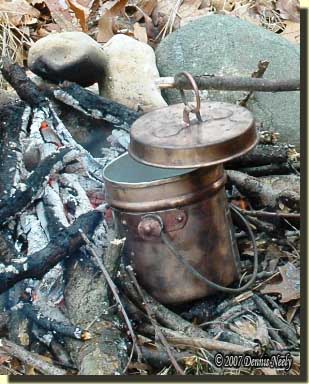 At a living history show, I happened upon a three pint, covered copper kettle made of heavy sheet copper and seamed with the classic overlapping box-edge joint. The reproduction included mushroom-shaped knobs riveted to the body, similar to those on original trade kettles. The price was fair so that kettle had to follow me home. I used it for a couple of years, until I heard rumblings about a high lead content in the “food safe tinning” used to line the kettle. I could neither prove nor disprove the rumors, so erring on the side of safety I stopped using the copper kettle for food preparation.
Not long after, I happened upon Jonathan Alder’s narrative. Alder seemed quite specific when he spoke of hauling water:
“They now ventured to call upon me to do some little duties and the white man told me to take the brass kettle and go to the branch and fetch some water…” (Alder, 40-41),
then at a salt spring, “Our kettles were small—nothing but common camp kettles…In general, each family had two kettles, one holding about three, and one about eight gallons. Many were there for weeks with but one small kettle…” (Ibid, 74),
and again, “…I had lashed my blanket and brass kettle to my horse.” (Ibid, 113)
James Smith’s journal, Scoouwa, included brass kettles in his description of maple sugaring:
“They had two brass kettles, that held about fifteen gallons each, and other smaller kettles in which they boiled the water [sap]…” (Smith, 52)
In describing the Native game of Bug-ga-sauk or Beg-ga-sah, John Tanner wrote:
“The beg-ga-sah-nuk are small pieces of wood, bone, or sometimes of brass made by cutting up an old kettle…” (Tanner, 99),
and another time he tells of a discovery made by Wa-me-gon-a-biew: “Disturbing with his foot a pile of dry leaves, he found buried under it a brass kettle, inverted, and covering a quantity of valuable offerings to the earth…” (Ibid, 144)
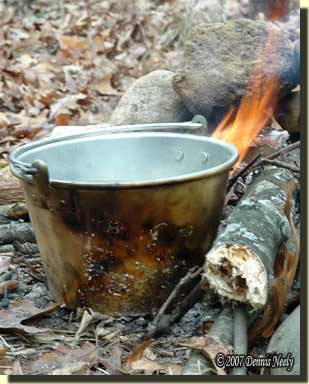 These writings, coupled with trade inventories and existing museum artifacts led me to purchase a reproduction brass kettle that approximates the originals. The bale ears are cast, rather than folded sheet brass and the sides are a bit taller than some I have seen. The No. 0 kettle holds a little over a quart of liquid, and it was this kettle that I christened on that January day.
Unfortunately, I don’t get to use the brass kettle as much as I would like, but that is my choice. With limited time, I would rather hunt than sit in camp boiling water for soup, which explains the procrastination, I suppose. But the journey down the path to yesteryear is one of discovery and learning. And by my estimation, I have barely begun.
Give traditional black powder hunting a try, be safe and may God bless you.
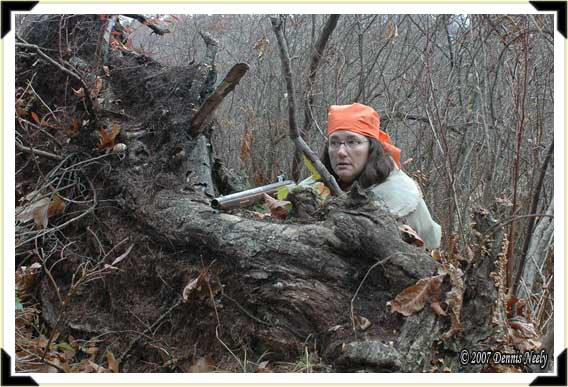
Lady of the woods, Tamara Neely, watches a doe and button buck meander on a trail upwind of her lair, the upturned roots of an ancient maple tree. Old Northwest Territory, 1795.
Two hen turkeys clucked, then squabbled. The ruckus came from the south; those birds sounded roosted, an hour after first light. A fox squirrel frolicked at the base of a red oak. Not far away, a blue jay watched from a witch hazel branch. The jay cocked its head as if it was deciding whether or not to scream. A hushed, six-note yelp echoed over the huckleberry swamp. One of the turkeys to the south answered in like fashion.
That October morn, in the year of our Lord, 1795, smelled fresh as it does after a warm spring rain, yet the acidy scent of fallen leaves tingled the nose now and again. The air was cool, but not crisp. A lingering dampness opened the possibility of stealth, a chance to stalk the wild turkeys, but as I sat hidden in the broken down top of an old hickory tree, I whispered, “not quite yet.”
Not fifteen minutes later, the turkeys grew silent, as they sometimes do. The antics of squirrels, chickadees and chipmunks nudged the sun along, as did a passing melee of angry crows and two or three wedges of low-flying geese, winging their way west to the River Raisin.
About mid-morning a single muzzle blast broke the tranquility. The shot came from the far side of the Raisin and echoed up and down the river bottom. Out of habit, my thumb traced an uneasy circle on the ear of the Northwest gun’s hammer. The Raisin’s deep current separated me from the other wilderness tenant, but as the minutes ticked away, that proved of little consequence.
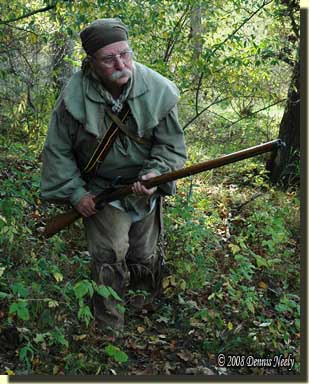 As I sat and contemplated this new development, the complexion of the sojourn changed. The hope of happening upon a wild turkey still existed, but the primary purpose shifted to scouting around the nasty thicket and huckleberry swamp for other British spies.
With care and caution, I scrambled to my feet, kicked leaves and twigs into the nest I cleared at dawn and struck off to the south on the mid-hill doe trail that skirted the nasty thicket. Not far ahead, a plump gray squirrel appeared from behind a white oak, but I paid little mind. Instead, I concentrated on watching my back trail and surveying from side to side.
In a short while a doe loped in the shadows, ahead and to the left. Two spring fawns followed, browsing as they went. I paused again, checked about, then moved with the does, paralleling their course but keeping my distance. Those deer slipped away, but over the rise and just before the raspberry brambles I glimpsed another young deer at the northeast corner of the thicket, near the stagnant water. Again I paused…
Some days the wild turkeys peck and scratch along the doe trail that eventually passes close to the broken down shagbark hickory. Unfortunately, that October morning I guessed wrong. When an ambush fails to materialize, I tend to hold on to hope longer than most hunters, I suppose because time is always so limited for my 18th-century wanderings. After all, traditional black powder hunting is a pastime.
But the gun blast of a squirrel or turkey hunter in the hardwoods on the other side of the River Raisin provided an opportunity to turn the remaining thirty or so minutes into a productive learning experience, one not entirely set on pursuing wild game. Hearing a gun’s report is not uncommon in the modern environment, the stage upon which our historical simulations must take place. For the traditional black powder hunter, someone else’s muzzle blast can be viewed as an unwanted intrusion or a chance to take a fruitless chase in a different direction.
Growing up, one of my jobs on the farm was checking fences for fallen trees or other damage that would allow the cows to get out. When I started down the traditional path to yesteryear, I still had to check the fences on a regular basis. It was then that I devised the game of “spies and scouts,” weaving a modern task within the fabric of my simple pursuits.
At first, spies and scouts was about covering ground, traveling light and fast. With time, my understanding of re-enacting matured, and the rusted posts and woven wire fence disappeared, at least in the context of my 18th-century adventures. The fencerows evolved into blazed trails, and when I ran out of fence to check, the playing field for spies and scouts expanded to include the trails in and around the various natural features of the North-Forty.
In those early years, squirrels, quail, pheasants and cottontail rabbits were plentiful. In season, I might take small game, if the opportunity presented itself, but I would avoid spooking the white-tailed deer that I happened upon. At some point, I recruited those deer as “bit-players” in my historical hunting scenarios. And when the wild turkeys were re-introduced in southern Michigan, they became bit players, too, “hostiles” in my 1790s Eden.
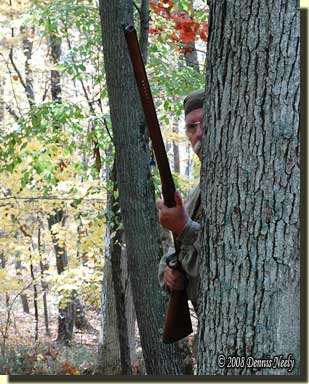 The objective of spies and scouts is to move about the forest without being detected. When the doe loped into the shadows, she became a British ranger out of Fort Detroit, but when her fawns arrived, the solitary scout grew into a more serious hostile presence. I chose a bold course by following them, but that is how woodland skills are honed.
The trio moved faster than I felt comfortable with, so when they wandered over a knoll, I leaned against a tree for a bit to make sure I wasn’t walking into an ambush. If, on the other hand, one or more deer spot me, I sit motionless until it is safe to retreat. If I draw a snort and the deer run off, I consider myself shot and lost to eternity.
In some ways, turkeys are tougher adversaries. If I run upon them in the midst of a round of spies and scouts and the fall turkey season is open, I become the aggressor and willingly engage them, if I have caught them unaware. But if they putt and race off, then I am the one who will be lost to the wilderness.
My best encounters with turkeys, from the standpoint of spies and scouts, seem to occur during deer season. The first priority is always putting fresh venison on the family dinner table, but wild turkeys wandering into a still hunt automatically initiate a brief game. For me, the challenge is to avoid detection, to become a worthy wilderness tenant, and that task is hard, but never without the unexpected.
Quite a few years ago, I think during an early September goose hunt, I played spies and scouts on the way back to camp. A frolicking fawn caught an ill-advised movement. The British agent stood and watched for a bit, alternating glances between the oak that hid me and its dam. When the little button buck walked towards the doe I slipped away and took a seat just down from the ridge crest, concealed by a broad red cedar tree.
At least ten minutes passed. I heard the doe snort, then stomp. She never saw me, and I did not consider myself shot, much less mortally wounded. A few moments later that buck fawn stood beside the oak that once hid me. It sniffed the ground, looked in my direction and started plodding straight at me, nosing out my scent like a hound pup.
Over top of the fawn’s back I saw the doe circling downwind of the oak. She snorted and stomped, trying to warn the youngster, now not more than five paces distant from my fortification. After it got a snoot full, the brash Englishman retreated back to the oak. I have never figured out how to score that encounter, but I refuse to believe I was the one who succumbed.
Give spies and scouts a try, be safe and may God bless you.
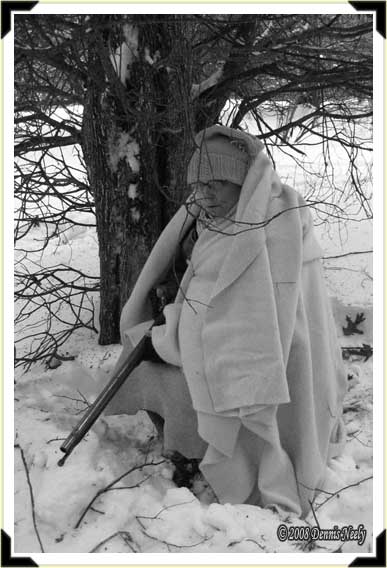
Another view of a traditional woodsman, in this case my wife Tamara, as seen by a white-tailed deer. The photo album contains a number of images like this for those individuals who believe camouflage clothing is a must for deer hunting. Old Northwest Territory, 1794.
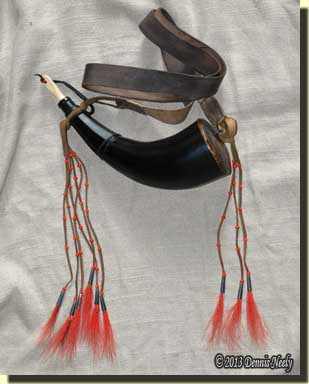 I just posted another “How-to” installment, this one dealing with reworking a bison powder horn. The project is divided into four parts: how and why I chose a bison horn for my persona, reworking an existing horn that I purchased “sight unseen,” making a new hickory stopper and fashioning a buckskin horn strap.
Each part has its own page, complete with step-by-step photos that I hope you find helpful. I tried to break the project down into manageable parts, demonstrating my thought process, faulty as it sometimes is, when researching, making or modifying an accoutrement—in this case a powder horn. In addition, I thought it might be easier and quicker for an individual to find information on a specific project, like fabricating a new stopper or creating a powder horn strap.
Be safe and may God bless you,