If I Bargain Hard

The smell of blooming lilacs filled the air. Now and again the fluffy clouds hid the mid-afternoon sun. When it shone, the spring rays warmed my back to the point of sweating. The propane burner uttered a constant, dull, whooshing roar that filled my heart with joy and radiated an equal amount of heat on my chest.

For the first time in three years I found time to cast round balls for “Old Turkey Feathers,” and none too soon. A small, scruffy beaver pelt, far from “prime,” would buy all that remained from my last casting. I’ll leave you to figure the actual count…
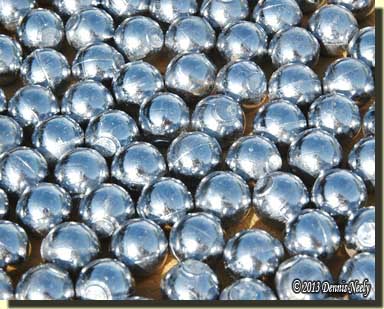
Lead balls shining in the sun.Casting lead is serious business. The fumes from molten lead are highly toxic, and because lead melts at about 621 degrees Fahrenheit, the slightest splash burns skin and singes clothing. Safety is of the utmost concern, and constant care and forethought is a must when casting round balls.

The plumber’s lead pot that I use was old and obsolete when I bought it, back in the late 1970s. It is certainly not as nice as some of the modern melting pots, but the price was right. The cast iron pot holds over thirty pounds of molten lead, but I like to work with about ten pounds. The propane company fitted it on an old style tank, short and squatty like a mushed pumpkin. The tank alone weighs almost sixty pounds filled and is quite stable, even when the lead pot is full.

I prefer to cast in a slight breeze and out in the open, away from the shop. With the wind at my back, the fumes are always whisked away, plus I sit in a stable chair an arm’s length from the pot. I dress in jeans, a long-sleeved denim shirt and heavy work boots. Leather gloves are a must and I tuck the buttoned shirt sleeve into the cuff of the glove. I used to use a leather work apron, which is often recommended, but I found it got in the way. Safety glasses are a must, too; a face shield offers better protection yet.

With the smaller, electric melting pots, pouring the lead into the mold is done over the pot, but that is not possible, or safe, using this propane-fired lead pot. I pour away from the pot, over a wide cottonwood board that was a cut-off from a Shaker-style tall clock that I built years ago. Inadvertent spills splash a bit when they hit the wood. I keep my feet pulled back under the chair to avoid the flying lead.

Grandpa Olson’s cast iron ladle has a longer steel handle. He used it to pour Babbitt bearings in his youth when he worked as a mechanic rebuilding Model T engines. He gave it to me, and even though the handle gets hot, it works great with the wide-mouthed lead pot. I never pour lead or Babbitt without thinking of him, which for me, adds a sense of kinship to a modern task.

The two-pound lead ingots are stored inside and the plastic pails are covered to avoid any contamination by water. Water turns to steam when it contacts molten lead, causing a “steam explosion” that can spatter the hot lead. Not long ago, one of the black powder forums had a thread about a steam explosion caused when a lead pipe was added to a melting pot. Unbeknownst to the fellow, one end of the pipe was plugged, trapping water that blew lead all over with great force. Fortunately, no one was injured.

No Tradition? No Bag Mold? No Campfire?

A number of years ago I bought a .600 “bag mold” in my quest to be an authentic Lower Great Lakes woodsman. I acquired a small, hand-forged ladle, made a steel mold to cast half-pound bars of “trade lead” and sewed a pillow ticking sack to stow the mold, ladle and a pound’s worth of chopped up bars. It took a few sessions, but I eventually caught on to producing descent lead balls using the hot coals of a burned-down campfire.

From the start, the sack’s pound-plus weight, coupled with a goodly bulk, proved a problem. It didn’t fit in my shot pouch, and was a bit much for my hunting bag. It eventually made its way to my bedroll, and that didn’t work well, either. The ball molding sack resided in my wooden cassette for a while, but now stays home. Like some traditional black powder hunting accoutrements, the bag mold and supporting supplies are victims of a better understanding of the historical record.

In the 1980s, when smoothbores were still considered “gas pipes,” the few folks who shot them applied a rifle mentality to their care and feeding—patched round balls, for example. But smoothbores need to be separated from rifles, and separated again as to who is using them—settler, hunter, Native American or military. I recent years, I have come to believe the end user’s life-station affects not only how he or she loaded round balls, but also where he or she acquired their “bullets.”
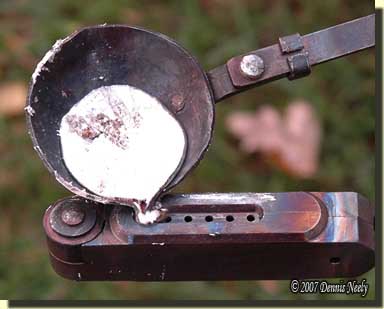
A hand-forged ladle pouring lead in a gang mold.

The hand-forged ladle and a gang mold for making round ball, buck shot and cast bird shot.

In the case of a rifle, a mold was usually furnished by the gun’s maker. Round balls might have been cast around a campfire, and in a time of need, the rifle’s mold was put into service, often by the women of a fort during the heat of battle:

“Lydia [Boggs] was at the second siege of Fort Henry and although but 16 years of age she melted bullets until her arms and hands were blistered.” (Allman, footnote, 200)

But bullet molds are conspicuously absent from the trade inventories, both at the posts and on the trading manifests for the Montreal canoes that transported goods on the Great Lakes. In addition, in the late 18th century, bulk lead is also absent. Rather, precast round balls were shipped by the sack full to the various trading posts, offering a monopolistic commodity for securing beaver pelts.

“When I returned to my family I had but seven balls left, but there was no trader near, I could not at present get any more…” (Tanner, 115)

If a bullet mold existed among Tanner’s adoptive Native family, he could have secured more ammunition, but as he says, “I could not at present get any more…” This seems to be a common occurrence for Tanner:

“When my balls were all expended, I drew my knife and killed one or two [elk trapped when they broke through a river’s ice] with it, but all I killed in the water were in a few minutes swept under the ice, and I got not one of them…” (Ibid, 65)

“I went to hunt with only three balls in my pouch…” (Tanner, 105)

In a like fashion, Michel Curot, a trader with the XY Company, sent Brazile David to accompany Kitchinimiscoutte and Payedgique. Curot’s journal entry for November 7, 1803 records:

“He [David] Asked me for thirty Balls, his horn full of powder, and one pair of deer skin shoes, and some Tobacco that I gave him…” (Curot, 422)

The entry for February 4, 1804 reads:

“This morning David left to go and rejoin Les Razeurs. Since the savages, according to his report, took from him each time he went among them his ammunition, I again supplied him on his departure with Two chopines [about a pint] of powder, a Demiard [about a half pint] of Lead [maybe lead shot?], 30 Balls, and Two Brasses [about two yards each] of tobacco, also a pair of Elk skin shoes…” (Ibid, 440)

On October 1, 1804, Francois Victor Malhiot, a North West Company clerk, recorded the sale of “sixty bullets” in the company ledger for two prime beaver pelts (Malhiot, 220). Similar transactions appear throughout the ledger. In addition, the inventory of goods sent to “The Ouisecansaint” includes “1 sack of bullets” valued at 40 plu, or prime beaver pelts (Ibid, 222). Based on the standard 30 bullets per plu, that is 1,200 round balls with an approximate weight of 50 pounds.

The documentation shows the Native Americans, white captives or employees of the various competing fur companies depended on the traders for their round balls and shot. If a hunter owned a rifle, he could always trade for standard round balls and melt them down, which was done, but the hunter who owned a gun purchased from the post depended on the trader to supply the round balls.

With that in mind, I choose to cast a couple hundred round balls in an afternoon, and limit the amount I carry for hunting to about a dozen. Although limiting the historical me to three rounds is period-correct according to Tanner, I do not follow this practice out of respect for the game I pursue.

And when someone asks if I carry a bullet mold and cast my own round balls over an open fire, I state simply that I must purchase my round balls, shot and gunpowder from the North West Company trading post. The trader’s name is Samuel, and I hunt for him, on occasion. A prime beaver will buy 30 round balls, a handful of shot or a double handful of gunpowder. A small, scruffy beaver pelt, far from “prime,” purchases fifteen balls, if I bargain hard.

Give traditional black powder hunting a try, be safe and may God bless you.
Posted in Safety, Skills | Tagged , , , , , , , | Comments Off on If I Bargain Hard

“Wait a while…”

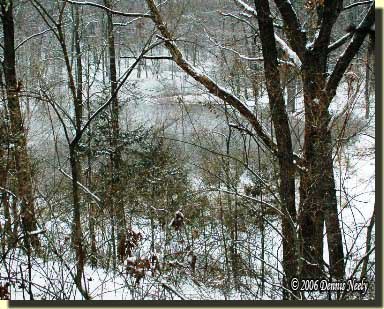
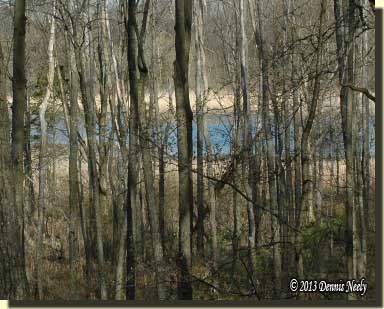
The River Raisin on a sunny May morning.The River Raisin beckons. To the south, the flooded ribbon looks silvery blue, to the north a dull, brownish gray. The broad lily-pad flats seem the dividing line. The air smells of spring’s greening, fresh, clean and leafy. A red-tailed hawk screeches overhead, displaced from its twiggy nest in a towering white oak by a scruffy interloper. The year is 1795, deep in the Old Northwest Territory.

I feel a burning desire to race to the river’s edge, but water stands everywhere in the bottoms. My moccasins are old and tattered. I know the mud is thick and slimy, the trek difficult. I want to see the river, to stand on the bank and watch the brisk current, to see the brittle cattails sway in the wind. The Raisin holds a special place in my heart, and yet, I understand it is not to be, today, at least.

A goose honks at the sandy bend, overwhelming the songs of dozens of song birds. The red-tailed hawk circled back. It flaps away, seeing that I am still here, I suppose. Glossy, ankle-high skunk cabbage leaves carpet the muddy bottom. In a few days’ time they will grow knee deep and squeak when I push through them, if time allows. But I must turn away and continue scouting for turkeys.

Ahead, the green umbrellas of emerging trilliums stand guard ‘round a weathered old log. They were not visible two days ago. Wood ducks whistle behind me, and I see them zigging and zagging in and out of the hardwoods. I wonder if it is the same pair from last time, when I sat and watched the bedded deer?

Ah, ruffled leaves, partway down the hill. Turkeys foraged this way, one or two, maybe more, here and there. From the scratch marks and fresh look of the leaves, yesterday afternoon? My mind suggests I sit, and this time I shall listen. The brilliant sun feels warm, the oak’s bark rough and furrowed.

Crows caw to the east. Their calls sound deep and raspy. More join in, but they are staying in one place, not milling in a frenzied melee. One, two knolls distant a deer’s tail wags side to side on a winter doe trail. It is walking away, not coming closer. Little bugs are flying about, not mosquitoes, but smaller, more fairy-like. I see them in the sun streaks, but they disappear in the shadows.

Since coming into the hardwoods, I have heard nary a putt or cluck, not even a soft pop or click. The birds are here, I can sense it. I need to be patient, to lean back and wait a while…

Incorporating Personal Beliefs

I find it hard to keep up with 18th-century research, let alone modern issues in the outdoor world. There simply is not enough free time to cover it all, and I my case, the historical research gets top priority. That said, I feel it is important to keep abreast of modern happenings, even if I have to force myself, especially in light of the current anti-gun, anti-hunting sentiment that is being touted by so many of our supposed leaders.

A few days ago I was skimming through the Outdoor Hub and came upon an article posted by Daniel Xu, “States Consider Removing Sunday Hunting Bans.” The article caught my eye for a number of reasons, but mostly because it triggered an association between “Sunday hunting,” and a short passage in Doddridge:

“Many of the hunters rested from their labors on the Sabbath day, some from a motive of piety; others said that whenever they hunted on Sunday they were sure to have bad luck all the rest of the week.” (Doddridge, 101)

Certainly, this passage opens the door for a lengthy discussion, both of God-fearing Christian beliefs and a host of superstitions that were prevalent up through the 19th century (and today, for that matter). Instead, I wish to point out that a traditional black powder hunter might consider incorporating personal beliefs, religious or superstitious, in his or her portrayal.

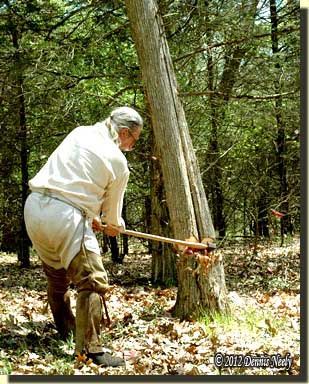
A traditional woodsman cutting a tree with a single bitted ax.Knowledge of the Sabbath’s significance was common in the backcountry. About 1790, when Jonathan Alder, an adopted white captive, was sixteen years old, he reluctantly joined an Indian raiding party that ventured into Kentucky to steal horses.

“…The next day, in the forenoon we came to the settlement. We could hear the axes chopping at many houses. The leader of our raiding party said, ‘Tomorrow is the day. They are all now chopping wood for the Sabbath, which is tomorrow. Their horses are all turned out and in the morning, the men will all be inside about the house.’ The whites were not out working the following day, and so we gathered up thirty-two of their horses…” (Alder, 81)

In his narrative, James Smith, mentions keeping his “books” in a pouch. The books included a copy of Russel’s Seven Sermons and a Bible.

“When I came into my longings I saw Russel’s Seven Sermons, which they had brought from the field of battle, which a Frenchman made a present of to me…” (Smith, 26)

“During his [Arthur Campbell] stay at Sunyendeand he borrowed my Bible, and made some pertinent remarks on what he had read…” (Ibid, 64)

Based partly on this passage, I carry a small copy of the New Testament, protected by a buckskin pouch and hand-sewn linen envelop, in my hunting bag. A brown ribbon marks the end of Matthew’s Chapter 6, one of my favorite passages, often referred to as the “lilies of the field” from the Sermon on the Mount:

“Therefore, I say unto you, Take no thought for your life, what ye shall eat, or what ye shall drink; nor yet for your body, what ye shall put on. Is not the life more than meat, and the body than raiment…Consider the lilies of the field, how they grow; they toil not, neither do they spin: And yet I say unto you, That even Solomon in all his glory was not arrayed like one of these…” (New Testament, Matt. 6: 25, 28-29)

Shortly after mentioning his Bible, Smith tells of a time of plenty. With a few simple sentences, he shows how his personal beliefs were ingrained into his being.

“…When we could have plenty of green corn, or roasting-ears, the hunters became lazy, and spent their time as already mentioned, in singing and dancing &c. They appeared to be fulfilling the scriptures beyond those who profess to believe them, in that of taking no thought of to-morrow; and also in living in love, peace and friendship together, without disputes. In this respect, they shame those who profess Christianity.” (Smith, 65)

And with a little research, other options exist, as well. The important factor in most narratives is how seamlessly the personal beliefs are incorporated into the telling of the tale. For traditional black powder hunters attempting to achieve a meaningful portrayal, this can be challenging task. At first, some forethought might be needed, and maybe a little practice. But personal belief systems are an integral part of who we are in modern life, just as they should be in our alter egos.  Take, for example, Nicholas Cresswell who tells of being ambushed by Indians while on the Ohio River, not far from the mouth of the Sioto [sic] River.

“…saw 4 Canoes full of Indians about two hundred yards ahead of us, upon which we pushed for the shore, but to our great surprise saw six other Canoes full of Indians betwixt us and the shore so that we were entirely surrounded…Out of twelve Guns five were rendered unfit for present use by the wet, mine happened to be in good order and I loaded her with an ounce bullet and seven swan shot. The command of our Canoes was given to me. We had only two Guns on board fit for use, Mr. Tilling’s and mine. Tom O’Brien in the scuffle let his fall in the River and got filled with water. He laid down in the bottom of the Canoe, begun to tell his beads and prayed and howled in Irish. Boassier’s Gun was wet and unfit for use. He followed O’Brien’s example. Weeping, praying, said Ave Mary’s in abundance, at the same time hugging a little wooden crucifix he pulled from his bosom most heartily…” (Cresswell, 91 – 92)

In my younger years, I often would forgo church during deer season. I was afraid fine buck might present itself in my absence. When my tastes turned to the old ways, I discovered the “Sabbath passage” in Doddridge and that got me to thinking. I realized that I rarely found success on Sunday hunts, and my habit changed. Most Sundays I was still in the woods at dawn, but I was out, cleaned up and sitting in a pew before the organist started the first hymn. I don’t feel I missed anything along the way.

See you in church on Sunday, be safe and may God bless you.

Posted in Living History, Persona, Scouts | Tagged , , , , , , , , | 1 Comment

Who Are You?

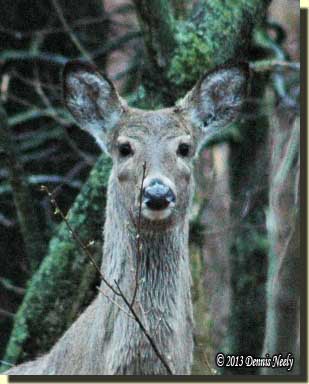
An alert whitetail doe looks straight on.Tiny waves raced to the puddle’s shore. A southwest wind dislodged another drop from a nearby maple branch. More waves followed the little splash in a puddle no bigger than a nice buck’s bed. Catkins hung from a poplar tree. The young doe watched me, but showed no alarm.  A robin flew by, but didn’t linger. A crimson cardinal perched on a crooked witch hazel branch, a dozen paces distant.

Not long before, my moccasins eased up a rise. I saw the doe’s ear twitch. When her head turned to the river bottom, I treed behind a red oak. Over the course of a few minutes, I counted five deer, lying along the ridge. I advanced a step, then stood motionless. I took another step, then another and another. I leaned against the next oak and decided to go no farther.

In due time, I knelt, slipped the bedroll from my shoulders and positioned it in front of the trunk. I sat for a while before pulling out my journal. I moved slow, expecting the closest doe would surely see me. It took her a while. The third one back seemed most concerned.

“Despite the cold, mouse-ear-sized leaves dot some branches in the underbrush,” I scribbled. “Rained hard last night and up until daybreak…turkey scouting is stalled…now see seven deer bedded upwind…no gobbles or clucks.”

A cottontail rabbit hopped from beneath a green juniper bush. The rabbit’s big brown eye surveyed the wet leaves and the traditional woodsman propped against the tree. It sat still while I recorded its presence. When the geese started honking from the River Raisin’s sand flats, its hind quarters tensed. A wood duck hen zipped through the bare trees, weaving in and out. The brilliant colored drake followed some distance behind, and that is when the rabbit bounded back to the juniper’s safety.

I returned to the journal, and wrote: “Who am I?” at the top of a folded page. “What is my given name? My Indian name? When was I born? How old am I now? When was I captured and how long did I live among the Potawatomi, or was it Ojibwa…”

Developing a Meaningful Backstory

A persona is an integral part of any traditional black powder hunt. One’s “character,” or “alter ego,” can be simple or elaborate, based on a real person’s life or a composite of like individuals from long ago. I view a persona as a “vessel” in which one collects and assimilates historical information for purposes of re-living 18th-century hunting exploits. I usually refer to this vessel as the “historical me.”

For the most part, a traditional hunter’s portrayal is first-person, meaning the participant speaks of the past in the present tense (“I did…”), because he or she actually lives the fair-chase circumstances he or she relates (Roth, 183). I consider this a unique aspect of our living history genre. A large portion of re-enactors present in the third-person, describing a given event in the past tense (“they did…”), referring to the past as the past, often demonstrating as “this is how it was done.”

On that rainy April scout, I chose to stop and watch the deer, rather than spook them and continue on with my sojourn. That decision changed the mental tone of the outing, shifting the emphasis to learning, observing and reflecting. But as I started recording the sights, sounds, smells and feeling of the glade at that moment, my mind wandered to my current project: the creation of a new persona based on the Indian captive narratives I have been researching.

Given the chance to just sit and reflect, my head fills with questions, some dependent on the answers to others. It is possible to assemble a meaningful persona that is summed up in a few sentences; I know many traditional hunters who have succeeded following this form. But having read and re-read the personal tales of John Tanner, Jonathan Alder, Charles Johnston, John Slover, Alexander Henry, Elias Darnell and a host of others, I want to be able to bring this new character to life around any a campfire, in any setting. This task is immense and weighs heavy on my mind.

In Past into Present: Effective Techniques for First-Person Historical Interpretation, Stacy F. Roth states,

“The first-person interpreter [she’s talking about museum presentations] must portray a character—fictional, real or a combination of both—with depth, validity and a wide range of knowledge that pertains to his or her world…A well-developed character has a relationship to other characters and economic, social, political and physical forces.” (Ibid, 59)

“I propose a framework [she gives credit to other living historians in a footnote for the formulation of this framework] for character development based on five spheres of knowledge: personal [person-specific information: birth date, family, education], local [information shared with others: neighborhood, hometown events, religious customs], occupational/domestic [source of income, trade tools, skills and job-specific tasks], stational [habits of social and cultural class] and worldly [world events, notable persons, national geography, arts, literature].(Ibid, 59-60)

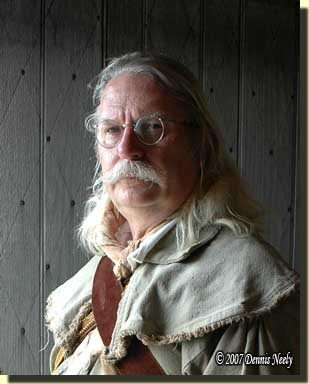
The "historical me" standing in a doorway at Fort Michilimackinac.As I sat there watching the does and listening to the geese, I attempted to address the personal side of my new character when I wrote, “Who am I.”

The evening before, a question arose while reading excerpts from Elias Darnell’s journal (Drimmer, 256). In the course of chasing down an answer, I found myself thumbing through the first few sentences of John Tanner’s narrative:

“The earliest event of my life, which I can distinctly remember, is the death of my mother. This happened when I was two years old, and many of the attending circumstances made so deep an impression, that they are still fresh in my memory. I cannot recollect the name of the settlement at which we lived, but I have since learned it was on the Kentucky River, at a considerable distance from the Ohio…” (Tanner, 1)

Curiosity got the best of me. I grabbed Jonathan Alder’s captive narrative from the bookshelf, turned to the first page, and read:

“A history of the life and captivity by the Indians of Jonathan Alder, who was born the son of Bartholomew and Hanna Alder on September 17, 1775, in the state of Maryland, not far from Philadelphia. When I was two years old, my family removed from there to Wythe County in Virginia. About four years afterwards, my father died, leaving a wife and five children…My father had bought a piece of land and had made some improvements before he died, and had some horses and cattle and other stock…” (Alder, 29)

As I compared the two beginnings, I thought of Ed Osmar and his response when I posed the question: “Who are you?”

“We live at Fort Detroit. My wife is English. I ended up buying her from the Indians that captured her. I found out she was Catholic. I was Catholic, so I married her.

“Pontiac was going to attack the fort. He went into the fort with a wampum belt. If he turned the belt one way, it was a signal to the Indians they would attack, and if he turned it the other way they wouldn’t. The fort’s commander got wind of the plan and armed his men so Pontiac and his warriors left.

“When he came back the next day, the commander locked the fort’s gate. Pontiac killed a British woman and her two children who were outside the fort. They were our neighbors. He said he’d kill any English he found so my wife Emily and I grabbed what we could carry and ran away. My wife is blind. She got real sick and almost died. She recovered, but lost her sight to the sickness. We’ve been hiding ever since we left Detroit…” (Rabbit River, 2011)

As I said, I want to be able to bring my new persona to life in any situation, should someone ask me “Who are you?”

Give traditional black powder hunting a try, be safe and may God bless you.
Posted in Persona, Turkey Hunts | Tagged , , , , , , , , | 2 Comments

Hacked Away Years Ago

Morning sun reflected off the tiny creek. The shiny silver band curled close to the big swamp’s edge, then disappeared in the matted canary grass. Unseen cardinals whit-sued to the south, this side of the watering hole. My moccasins crested the hog-back ridge. I stood silent, my eyes surveying the cedar-covered hillside.

What sounded like a dozen or so crows raised a ruckus, a good distance west of fox hill. The air smelled clean, warm and inviting. In a conscious moment, I felt the years melt away. A chipping sparrow bounced on a wispy cedar twig a few trees distant. “Chip! Chip, chip, chip,” it sang, welcoming me back to my 18th-century Eden.

My moccasins crossed the upper deer trail. I slipped between two cedar trees and sat against the right one. That tree’s dead branches had been hacked away years ago by Ainslie’s belt ax, a gift from my late wife, Mary. As I settled in on a preseason scout, a red-winged blackbird warbled from out in the swamp, close to the wallow: “Oh-ka-leeee. Oh-ka-leeee. Oh-ka-leeee.”

A tom turkey moving behind the tangled branches.

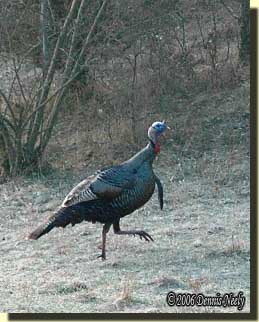
When the tom stopped, I could only see his body. Later, when I viewed the image, I could see his red head in the space between two cedar trees and his eye (see arrow) fixed on my lair.

“Utt…uttt.” Not ten minutes after I crested the ridge and took my seat I heard the first hushed clucks from the far side of the swamp. The utterance was sharp, deep in tone and sounded like it came from near the old apple tree—clearly an older turkey. The putts marked the bird’s progress as it crossed east to west, following a winding trail that skirted the wallow’s mucky wetness.

“Kee-honk, kee-honk, yonk, yonk…” The Canada geese sounded high up, well off to the east. A few geese answered behind me, out on the River Raisin’s lily-pad flats. With the geese music, the clucks and putts ceased, but my concentration held steadfast to the thicket where the trail broke from the swamp. A shiny black shape moved behind the gray tangle of dead branches. A red head passed through a small, sunlit space. My heart thumped.

Driven by cautious steps, the tom’s body herky-jerked right, fifty-paces distant. “Utt,” he clucked as he stood tall and gazed uphill. “Utt…” He turned away, pecked at the leaves twice, then started walking on the doe trail that hugged the swamp’s edge. I feared he saw me keeping still, but he showed no alarm. I rationalized that he might have sensed an intruder. After viewing the photographs there is no question he spied this woodland tenant, a would-be time traveler, two-centuries removed.

The Importance of Place

For the last six months, the majority of my research has centered on “captivity narratives:” the first-person accounts of young men and women captured by marauding Indian warriors and adopted into Native American society. These accounts are fascinating, but not without some problems—often as a reflection of the prisoner’s age, quality of treatment or personal agenda at the time the account was written.

A given captive’s odyssey usually covers large geographical areas. To add perspective for the reader, the author references the region’s major rivers, tributaries or known landmarks of that era. In order to follow the captive’s journey, the modern reader must pull out an atlas and try to connect today’s names with those of long ago—sometimes that works, and sometimes it doesn’t. The same holds true for many 18th-century journals and points out the importance of place in the telling of any tale.

Most narratives were written years after the fact, and some, like Jonathan Alder’s, note the changes in the landscape in hopes the reader might recognize “modern-day” landmarks:

“…They went on down Darby as far as Duere Mill, and there fell in with another company and came back up on Little Darby opposite of where Hampton is, and there built a fort and all moved into that. The land on which the fort stood is now owned by Alex Wilson…” (Alder, 153)

Earlier in his narrative, Alder attempted to set the record straight as to the proper names of some of the rivers near his Ohio-country home:

“The word Scioto is not the proper name for that river. Its proper name is Scinutu, but because it is difficult for the whites to give it the right sound, they call it Scioto. The Indians’ original name for Little Darby was Sycamore Creek, from the great quantity of sycamore trees that grew there. Big Darby’s name is Crawfish Creek…It was named Big Darby by the white surveyors who named it after an Indian of that name who they found living on it near its mouth…” (Ibid, 108)

Elsewhere, Alder tells of losing his thousand-acre homestead and how it was divided up into hundred-acre plots for the new owner’s children (Ibid, 142). Over time, the vast tracts of land that comprised the Old Northwest Territory suffered the same fate.

Our Dependence on Place Names

Today, traditional black powder hunters consider themselves lucky if they can engage in a simple pursuit on forty acres. If one’s moccasins trod a piece of ground for any length of time, certain places take on special meanings, just as they did for our 18th-century hunter heroes.

Place names anchor a tale to the land, whether it be told around a crackling campfire or scribbled on a journal page. The hunter’s personal relationship with a given place stirs golden memories, churns up harsh lessons, learned through a harrowing calamity, or elicits no feelings at all, other than a remembrance of passing close by.  Place names mark seasonal changes, the coming and going of game, or a noted natural feature.

The “big swamp,” “the tiny creek,” “the watering hole,” “the hog-backed ridge,” “the upper trail,” “the wallow,” “the old apple tree,” and two cedars, one with its dead branches hacked away all create reference points as solid as the surveyor’s blaze. That April morning’s tale can be related without such ties to the land, but in the future, perhaps others, my grandchildren I hope, might wish to retrace my footfalls as they seek to understand who granddad was and what he was about.

Winter tames the "nasty thicket's" roughness.My stories are filled with place names, just as Jonathan Alder or John Tanner or Meshach Browning’s exploits are. I don’t give the names a second thought; to me they represent fifty years of familiarity. A few years ago I started adding the names to the North-Forty’s natural features map at my son-in-laws’ request. Some of the place names made sense to them, like the “north or south islands,” “the narrows,” and “the white oak island.” “The yellow tree,” “fox hill,” and “Fred’s woods” took some explaining.

A few years ago, Andrew downed a fine doe that made it into heavy cover. He plunged in after the deer, and as he started dragging her out, he commented, “This is the nastiest place I’ve ever been.”

“There’s a reason this is called the ‘nasty thicket,’” I said, trying to stifle a laugh.

Daniel Boone’s Three Notches

In Delineations of American Scenery and Character, John James Audubon wrote of spending a night with Daniel Boone. “Colonel Boon” recounted how he was captured by Indians one night, taken to their camp, a few miles away, and how he made his escape.

“But, Sir, I felt determined to mark the spot, and walking to a thrifty ash sapling, I cut out of it three large chips, and ran off…” (Audubon, 113)

Boone continued by telling how, twenty years later, he was called upon to assist in verifying a land claim near the Green River in Kentucky.

“…[he] took for one of his corners the very Ash tree on which I had made my mark, and finished his survey of some thousands of acres, beginning, as it expressed in the deed, ‘at an Ash marked by three distinct notches of the tomahawk of a white man.’” (Ibid, 114)

The gentleman learned of Boone’s escape and that the famous woodsman marked the tree. He wrote to Boone and offered to pay all of his expenses in hopes he might be able to locate the marked ash tree.

“After some conversation, the affair with the Indians came to my recollection. I considered for a while, and began to think that after all I could find the very spot, as well as the tree, if it was yet standing…On approaching the place, I felt as if the Indians were there still, and as if I was still a prisoner among them.” (Ibid)

The pair camped for the night, and the next morning, feeling he needed witnesses, the gentleman left Boone at a promising ash.

“[He] returned, accompanied by three gentlemen. They looked upon me as if I had been Washington himself, and walked to the Ash tree, which I now called my own, as if in quest of a long lost treasure. I took an axe from one of them, and cut a few chips off the bark. Still no signs were to be seen. So I cut again until I thought it was time to be cautious, and I scraped and worked away with my butcher knife, until I did come to where my tomahawk had left an impression in the wood. We now went regularly to work, and scraped at the tree with care, until three hacks as plain as any three notches ever were, could be seen…” (Ibid, 115)

Perhaps twenty years from now my grandchildren will ask me to show them where I sat when I wrote that journal entry, perhaps…

Give traditional black powder hunting a try, be safe and may God bless you.
Posted in Turkey Hunts | Tagged , , , , , , , , | Comments Off on Hacked Away Years Ago

“Okay, Junior…”

A longbeard struts toward a clucking hen.“Gob-obl-obl-obl-obl-obl!”

“Kla-whoosh-BOOM!”

Silence hung over the clearing for as long as it took the white, sulfurous stench to drift down range and dissipate.  Before I got close, there was no question the fourth turkey was dead. I knelt beside the cardboard box, now riddled with #5 lead shot, and peeled off the target. The chrome stapler snapped four times. I rolled the box upright and shifted it in the grass so the next turkey’s head was square with the shooting bench.

“Ark, ark…ark, ark, ark, ark.”

The hen sounded young. I was maybe three paces from the pickup’s tailgate. I wiped the frizzen clean with the loading rag, then the flint, and finally the pan. I took care while measuring the powder charge, then selected two oak leaves, rolled them each in a ball and rammed them firm over the powder. The sound of shot rattling in trade gun’s barrel carries a sense of urgency, at least for me. With another leaf-ball packed tight on the shot, I started the short walk to the old picnic table I use as a shooting bench.

“Gob-obl-obl-obl! Obl-obl-obl-obl!”

“Okay, junior, see how you like this load,” I said in a whispery voice as black granules trickled into the pan. I thought of Wayne Lamson’s bench shooting lesson last summer, eased my grip on the wrist and steered the turtle sight with my shoulder. “Old Turkey Feathers’” muzzle clung to the turkey’s neck and hovered over the crossed lines. I didn’t have to wait more than a dozen seconds.

“Gob-obl-obl-obl!”

“Kla-whoosh-BOOM!”

Quiet fell as quick as the English flint did. The Northwest gun rested against the tailgate. Smoke curled from the muzzle and the touch hole. “Junior, you’re dead again,” I said before I got to the target. “This is the best so far.” My finger counted twelve pellets in the brain and spine areas and another twelve in the head and neck.

“Ark, ark.”

“Not yet, the last target’s not stapled.”

We Played ‘Cat and Mouse’

The turkeys and I played a game of “cat and mouse” that fine March afternoon. I only had time for a few shots. I wasn’t out of the truck when I heard the first gobble on the hog back. The hen teased before the tailgate thumped open. The gobbler called again while I filled the horn. In a while, I sat on the picnic table’s seat, thinking I had heard the last of the romantic banter. The sear was sliding out of the tumbler when he gobbled again. I laughed and had to regain my composure. Test patterning shot loads at the range is supposed to be serious business.

The hen clucked on my return trip to the truck with the target, which set the pattern for the rest of the shots. At first I called the boisterous tom “Mr. Longbeard,” but the old birds don’t usually call that much mid-afternoon, especially after a shot or two. I suspected he was a jake, and the real longbeard wouldn’t let him anywhere near the hens; I changed to calling him “Junior.”

The tom’s gobble, my shot, the trip to put out a fresh turkey head and the hen’s clucking stayed synchronized throughout the range test. Six targets eased my doubts about the leaf wadded shot column. I tossed the last target on the front seat, then started to stow the measure and shot bag. I hated to leave the clearing, besides, I still had time left for another four or five shots.

“Well, will you look at that, four round balls fell out of the ball bag.”

Fun Time Turns Serious

Curiosity is sometimes my undoing. Throughout deer hunting season I keep a cardboard box in the back of the pickup with a round ball sighting target stapled on it. I like to set it out at about 40 paces when I discharge a load that has been in the trade gun for more than a couple of days. I usually shoot offhand, convincing myself this is the best shot at a fine buck. I like to see where the shot impacts. That target was on the front seat, so I re-stapled it and set it out at 28 paces.

I don’t have many round balls left from the last casting, two dozen, if I’m lucky. I loaded the trade gun using oak leaf wadding, then took my seat at the bench. I waited for the usual gobble, but the spell was broken, which seemed fitting.

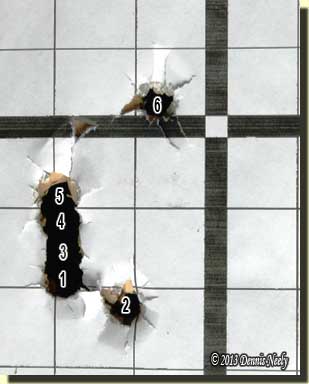
A sighting-in target showing the six shots.The first shot hit two inches low and to the left. I was a bit frustrated with myself, but I haven’t shot a lot in the last two years, either. I knew my sight picture was incorrect; from experience, I understood what was wrong. I made a conscious choice to continue with the incorrect sight picture in favor of seeing how well I could group.

The second was closer to the vertical aiming line and a tad lower, which I put off to not concentrating like I should have. After all, this was supposed to be fun. When the smoke cleared the third round ball’s hole touched the top of the first. The fourth walked up the line, and at that point, I decided to try once more.

The leaf wad seemed tighter when the wiping stick rammed it home, but I expected that because I was not wiping the bore between shots. The round ball hung up in the fouling and had to be tapped down, too. If I could squeeze off the shot in the same manner as the first four, I expected to stack another hole on the pile. I had to ease off and re-gather my thoughts and settle in a second time. The fifth shot continued the walk up the line, consistent with my expectations.

The allotted time was spent, but I couldn’t resist one more try. I have learned in such situations to just load and maintain a rhythm, keeping a close eye on consistency, of course. The forestock soon rested on the blocks, I maintained the incorrect sight picture, but took a new aiming point, one inch above center and two to the right. I had a hard time seeing the intersection of those lines, plus I had heat ghosts rising from the barrel. The sixth shot printed ½-inch high and ¾-inch left of dead center.

The fun was over, and I packed up. But, as so often happens, the impromptu round ball shots tweaked my curiosity. My goal has always been to master the use of natural wadding to the point of duplicating the accuracy our forefathers experienced. With that session, I feel I came a bit closer to that reality, but I also came away with more questions than answers. Such is the traditional hunter’s lot.

Give traditional black powder hunting a try, be safe and may God bless you.
Posted in Research | Tagged , , , , , , , , | 2 Comments

The Powder Horn Blew Up!

“I was very fortunate,” my friend said. His voice betrayed the emotional aftermath he was trying to contain. “You heard the powder horn blew up? I always stress safety. I can’t believe it happened, but it’s got a lot of people thinking and talking, so it’s a ‘positive accident,’ if it helps make people, other shooters, aware.

“We were at Laingsburg [Michigan] for the January woodswalk and almost through all the targets. I had my Southern Mountain rifle, it’s .50-caliber, my favorite rifle. I started to load and got interrupted. I didn’t know where I was at in my loading sequence, so I put a little bit of priming in the pan, held the muzzle down and touched it off. I held the rifle out in front of me, midway in my body, which I usually do. It had to be about 18 to 20 inches from the horn. That’s when I had a ball of fire on both sides of my body.

Weskit and shirt sleeves after powder horn blew up.

Ted Jayson photo.

“I had two shirts on, I think they were cotton, and a wool weskit [on top]. The weskit had a glowing red circle where it was burning. The shirts had a little bit of flame. I was shooting with four guys, and two started beating out the flames. They pulled out their knives and cut the sleeves off. I was very fortunate; just two small spots on my arm that got burnt, and they went away in a few days.

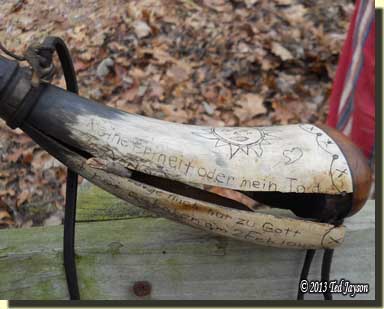
“I had maybe 300 grains left in the horn. The plug was in, I remember checking that. The horn had a hairline crack. It didn’t look all the way through. I put sealer along the crack. The rupture occurred along that crack.

“I’ve stayed awake nights thinking about it. About the only thing I can think of is a spark got into that hairline crack. I didn’t think it was all the way through or unsafe. I’ll never do that again, use a cracked horn, I’ll tell you.

“I’m right handed and left-eye dominate. I’ve had issues over the years with my right shoulder, so I started shooting left handed. It was a left handed gun. I find it more convenient to have the horn on my left side, and I like it high up. I’ve started putting the horn on the opposite side of my body.

“I carry a canvas possibles bag on my left, four or five inches above my hip bone, and my shooting pouch on the right. The heat from the explosion went through the canvas [of the possibles bag] and charred the patch material on balls in a loading block, and dried up the bear grease I had on the patches.

“A lot of guys glue the end plug in, and I’m not sure that’s a good idea. I don’t, I make it fit tight, then tap it in and set it with toothpicks. I think that helped release some of the pressure.”

Sifting Through the Aftermath

The ruptured powder horn, split in two, end for end.

Ted Jayson photo.

With any accident all of the details are never fully known or understood. The shooters around my friend were just as baffled with the situation as he was. No one has a good explanation, and I doubt anyone ever will. What we are left with is a life lesson that demands a little soul-searching on an individual basis, or at least that is how I view it.

One of the first considerations is to put the incident in perspective. My friend has 49 years of black powder experience, is an avid competitor and has fired thousands of shots. Add in the lifetime shooting experience of the folks on that woodswalk, plus all the other participants at matches around the state, and the number of potential situations grows while the frequency per shot of a horn blowing up diminishes. But I don’t feel that absolves me, or any other black powder enthusiast, from exercising due care.

I feel the same concern my friend does; that accident has eaten at me for many weeks. The day I received the first report, I checked my horn, Tami’s horn and the two “loaner” horns I have. Doubts kept gnawing so I put on my OptiVisor® and took a second gander.

As I told my friend, I fear a missing horn plug the most. I am a brush hunter. Being right handed, I carry my horn on the right, at the lower ribs and to the back, unless it works forward in the heat of a chase. I spend a lot of hours in the field, and on occasion a twig will catch the leather thong on the horn’s plug and pull it.

Over the years I have learned to check the plug and adjust the horn regularly throughout a sojourn. Another traditional hunter offered a solution to brush-pulled plugs: switch to a small day horn that can be carried in the shot pouch. The loaner outfit my son-in-law hunts with includes a small day horn, and I recently picked up a small flask for the pouch that goes with the fusil de chasse.

But that is not without possible problems: say the plug comes out and spills powder in the pouch? I have heard of this happening at battle re-enactments using paper cartridges. Some events require all shot pouches to have flaps that close over the pouch.

As another example, I remember being told of one living historian who kept tucking the “used” paper cartridge in his tri-corn so as not to litter the historic site. Loose powder collected in his hat brim and towards the end of the event it went “POOOFFF!”

Switching the horn to the opposite side of the body offers greater separation, but when I tried it a few years ago, I found the new placement very awkward and abandoned the attempt. I have since noticed several shooters follow this practice and their loading process seems fluid and unhindered. I think I will revisit this choice while on the practice range this summer.

Photos comparing the flash streamers.

Left: a pan-flash using 3fg for priming powder; center: 4fg priming; and right: streamers from a standard percussion cap

But subtle changes may have unintended consequences, too. In my quest for greater authenticity, I started priming from my horn (3Fg) some years back. With the horn accident fresh in my mind, I looked at a recent hunting photo that showed a brilliant pan flash and gained a new perspective. The image showed hundreds of orange “streamers” blown from the pan. I compared the image to several taken when I primed with 4Fg and saw a significant difference.

The granules in the coarser powder contain more charcoal solids than the finer powder and thus burn longer. The barrel’s backpressure blows the pan clean, scattering the still-burning granules and increasing the chances for disaster. Percussion caps show similar streaming embers, so this is not just a flintlock issue. I’m still mulling this over…

If nothing else, there seems to be a consensus of opinion that all horns, flasks or other powder containers should be inspected on a regular basis. At the first inkling of a defect, the container must be relegated to “wall hanger status” and not used further. Sometimes that choice is a difficult one, but safety overrules sentiment.

Opinion on gluing or not gluing in the end plug seems evenly divided. Given the cost of a powder horn, testing of the glue/no-glue theory will be expensive, but not impossible. Perhaps this subject needs the backing of either the MSMLA or the NMLRA, and I intend to pursue the matter further.

By its very nature, traditional black powder hunting depends of the safe handling, storage and use of a dangerous explosive compound. We all bear a responsibility to keep our minds focused on the seriousness of our hobby, even in the midst of the simplest of pursuits. In no way am I saying or implying my friend let down his guard for a moment, but what I am saying is even with diligence and a constant eye on safety, accidents happen. It is our job to minimize the probability. And as he said, his unfortunate experience has “got a lot of people thinking and talking,” and that’s a “positive.”

Give traditional black powder hunting a try, be safe and may God bless you.

Posted in Clothing & Accoutrements, Safety, Worth thinking about... | Tagged , , , , , , | 15 Comments

And Yes, I Answer!

“That should be enough,” I said, walking to the truck with two big fistfuls of oak leaves pressed against each other. A cold but gentle northwest breeze dislodged a few strays and sent them fluttering on their way. I dumped the right handful first, in the back corner of the truck box, then the left. The truck cap’s door snapped closed with a rubbery thud as the sun poked through grayish clouds.

If you must know, it was late March, and the year was 2013. There was no intent to travel back in time that afternoon, but I felt the urge once or twice. I had an hour or so set aside—well, rescheduled to be more accurate—for range time, I think the first such indulgence in over a year.

The official work plan said “turkey head pattern tests,” but given the allotted time I knew a dozen shots was all I could hope for. It didn’t matter. I grabbed the leaves driving to the range. I saw them windrowed against some deep grass along the two-track and knew they would be dry. I suppose it looked funny, but, as I said, it didn’t matter.

“Gob-obl-obl-obl-obl-obl!” As the pickup’s door swung open, I heard the gobbler. The tailgate wasn’t down yet when a hen answered: “Ark, ark, ark, ark…”

Another hen, farther to the south, chimed in as I uncased Old Turkey Feathers. “What a joyous afternoon. Thank you, Lord,” I whispered.

The powder horn, shot bag and brass measure took their usual places on the tailgate. The horn felt light, so I shook it. “Hmmm, you didn’t refill it after the last outdoor show,” I muttered to no one in particular. Before leaving the house, I had put a spare can of fffg in the truck, along with the tub of #5 shot, allowing for my usual absentmindedness. Without thinking, I started humming the theme to The Last of the Mohicans as the black granules trickled into the horn’s spout.

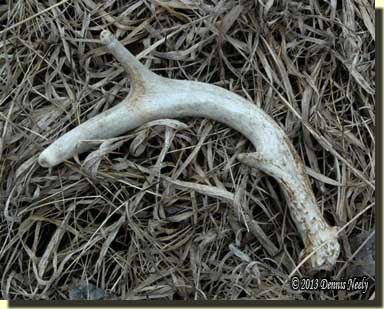
A three-point right-beam shed anlter.Gob-obl-obl-obl! Obl-obl-obl-obl!”

“Just keep teasing. Your day is coming Mr. Longbeard,” I said, walking downrange with a turkey-head target in my hand. “We’ll see how you fare in a minute.” Then, as I looked to my left, I spotted a shed antler in the grass, not fifteen paces away. The little three-point right-beam antler was an unexpected treasure. “Well, that makes the afternoon a success before I even get started. And I didn’t have to fire a shot.”

By now it should be obvious I talk to myself when I am alone at the range—and yes, I answer!

Success Comes with Reservations

Spring turkey hunting is still a few weeks away, but it is not too early to start making preparations. I hope to begin scouting this weekend, and maybe Tami will come along, too. She’s looking forward to the spring hunt, her first chance in three years.

That afternoon’s session was a holdover from a November turkey hunt where I took a fine young jake. I was only able to hunt a few times, so when he offered, Old Turkey Feathers accepted. But sometimes it seems success comes with reservations. I only found three pellets in that jake’s head and neck: one in the brain and two in the spine. The jake never moved, but the results ate at me over the winter.

I always check my birds, or any game, for that matter, for hits in the kill zone. I want to know how the Northwest gun performed, even after thirty years of faithful companionship. Of course, we have no control of the death bees once they leave the hive. The concern is born out of a deep respect for the game and a desire to affect a clean and humane kill.

In my quest for greater authenticity, I started using natural wadding materials about three years ago. A cloud of doubt hangs over any major change, especially when that change is driven by choice, rather than necessity. I wanted to retest the pellet distribution to make sure my perception of how the load was performing matched reality.

With the first target posted at 28 paces (25 yards), I followed the same loading procedure as last fall. I used the same powder charge, two oak leaves, the same shot charge and one oak leaf over the shot. That first target was the worst of the day, with ten hits in the head and neck, five in the kill zone. The best was twenty-four, with twelve in the kill zone. The average was fifteen/seven.

Achieving Valid Results

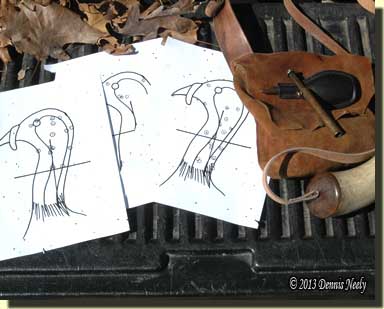
Targets on the tailgate, next to the shot pouch and horn.The March range results duplicated those of last fall, and that raises two important points in my mind. First, structured range practice is an absolute necessity for the traditional black powder hunter (and modern hunters, as well); and second, if the results are valid, they can be duplicated under similar conditions.

A few Saturdays ago, I covered the southeast Michigan Trade Gun Round Robin for a future black powder shooting sports article in Woods-N-Water News. Two competitors were shooting their trade guns for the first time. One smoothbore was newly completed and still in the white, the other was an older gun, purchased the week before.

We talked separately, but each fellow made the same statement that the gun was new and that he hadn’t been to the range yet. Both chose safe, conservative target loads, based on their experience, and neither had grand expectations beyond having a good time. The point I wish to make is that both of these individuals acknowledged that range practice is an integral part of familiarizing oneself with a given gun.

On the other side of the coin, I spoke with a French & Indian War re-enactor a while back who planned to hunt deer during Michigan’s December muzzleloading season with his Brown Bess. This living historian had never fired a round ball from the Bess, only powder charges in mock battles. “A fellow re-enactor told me what load to use,” he said, much to my consternation. I explained the importance of first-hand range experience, and to his credit, he then understood and accepted the responsibility he had to the game he intended to pursue.

Living historians and students of the wilderness classroom often fail to fully realize the need for clearly defining the steps they follow in their laboratory experiments. The goal is to experience the happenings recorded in an old journal, but to do so in a manner that can be duplicated over and over under similar circumstances with similar results.

If I am tweaking a load during range practice, I only change one component at a time and test the load multiple times. The reason behind this process is to create a consistent, efficient load that can be repeated time and time again—similar circumstances/similar results.

In the case of the March tests, I changed nothing, but instead, followed the same steps used the day I shot the jake, which were the same steps used at the range, two falls ago. The targets from both sessions are essentially interchangeable, thus duplicating the first findings. My doubt is not completely dispelled, and probably never will be. I intend to return to the hillside and look for other reasons for that particular load’s poor performance. And if need be, I may set up a portable turkey-head target and blast away, which sounds like fun. And yes, I will talk to myself through the whole process.

Give traditional black powder hunting a try, be safe and may God bless.

Posted in Research, Turkey Hunts, Wilderness Classroom | Tagged , , , , , , | 1 Comment

Ax Maker?

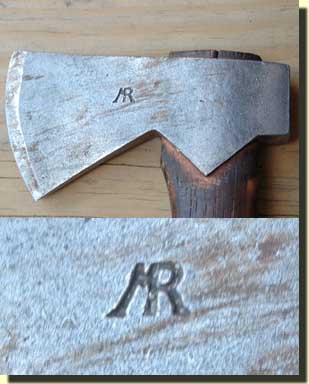
Can anyone identify who made this ax?

Polled ax with MR maker's touch mark. I am looking for background information on an ax that I acquired a few years ago. The previous owner knew little of the ax’s history.

The head appears to be cast steel, has a rectangular poll, diamond-shaped ears, an elongated tear-drop eye and what looks to be a combined “M” and “R” touch mark on the left face.

The head weighs about 10 ounces, is 4 5/8 inches long and has a 2 1/2 inch bit. Any help would be greatly appreciated.

Thank you,

Denny

dennis@dennisneely.com

Posted in Clothing & Accoutrements | 2 Comments