Perhaps Another Time

The neighbor’s rooster cackled. A slight easterly breath pushed the morning’s fog. A crow cawed, off to the west, near the nameless creek that meanders through the big swamp. Jerry’s rooster cackled again and again.

“Caw, caw.” What sounded like a single crow offered a timid response as it flew overhead. I looked up, but there was no yellow or lavender or bluish sky, no black bird, only thick, damp roiling fog. In a minute or so, two crows passed over, winging from the east, not making a sound, just above the cedar tree tops.

“Urka, ur, urkkk… Urka, urka, urrrr,” Jerry’s rooster crowed for the last time that morning.

Moisture dripped from the tips of the cedar boughs with nary a plop or a splash. “My hilltop floats on a cloud,” I scribbled on the folded page, “like a sea of grayish white. If it were not for the trees about me, firmly rooted in the earth, I could be a hundred or a thousand feet in the air—floating, drifting, weightless on an ethereal carpet…”
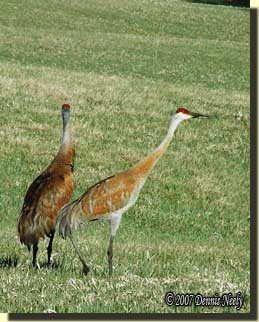
Two Sandhill cranes walking in a field.Well to the east two Sandhill cranes conversed as they approached a harvested cornfield, “Errooo, errooo, errool…” they cried. In my mind I saw their broad, cupped wings set, their necks stretched out and those long spindly legs take a few steps as they landed in the stubble. Two Canada geese bantered, and I knew the cranes were not the only ones gleaning a breakfast meal. My stomach growled, and I felt my innards twist.

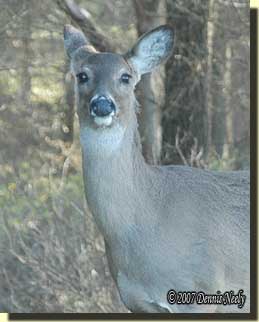
About ten minutes passed. A gentle breeze began to whisper through the cedar grove, and in another ten minutes the fog was gone. A doe and her two spring fawns lay under the maple tree that grows in the center of the cedar grove. As soothed as I by the mid-October fog, the three rested with drooped heads, barely awake.

A ball of grayish fur lumbered on the ground, to the right of the farthest fawn. The creature’s waddle was distinctive, a mature raccoon for sure. It stopped and started, searched right, then left, then ambled by the fawn on its way to the maple. It stopped short of the trunk and rummaged in the yellow leaves, perhaps intrigued by a damp morsel of food. The raccoon sat a spell, moved to the tree, then curled up with its rump neatly tucked in a space between two gnarled roots.

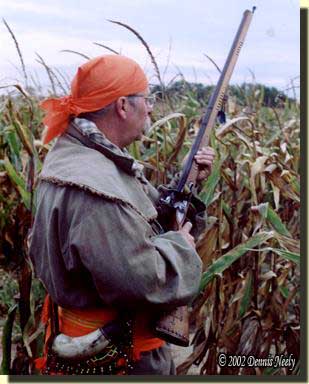
A wild turkey was the preferred choice that day, in the fall of 1794. A stout charge of shot waited in “Old Turkey Feathers” breech. The raccoon’s pelt looked prime, but the slightest move downhill assured a deep snort, flagging white tails and a quick, scratching beast destined for a limb crotch that afforded a less than optimal chance. I sat quiet, choosing instead to watch and wait. Perhaps another time…

No Mention of Raccoons

For a traditional woodsman, every moment spent in the glade is a cherished blessing. The thrill is not harbored in the fleeting instant the death bees deliver their morbid message, but rather the minutes and hours before or after. As on most outings, the cackle of a neighbor’s rooster, the caw of crows, the chortle of unseen Sandhill cranes or geese, the discovery of bedded white-tailed deer and an unexpected visit from a forest tenant define success, not the smoke and flame of a flintlock smoothbore.
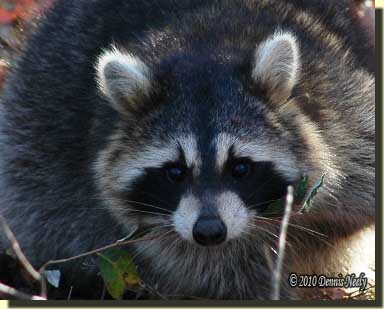
A raccoon looks straight on.In talking with other like-minded living historians, the preferred wild game of most traditional hunters is the deer, followed by wild turkeys and squirrels. For some of us, Canada geese, mallards, wood ducks, rabbits, pheasants, ruffed grouse, woodcock or quail fit in an extended list. Now and again, bison, bear, elk, moose, caribou, coyotes, fox and even crows get honorable mention. And not long ago, Jeff Parks wrote of looking forward to chasing spring woodchucks, but I don’t believe I have ever heard anyone mention raccoons.

This point hit home the other night as I studied Jonathan Alder’s narrative. In 1782 Alder was taken captive by Shawnee warriors. He was nine years old. A Mingo warrior, Succohanes, and his Shawnee wife, Whinecheoh, adopted Alder. The narrative spoke to his early experiences in his Native American family:

“The first work required of young Alder was to skin and stretch the pelts of coon. That kind of work was always done by the squaws and boys. At first, he was very slow and awkward, but soon became adept at the business. He says, ‘I soon learned to skin and stretch a coon or other skin as quickly and as neatly as any boy or squaw in the village’…In a few years he became very expert, and concluded he could beat any Indian he ever saw skinning and dressing anything, for a coon to a buffalo.” (Attributed to the Dr. George W. Hill version, Alder, 51)

“…During the summer, I worked in the garden, or patches as they were called, and during the fall, winter and spring—at skinning time—dressing and stretching skins. To do this properly was quite a trade…This was one of the few things Indians seemed to take pride in doing well, and they certainly had some reason for so doing. If the peltry were not properly prepared, there would be a reduction in price. I have thought the traders often took advantage of slight defects in dressing skins, more to make a bargain than from real injury. They examined every skin very carefully and appeared anxious to find some fault.” (Ibid, 52)

As so often happens while trying to sift and sort through historical nuggets, other passages take on new significance or add to the understanding of a just-read tidbit. If fall, winter and spring were described by young Alder as “skinning time,” then we are not talking about taking game with the same frequency as today—certainly not five or ten or twenty raccoons gathered over the course of a modern four-month fur-harvesting season.

After reading the passage, I retired to my research files. About a year ago, Gary Noblit, a fellow traditional hunter and outdoor writer, sent along a page from a 1940-era copy of “Michigan Conservation” magazine. The significance of the piece is a table listing “skins sent out from the post at St. Joseph, Michigan.” According to the table, during the fall of 1796 to the spring of 1797, the post traded for and shipped 22,032 raccoon skins, compared to 117 beaver, 2,899 bucks , 3,127 does, 280 fox, 517 mink, 5,091 muskrats and 436 otter.

The numbers give one pause, especially considering the non-mention of raccoons in modern traditional black powder hunting circles. One part of this is the shift in the balance of nature among game species, a second is the lack of dependence of raccoons for food, a third consideration is the lack of field time available to traditional woodsmen, and to some extent, a fourth cause is the disproportional importance placed on white-tailed deer, elk and wild turkeys by the outdoor news media.

Another contributing factor is the stigma placed on “coonskin caps” within the living history community. In the early days of the black powder revival, those who wished to pursue the primitive side of muzzleloading tried to copy the few historical records available. The distinction between “primary,” “secondary,” and “fictional” documentation was unknown at the time, so sources got jumbled up.

The 1940’s issues of Muzzle Blasts are filled with images of fur caps, and patterns, based on the best histories available and characters in classic novels such as James Fennimore Cooper’s The Leatherstocking Tales. Hollywood’s wardrobe choices for Davy Crockett and Daniel Boone just added insult to injury. The end result is that raccoon skin head gear is taboo in today’s re-enacting world, regardless of what the historical record says.

I remember being so excited when I came upon the brief biography of Josiah Hunt. Hunt was a soldier and hunter for Wayne’s Legion in 1794. According to the remembrances of T. C. Wright, Hunt was allowed to come and go at will, slipping through the Native forces that surrounded the fort. In thinking I might wish to emulate his dress, I recall the disappointment I felt when I came to his cap:

“He was an excellent hunter. In the winter of 1793, while the army lay at Greenville, he was employed to supply the officers with game, and in consequence was exempted from garrison duty. The sentinels had orders to permit him to enter and leave the garrison whenever he chose….the parties in quest of him [the Native peoples of the Miami Confederacy] had often seen him—could describe the dress he wore, and his cap, which was made of a raccoon skin, with the tail hanging down behind, the front turned up and ornamented with three brass rings…” (Howe, 698-700)

Thus, I suppose it is little wonder raccoons receive no mention these days…

Give traditional black powder hunting a try, be safe and may God bless you.
Posted in Clothing & Accoutrements, Living History, Turkey Hunts | Tagged , , , , , , , | 2 Comments

What’s That Bird?

Standing corn bordered the swale hole. Tall cottonwoods flourished in the outer edges, amongst the sedge grass and raspberry tangles. The oldest tree, at the swale’s southernmost tip, was dead. Two upper branches tented against the trunk. Slabs of bark littered the great tree’s base. One bark piece dangled in the evening’s cool southwest breeze.

The air smelled sweet and moist. I don’t recall stepping over time’s threshold or passing into a specific year from long ago. This was a late-October pheasant hunt, early on in my traditional hunting. At that time, I don’t remember if I fully understood the mechanics of time travel. I doubt I had a hunt scenario, either. That sojourn’s goal was to experience life in the late 18th century while putting fresh meat on the table.

A traditional woodsman at the edge of a cornfield.Two rows from breaking into the open, a cottontail rabbit bounded from a patch of dried grass. The Northwest gun’s hammer clicked to attention. The muzzle swung right, knocking over the tassels of the first row’s short cornstalks. The flat, brass buttplate slammed into my shoulder. My eye found the turtle sight, but the rabbit vanished in a sea of amber grass, and that was that.

I eased the anxious English flint back to half cock, then stalked the rabbit’s lair. My left elk moccasin pushed away the cover grass. I saw the scratch marks in the dirt where the rabbit’s hind legs pushed off. My mouth felt parched, my tongue sticky, my nose stuffy.

To the east, mixed pasture grasses covered a steep hill that slid into the little swale’s far edge. As I stood between the corn rows, I decided to work the semi-dry swamp from north to south. A dozen footfalls later, I emerged from the corn, walked around a cottonwood and began my usual zigzag dance.

Hunting pheasants or bobwhite quail without a dog is difficult. In my youth, I learned an erratic course mixed with pauses, about-faces and sudden changes in direction unnerved the birds’ confidence and sense of security. I pursued such a course, and in the middle of the swale hole a hen pheasant flushed wild. “Hen!” I shouted in my mind as the sear clicked and the trade gun again settled against my shoulder.

With the smoothbore at full cock, I stood for a long five minutes, or so. With no second flush, I set the hammer at half cock, took an about face, veered left, paused, then turned left again. My elk moccasins took three or four ragged steps. I stopped, and as I did, a second hen exploded from a clump of canary grass. Feathers floated in the air. With the first glimpse of that bird’s head, my body relaxed. I watched as the hen set her wings and coasted into the middle of the cornfield, back to the west.

I chose to wait a bit longer. As I mulled over the location of the two hens, I realized I had not spoken the hunter’s prayer. The western tree line was ablaze with oranges and lavenders as I whispered, “A clean kill, or a clean miss. Your will, O Lord.”

“…our birds are all gone, now.”

This past weekend, I had the pleasure of tagging along on the third leg of the Southern Michigan Trade Gun Round Robin, held at the Lansing Muzzle Loading Gun Club in Laingsburg, Michigan. Six clubs each host a leg of the Round Robin. The shooting match is for trade guns only, so the talk of the day, both good-natured kidding and serious historical conversation, centered on smooth-bored trade guns. I was in heaven.

The shoot format is the typical trade gun woodswalk that includes round-ball steel clangors, clay birds, knife and hawk throwing, and fire starting. While competitors waited to try their luck with the clay pigeons, I spoke with a gentleman who said he only hunts deer with his trade gun. When I asked if he hunted birds with his Northwest gun, he expressed interest in turkey hunting, and then, as an afterthought, he said, “I used to like to hunt pheasants, but our birds are all gone, now.”

As the gray-haired shooter stepped to the line for his third bird, I started thinking about what he said in the context of my own frustration over the decline of our local pheasant population. On the drive home, my mind tied together two other similar occurrences with some local history.

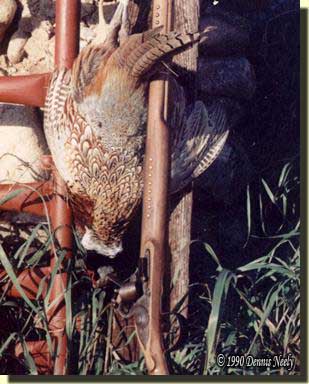
A rooster ring-necked pheasant taken with a Northwest trade gun.The first instance happened in mid-February, at the Deer & Turkey Spectacular, held at The Summit in Lansing, Michigan. Tami and I had our 1790s hunter’s camp set up, complete with several photo albums featuring an array of traditional black powder hunting pictures. On three occasions this year, young people leafed to a photo of a ring-necked pheasant and asked, “What’s that bird?”

The second occurred a few days before the Round Robin. As I started to reread Jonathan Alder’s journal, I came upon a familiar passage, but viewed it in a different way.

In 1782, Jonathan Alder, a lad of six, was captured near his family’s isolated cabin in Wythe County, Virginia. His brother, David, was killed and scalped. With a buffalo tug tied around their waists, Jonathan and another captive, Mrs. Martin, were led northwest toward the Ohio country.

After traveling for seven days, the captors came to the headwaters of the Big Sandy River, built hickory bark canoes and started paddling downstream. At the Ohio River, the Indians crossed to the north bank, chopped holes in the canoes and set them adrift.

“About the second or third day, they killed a large buffalo…” (Alder, 38)

At this point in his narrative, Alder tells how the Ohio Indians dried the buffalo meat. I’ve seen this passage used as a primary “how-to” for jerking meat. But as so often happens with instructive passages, living historians focus on the step-by-step process and read over an interesting tidbit of information: buffalo roamed southern Ohio, between Chillicothe and Huntington, West Virginia, in 1782.

As I drove south from Lansing, my thoughts shifted to the written remembrances of the early settlers in Jackson County, not that far from the headwaters of the River Raisin. In 1837, Mrs. M. W. Clapp wrote of the game seen in the area near Hanover, Michigan:

“The wild deer would gambol over the plains, and the turkey was also seen. Now and then a massasauga put in an appearance, and the wolves and screech-owls would sometimes make night hideous.” (History, 204)

In that same era, W. W. Wolcott told of bears near Tompkins, in northern Jackson County:

“On the way up they crossed a number of fresh bear tracks in the snow; plenty of deer, but got nothing, as their guns were wet.” (Ibid, 206)

Bears, elk, wolves, and for a while, turkeys, disappeared from the River Raisin’s bottomlands, and the historical record offers a reasonable time table for those disappearances. Some settler recollections, penned in the last half of the 19th century, recognize the demise of these species with a nostalgic sense of loss.

Pursuing ring-necked pheasants within a 1790-era historical simulation is not period correct, because pheasants were not introduced in Michigan until March of 1895. The first legal hunting season was in 1925.

If habitat restoration initiatives fail, it is quite possible my son-in-laws and I will be the last to hunt pheasants on the North-Forty. My grandchildren may never have that opportunity. That reality hit home north of Jackson; perhaps the day has come and gone. If that is the case, then like those local settlers, we can only speak or write of fond memories and lament, “I used to like to hunt pheasants, but our birds are all gone, now.”

My course zigged and zagged. Twenty-five paces ate up the remaining cover, save a purple tangle of raspberries to the east of oldest, broken-down cottonwood. I had no intention of wading through the briars, but instead circled them, north to south. A half-dozen steps into the pasture grass to the east of the raspberries, a red-wattle surrounding a panicked yellow eye rose straight up, propelled by frantic wing beats.

“Kort! Okk okk,” the rooster cackled. Cocked and mounted, the Northwest gun’s muzzle chased the ring-necked pheasant’s short tail feathers. The bird’s flight flattened and angled to the west, left to right. The turtle sight passed through the fowl’s body, through the iridescent green head, and when it reached the beak, the hammer fell.

“Kla-whoosh-BOOM!”

The rooster’s head pulled back, then went limp. The bird tumbled head over tail, thumping down four rows into the cornstalks. I ran through the smoke cloud at a slow lope, all the while keeping my eye on the pheasant. Before I reached the first row, I returned to a quick walk, whispering a prayer of thanksgiving for a joyous evening and food for the table.

Give traditional black powder hunting a try, be safe and may God bless you.
Posted in Pheasant Hunts, Worth thinking about... | Tagged , , , , , , , | Comments Off on What’s That Bird?

“Testify to what you did…”

A young doe ran by, its white tail up. It did not appear alarmed, just in a hurry. A pleasant breeze caressed my face, coming out of the south, same as the deer. The faint scent of oak leaves and an impending rainstorm filled my nostrils. I squinted to avoid eye contact, confident the hemlock’s upturned boughs concealed my human form. The deer’s ears offered the only sign the animal was testing the forest. When it drew even with the hemlock it slowed to a steady walk.

This deer’s shape was fuzzy and gray, distorted by almost closed eyes. As I watched, I thought better of the situation. My thumb found the Northwest gun’s hammer; the smoothbore’s muzzle eased a bit downhill; and when the doe glanced east I pulled my left knee up to provide a steady shot at a trailing buck. Sequestered within the evergreen lair, my mind sifted through the death sphere’s potential paths.

The doe curled to the northeast, removing any chance of passing through my deadly fragrance. I lost track of it after the crooked cherry tree, choosing instead to watch the cedar-covered hillside where it first appeared. Hidden amongst the cedar trees was a string of rubs and two scrapes, and that deer seemed to follow the rub path. “A buck cannot be far behind,” I reasoned.

A young anterless deer pauses at the isthmus.Turkeys bantered and squawked across the nasty thicket, on the west face of the ridge. While I listened another antlerless deer walked down the hill and struck the same trail as the first. It sniffed the ground, loped to the crooked cherry, then sauntered in the same direction as the first.

Next, a skittish old doe crossed the narrow isthmus that separates the nasty thicket’s two lobes, angled up the hillside and stopped thirty or so paces to my right. Her spring fawns wandered along, an abnormal distance behind.

The last fawn, a little doe, stood and stared at the hemlock. Seeing her attentive concern, the old doe turned about and surveyed the hillside. The young one half-sniffed, half-snorted, relaxed her haunches and scampered after the button buck. The three milled about, scrounging for acorns, then disappeared over the rise.

Constructive Assistance vs. Caustic Criticism

As a single turkey uttered a soft “ark, ark, ark, ark…” on the ridge, my fingers fiddled with the brass tacks on the trade gun’s forestock. The domed tacks were not period-correct for that 1794 traditional black powder hunt. They have drawn criticism from astute living historians, and as so often happens, one discovered fault seems to spawn closer examination.

“Old Turkey Feathers’” history-based lineage is suspect, and I know that. I fall out of character now and again and pick the gun, or some other accoutrement, apart—I am my own worst critic. But thirty-plus years ago, trade guns were an oddity, appreciated by Charles Hanson, Jr. and promoted by Curly Gostomski, Ray Woodall and a very few others. There is a reason they were called “gas pipes” in the early 1980s. The majority of trade guns in existence at that time sported brass tacks based on museum examples. In that era accepted research and documentation techniques weren’t what they are today. On the one hand, that is a tribute to the advancement of the hobby, but on the other, it is a feared bane for folks like me.

Now I have changed with the times and worked diligently to improve my kit using a balance of primary source documentation, surviving artifacts and period illustrations or paintings. But traditional black powder hunting is, after all, a hobby, and as with most hobbies, limited time and resources often dictate how far an individual can take that hobby.

In the case of limited time, faced with a choice between spending an hour or two in the woods hunting or staying home and working on a new trade gun, the hunting trip will always win. Although well-worn, I own a Northwest gun that has served me well and is an accurate and productive arm.

Regarding limited resources, right now I just can’t afford the parts to build a new gun. For less money I can clothe a whole new woodland persona, which interests me more at this point. I find fleshing out this new character fun and exciting, a close second to the exhilaration and enjoyment I get from hunting. The adrenalin rush is similar to that when I first started my journey back to the 1790s, and I am discovering that those feelings are recharging my enthusiasm.

A valued friend, I’ll call him “Joe,” emailed me the other day. The emotion in his words was evident. “I have a question and need an honest answer,” he began. He questioned whether his kit “looks right and has what it takes” to properly fit within the framework of his historical simulations. Like me, Joe has worked to improve his living history impression, but has used the same outfit “for a long time. My clothing is not hand-sewn but is made by people who have good background in what they do, and every faded and stained piece has been, I think, honestly earned.”

A few sentences later, Joe got to the root of his fears: he has witnessed the brutal criticisms other living historians have weathered in recent days, especially on the online forums. In the last year, the caustic comments have spilled over to many living history venues. I see the criticisms forcing dedicated living historians to question their every choice, and in few instances, this close scrutiny is driving folks from the hobby.  As a society, we seem to be losing all sense of civil decency in our daily discourse.

Because I write about living history, specifically traditional hunting, I share Joe’s fears, but about ten times worse. None of us want to be judged and found wanting, especially when our leisure activities are the brunt of the scrutiny. I find myself expending conscious effort to reign in the fear of “not getting it right,” because if I don’t, the trepidation cripples the mental attitude so necessary for an enjoyable time-traveling experience.

Yet, I do not want my words or example to lead someone astray or appear to criticize their portrayal. A long time ago, a respected attorney advised me to “testify to what you did, what documents you relied upon and how they affected or shaped your actions.”

Fortunately, traditional black powder hunting, by its very nature, is a solitary endeavor—a one-on-one encounter with the wild and its creatures, framed in the past. As I told Joe, this hobby is supposed to be about having fun, putting wild game on the table and advancing the participant’s knowledge and understanding of his or her chosen time period—not an ongoing source of angst and gut-wrenching fear.

Dennis sitting on a bench in front of the guard house.As fellow traditional hunters, we must recognize that each participant is at a different point on his or her journey back in time; some folks will always be ahead of you, and some behind, and that fact will never change. What does change is our knowledge and understanding of our own historical persona, and each unearthed nugget should advance that understanding, not set it back. And even then, traditional hunters must realize that any hunting scenario based on a bygone era, can only approach the circumstances of that era, but never achieve a 100-percent duplication.

I believe each living historian is responsible for his or her own impression and the level of authenticity that portrayal achieves. If an individual discovers the tacks on his Northwest gun, for example, are not right, and he possesses the resources to correct the oversight, then he should consider the upgrade based on his current best understanding of what constitutes a true representation. To buy or build a new Northwest gun because someone simply states “that’s not period-correct,” is no different than buying a trade gun because “you like the way it looks.”

“Yes, your kit ‘looks right,’” I wrote, to reassure Joe and dispel his fears. “If you traveled back to Fort Michilimackinac in 1776, and I was sitting on a bench, I doubt I’d pay much attention to your comings and goings.”

Take any criticism with a bucket of salt, be safe and may God bless you.

Posted in Deer Hunts, Living History, Persona | Tagged , , , , , , , | 4 Comments

Feeling Small

November’s last day broke with a violent rainstorm. A steady drizzle and a high wind rendered a morning hunt impossible, but by late afternoon the tempest subsided. The air was late-March warm; the mixed stench of night crawlers, stale urine and rotting deer pellets filled the cedar grove. Water dripped. Winter moccasins squished. The year was 1792.

The cedar grove seemed barren of white-tailed deer, yet the evening’s still-hunt progressed at a slower pace than normal. On the one hand, I fought the rain’s aftermath, and on the other, I knew the deer would soon pass through the cedars on their way to the night’s frolic. The wind slowly shifted to the north and caressed my face. At the broad mouth of the big gulley I chose the lower trail.

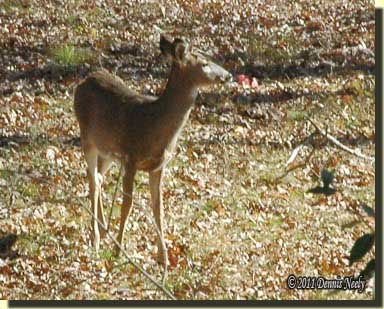
The deer glanced about, looking for danger.In time, the still-hunt made the great cottonwood. During that pause, three deer, a doe and two fawns, appeared at the edge of the big swamp. One of the fawns took two steps into the clearing, paused and looked about. The second fawn ran past the first. I think the old doe gave a soft, admonishing bleat. The brash youngster stopped stiff-legged, laid her ears back, then surveyed the clearing.

When the three all nuzzled the ground, I sat where I stood. The soaked ground damped the seat of my knee breeches, but in the unseasonable warmth I tolerated the inconvenience.

Despite the eagerness of the fawns, the old doe showed reluctance to cross the small, grassy clearing. She turned southwest, flicking her tail, rolling her ears and bobbing her head up with frustrating regularity. She was never more than two bounds from the fen’s thick, tangled grasses.

Another trio walked around the far knob and milled about, venturing farther into the open, and in a short while, two more met the first three. The cautious old doe settled down a bit, but still displayed a higher level of concern than the others. The eight browsed with a synchronized vigilance; at least one deer’s head was up and watching all the time. An opportunity for me to slip away was never offered.

Judging from the demeanor of the eight, a buck was not expected soon. I understood that that might change in an instant, but that understanding was more folly than reality. Trapped with nowhere to escape, I was left to wallow in my own thoughts. I felt the skin on my rump wrinkle, and the sopping breeches became an almost unbearable irritation.

The does never crossed the clearing on that November evening in 1792. Much to my relief, the dense, gray clouds ushered in an early nightfall. Just at dark the eight went their separate ways, fading into night’s abyss as good deer do, never coming within the Northwest gun’s range.

I scrambled to my feet and sloshed homeward, knowing I must run the cedar grove’s gauntlet and take a stout switching from unseen dead branches, all the while feeling small.

Pursuing a True and Meaningful Re-creation

Traditional black powder hunting can be brutal, sometimes in a physical sense, sometimes in a mental sense. On that particular evening, the last day of Michigan’s regular firearms deer season, the wet knee breeches did not qualify as “brutal,” either in a physical or mental sense; they were a minor irritation that has been overlooked many times before.

Finding myself trapped, alone with my thoughts, was not brutal, either. For me, it is quite commonplace to spend the last evening of a hunting season in a state of melancholy as I reflect on events of the days or weeks prior. Thus, when I started reading George Nelson’s journal, I experienced an unexpected pristine moment, a feeling of kinship with the young XY Company clerk:

“Why then do I write? First, it is to while away some moments & dissipate some thoughts of melancholy that frequently oppress me…” (Nelson, 31)

For lack of a better word, the “brutality” of that evening was a tremendous feeling of smallness that swelled up within me as darkness fell. Perhaps it was triggered by the immensity of the towering cottonwood, or the realization that I was powerless to will the deer closer, or the discouragement of not knowing what action Josiah Hunt or Meshach Browning or Jonathan Alder might take in such a predicament. I don’t know, and expect I never will. That feeling of smallness just happens.

In those moments when I feel small, my mind seems to run with a scary abandon; they have come with some regularity of late. I started researching a new persona a few months ago, and that is a contributing factor. On the one hand, I find the opportunity exhilarating, and on the other, terrifying. Stepping out from the safety of years of familiarity injects a sense of excitement into the endeavor, and at the same time, today’s dependence on solid, primary documentation and a stronger emphasis on authenticity elicit an overwhelming fear of “getting it wrong.”

I felt such a fear at the Battle of Frenchtown. As Lacroix’s infantrymen marched down a street in Old Frenchtown, my mind slipped back in time, which was the hoped-for-intent of the commemoration’s organizers. From my alter ego’s perspective, I saw folks from the future, not just Capt. Lacroix’s militia or the Kentucky volunteers, but the American Army of the Northwest Territory, the British regulars of Colonel Proctor and the women and children of Frenchtown. I realized I lacked the knowledge and expertise to determine if these 19th-century time travelers presented a true and meaningful re-creation. I felt small, left to trust their judgment on the matter.

A mid-battle volley of musket fire at the Frenchtown fence.An hour or so later, when I watched a mid-battle volley of musket fire, I found myself focused on one re-enactor. His linen hunting shirt, black felt hat and overall kit matched that of the others in his unit. He fumbled loading his musket and fired out of sequence with the officer’s commands. Just before pulling the trigger, he raised his head from the walnut stock, turned away from the firelock, closed his eyes and pursed his lips. And that might have happened in the real battle, too.

It appeared this re-enactor was newly arrived on the path to yesteryear, yet he was doing his best to present a true and meaningful impression. I suspect he succeeded with the vast majority of onlookers, but his obvious enthusiasm, his commitment to the historical moment made me feel small again, twice in one day.

For me, there is always an equal and opposite reaction to these feelings of smallness. In the case of the wincing militiaman, I saw myself many years ago, when I first started out. I realized how far I have progressed on the path to yesteryear, and how far I want to go. His enthusiasm recharged my enthusiasm, his commitment firmed my commitment.

I believe this feeling of smallness is a manifestation of our human frailty, a fear of failing or falling short in our humble endeavors. This is natural, but we must strive to keep it in context or it will stifle or perhaps destroy our travels back in time.

But feeling small is also representative of the living historian’s constant process of critical self-evaluation, and there is where the brutality lies. We are, after all, our own worst critics, but that criticism must be constructive and lead to a betterment of our individual impressions and hunting simulations. The key is to delve into our shortcomings and emerge with a new sense of excitement, enthusiasm and commitment to pursuing a true and meaningful interpretation of the past.

Give traditional black powder hunting a try, be safe and may God bless you.
Posted in Deer Hunts, Living History | Tagged , , , , , , , | Comments Off on Feeling Small

A Joyous Chorus of Hound Music

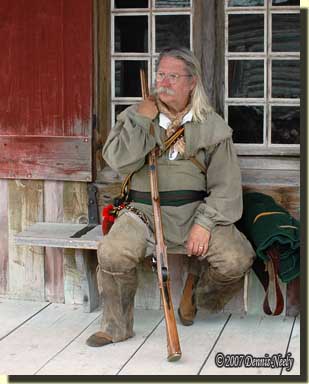
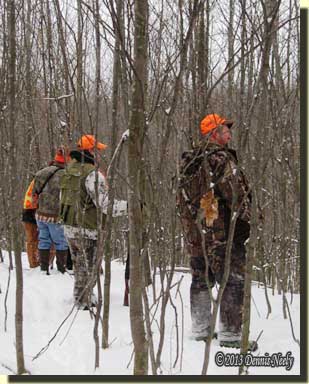
Seven woodsmen trudged up the long grade. The blazed trail cut through a young, regenerated forest. At seventy paces, the tight-growing maples, beeches, cherries and oaks looked like an impenetrable gray palisade. Before the first pause, the ragged column strung out. In my usual manner, I guarded the back trail, and grew concerned as the space between us hindered a common defense.

The trace narrowed, then turned to the southwest. Snow clung to slender branches and fell at the slightest disturbance. A wool mitten, gripped about the Northwest gun’s breech, protected the firelock’s prime from the inevitable crystalline cascades. Up ahead, three young beagles crisscrossed between Andy Duffy and Rick Aube, the lead dog handlers. Bufford and Zack, the oldest hound, nosed the column’s right flank, weaving in and out of the saplings.

Aube, Parker and VanHouten watched the beagles work.Deeper in the glade, days’ old snowshoe hare tracks crossed the trail; the beagles paid little attention as they looped to and fro. At the second pause, Aube stood with Bill Parker and Jacob VanHouten on a ridge crest and watched Nolan Beadle and Chris Case circle south in search of Buster and Bailey, a fine brother and sister pair of five-year-old beagles. A hound bayed to the west, then shut up. Spirits as quick as they soared; a rousing chase that was not to be.

The three woodsmen descended the hillside, striking off for a swamp Rick Aube knew about. “Andy’s headed that way with Bufford, Maggie and Zack,” he said.

The hill’s grade appeared too steep for smooth-soled buffalo-hide moccasins; I headed due south, following a gentler slope, then cut west and joined the other hunters at the swamp’s edge. VanHouten concurred with the wisdom of that decision.

As we wandered through the saplings, the hounds bellowed once or twice, but again, a chase never materialized. After conferring, the hunting party turned back. Just east of the swale hole, Parker, Aube and I paused; Duffy, Beadle and Case eased east; and VanHouten split the center.

Caught up in a wilderness moment, Parker and I commented on the magnificent beauty of this piece of ground. Rick Aube concurred while two beagles sniffed around us. As we continued our hushed conversation, a snowshoe hare bolted from under a deadfall, not fifteen paces distant. The hounds bellowed. My eyes lost the streaking hare in the white snow and close-growing saplings, only to glimpse it again thirty or so paces away.

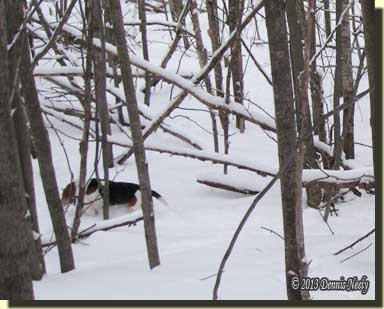
A beagle baying after a snowshoe hare.Well ahead of the hounds, the hare circled south, ran beside a large, fallen tree trunk, then ducked under a black shadowy space beneath the snow-covered hulk. The other three beagles joined the chase. A joyous chorus of hound music echoed in the glade as we watched the dogs sort out the trail on the far hillside.

Anticipating a future shot, I glanced down at the smoothbore’s lock with the intention of checking the prime. An upsetting clump of snow rested on the frizzen and against the Northwest gun’s browned barrel. I brushed it away in anger, not at the circumstance, but from frustration with myself. There was no knowing how long the treacherous glob perched; I could not remember covering the firelock since before we crossed back over the swale hole.

In disgust, I snapped the frizzen open, rolled the trade gun and spilled the precious gunpowder beside my right moccasin. I grabbed my shirttail and wiped away what little water I could see. As I picked the touch hole with a priming wire, the hounds sang their woodland aria. The disaster for the day, at least from my perspective, was yet to come.

A Classroom Experiment Gone Awry

On that pleasant Saturday in early February, I found it impossible to slip time’s shackles. In truth, I didn’t expect I would, but that did not deter me from experimenting in the wilderness classroom.

Each winter members of the Michigan Outdoor Writers Association attend a “winter rendezvous,” a weekend set aside for good fellowship, craft improvement and a heavy dose of the outdoor world. A long-standing tradition for the winter gathering is the annual “MOWA Rabbit Hunt.”

Earlier this month, Tami and I traveled to the Pere Marquette River Lodge, located south of Baldwin, Michigan, on M-37. The lodge served as the hub for the weekend. On Saturday, some MOWA members explored the area’s cross-country ski trails, others floated the Pere Marquette River, fished for pike through the ice or called coyotes in the nearby state forest. Andy Duffy, Jacob VanHouten, Bill Parker and I pestered snowshoe hares in the Pere Marquette State Forest in Osceola County.

Andy Duffy organized this year’s hunt, enlisting the help of Rick Aube, Nolan Beadle and Chris Case and their beagles: Bufford, Maggie, Buster, Bailey and Zack. At the end of the morning hunt, I felt it best to unload “Old Turkey Feathers,” so without thinking about the snow glob, I asked if anyone wanted to shoot a trade gun. Andy stepped up, shouldered the Northwest gun and cocked the hammer. The pan flashed, but the charge failed to ignite.

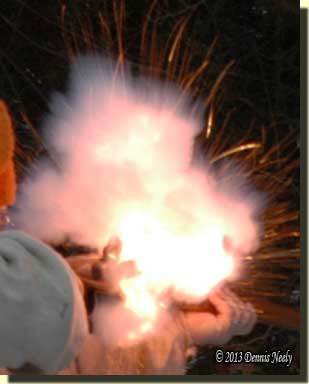
Sparks fly as the flintlock ignites.In hindsight, I should have stepped off to one side and discharged the load myself, then reloaded for others to try. Following that course, there is no question the trade gun would have fired every time. But I didn’t, and I feel the two flashes reinforced “the unreliability of flintlocks” myth among those watching, despite my explanation of the snow glob. Again, from hindsight, I fear this was a huge mistake.

Since last fall, one of the ongoing experiments in my wilderness laboratory has focused on keeping the priming powder dry during damp or wet hunting situations without the use of a cow’s knee. While researching a new persona, I started questioning my reliance on a greased leather lock cover, especially with regard to the Northwest gun in the late 18th-century lower Great Lakes region.

I have several references marked that refer to the use of a leather lock cover or a greased patch, but all of them involve a rifle, none with smoothbores. In discussing this with other traditional black powder hunters, I find that some feel a greasy rag or scrap of cloth was used, but no one has definitive documentation for this practice, either. Several of Cornelius Krieghoff’s mid-19th-century winter paintings depict something wrapped around the lock area of the arms carried by Native hunters and trappers. The time period and location are incorrect for this study, but nonetheless intriguing.

Throughout my journey back to yesteryear, I have always embraced failure as a positive—something akin to: “Now I know that won’t work.” Safety is always the first priority, and with that in mind, I always try to consider and anticipate the consequences of any given experiment before commencing. No matter how small or seemingly unimportant, each result is weighed and analyzed, compared to known documentation and considered in light of other results. Sometimes the results confirm the hypothesis, but most times they lead to more study.

When I glanced down and discovered the snow clump on the pan cover, I viewed the incident as failed diligence on my part and another stepping stone toward a period-correct solution. After all, I am used to taking such little failures in stride and assimilating them into a larger mosaic. And in the back of my mind, I knew there was a high probability the gun would not fire.

After much thought, the point that keeps recurring is that I need to do a better job of selecting the appropriate classroom setting for my experiments. For me, the opportunity to hunt with others, both modern and traditional folks, is so infrequent that I don’t, or didn’t, consider the ramifications of a failed experiment. That will change, and I hope my shortcomings might be a lesson to other traditional black powder hunters.

Give traditional black powder hunting a try, be safe and may God bless you.
Posted in Rabbit Hunts, Wilderness Classroom, Worth thinking about... | Tagged , , , , , , , | Comments Off on A Joyous Chorus of Hound Music

Hunger Knows No Preference

Morning clouds dispersed. Four wild gobblers gleaned the cornfield, beyond the hayfield, north of the homestead. A brilliant early afternoon sun cast a short shadow from the great oak. The night before’s fresh snow dripped from the eaves. The cabin grew too warm, the space too confining. “Answer the call, go to the woods,” my wife urged in a knowing tone.

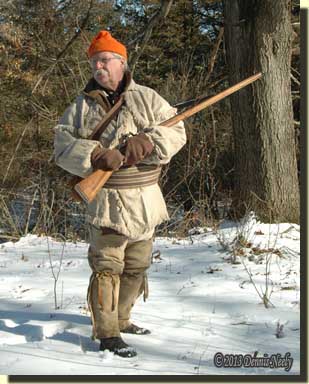
I did not argue. The elk center-seams fell beside the stool; wool knee socks cushioned lined winter moccasins. Hunt-stained buckskin leggins, an extra osnaburg trade shirt, a wool shirt and the linen hunting shirt came next, held snug with a woven sash. The wiping stick thumped on the Northwest gun’s breech, to confirm my recollection. The horn and pouch nestled on my right hip. I pulled the knit cap on after closing the back door.

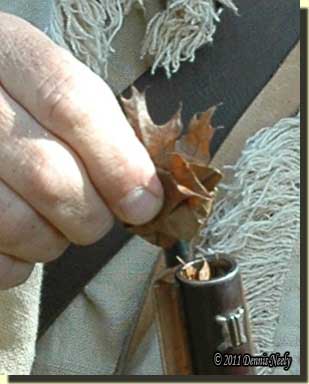
The air smelled fresh and damp. A brisk jaunt put me at the edge of the big woods. A proper measure of gunpowder tumbled down the trade gun’s bore. A few steps to the left, I tugged a handful of white oak leaves from a low branch; two fell to the melting snow. I tore three leaves, discarding the damp stem-end in favor of the dry body, stuffed them in the muzzle, then tamped the wadding tight over the powder. Shot rattled; a single leaf held the death bees firm. With my thumb over the horn’s tip, a sprinkling of gunpowder primed the pan.

While loading, the historical me took charge and waltzed through time’s portal. It was early February and I found myself standing in the Old Northwest Territory, three hills east of the River Raisin. The year was 1795. My buffalo-hide moccasins whispered south, bent on the crease between the hardwoods and red cedar trees. Fox squirrels or cottontail rabbits, it made no difference; hunger knows no preference.

At the second pause a red-tailed hawk circled high above the hardwoods, soaring in majestic splendor against a cloudless, azure sky. I expected a piercing scream, but heard none. Two more steps and my moccasin stomped snow from a juniper. Four sets of rabbit tracks flirted with the ground hugging evergreen; a night’s worth romped here and there on the rolling hillside, mingled with a doe and two spring fawns, a weaving coyote, several turkeys, an opossum, fox and red squirrels and an occasional mouse.

A traditional woodsman turns at the sound of the crows.Far off, to the south, a crow hollered, “Caw, caw, caw, caw…” Another answered, in the oaks to the north of the nasty thicket.

My course zigzagged south, checking all the junipers, a few dead cedars and two oak limbs that rested on the ground. At the east end of Fox Hill, I chose not to test my luck by venturing into the ice-filled sedge grass and elder, fearing the soaking consequences of a mild winter.

Standing on the swamp’s cut bank, my eyes tracked a cottontail as it meandered in a graceful loop to the shallow deer crossing, about thirty paces to the northwest. I change my plan and eased toward the a downed oak top that still held dry summer leaves, realizing the various rabbit tracks intersected at that brushy lair.

The top half of the young oak lay sprawled next to the frozen swamp. An inner voice suggested care; I felt supper was close at hand. A cold thumb fiddled with the firelock’s hammer. Without thinking, I checked the smoothbore’s precious prime a few footfalls from the tree’s bushy crown. My moccasins crept down the trunk. Near the splintered break, at a fork, a light sprinkling of dirt colored the snow. Dingy, gray ice, packed from coming and going, marked the rabbit’s hole. I sighed, stood and looked to the north; discouraged, but hoping the rabbit was sunning nearby, I returned to working the hillside.

As I descended the hillside, fox squirrel tracks crisscrossed cottontail tracks. But all afternoon I spied not a single squirrel in the barren branches overhead. I again found myself in the midst of rabbit runs, all converging on a single thicket, and again I found not one, but two icy holes. In frustration I crested the next hill and came to rest on my blanket roll with my back against a young cedar tree.

“Kee-honk, kee-honk, yonk, yonk…” Geese called from the River Raisin, near the sand flats where steam rose from the unfrozen current. “Kee-honk, yonk, yonk…”

Several Sandhill cranes winged over the flats, banked, then settled down. “Urrr-ggooou-aaa, Urrr-ggooou-aaa,” they cried. This was the first winter I could remember when the cranes did not fly south. Light snows, open water and an abundance of cornfields seemed to make the migration unnecessary.

I sat for longer than I planned on the oak ridge. The afternoon breeze grew colder, and I felt it best to move. In a while I emerged from the big woods and still hunted the border crease between the hardwoods and cedar grove. The still-hunt returned to the point of beginning, the little white oak that offered up the Northwest gun’s wadding. A rabbit run headed east, angling in the homestead’s direction. I followed, seeking to amuse myself on the walk home.

We See, But Don’t Comprehend

“Where are you going to find leaves and grass in the dead of winter?” Bill, my passenger, asked the week prior.

Pushing dry oak leaves down the Northwest gun's muzzle.“All around,” I answered, not trying to appear smug or cocky. Bill and I discussed a variety of topics on the thirty-five-mile drive to state land for a snowshoe hare hunt, an annual outing for the Michigan Outdoor Writers Association. Just before reaching our preset rendezvous point, the Northwest trade gun and my passion for traditional black powder hunting took center stage. The conversation touched on using natural wadding materials, such as leaves and grass, to load “Old Turkey Feathers,” and that spawned Bill’s question.

Natural wadding lessons recur with regularity in my alter ego’s classroom curriculum, and have for the last three or so years. Two winters ago I shared Bill’s concern as I prepared for the MOWA February rabbit hunt near Onekama. Thinking leaves and grass would be non-existent in a pine forest blanketed with snow deep enough to require snowshoes, I tossed some .125 cards in my shot pouch. The lesson plan that day focused on 18th-century snowshoe bindings. Like a good student, I followed the syllabus and chickened out, choosing the modern cards for wadding.

The single-thong snowshoe bindings worked with little alteration, which is unusual in the wilderness classroom. In my living history endeavors, failures outnumber successes, learning curves resemble roller coaster tracks, and a smooth bell curve is a rarity. With that in mind, I brought along a second pair of snowshoes with modern leather bindings, in case of a disaster.

But on that Saturday, the failure I experienced was not related to the leather bindings. A few strides off the two-track, the thong bindings and the snowshoes became a non-issue. As we swooshed along a little bubbling creek, I spotted dried leaves on scrub oaks and tufts of grass above the snow. Much to my surprise, I could have filled one of John Sayer’s Snake River rum barrels with a season’s worth of natural wadding, dispelling my preconceived notion of availability.

Such circumstances frustrate me no end. I enter the glade bent on learning, on being a good observer and becoming a wise forest tenant, yet, I see that which is in plain sight, but do not comprehend. The same holds true with museum artifacts, photographs or paintings. Even after repeated viewings, I see, but the visions fail to register with conscious perception. Only when I concentrate on a specific classroom lesson and engage in hands-on participation do I gain the knowledge and understanding that I need to flesh out my persona. Frustrating, frustrating indeed…

After arriving at the state land for the MOWA hunt, I pulled the Northwest gun from its leather case and started fielding questions as I loaded. When I explained that I was going to use leaves for wadding, one of the observers repeated Bill’s question. A few paces distant, I tugged a handful of dry leaves from a scrub white oak. The one fellow frowned, looked about and said, “I never saw them before.”

“One last try…”

The winter moccasins trudged up a small knoll; my intention was to shorten the distance home as night was not far off. At the wagon trail, piled brush, cut to clear the roadway, teased my thoughts. I turned back at the urging of an inner voice that said, “One last try.” My left moccasin pressed on the heap’s outer branches, dry and devoid of foliage. Snow dribbled. Gray fur bounded straight away, veered right, passed behind an oak then reappeared, hind legs over ears.

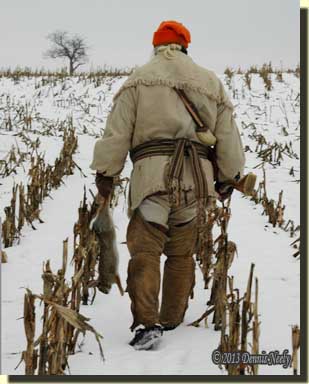
A traditional woodsman carries a rabbit as he walks down a corn row.The English flint clicked to attention. The trade gun’s buttstock slammed into an eager shoulder. The muzzle swung in pursuit, hitting a snow-covered cedar bough. Ice crystals showered. White globs clung to the browned barrel as “Old Turkey Feathers” caught the streaking rabbit’s white, bobbing tail, then raced through its flexing body.

“Kla-whoosh-BOOM!”

A yellow tongue of fire belched from the bore. A thunderous roar broke the evening tranquility. The recoil shook the snow from the dropping barrel. With long, slipping strides I arrived at the rabbit. A bit distressed, I realized I had not prayed for “a clean kill, or a clean miss” at any time during the afternoon’s many pursuits. I knelt and thanked God for the blessing of that meal. I expect He understood and knew that hunger knows no preference.

Give traditional black powder hunting a try, be safe and may God bless you.
Posted in Rabbit Hunts, Research, Wilderness Classroom | Tagged , , , , , , , | 2 Comments

Feeling a True Kinship

A fox squirrel’s bushy tail flicked, then vanished. A black oak’s welted bark pressed hard against the hunting shirt’s linen shoulder. The tail reappeared, head-high, on the backside of an arching red oak, then disappeared. A slight breeze rustled what few leaves remained overhead. A brown leaf dislodged and spiraled earthward, drifting northeast. I waited.

“Kee-yonk, yonk, yonk…” Over the rise, through the maple bottoms, east of the lily-pad flats on the River Raisin, a Canada goose hollered. Another honked, louder and more boisterous. There may have been others, but it sounded like two engaged in a vicious shouting match over some territorial transgression. The ruckus echoed up and down the river bottom, then died.

“Jay! Jay! Jay! Jay!” A blue jay screamed from a dead spire in the midst of the huckleberry swamp. I saw it fly away out of the corner of my eye.

The fox squirrel’s tail flicked again, in the same spot, on the red oak, forty or so paces down the trail. A few minutes passed. The squirrel scrambled into sight, hung upside down, then with one long, mighty leap jumped to the ground. Leaves exploded. Two big bounds and a dainty hop later the critter sat on a limbless trunk that lay on the forest floor. It wasted little time running the length of the rotting log and through the leaves to the top of the rise.

I realized I had lost track of time. My shoulder ached from leaning, and my back muscles throbbed. I charted a tree-to-tree course that swung a bit east, then circled back to the white oak where I last glimpsed the fox squirrel. With the afternoon waning, the still-hunt progressed as more of a casual walk than the usual two steps and pause.

Once on the top of the knoll, I leaned against a stout red oak that stood two trees distant from the white oak. Throughout the approach, my eyes scanned the treetops, but I never saw the fox squirrel. My right moccasin scuffed away the duff at the tree’s base. Fall’s aroma filled the air. I dropped my bedroll, adjusted it with my foot and sat. It was the last week of October, in the Year of our Lord, 1795.

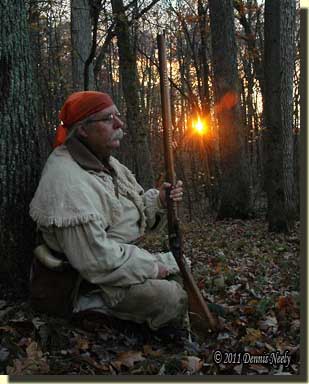
A woodsman gazes out over the River Raisin.The yellowing sun dropped below the western clouds and flirted with the tree line. The breeze died down and the air chilled. With the day spent, I eased back against the oak and gazed out upon the River Raisin. Geese floated here and there, and I supposed they were the ones I heard earlier. A wood duck whistled; somewhere over in the hidden bay, a mallard squawked.

An inner calm washed over my being. I closed my eyes, but only for a few moments. Despite the relative peace that followed Fallen Timbers, it was not safe to doze in the woods. The sun grew orange; the undersides of the clouds turned yellow, then orange, then pink. I wondered if a canoe or bateau might pass with travelers bent on making the portage to the Grand River before dark.

“Real people lived here…”

In January, Tami and I attended the commemoration of the 200th anniversary of the Battle of Frenchtown in Monroe, Michigan. After the featured events subsided, we sat in the car, warming up and talking. Tami gazed out the window at the battlefield in that distant, I’m-not-really-here manner living historians sometimes exhibit. In a few moments phrases bubbled forth, in a disjointed attempt at expressing the deep feelings of reverence that swept over her as we walked the grounds, heard the guns and smelled the billowing smoke. “Real people lived here and fought here and died here,” she said, trying to compose her thoughts. “I feel that same connection on the farm.”

We drove in silence for a few miles. I can only imagine what she was thinking; as for me, that late October squirrel hunt came to mind. I remembered leaning back against the oak, closing my eyes, and when I opened my eyes, I fully expected to see a trader’s bateau or a Potawatomi canoe on the river. I sat until dark waiting for an 18th-century traveler to pass by, and I was truly disappointed when I walked back to the brush lean-to, packed up and headed home.

I had similar feelings on my first muzzleloading deer hunt, back in the late 1970s. I missed an unsuspecting six-point buck, but the aftermath of that errant musket ball was the real prize that Sunday. After confirming my error and the clean miss, I returned to my seat on the west bank of the big swamp. My imagination ran wild, then settled down to wondering about the hunters, the traders and/or the Native peoples whose moccasins stepped on the ground where I sat, who might have shot at a deer or elk at the spring, centuries before.

The common thread that connects us all, moderns and ancients, is the land. Historical plaques and re-constructed buildings contribute to the texture of the overall living history experience at places like the River Raisin National Battlefield Park or at Fort Michilimackinac, but the land that our moccasins tread upon is the glue that binds our lives with the peoples of long ago. Our hunter heroes passed through this life, so must we and so will our grandchildren’s grandchildren. Like those who came before, we are but temporary caretakers for those who will come after.

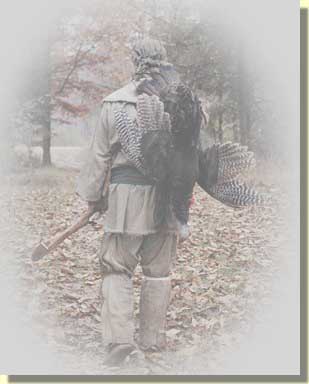
Haze shrouding an ancient turkey hunter.As a living historian, as a traditional woodsman, my interest lies with those individuals who lived, hunted and survived not only on the family farm, but also in the Lower Great Lakes region of the Old Northwest Territory. The bonds that my historical simulations form with these people, not just from reading their words, but through experiencing what they experienced, in some small measure, is one of the greatest gifts traditional black powder hunting affords.

We are visitors to the past, time travelers who share the same ground, separated by centuries. As a traditional hunter, I speak so often of my addiction to pristine moments, those fleeting points in time when my life parallels that of one of my many hunter heroes. Such happenings tick away in seconds, but the profound sense of participating in a bygone era remains. Attempting to explain a pristine moment to someone who has never experienced this phenomenon is difficult and often draws funny looks or blank stares. Yet, within each pristine moment resides an opportunity to feel a true kinship with the people of yesteryear, a chance to share their hardships and their joys, their triumphs and disasters, their successes and failures firsthand. And the common thread in all of these historical simulations is the land.

The sun is high, the latest snow is dripping from the eaves and my mind cannot help but wonder what thrilling adventure awaits the historical me on the North-Forty. And so, in the next few minutes, I shall don linen and leather, stoke Old Turkey Feathers with a stout load of gunpowder and shot and abide by my own advice…

Give traditional black powder hunting a try, be safe and may God bless you.

Posted in Living History, Squirrel Hunts, Worth thinking about... | Tagged , , , , , , , | Comments Off on Feeling a True Kinship

“Follow the pair…”

Gentle, cautious footfalls avoided a tumble. A lone rabbit track teased, emerging from under a stump, then rounding a bushy cedar tree. My winter moccasins shuffled in a joyous, yet measured pursuit. The track angled downhill, straight at a toppled cedar tree. My thumb fidgeted on “Old Turkey Feathers’” hammer, then pressed firm on the jaw screw’s crown. After three side steps to the east, I paused.

A traditional woodsman checking a downed cedar tree for rabbit tracks.The air smelled of red cedar as my eyes searched the damp snow around the windfall, hoping the track ended under that tree. Faint depressions said not; the cottontail continued west. Falling ice crystals began striking the cedars’ magenta boughs; some popped on the grove’s white carpet. Raindrops tickled my cheeks; small drips splashed on the browned barrel’s flats.

The distinctive footprints entered a shallow ravine, and on the far side, joined with a myriad of others under the cedar trees that lined the gully’s bank. My moccasins circled south, in part to avoid the steep slope, but more in search of another single set of tracks leaving the area. In a few minutes I happened upon a beat-down rabbit trail, the kind I hadn’t seen in years.

This little trace crossed a wagon path and fanned out in the next group of cedar trees. The sky grayed more and the shadows grew darker. Dozens of rabbit tracks beat down the snow beneath each tree; round, brown droppings littered the ground, along with green, clipped bough tips. I stood for a while, visually checking the base of each tree for a resting cottontail, but to no avail. I struck off to the south until the tracks thinned.

At the edge of a clearing I found a pair of tracks, one heading south and one returning. Or was it the other way around? That afternoon’s course turned west as an occasional snowflake mixed with the ice and rain. My moccasins stitched in and out of the second cedar grove, but the abundance of tracks persisted, distributed evenly under each cedar tree.

The “going and coming” tracks prodded and poked at my subconscious thoughts as I stood and surveyed. I envisioned two or three cottontails moving about in the moonlight. One in particular hopping to the cedars, then leaving just before dawn. I worked my way over the hill, and again, I paused and scanned the base of each cedar trunk. It was then that I succumbed to an impatient inner voice that said, “follow the pair…follow the pair.”

The tracks crossed the clearing, veered through some cedar trees, then parted where the red oaks start on a gradual side hill. Here too, a rabbit, or rabbits, tramped down the snow around the tree trunks and left ample droppings. A tangle of barberries grew a dozen paces distant from where I stood. In the midst of the prickly bushes, three old cedar trees lay tangled together, their branches overgrown with grass and heaped with weathered oak leaves.

The Northwest gun’s muzzle pointed overtop of the brush heap. My thumb played with the flintlock’s heavy hammer. I checked the pan’s prime, then approached from the west, seeking an uphill shot. I saw no tracks, neither in nor out. “A perfect lair but no tracks,” I thought.

With care, I rested my left moccasin on the outer tree’s barkless trunk and pushed down, shaking snow from the captured leaves. Nothing bolted. I stood quiet for a few minutes, then shook the pile one last time. Nothing. I turned about and saw that the tracks diminished a few oaks down the hill, before the sedge grass at the edge of the big swamp. I decided to walk to the swamp, then circle around the barberries on my return uphill, but the plan did not set well with my subconscious. I cogitated, as I sometimes do when I am unsettled with a given course of action.

The Shooting Pouch was Another Story

With deer season over, my attention turns to small game, cottontail rabbits in particular. I expect to chase squirrels a time or two more, but fresh snow, moderate winter temperatures and the discovery of a lone set of rabbit tracks bring a special woodland thrill to my heart. I suppose the excitement is in some respects a re-living of so many youthful lessons, taught by a host of educated cottontails.

When the opportunity arose, I spent but a few minutes donning my 18th-century garb. All the while, violins fiddled “The Elk Hunt” theme from “The Last of the Mohicans” in a back corner of my mind. With the urgency of that melody, it didn’t take long to run a wet patch down “Old Turkey Feathers’” bore, check the English flint and slip the Northwest gun back into its leather case.

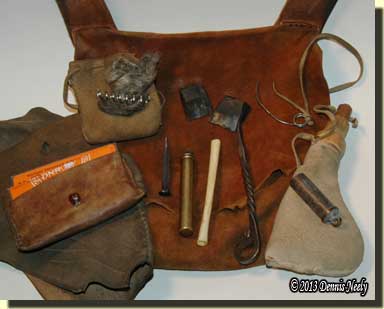
But my shooting pouch was another story. Swelled with the obesity of excess, the bag’s contents exhibited a pitiful cross between that of a modern, black powder competitor and a period-correct, Lower Great Lakes hunter of 1794. In that respect, as a living historian, I am my own worst enemy for allowing the two worlds to mingle.

The contents of the shooting pouch displayed.So as not to delay the moment, I pulled everything from the shooting pouch and started anew. A hand-forged turn-screw and a small cylindrical brass oil bottle nestled in the bag’s lower seam. The leather pouch that hides my hunting licenses went in next, along with a small deerskin bag of flax tow and two wire gun worms.

Two English flints and a wrought nail, filed round to fit the hole in the hammer’s jaw screw, made the cut, too. I put the greased leather cow’s knee over the contents in the bottom of the bag, much like a divider. A turkey wing bone always resides in the bag’s back crease; a priming wire, secured to the bag with a buckskin thong drops in the front.

Because the late goose season was still on, I chose to load with bismuth shot that day, stored in a small stoppered pouch. And since I have not mastered measuring gunpowder into the palm of my hand, I included a brass charger.

In today’s world, the time allotted to personal activities, like living history and traditional hunting, is limited. Therefore, I spend a large percentage of that time hunting, relative to target shooting. On those few instances when I enter a shooting competition, I simply load up shooting supplies in the pouch that I am most comfortable with, my hunting pouch, and that practice has to stop.

A considerable difference exists between what I consider a “necessity” for match shooting and traditional hunting. The logical solution is two bags: one for competitive shooting and one for traditional hunting. I maintain a separate shooting pouch set up for the fusil de chasse that I sometimes loan out, and one for the T/C Hawken my son-in-law uses for muzzleloading season. Making and keeping a separate pouch for competition is not an issue, I just have failed to do that.

An Inadvertent Stalk

As I stood cogitating on where to go next, a sudden burst of ice crystals clattered all about; snowflakes followed. A few steps away two small dead cedars lay crisscrossed amongst a few young barberries, where the cedar grove and hardwoods meet. Without thinking, I stalked those cedars, flexed the largest one with my left foot, then stepped back. A gray-brown flash of fur streaked straight away. The sear clicked. The buttstock found my shoulder.

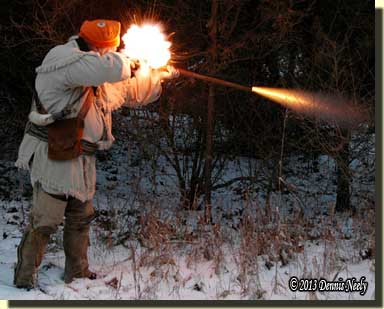
In waning light, the Northwest gun's pan flashed and the muzzle belched fire.The rabbit skirted the bigger cedars, hopped left, hit a deer trail and passed behind a young oak. The turtle sight chased close behind. On the west side of the oak, the turtle caught the hare.

“Kla-whoosh-BOOM!”

White smoke engulfed the young oak. The bounding cottontail vanished. Ice pelted. Two quick steps to the left brought the rabbit back into view, laying in the trail, a hop or so ahead of the gray ruts in the snow that marked the death bees’ flight.

Give traditional black powder hunting a try, be safe and may God bless you.
Posted in Clothing & Accoutrements, Rabbit Hunts | Tagged , , , , , , , | 1 Comment