“Snapshot Saturday”
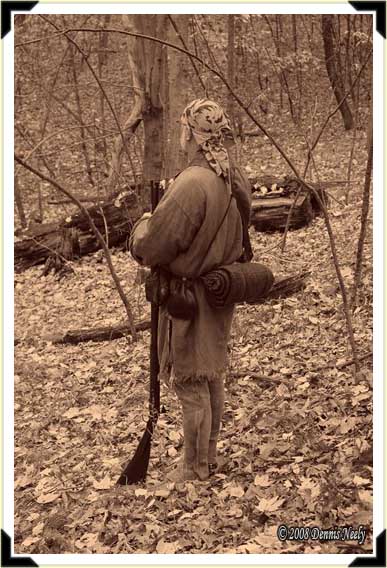
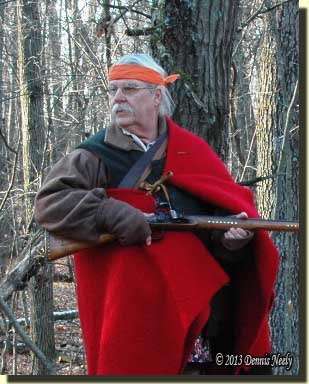
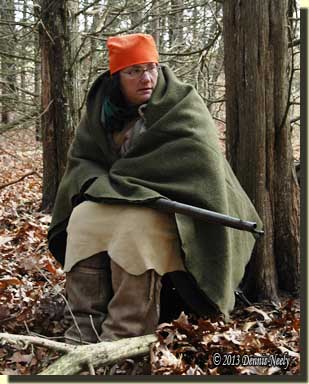
Traditional woodsman Jon Hollenbeck paused to take in the beauty of the forest during an October squirrel hunt. New France, 1753.
Traditional woodsman Jon Hollenbeck paused to take in the beauty of the forest during an October squirrel hunt. New France, 1753.
A gentle north wind bit bare skin. Downhill the same contrary wind blew waves of light snow from south to north over the thin gray ice that covered the watering hole. Buffalo hide moccasins trudged on; the evening’s anticipated ambush was no longer viable. Such were the circumstances of that cold November afternoon in 1795.
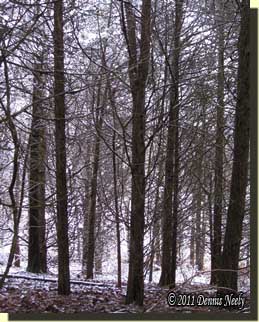 Up over the rise, the still-hunt veered east as I sought respite beneath an aromatic red cedar tree draped with wrist-thick grape vines. Like a wandering fawn, my course curled and wound around a dozen bushy cedars. I pulled the trade blanket’s folds snug about my cheeks. Falling snow melted on my nose and caught on my eyelashes as the favored tree came into view. To my delight, the north wind held true at this humble fort.
Settling in amongst the vines demanded patience. Years before the belt ax George Ainslie forged judiciously trimmed suckers from the half dozen vines that hung from the old tree’s crown and the dead branches on the cedar’s lower trunk. Hunched over, I pulled the blanket’s folds tight about my legs, then sat back cross-legged with the Northwest gun’s muzzle pointed downhill.
A deer trail angled down the hill, upwind of the old cedar on that particular evening. I nudged the scarlet blanket’s folds around my ears and against my cheek bones. My breath fogged my silver-rimmed spectacles. I exhaled through my mouth, forcing my body’s inner warmth against my chest. The tree’s keg size trunk blocked the north wind. I sat quiet and contented.
As the sky grayed, a lone turkey clucked in the distance. I never heard its big wings flap on its way to the night roost. A bit later a fox squirrel spiraled down a skinny cedar, forty paces down the slope, a few trees from the swamp’s edge. Wispy boughs bounded; snow flicked in the air. The fluky wind current pushed the white showers south to north, which I felt worked to my advantage. Any deer on that trail would crest the ridge with the wind at its rump, but before it arrived at the swamp trail the wind would be nose-on, or so I reasoned.
Along towards dark a single doe plodded on the trail. When it reached a clump of cedars with tops broken down by winter ice some years before, it stopped and sniffed the air. It waved its ears and dashed its tail about. At one point it offered a longing look uphill, the kind of look that makes a hunter dream of a trailing buck.
Light grew dimmer before the doe ventured to the swamp trail. The solitary whitetail ambled on with a painstaking deliberateness, burning up the rest of that day’s light. I sat until I was sure the young doe was gone, then got to my feet, bent over and exited the old cedar’s sanctuary.
Subzero cold and waist-deep snowdrifts delayed my early January hunts. I’m not happy about that, but there’s not much I can do. With the old persona, that of a hunter for a small trading post on the River Raisin, I can tolerate mercury that hangs around zero—on two occasions I’ve hunter bobcats at 10 degrees below. But my attention right now is on the new persona, an adopted native captive who returned to white society.
By that late November evening, it seemed obvious winter would come early and be harsh when it arrived. Unfortunately my weather instincts proved correct. I pushed the physical limitations of the captive persona through the end of Michigan’s muzzleloading deer season in late December, but temperatures below fifteen degrees proved unproductive for meaningful wilderness learning.
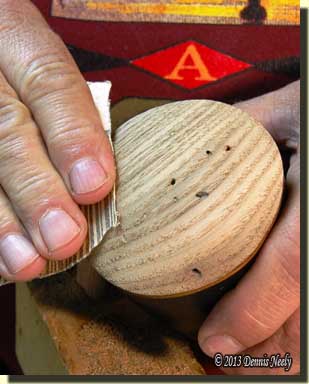 There hasn’t been much spare time so far this year, but I have managed to work on a few projects to move the new persona along: a revamped bison powder horn, leggin garters, a split pouch, a new horn strap and a heavy linen trade shirt. In response to a number of requests, I have documented each project with photographs and I hope to post step-by-step instructions in the “How-to” section of this web site.
With that in mind, I started updating the hand sewing pages and I posted the first revisions today. The second half to the hand sewing how-to is written and deals with the stitches themselves. Those pages are already in draft form, awaiting the accompanying photos. In the weeks ahead I hope to get caught up posting the results of the currently completed projects.
So please be patient. Improvements to the site are on their way. And as always, I enjoy hearing constructive feedback.
Give traditional black powder hunting a try, be safe and may God bless you.
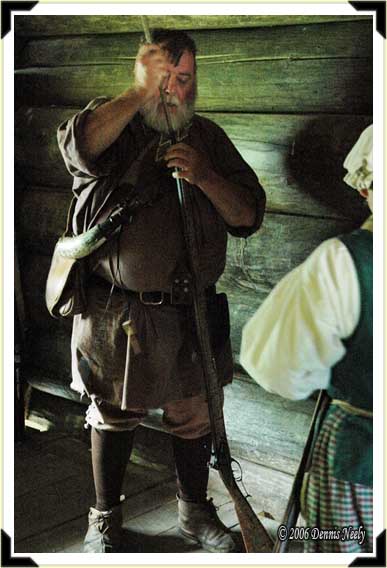
Fred Martin loads his longrifle in defense of the blockhouse during the Fort Greeneville Match on the National Muzzle Loading Rifle Association’s Max Vickery Primitive Range in Friendship, Indiana.
A chickadee bobbed up and down on a flimsy sprig. The little songster turned its head side to side, trying to make sense of the motionless woodsman, not two trade gun lengths distant. Two or three more chickadees flitted by, but this one lingered. A snowflake or two landed on the black feathers that adorned the little bird’s head. Then, its curiosity satisfied, the tiny wilderness tenant moved on. The woodsman’s buffalo-hide moccasins moved on, too.
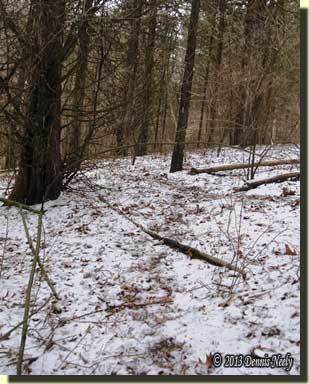 An inch or so of fluffy snow carpeted the doe trail. Four sets of tracks ruffled the leaves that covered this upper trail. The bigger tracks, typical of mature does were missing, and the still-hunt never produced a buck’s spread-toe track. The mid-hill trail showed similar scanty use. The majority of older deer were gone, killed by disease the year before.
At a break in the cedar trees, fresh turkey tracks crossed the trail, heading west. I counted nine birds in that flock. To the left, a plump fox squirrel rumpled leaves in a young white oak. The sound seemed loud in the late-afternoon quiet. With its mouth full, the squirrel ran up a slender branch, jumped to a tall red oak, climbed high and made a bit of a commotion as it added more insulation to its winter abode.
The day’s fruitless hunt weighed heavy on my bones. Up ahead, a large cedar tree waited; years ago a belt ax carved a makeshift hole in the tree’s thick dead branches. That was a mid-December pursuit, too. At the time, three thawed depressions in the snow about that tree attracted my attention. Two faced north, rumps to the wind; the third faced south.
Pulling the crimson trade blanket tight about my hips, I sat, content to “sit back and enjoy the evening,” as I soon scribbled on a journal page. A light, sugar snow began falling. The forest grew quieter. The lead holder ceased recording the details of that day’s simple pursuit. A tranquil solitude overtook my soul. I slipped into silent prayer, offering God thanks for the joys and frustrations of the fall hunts.
Big wings thrashed as a wild turkey flew up to its night roost, down the hill and off to the north beside the huckleberry swamp. I chuckled, thinking that perhaps God was treating me to the ethereal sound of angel wings. In all, nine angels ascended.
But, in the midst of waiting for the birds to fly up, the notion turned from humorous to troubling. I knew the new historical me did not have a copy of the New Testament on his person. I felt a compelling, unfulfilled desire to return to the Gospel of Luke and read about the shepherds and the coming of the angel and the tidings of great joy…
I approached this fall’s hunting seasons caught up in the exuberance of a new persona: that of an older white man captured in his youth, adopted and raised in an Ojibwa family, who finds it hard to let go of his Ojibwa upbringing later in life when he returns to white society. This version of the historical me is still in its infancy, still just learning to crawl, but each trip to the forest breathes additional life into the portrayal.
I chose to start out with what I had and build from there, knowing that the early stages of this portrayal, especially the illustrative record, would be crude and miss the benchmark of an authentic representation by quite a bit. In essence, I found myself back at the point of my beginnings, taking my own advice to “just get out there and do it.”
But divorcing one’s self from a persona that developed over thirty years is hard. The task is made doubly difficult when one must use some of the clothing from the older persona to give the new one a place to start—no one likes hand me downs.
To compound the frustration, most of the captive narratives include an adoption ceremony where the adoptee is cleansed of his or her “white blood” through a thorough scrubbing in the local river or creek and given a new set of clothes, symbolizing the birth of a new family member. But to follow this model it would take at least another year to assemble the period-correct clothing and accoutrements, and I feared that if I didn’t embark this fall it would not happen. Perhaps that was impetuous of me.
When creating a new persona, the living historian must depend on his or her primary research, make a choice and implement that choice within the portrayal. One of the most difficult decisions was to leave my copy of the New Testament home. I’ve hunted all fall without it, and frankly, that choice did not seem right. However, I accepted it as part of the divorcing process, a part of the necessary separation between multiple historical hunting personas.
A few days ago I was rummaging through James Smith’s captive narrative for clues regarding split pouches when I accidentally tore the corner of the paper that covered my Christmas gift:
“When I came into my longings I saw Russel’s Seven Sermons, which they had brought from the field of battle, which a Frenchman made a present of to me…” (Smith, 26)
At that moment the entire complexion of the evening’s research changed, and being the bumbling, inquisitive kid that I am, the paper tore some more. Really, it was an accident…
“On this route we had no horses with us, and when we started from the town, all the pack I carried was a pouch, containing my books [more than one!], a little dried venison, and my blanket….” (Ibid, 40)
Did you hear the paper tear again? Did you catch a glimpse of a treasure, bright and shiny?
“While we remained here, I left my pouch with my books in camp, wrapt up in my blanket, and went out to hunt chestnuts. On my return to camp my books were missing… (Ibid, 43)
Oh, I was being teased bad…
“They called me by my Indian name, which was Scoouwa, repeatedly. I ran to see what was the matter, they showed me my books, and said they were glad they had been found, for they knew I was grieved at the loss of them…” (Ibid, 54)
And then my Christmas gift fell from the pages…
“…During his stay at Sunyendeand he [Arthur Campbell] borrowed my Bible…” (Ibid, 64)
Needless to say, I laid James Smith’s narrative aside, retrieved my Bible from the bookcase over my desk and allowed my new alter ego a few moments alone with his Christmas gift, delivered on angel’s wings…
“And there were in the same country shepherds, abiding in the field, keeping watch over their flock by night. And, lo, the angel of the Lord came upon them, and the glory of the Lord shone round about them; and they were sore afraid. And the angel said unto them, Fear not: for, behold, I bring you good tidings of great joy, which shall be to all people. For unto you is born this day in the city of David a Savior, which is Christ the Lord…” (New Testament, Luke 2: 8 – 11)
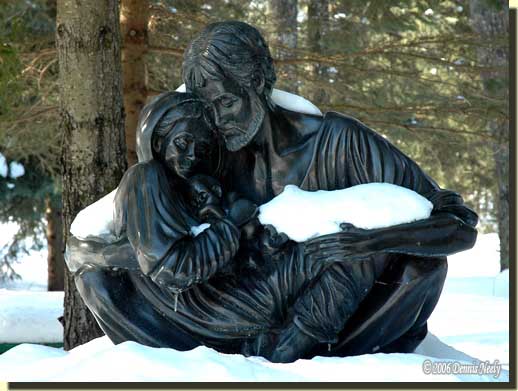
The Holy Family in the pines at The National Shrine of the Cross In The Woods, Indian River, MI.
May the peace of the Christmas season be always with you, be safe and may God bless you.
A not-so-distant maple tree popped. The sound echoed in the frigid hardwoods. A red-bellied woodpecker grasped a dead oak, moved about the gray, barkless trunk, but never drummed. Disappointment rushed over me. I associate tapping woodpeckers in a barren forest with popping trees. Yet, the still-hunt continued.
My right buffalo-hide moccasin slipped forward on the brittle leaves that covered the steep hill’s mean slope. I kept my balance. Ahead, a string of pried up leaves told of a single deer traveling north on a trail that once was as wide as a woodsman’s shoulders, churned up and thick with deer tracks. The upper doe trail was no longer visible, the lower showed signs of two or three deer passing.
The hillside leveled out, then rose a bit. Upturned leaves, angling in from the south, marked the course of a second deer with a shorter stride. When I came to that animal’s path, I leaned against a white oak and pulled the scarlet blanket’s folds tight about my hips with my left hand.
As the deer do, my eyes skimmed the knob’s crest and gazed beyond, out into the River Raisin’s bottom lands. My nose dripped. Faint clouds drifted from my mouth. Ice clung to my mustache whiskers. Behind me another tree popped with a bang reminiscent of a small, half-charged squirrel rifle.
Scraggly juniper bushes dotted the knob’s gently rolling north side. Sedge grass patches, mucky flats with treacherous, moss-covered roots and a tangle of maple and yellow birch saplings strewn with fallen white ash trees offered no sign of movement. I stood until my bare thighs grew cold, then stalked on.
That morning’s still-hunt proceeded up and over another hill, around the tamaracks that grow on a swampy thumb that protrudes into the hardwoods and up the next rise. I paused behind a tall red oak and surveyed the ridge top. Again I pulled the blanket tight about my thighs, but that didn’t seem to quell the chills. Intermittent sunlight bathed the trunk of a nearby oak with a distinct westward slant. A couple of cautious steps later I stood beside that tree. With as little movement as possible, I worked the blanket’s outer fold up over my shoulders, gathered the inner layer about my hips and sat cross-legged with my back against the trunk.
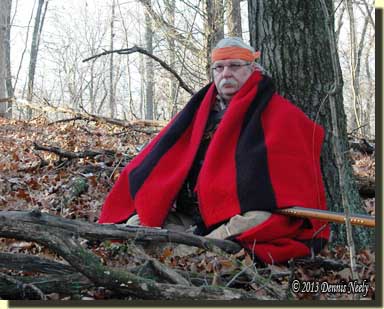 Not a minute later, another tree popped, and like before a woodpecker swooped near. The bird’s tapping seemed half-hearted, falling short of my expectation. I found myself warming in the sunlight, enthralled in my 18th-century Eden as the tarnished brass lead holder raced across the folded page. The lead scribbled “the desolation of December has set in. The air has that dampness to it that gnaws through the trade blanket, biting deep to the bone.”
As I sat huddled in a four-point trade blanket, my mind wandered back to a sweltering June afternoon at a Spring National Shoot at Friendship, Indiana, the home of the National Muzzle Loading Rifle Association. I was talking with Roy “Pa” Keeler at his booth in the sheep sheds, as the commercial row area is called; the conversation centered on traditional black powder hunting, as it most often did with Pa. I asked Pa, “What were you guys thinking when you set the [Michigan] muzzleloading deer season in December?”
Pa’s eyes started to twinkle and that wry smile of his was unmistakable. “You hunt it, don’t you?”
Pa went on to explain that there was a lot of resistance to the idea of a muzzleloader only season, not just at the state level, but among hunters. The bow hunters didn’t want their season interrupted, the firearms deer season dates were set in stone and the only alternative was mid-December, after a respectable hiatus to allow the remaining deer to settle down. Then, in typical Pa Keeler fashion, he looked straight at me and said, “Besides, black powder people are tough. A little bad weather won’t stop us.”
I cannot begin to count the times I hunted through a rough patch of weather, driven on by muttering “black powder people are tough.” I hope I never lose sight of Pa’s wisdom and the subtle lessons he taught, both through his words and by his actions. After all, he epitomized “Black powder people are tough…”
Yet, when I tell this story, I usually note that Pa never said “foolhardy.” He was a huge advocate for safety, and not just on the range or when handling black powder arms, but rather in all aspects of the hobby. When talking with Pa, I always knew “be safe” was implied in his tutelage just as my father always said “be safe” when I headed to the woods—and if he didn’t, you thought it.
In traditional black powder hunting a fine line exists between “tough” and “foolhardy.” I would be less than honest if I did not admit to crossing that line on occasion—sometimes by accident, and sometimes not. But in either case, the result is a better understanding of a traditional woodsman’s personal limitations, a deeper knowledge of the harsh realities of surviving in the wild and the consequences of not living within those limitations.
For this traditional woodsman, two different and distinct dates exist for the “start of winter:” the winter solstice, celebrated or despised by 21st-century folks and that point in time when Nature turns harsh and unsympathetic to the forest tenant’s plight.
Fall lingered this year through the end of October, then three windy days the first week of November brought down all of the leaves. Winter’s cold arrived by mid-month, the ground froze and the whitetails began limiting daily movement to conserve fat and precious energy. The entire complexion of the firearm deer season changed to that of the December muzzleloading season.
The popping of the trees is a month earlier, too. When the maple tree popped, I jumped as if startled by a close-by muzzle blast. The echoing sound triggered an unconscious set of woodland expectations that I associate with pursuing smaller game, not whitetails. Those trips afield are usually shorter, governed by the biting cold, not the all-day affairs of chasing deer.
The November hunts grew hard and harsh, compounded by the clothing restrictions of a new persona. I found I had little time to adjust to the fast-falling temperatures, but that is what re-creating life in a bygone era is all about, from the living historian’s perspective.
 By experimenting in the wilderness classroom, I was able to adjust the way I wore the clothing of a returned captive and adjust hunting techniques to maximize my tolerance of the unseasonable cold. The task was difficult, but with perseverance my alter ego pushed his comfort level from the upper thirties down into the mid-teens in a matter of three weeks.
Twice during the process of acclimating the historical me to Michigan’s unpredictable winters, I crossed the line of human limitation and experienced mild hypothermia. Fortunately I recognized the symptoms early enough to retreat to safety, but not in time to avoid chills throughout the night. Such actions flirt with foolhardy, and yet there is an element of kinship that exists in sharing shivers with the likes of John Tanner, Jonathan Alder and Col. James Smith.
On that particular December still-hunt, the temperature never rose above eighteen degrees. The historical me survived for four hours in the Old Northwest Territory of the 1790s, overlooking the bottom lands of the River Raisin. Wrapped in a scarlet trade blanket, basking in sunlight, a traditional woodsman found time to scribble “the desolation of December has set in.” As Pa Keeler once said, “black powder people are tough…”
Give traditional black powder hunting a try, be safe and may God bless you.
Ed Schmidt, editor of Whitetales: The Official Publication of the Minnesota Deer Hunters Association, sent me an email the other day. The Minnesota Deer Hunters Association is a grassroots conservation organization dedicated to the betterment of deer, deer habitat and deer hunting in Minnesota. Since 1996, the MDHA has spent over $16.5 million supporting habitat restoration projects with innovative programs such as Hides for Habit, the Food Plot Program and the Conservation Seed Program.
The subject line of Ed Schmidt’s message read “Cool Coincidence,” and the body contained two images of magazine covers. The first is the Winter 2014 issue of Whitetales, showing traditional black powder hunter John W. Hayes, obscured by smoke from his flintlock.

The Winter 2014 cover from Whitetales: The Official Publication of the Minnesota Deer Hunters Association. Used with permission: MDHA.
John’s son took the photo in March of 2013 after a heavy snowfall. Hayes portrays a Virginia hunter/farmer who is “a guide and courier working between the Fairfax grants of Northern Virginia and Western Pennsylvania and New York in the 1760s.”
The Whitetales cover shows John firing an eastern-style, 24-gauge fowler he built from a Chambers kit, complete with inked vines on the stock. The snowshoes are of the Ojibwa pattern and add to the authenticity of his historical impression. The hunt took place in the Sugar Hills area of Itasca County in Minnesota where Hayes has taken 11 white-tailed deer in the last 13 years.
John made the blaze-orange sleeved waistcoat himself and lined the coat with wool for added warmth. In Minnesota, any hunter or trapper in the field during an open deer season must wear blaze orange above the waist, including the hat or cap. It is imperative that all traditional hunters understand and adhere to all game regulations. Applying a healthy dose of measured compromise, Hayes continues to hunt in the style of his ancestors, willing the orange color invisible as far as his historical simulation is concerned. John Hayes started down the traditional black powder hunting path in 1984.
I first met John at an Outdoor Writers Association of America conference. The wool weskit and drop-sleeve shirt he wore were a dead giveaway of his interest in living history. John’s articles appear in a number of publications, including MUZZLELOADER, Muzzle Blasts and Whitetales. In 2006, Hayes published Seven Thought Provoking Essays in Chapter Form On the Subject of Participating in Historical Events and Maintaining Historical Venues in General, which is now available as an E-book on Amazon.com.
The second magazine cover is from the December 2013-January 2014 issue of Outdoors Unlimited: The Voice of the Outdoors, a bimonthly magazine published by the Outdoor Writers Association of America.
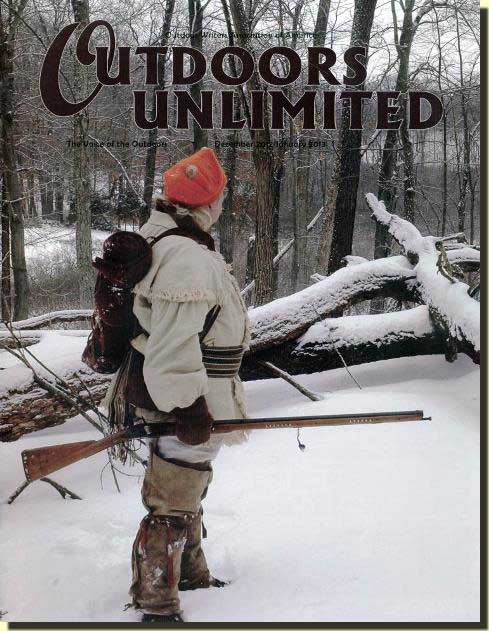
The Dec 2013/Jan 2014 cover from Outdoors Unlimited: The Voice of the Outdoors. Used with permission: Outdoor Writers Association of America.
The Outdoors Unlimited cover photo, titled “Next Ridge West,” was taken on a cloudy February squirrel hunt. The morning’s still-hunt reached a crossroads, or better put, crossed oaks. The squirrels were skittish that day, and my alter ego was considering spending an hour or so sitting in the windfall when a fox squirrel barked at the base of the far ridge. “Do I move on, or stay put?” In hindsight I realize that is a recurring question within so many of my 18th-century sojourns.
Kelsey Dayton, Publications Editor for Outdoors Unlimited, said she chose the “Next Ridge West” because it fit December and January outdoor activities. The unique nature of traditional black powder hunting caught her eye, too. “The hunter looking into the distance shows a mystic, yet universal outdoor moment…with a pop of color that reflects the texture of winter,” Dayton said. I feel flattered by her kind words of encouragement and honored by her choice of cover images.
Having two covers published at the same time in respected national magazines outside the black powder genre is, as Ed Schmidt says, “a cool coincidence.” The images present an opportunity for readers unfamiliar with living history or traditional black powder hunting to reflect on America’s rich hunting heritage. The exposure also offers a chance to promote this wonderful and exciting pastime.
Yet, in a more global sense, the two covers serve as a reminder that each of us who step over time’s threshold in search of a few precious moments shared with our individual hunter heroes must shoulder a small part of the responsibility for forwarding the hobby. The uniqueness of the traditional black powder hunting experience attracts attention, because it is different than today’s mainstream hunting messages.
The task at hand is to increase awareness of the traditional black powder hunting philosophy on a one-on-one personal basis. The vocal, anti-hunting minority advances their cause when we fail to speak up and say “I am a hunter,” and most often, we let that chance slip away in small gatherings of close friends, family and business associates, especially around the holiday season.
Perhaps the uniqueness of traditional hunting holds the key necessary to unlock our lips and thus the minds of others. In the arena of ideas, those of us who favor the simple pursuits of a bygone era are in the best position to defend out great American hunting legacy, because the living historian’s perspective is one of hindsight. For our part, we each need to shoulder our responsibility with courage, step forward and declare “I am a traditional black powder hunter. Let me tell you what that entails…”
Speak out for traditional black powder hunting, be safe and may God bless you.
Pre-dawn’s silence stoked anticipation’s fire. Fading stars spawned an age-old wanderlust. In the graying darkness, silver dew drops clung to every grass blade, every bough tip, every greening stem. The air smelled clean and fresh, laced with a hint of rotting deer pellets. Elk moccasins splashed, driven by boyish glee; buckskin leggins swooshed. On that May morn, in the Year of our Lord, 1792, the woodsman’s course pushed ‘round the bend, crossed into the dip and ascended the steep trail to the ridge’s crest.
Crows, cardinals and chickadees delivered the first sounds of the new day. “Aww, coo, coo, coo.” A mourning dove cooed, somewhere in a cedar tree to my right. The dove’s haunting refrain cast an aura of doubt on my humble fort: four cedar trees that grew in a horseshoe-shaped clump. I heard not one wild turkey and began to wonder about the morning’s choice of lairs.
Then, in the distance, off to the east, I detected a series of faint “arks.” At that instant, a flock of song sparrows serenaded the makeshift fort, chipping away, hiding the hen’s yelp. As I strained to listen, the clucking grew louder; that bird was on the ground, advancing closer.
“Gob-obb…” A weak, half-gobble echoed in the hardwoods, three rolling knolls to the west.
“Ark, ark, ark, ark.”
“Gob-obl-obl-obl-obl-obl!” The tom answered quick, its intentions apparent. I rolled to my knees; my right hand pressed down on the Northwest gun’s forestock, holding the smoothbore’s butt firm to the ground. The hen responded with four more clucks, the tom with another long, forest-shattering warble that sent shivers up and down my spine. My mind charted each turkey’s probable course; I was certain the little clearing on the ridge crest was the rendezvous point.
Moccasins thumped. Droplets sailed. Purple raspberry switches clawed. Arms churned. The flap and swish of the impetuous rush covered the clucks and gobbles. I stopped after about sixty strides, pressed my linen and leather clad shape into the boughs of a broad cedar tree and listened.
The hen was closest, on the path that skirted the big swamp’s east edge. Her boisterous clucking had turned to soft, spaced-out “putts,” uttered not in alarm, but rather to mark her progress.
“Gob-obl-obl-obl-obl-obl! Gob-obl-obl-obl-obl-obl!” The tom sounded a tad more worked up as he crested the second hill. I remained still, fighting the urge to move forward, not sure of where the two lovers might meet.
The hen putted once in the middle of the sedge grass. She had passed the longer trail at the north end of the little pond and had chosen the shorter path beside the spring, straight down the hill from where I stood.
“Gob-obl-obl-obl-obl-obl! Gob-obl-obl-obl-obl-obl!” The tom’s answer echoed through the hardwoods, and from the sound it was clear he was not going to follow the path that led through the valley.
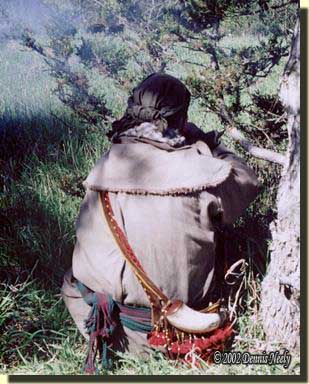 My moccasins splashed ahead. The hen’s second putt from the west edge of the big swamp showed signs of hesitation. In an instant I decided to change fortresses. I gambled she would wait on him to strut and serenade her from the ridge top. I took refuge behind a spindly wisp of a cedar tree that grew off to the side of a grassy clearing, uphill from the tom’s last gobble.
Dew soaked through the seat of my drop-front trousers as I threaded the Northwest gun’s muzzle through the skimpy branches. My thumb pushed the frizzen forward; the pan’s prime met with satisfaction. The English flint clicked to attention. “A clean kill, or a clean miss. Your will, Oh Lord,” I prayed in haste.
I started this post before Thanksgiving. Being addicted to traditional black powder hunting I spent the weekend in the woods as a returned white captive hunting white-tailed deer, instead of writing. I haven’t put hunting first in several years, and it felt quite refreshing.
Last Tuesday morning’s still-hunt paused behind that scrawny cedar tree. It’s a lot taller now and more filled out—time marching on, and all. That tree, coupled with Thanksgiving being two days away, brought to mind the excitement that surrounded that May turkey hunt, so many years ago. Curiosity got the best of me. When I returned home, I pulled out the photo album that holds the pictures from that morning. The cedar was a lot smaller back then. “Different” is the word I often use for such circumstances.
But the comparison went beyond just the cedar tree. As I leafed through the pages, I could see the progression of my trading-post-hunter persona over time. Like the cedar tree, I have grown. I am different, too.
I mentally started listing the changes—some were obvious, others hidden from sight. Again, out of curiosity, I skipped ahead a decade or so to last fall’s turkey hunt, the last time my trading-post-hunter alter ego killed a wild turkey. I began comparing the two images.
Both photos show a living historian attempting to put forth a truthful representation of a traditional woodsman from the 1790s, but the impressions are different. The Northwest gun, the powder horn (less the beaded strap), and the leather leggins are all that remain of the former historical me. The rest of the clothing and accoutrements have been replaced over time, but this is the normal progression of knowledge that typifies this joyous pastime.
A traditional black powder hunt is a solitary endeavor, and on occasion several like-minded traditionalists might camp or hunt together. But when talking with other traditional hunters, I find few who take pictures of themselves. A camera is rarely packed; it is simply not period-correct. In the last year or so, I have come to realize I am an exception, because images are a necessary part of the writing profession, an effective tool for spreading the word about traditional hunting.
Most living historians base their persona on a prudent mix of primary documentation, existing historical artifacts and paintings or illustrations created by first-person observers of a past time period. For me, the highlight of this fall’s hunting is a new persona based on the captive narratives of John Tanner, Jonathan Alder, O. M. Spencer and a host of others.
After two months of hard hunting, I already look at the photos of my returned captive persona and shudder at the errors. I’m embarrassed for publishing some of the images, but I do so with the hope others will learn from my first-hand experiences in the wilderness classroom. The impression will never be perfect, but like moving up on the tom, seeking refuge behind that pitiful cedar and anticipating a wild turkey’s approach, I hunted with the best understanding I had. I entered the glade, ventured into the past and I hunted.
As with all living history, the goal is to edge closer to perfection, knowing every historical simulation will fall short of “exactly right.” With that goal in mind, my recent research has focused on illustrations, paintings and etchings of Ojibwa and Potawatomi peoples from the 18th-century’s last decade. Without thinking about it, I have been comparing this fall’s photos with those historical images, thus my disappointment with my current impression.
Until this week, I never realized how helpful a photograph of my persona, taken under field conditions, was. I have made such comparisons for a long time, but never with conscious awareness of the value of the practice. As a result, I would like to urge all traditional hunters to start accumulating photos of their alter egos, if for no other reason than as a learning tool for perfecting one’s persona.
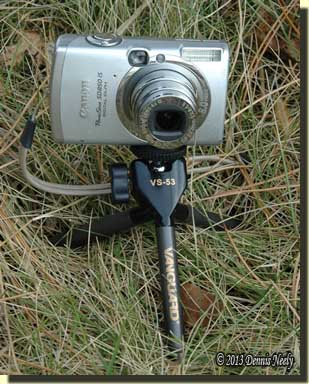
A digital camera and a small, table-top tripod can be stowed out of sight in a hand-sewn linen pouch. The “ball pivot mount” allows for portrait or landscape picture orientation. The 5-inch tall tripod features legs telescoping 8-inch legs.
Most of today’s digital cameras have a “timed-delay” feature. A stump, a downed log, an improvised crib of sticks or a re-purposed haversack can provide suitable support for the camera. I usually pick a spot, lean the trade gun against a tree and then focus the camera on the trade gun. In my case, I use a larger camera with a remote control to activate the time-delayed shutter. And the easiest method is to ask a hunting companion to snap a few pictures, or have a family member tag along on a short scout.
Once the image is created, print it out or store it electronically for future reference. Almost every family has a photo expert, adept at cropping and enhancing a digital photo, most often for posting on social media. Ask for that person’s assistance. The basic skills are not that hard to master. The benefits are tremendous.
“Gob-obl-obl-obl-obl-obl! Gob-obl-obl-obl-obl-obl!” My left elbow pressed hard against my raised knee. The turtle sight lingered in the area of the doe trail that emerged from the cedar trees. I saw the tom’s white pate first. The gobbler took three bold steps, never pausing to survey the clearing for danger. He fanned his tail. His flowing black beard dragged in the wet grass. He tipped his head back and opened his beak. “Gob-obl-obl-obl-obl-obl!” His whole body shook.
The turtle sight caught his eye. The flint lunged. Sparks flew. Gunpowder flashed.
“Kla-whoosh-BOOM!”
The big gobbler rolled backwards and flapped his wings. I pushed myself up and ran to the downed turkey with long strides. My moccasins anchored his legs, but that was not necessary. I knelt and gave thanks for the blessing of the morning.
Snap a photo of your persona, be safe and may God bless you.
Crows cawed to the west; Sandhill cranes chortled to the east. A robin sang “Cheeri-leee, cheeri-leee,” near where the cedar grove meets the meadow grasses. Not long after first-light a wild turkey hen clucked to the north and a bit later, a blue jay uttered a soft, contented string of “jaaays” off to the south.
Through the four-year absence, the underbrush grew thicker at the gravely mouth of the big gully. Tall, arching branches of flourishing autumn olive bushes draped over what once were long, narrow openings between old red cedar trees. Some of the invasive autumn olives still sported an abundance of light-green, fish-shaped leaves, while others stood almost barren, encircled by a faded-yellow carpet of fall’s castoffs.
“I don’t believe this,” Tami whispered, “but it’s been a while, hasn’t it? I hear something straight out.” I listened and didn’t answer.
An hour or so later, we still-hunted north. Because of her arthritis, Tami had to ascend the gully’s steep slope backwards, using small but sure moccasin steps. We lingered at the crest, scanning the gently rolling hilltop peppered with more red cedars, a few wild cherry trees and an assortment of oaks. Young, dead, barkless cedar trunks, starved of sunlight by the older growth, littered the forest floor.
 “Over there,” I said. “See how those trees look like a solid mass? That’s a good spot.” In due course we reached the little sanctuary. I opened Tami’s folding stool and she sat facing west; I sat on the ground, cross-legged, facing east. A hint of breeze came from the southwest, leaving the vast majority of this cedar stand upwind of the makeshift fort.
A fox squirrel left its leafy nest and descended a tall cedar tree headfirst. Its tan underbelly fur did little to hide it. About four trade-gun-lengths up, it stopped, sat on a branch and began an incessant chatter as it flexed its tail now and again as if emphasizing an important point in its discourse.
“I’ve got movement,” Tami whispered in the midst of the fox squirrel’s chuckling. In between the critter’s sharp notes, I heard leaves rustle. I watched my section of the hilltop, but listened to my wife’s. Three or four half-hearted snorts, upwind and back over my right shoulder, marked the deer’s progress. The doe had found our scent trail, laid down not more than ten minutes before.
The snorts continued for a couple of minutes, not the hard, warning blow of a frightened whitetail, but more on the dainty side, intended to force a suspected interloper to move and show him or herself.
I next heard the scratches of the fox squirrel running on an oak branch, then clawing higher. That oak stood not three paces to Tami’s left. The squirrel climbed up, then scratched its way back down the trunk, coming as close as it dared. Afterward, Tami said it hung upside down and looked straight at her; we both heard the two sharp barks, and we both thought the fox squirrel exclaimed, “Ahh, Haa!” as if it just discovered our presence.
“The doe’s gone,” Tami whispered. “She came straight at me, then angled to my left.”
“How close?”
“No more than fifteen yards,” my wife answered. “She wasn’t concerned about me until she came to where we walked. Hear that?”
The sound came from the tannish leaves under a clumped wild cherry tree. A big doe passed behind the two trunks that shared a common root; the doe’s spring fawn straggled behind. The pair picked their way through the cedar trees at the edge of the meadow. The wind shifted to due south, ruffling the long, white tail hairs of the older deer. They took their time, browsing and nibbling and wandering about. Ten minutes later they slipped into the big hardwoods.
“You can look. They’re over your right shoulder,” I whispered.
“There’s two coming up the hill to join them.”
“You’ve got the advantage,” I whispered. “I can’t see them from the ground.”
Opening day of Michigan’s firearm deer season is always special, but more so this year because Tami wanted to get out and hunt, too. She’s not into setting an 18th-century date, and she doesn’t cross time’s threshold, at least not consciously.
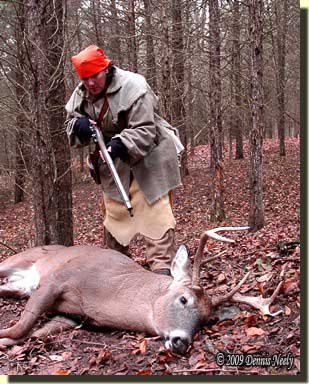
Tami Neely approaching the fine buck she took in 2009.
Arthritis has kept her out of the woods for the past four years. The last time we hunted together she downed a fine buck with her chiefs-grade trade gun. She wanted to “try the same spot” where she got her buck. Had I known that, I would have scouted the ravine before the opener. The rapid growth of the invasive autumn olive bushes disappointed both of us.
We both whispered it was time to move on at the same moment. There is a reason we are married. I suggested a circuitous route to avoid the gully’s steep bank out of concern for her knees. She wouldn’t hear of it, citing the wind and our scent as the governing factor. She took two steps, paused, then turned around and walked up the trail backwards with short baby steps. “It’s easier for me this way,” she said.
Once on the hilltop, she grumbled about lugging the folding stool along, but sighed and said she knew she couldn’t sit on the ground. She draped her blanket over the stool, “So it won’t show in your pictures. I know it’s not traditional.”
“That’s what measured compromise is for,” I said.
Regardless how hard a living historian tries, it is impossible to duplicate a bygone era in every detail. The best we can hope for is to approach as close as is humanly possible to a viable simulation of life in our chosen time period. Sometimes modern circumstances, like bi-lateral knee replacement, impose limitations on a traditional hunter’s attempt at duplicating yesteryear.
When a modern encroachment interferes with historical accuracy, be it new knees, the mandated hunter orange laws or a camo-clad trespasser wandering into an 18th-century station camp, the best approach is to evaluate the infraction and seek a conscious measure of compromise that minimizes the adverse impact. Over the years, I’ve come to call this process simply “measured compromise.”
In reality, we cannot paddle our canoe around the river’s bend, beach it and step back into the past—that is physically impossible. Likewise, living historians are human beings and cannot stop the aging process—that is physically impossible, too. As our bodies age, prudence and “doctors orders” change our outlook on what we can and can’t do. But applying a healthy dose of measured compromise helps the traditional hunter continue his or her time traveling.
Perhaps the biggest single compromise for traditional hunters over the age of forty is footwear. The need for orthotic shoes and elk center-seamed moccasins don’t mix; and under inclement weather conditions, aging bones, wet snow and smooth-soled mocs compound the problem. Unfortunately, too many traditional hunters give up the simple pursuit, rather than accept a reasonable compromise, often because they do not see “any other way.”
In such situations, continued good health and personal safety afield overrule authenticity. After all, this is a hobby and the idea is to have fun while learning. Like dealing with hunter orange, the remedy is a mental attitude that “wills invisible” the offensive intrusion by concentrating on what belongs in the historical scenario while ignoring what does not—in essence, seeing “what was,” not “what is.”
And the second biggest compromise is hunting from a stool, chair or other contrivance that eases stress on the legs and lower back. Sitting on a downed log, a stump or rock might work in some locations, but that limits mobility and choice of ambush—a limitation many folks are not willing to make. Tami is one of those people. For her, the folding stool is the best form of measured compromise, because it allows her to return to the glade in a traditional style, picking and choosing ambush sites on her terms.
In the end, to fuss about a modern imposition and know that “it is not traditional” is one thing; to foster a keen mental attitude that applies a dash of measured compromise and wills the transgression invisible is entirely different.
Apply a dash of measured compromise and get in the woods, be safe and may God bless you.