The Wisdom of Our Ancestors

Rain pounded the roof. A thunder clap ended a sound sleep. Outside, big, silver orbs fell earthward, looking like ten thousand spears piercing dawn’s gray abyss. Water splashed everywhere, ending all hopes of covering the wooden crate and canvas-bound bales. I had gambled and lost.

In my disgust, I began the all too familiar litany of “I should haves.” Tami tried to calm my self-incrimination. I finally shrugged, accepting the conditions the new day offered. Yet, I wondered if I would face an unpleasant, albeit period-correct, task—drying out my trade goods—when the sun did come out.

As I shaved, I found myself chuckling. I thought of Duncan M’Gillivray, the young clerk for the North West Company, and how, in 1794, one of my favorite years to visit, the company of canoes he was with had to stop and dry out their goods:

“At 10 O’clock all of the Canoes being about 60 went off to choose a convenient place to dry the Goods, which the late rains have entirely soaked through.” (M’Gillivray, 10)

There are numerous other instances of stopping to dry goods, but this is the one that came to mind. The fault was my own, pure and simple. We got in late from the Woods-N-Water News Outdoor Weekend at the Eastern Michigan Fairgrounds in Imlay City, Michigan. The weather report predicted rain starting late the next morning. Being exhausted, I opted to empty the truck early, “before the rain starts.” God had other ideas.

David McCrea’s Case No. 47

A fur-trade crate with some of its contents.The pelting rain subsided a few minutes before 10 o’clock, but I didn’t feel much kinship with M’Gillivray. My concern focused on a reproduction of “Case No. 47” from an inventory of trade goods allotted to David McCrea. In 1777, at Fort Michilimackinac, William and John Kay outfitted a Montreal canoe (about forty-feet long) for McCrea’s account. The manifest contained fifty numbered bales, barrels, cases and sacks. Case No. 47 held “24 half axes, 24 Tomahawks, 3 Large axes, and 7 Tranches [cutting knife].” (Armour & Widder, At the Crossroads…, 198-206)

I made the case some years ago, along with Case No. 36, which contained “84 lb Castile Soap.” On a visit to Fort Michilimackinac the summer before, a lone, weathered-gray crate caught my attention. The artifact looked out of place, sitting off by itself in a corner of the fort, close to the French Chimney. I took several photos of the crate and recorded its dimensions. As I walked around the orphaned wooden box, I came to realize it covered some 21st-century outcropping that could not be avoided. With my curiosity tweaked, I kept my eye out for other crates, and to my delight found many, all looking similar in design: six rough boards fastened together with wrought nails and banded with wooden, external cleats.

The gray crate sitting near the French Chimney.I spent a fair amount of time trying to find primary documentation to corroborate this design, but that search proved fruitless. As a last resort, I contacted the Curator of Collections for the Mackinac State Historical Parks, Steven Brisson. I eventually learned that the pattern was adopted many years before, based on what seemed to be secondary sources. Much to Mr. Brisson’s frustration, the individuals in charge of researching, documenting and constructing the cases had since retired, and the documentation relied on was no longer available. I got the same story from two other historical sites that copied their crates from those at the Michigan fort.

I have yet to uncover rock-solid primary documentation or specifications for the crate/case construction, but the circumstantial evidence indicates the pattern was simply the accepted method of durable packaging in the 18th century. If anyone has primary source material, please share.

Wilderness Classroom Lessons

I was satisfied with the end product, but had some reservations about the external cleats, given the lack of 18th-century source material. In addition, case No. 47 looked bright and new, which is how I would expect it to look in Montreal or at Michilimackinac when it was first constructed. But my alter ego was a trader hunting near the headwaters of the River Raisin, not in the pine forest, just outside the fort’s land gate. I reasoned the case should look worn from the trip inland from Frenchtown at the mouth of the River Raisin, to say nothing of the trip to Frenchtown on Lake Erie and points north or east.

To remedy that situation, I left the crate sitting out part of the fall and into the winter, hoping natural exposure to the elements would add a period-correct patina. In a matter of days, the wrought nails rusted and streaked the yellowy-white softwood boards. As the case weathered, I noticed the small spaces between the three top and three bottom boards swelled tight from the constant moisture. After a rainstorm I pulled the lid off and found the inside was dry—the first lesson learned.

A few weeks later, in the middle of October, I decided to lug the crates to the woods. When I put the cases in the truck’s bed, the cleats held the boards up off the bed-liner, just as they would in a canoe. A mental lightning bolt struck; I understood the casual water that always sloshes about in the bottom of my canoe would never touch the crate proper, let alone its precious cargo—the second lesson learned.

At first I didn’t give much thought to transporting the crates from the Dodge to the wedge tent, which almost turned into a huge, wilderness-classroom error. I had it in my mind that I would just pick up each crate and carry it to the duck camp. A second lightning bolt hit as I crossed the sand bridge in the North-Forty: “carrying them isn’t very period-correct.” I parked two ridges and a valley from the duck camp, and when I gazed at the white canvas tent sitting alone on the hill, I muttered something like: “what the heck, let’s portage them.”
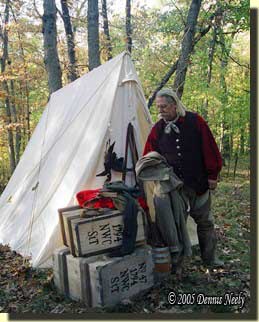
Taking off my hunting shirt in front of the wedge tent.I unbound the bedroll and tied the portage collar’s eight-foot leather tails around the crate, knelt down and hefted the first crate onto my back. Not wishing to injure my neck, I positioned the wide strap around my upper shoulders, and quickly learned the external cleats helped keep the leather tails from slipping. When I eased the smaller, Case No. 36 onto No. 47, the cleats “locked together” with a slight offset to the crates’ sides—lessons three and four.

The two crates are now nine-years old, as it turns out, almost to the day. At the various outdoor shows, the crates give a fair representation of the Great-Lakes, fur-trade era and often form a focal point for questions, especially among younger guests.

When traveling to and from a show venue, I pack each crate with an assortment of trade goods, from brass kettles to tanned peltry for display. Being a creature of habit, I tend to pack the same items in each crate. For a while, I wrestled the loaded crates onto a dolly and wheeled them into the show hall—they were all I could lift. About five years ago, I started unloading part of the plunder before lifting each crate—that took more time, but was easier on an aging back.

At one of the shows, a volunteer helper commented: “these must weigh a hundred pounds each.” Of course I started into my spiel about how original “pieces,” as the bales, cases and sacks were called, each weighed 90 pounds. Yup, the light went on again, and when weighed, case No. 47 was 85 pounds. The contents change the weight with all hides tallying somewhat lighter than tomahawk heads and copper kettles, but the physical volume of that crate seems best suited to handle 80 to 90 pounds—another lesson learned.

And as I should have expected, when I opened the crate on Monday, I found only a few droplets of water on the large beaver hide and my winter moccasins, everything else was dry. We recorded almost an inch of rain overnight, and by design, the gaps in the top boards swelled shut again, but such is the wisdom of our ancestors.

Give traditional black powder hunting a try, be safe and may God bless you.
Posted in Clothing & Accoutrements, Research | Tagged , , , , , , , , | 1 Comment

“Denny’s Been Baptized…”

A bawl-mouthed Walker bayed. Crisy’s distinctive “awoo, awoo, awoo, awoo…” spurred a sense of urgency, tugging my buffalo-hide moccasins due south from the wagon trail. The light, fluffy overnight snow poofed with each footfall; the under layer crunched. A stiff breeze died just over the ridge, where the hardwoods eased into a thick, white cedar swamp. I continued on, despite breaking through the ice that hid the many tiny puddles that lurked among the tangled roots.

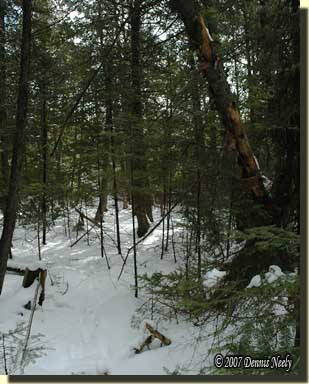
Sunlight streaming through a thick cedar swamp and reflects on the snow.A Plott’s lower tones joined Crisy’s; the pair sounded louder and closer. The morning’s cold bit my nostrils and tingled my fingertips. I stopped and leaned against a gray-barked cedar to listen. The hounds pushed easterly, then hushed. The forest’s stillness hugged my being. A sense of calm mingled with peaceful contentment. Snowflakes drifted in and out of the sun streaks. I could almost hear them whoosh side-to-side.

The hounds’ baying swung in a large, looping arc that turned west. At first, I thought they might circle behind me and hug the swamp’s edge, but as they approached, it became evident the bobcat was in front of me. It made little difference, because the swamp was so thick I could barely see beyond “Old Turkey Feathers’” effective distance for buckshot. From the sounds, Crisy and Zoe passed forty or so paces out. I never saw them.

The hounds chased the old male bobcat by two more times, and all three times the barking hung up to the southwest. With the baying a mile or so distant, my woodland companion, Randy Waites, suggested we move closer to the place where the dogs lingered. Being familiar with this plot of ground, Randy said it would be best to cross the little creek that I heard babbling not far to the west.

Here and there fallen logs bridged the creek. From the tracks, Randy had crossed over and back once before that morning, scouting the cat’s trail. The log was a foot or so thick with a nasty crook, halfway across. Randy went first, which only served to pack the fresh snow into an icier mess. I looked up and down the creek for a better choice, but found none.

Envisioning each moccasin step, I decided to lead with my right foot, but at the crook, my left was ahead. For the next step, my right leg would have to cross over my left, and I figured that was not going to work. To remedy the situation, I put my feet together and shifted my weight with the idea of moving my left leg next. The smooth-soled, buffalo-hide moccasin slipped and my left foot splashed down in the sandy-bottomed creek.

I pitched forward. I pushed “Old Turkey Feathers” down and away. The forestock came to rest on the log with my left foot under water, saving a fall. I felt a cold, slow trickle sneak under the moccasin’s tight-tied buckskin flap.

“Pull your foot out!” Randy’s yelp echoed in the forest.

“No,” I said in a quiet, controlled tone, knowing that to pull my left leg up all but guaranteed an instant dunking.

“You’ll get soaked. Your moccasin’s under water.”

I did not answer, but rather concentrated on keeping my balance as I lifted my left foot clear. Water beaded on the leather upper and damped the hunt-stained leather leggin. Once back up, the last few steps were easy. Glancing ahead, I saw Randy sitting on the snow, unlacing his right hunting boot.

“What are you doing?”

“I have two pair of insulated socks, and I’m going to give you one,” he said.

“No need,” I said, pulling the buckskin leggin up. “The moccasin flap is tied tight around my ankle, and what little water got in will be wicked away by the wool liner. Lace your boot up.”

As we moved nearer a big deadfall, I explained to Randy that the old woodsmen depended on natural fibers for their clothing and comfort. We hadn’t traveled more than sixty yards before he asked how my foot was doing. I told him the left felt a bit warmer than the right. He seemed surprised.

In a while, the bobcat led Crisy and Zoe back around our way. Instead of running up the big angled cedar and taunting the hounds, the bobcat chose the swamp’s edge. About ten minutes later, Randy’s radio squelched and the head dog handler, Doug Agren, told him they planned to switch out the dogs and put an old timer, Fred, on the trail.

Randy radioed back that that was fine, and that the cat had changed course. He said we’d be moving out a ways. Then a broad smile appeared and Randy said, “And by the way, Denny’s been baptized in the creek.”

A long pause followed, and then a concerned Doug asked if they needed to send someone “to help him get out.”

I scowled as Randy assured him I was just fine. “Actually, it’s a little scary. He’s a tough old mountain man (we had a talk about personae and time periods afterwards) and I’m afraid he’s not coming out until he kills a bobcat. We could have a problem at dark.” Randy was laughing and shaking his head. “Yup, you’ve been baptized.”

A Period-Correct Dunking…

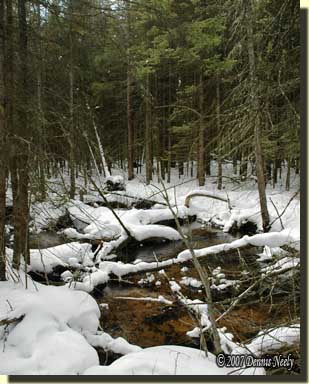
The babbling creek, littered with logs and tree tops.The picture of that little creek is a favorite in my photo album. It draws many questions at the various outdoor shows where we set up a demonstration camp, mostly because there isn’t a traditional woodsman in the picture. It is simply a pleasing landscape that generates curiosity. When I posted that image on “Snapshot Saturday,” it drew a number of comments and generated several emails.

I often use the “bobcat dunking” story to illustrate the versatility and warmth of the natural fibers and how the clothing served our forefathers well. The tale also acts as a focal point for comparing and contrasting modern hunting clothes with those of our hunter heroes. And many times, today’s hunters walk away with a better understanding of possible options for keeping warm during a harsh, Great-Lakes winter outing.

During the morning, my moccasins kept breaking through the ice on the water collected between the cedar trees’ roots. That is a common occurrence, and one that I rarely give a second thought to. If water happens to get past the tied flaps, the wool wicks it away, as I told Randy. That is not to say that I am not cautious about getting soaked, but only that I don’t obsess about keeping dry at all costs.

And to be sure, there are many historical references to getting wet and suffering hypothermia, or just plain succumbing to the cold. Perhaps one of the most telling is in the journal of John Tanner:

“…we came to a small creek of salt water, and on the summit of a little hill by the side of it, we saw a man sitting. We went up to him, but he gave no answer to our questions. We then took hold and tried to rouse him by shaking, but we found him stiffened by the cold, and when we took our hands off him, he tumbled to the ground as if he had been frozen entirely stiff…We tried all the means in our power to resuscitate him, but all in vain…” (Tanner, 80)

Like many of the old journals, Tanner mentions stripping off moccasins and leggins when encountering a stream or creek, and there is no pressing need for an immediate crossing. Yet, he spoke of the rigid protocol followed in the initiation of young warriors:

“…They must, if possible, avoid wetting their feet, but if they are ever compelled to wade through a swamp, or to cross a stream, they must keep their clothes dry, and whip their legs with bushes or grass when they come out of the water…” (Ibid, 109)

Like Tanner, Meshach Browning seems to emphasize the importance of the situation’s urgency. Caught up the midst of a winter chase, Browning discovered snow wet his priming. Wishing to finish off “a large buck,” the valiant woodsman waded into a creek of unknown size:

 “…while the faithful dog was holding the buck by the nose, I drew my hunting-knife from  my belt and made a desperate pitch at the heart of the infuriated beast, which laid him out dead in the creek…My friend and myself were both wet to the knees…” (Browning, 29)

Again, in late fall, Browning is confronted with a river crossing, but follows a different course, dictated by ample time.

“On the morning when the first snow fell that season, I rose early, intending to hunt on the west side of the Great Yough river. I went to the river, which, being pretty well up, the water reached about half-way up my thigh. I took off my pants and moccasins, waded over, and after again putting on my clothes, I felt first-rate… (Ibid, 250)

On the one hand, I find Browning’s last comment, “I felt first-rate,” interesting. It sounds like the early-morning dip left the famed woodsman invigorated. On the other hand, his assessment doesn’t surprise me, because I understand the physical sensations associated with that experience. In essence, the creek dunking on the bobcat hunt is period-correct, a key to the past and a point of kinship shared with more than one hunter hero.

Give traditional black powder hunting a try, be safe and may God bless you.
Posted in Bobcat Hunts, General | Tagged , , , , , , , , | 4 Comments

The Jake Died Thrice

“Jay!”

The blue jay cried out but once. The alarm seemed halfhearted and without authority. After a pause, my elk moccasins whispered along the familiar trail. The blue jay watched. The empty Northwest gun hung heavy in my right hand. A cool breeze whispered in the tops of the cedar trees, sounding like a gentle gasp of unexpected delight. I paused at the fallen cedar tree, just as I had on that gray morning, back in December of 1795.

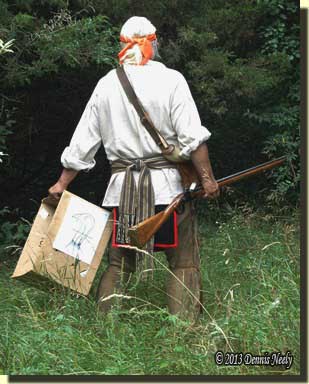
The traditional woodsman leaving the road and heading downhill, carrying the target box and his Northwest gun.On that day, barren branches made the course easy, but now a sea of green leaves flittered, obscuring the path to the oak where the grape vine grew. As I crested the little knoll, a cedar tree’s dead branch scratched across the cardboard box I carried in my left hand. A skeleton-like twig grasped the open side, tugging it back. I stopped, not wishing to tear the precious target.

As I unhooked the twig, I realized I was rushing. My mind had filled with the excitement of that morning. The rhythmic clucking of wild turkeys echoed in my subconscious. The same tingle ran up my spine and tweaked my neck hairs. I remembered the two crisp “arks,” and the unmistakable thrashing of big wings leaving the roost. As I stood beside the oak, I relived the young hen’s swooping descent as it winged across the big swamp and thumped into the leaves, fifteen or so paces to the north.

I have no idea how many spring and fall turkey seasons I sat and dreamed about a roosted bird taking flight and landing within “Old Turkey Feathers’” effective range. Time and time again, in my mind’s eye at least, I was up to the challenge, mounting the smooth-bored firelock and unleashing the death bees with the skill and efficiency of Josiah Hunt or John Tanner or Meshach Browning.  But when the moment of truth came, a hefty splash of cold water washed away those follies.

Fancy Meets Reality

On that morning, the Northwest gun held a single death sphere, not the bees, and turkey season had come and gone a month before. With the frizzen up and the hammer down, I remembered rolling the trade gun to scatter the pan’s gunpowder—legally unloading the piece. By then, the turtle sight was easing toward the hen’s eye, but she caught the motion and ran uphill. The harsh failure in that fleeting pristine moment proved a bitter pill.

For me, the wilderness classroom is always in session. The brass lead holder scribbled a loose account of the happening as I leaned back against the oak and sulked. I couldn’t believe it when I heard another string of “arks” coming from the same tree where the hen once roosted. I don’t even remember dropping the leather envelope that holds the journal pages or the porta-crayon. The hammer was down, the pan dumped and the butt stock was halfway to my shoulder before the jake took wing.

The turtle sight caught him as he flew straight at me. The bronze streak banked left. I remember my mind yelling “NOW!” as the jake coasted from behind a cedar tree. I honestly believe I could have made that shot with a round ball. It wasn’t the first time I have been in that situation. In the past, I have wrestled with finding a way to duplicate such a situation, to test if the 18th-century me is truly capable of making that shot, but I have never come up with a safe alternative. On that morning, it didn’t matter.

The jake landed a few paces closer than the hen, and like the hen, he stretched his neck high. I recall having time to line up the turtle sight with the tang screw, and in a second the voice in my head yelled “NOW!” The unsuspecting wild turkey took two steps, then paused and looked uphill. “NOW!” After a couple more steps a bird putted uphill. The jake froze. The turtle sight dallied on his eye before the voice unleashed the third and final death sphere. I swear I could smell burnt gunpowder and see the white smoke drift over where that jake once stood.

Fulfilling a Promise

Quiet reflection filled the days that followed. A lingering curiosity kept prodding and I spent a lot of time thinking about Meshach Browning’s wife Mary asking him “to bring home some young turkeys for supper” when her eldest sister came to visit:

“Into the glades I went, where I soon saw three or four old turkeys, with perhaps thirty or forty young ones. I sent Watch [his dog] after them, but they flew into the low white-oak trees; and when I would walk fast, as if I was going past them, they would sit as still as they could, for me to pass on; but after walking twelve or fifteen steps, I would stop and shoot off their heads. I thus kept on till I had shot off the heads of nine young turkeys… (Browning, 122)

The first hen provided a valuable lesson in the wilderness classroom. Thinking through the situation, a body shot was the only reasonable possibility, if such a choice were legal under modern game regulations. But keeping in character, that course was bound to damage valuable table fare, which is why Browning took head shots. In hindsight, the importance of the hen rested in the sequence of calls that preceded the fly down.

The jake represented a second chance. For once, I learned from the hen and was better prepared when I heard those two sharp clucks. Legally unloaded and up, my mind chose a wing shot first. After landing, the jake had nary an inkling of my alter ego’s presence, because there was no barrel swing to detect; the turtle sight had a firm grasp of his eye.

In the next four or so steps the unknowing youngster afforded not one, but three opportunities for the historical me to feed my family in the manner of Meshach Browning. Before deer season ended, I promised myself I would return with a turkey-head target and answer the pesky “what if” question: “Could I make the head shots with ‘Old Turkey Feathers?’”

Where I sat that morning is a bit remote. Dragging a portable target frame up and down the east slope of the big ridge is not a good choice, and certainly not necessary for what I had in mind. A small cardboard box with a life-sized, turkey head target stapled on one side would serve just fine. At the last minute, I decided to set the box in line with where the jake stood, but at the hen’s distance. I reasoned I might as well find out if I could make the shot on both birds.

After loading, I sat and took aim, but the thrill of that pristine moment proved lacking, the shot too easy, too much like target shooting at the range. I let the Northwest gun down, closed my eyes and remembered the two clucks. I intentionally increased my breathing. When I heard the wings flap, instead of dumping the pan, I shouldered the gun and swung on the imaginary jake as it cleared the cedar tree. It took three tries to bring my heart rate up, to simulate that 18th-century instant. On the fourth try, the turtle sight caught the jake’s eye. My arteries pulsed. As on that morning I took quick aim, long enough to be aware of aligning the sights.

“Kla-whoosh-BOOM!”

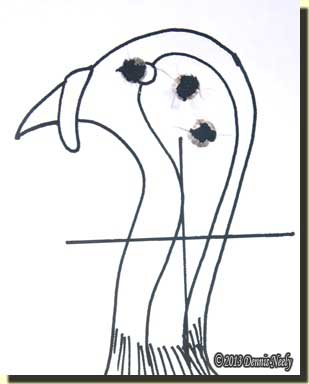
The turkey head target showing the three shots.I smelled the joyous stench of spent gunpowder, for real this time. Letting the smoothbore down a tad, I peered through the white, roiling smoke. The death sphere left a black hole in front of the jake’s eye. My left hand exhibited a noticeable tremor as I dumped another charge of powder down the barrel. I kept breathing shallow, duplicating the exhilaration I felt last fall after the death bees swarmed about a fine wild turkey. Not wishing to lose the emotion of the moment, I sat, closed my eyes and swung again. The turtle sight clawed at the gaping hole in front of the jake’s eye .

“Kla-whoosh-BOOM!” The blast echoed up and down the big swamp. I think a blue jay started screaming up the hill. I realized I was breathing harder, perhaps from the induced excitement, but I think more from the fact that the second hole, at the base of the jake’s skull, shouted that I almost missed. I fought the urge to settle myself down as the wiping stick rammed the third lead ball firm. I dropped to my seat and again heard the thrashing, rhythmic wing beats.

“Kla-whoosh-BOOM!”

On a pleasant August afternoon, back in December of 1795, a thick white smoke hung heavy over the spot where a young wild turkey once landed. The lingering “what if” question of that 18th-century circumstance found an answer: the jake died thrice.

Give traditional black powder hunting a try, be safe and may God bless you.
Posted in Turkey Hunts, Wilderness Classroom | Tagged , , , , , , , , | 1 Comment

A Magnificent Memory

A gray nose poked from the deep green grass. A cunning eye, attentive ears and a sleek, lean body burst from the left. The Jeep’s brake pads gripped the rotors firm, but not hard enough to squeal tires. A second wolf, a bit smaller than the first, appeared. Both looked straight at me as if questioning my intrusion into their territory. Neither animal hesitated or broke stride. In a matter of heartbeats the wolves melted into the lush underbrush that hugged the right roadside.

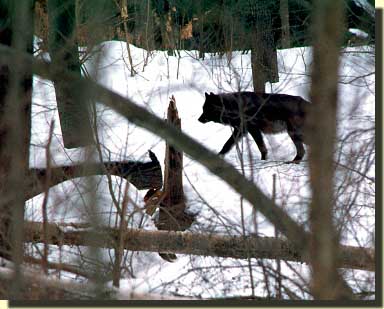
A Michigan wolf in the winter forest.

Wolf photo courtesy of Michigan Department of Natural Resources Photographer David Kenyon.

We traveled a short distance before either of us said a word, other than “wolves.” Tami commented about how it was “3:30 in the afternoon on a bright and sunny day.” It was then we both thought about the Nikon sitting on the back seat. As married couples do, I answered her unspoken statement with a reassurance that the wolves came and went so fast neither of us could have gotten a picture. The chance meeting was destined to fall in the magnificent memory category for both of us.

We were in route to the Michigan Outdoor Writers Association dedication ceremony for the Ernest Hemingway historical marker at the East Branch of the Fox River Forest Campground, located on M-77, eight miles north of Seney, in Michigan’s Upper Peninsula. In 1919, Hemingway rode the train into Seney, then hiked to the Fox to camp and fish. His famous short story, “Big Two-Hearted River,” is based on that fishing trip.

A Couple of Firsts

That afternoon turned out to be special. I wasn’t dressed in 18th-century garb or toting “Old Turkey Feathers,” but outdoor experiences are like that. On the one hand, we had a great time at the dedication—we saw new country, made new friends and reconnected with old ones. A few feet away, down over the cut bank, the Little Fox River gurgled on its way throughout the speeches and stories, just as it did before and will after.

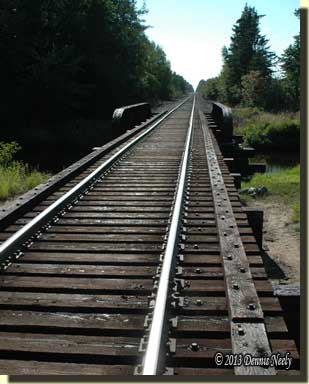
Looking down the rails to the west of Seney, Michigan.When the festivities ended, we all quietly, almost reverently, dispersed. I had reread “Big Two-Hearted River” the week before, so the historian in me wanted to see the Seney train station and walk the tracks a ways. I was hoping to experience the same kinship with Hemingway that I feel with my hunter heroes, and I did. If I had the time, I suppose I would like to try traditional fly fishing—I’m sure there are fishers out there who do that.

On the other hand, the brief encounter with the wolves was also a first for Tami and I, the first time either of us have seen wolves in the wild. I’ve seen fresh wolf prints on a sandy two-track not far out of Escanaba, but never seen the real deal. That’s not surprising, because I spend the vast majority of my woodland hours on the North-Forty. I’m happy with that, and have been for all my live. A person grows to love a piece of ground, and one of the attractions of that love affair is the constant change and newness each excursion offers.

The physical changes that mark a given piece of property happen gradually, and most hunters, traditional or modern, never give them much mind. Only when we catch ourselves telling stories of what the lay of the land was like “back in the 1950s, or 1960s, or 1970s” do we come to realize the land has evolved. Seeing the wolves was such revelation.

One of my first mentors was Joseph Doddridge. Like so many traditional hunters, I read over his musings about the wolf but failed to assimilate it in my historical persona—wolves were not relevant to my 18th-century experience, in part, I think, because I lacked 20th- or 21st-century knowledge of wolves. And even Doddridge, looking back in 1824, spoke of wolves more from memory.

“The wolves, formerly so numerous, and so destructive to the cattle, are now seldom heard of in our older settlements…” (Doddridge, 57-58)

As my research progressed and focused more on the North-Forty, I found myself reading the early accounts of the pioneers who settled in Jackson County, Michigan. The Reverend Asahel A. King wrote:

“The wolves used to howl terribly at night. In the winter of 1837 they killed and ate an Indian, near the corner of Tompkins, Eaton Rapids, Springport and Onondaga townships [the northwest intersection of Jackson County with Eaton and Ingham Counties]. He backed up against a tree and fought with his hatchet until he killed seven wolves; then he was overpowered. His hatchet, some of his clothing and part of his body and the wolves were soon found. Many others made very narrow escapes.” (History of Jackson County, 199 – 200)

A hop, skip and a jump west of the North-Forty, Mrs. M. W. Clapp echoed King’s statement about the wolves howling at night, also in 1837:

“…the wolves and screech-owls would sometimes make night hideous…” (Ibid, 204)

“Six Months Among…Wolves”

And then there is Darius Cook’s narrative, appropriately titled Six Months Among Indians, Wolves and Wild Animals, in the Winter of 1839 and 1840. I passed over Cook’s writings based on the fact the time period did not correspond to my 1790-era persona. I have come to the opinion that sometimes the well-meaning emphasis on limiting one’s research to a specific time period, geographical location and station in life creates a vision pattern that distorts the overall perception of one’s persona.

A generation after my beloved 1790s, a young journalist by the name of Darius Cook suffered a bout of ill health. A doctor happened into the newsroom at the Kalamazoo Gazette. After listening to Cook’s symptoms, Dr. Starkweather prescribed a remedy:

“You want fresh air and exercise. Go live with the Indians, sleep in their wigwams on a bed of leaves, hunt in the forests, live as they live, and the chances are you will recover. Pure air, rarefied by the trees in the forest, will do any man good.” (Cook, 16)

Darius Cook enlisted a companion, James Rhodes, and the two set out on a journey that landed them in “an old log shingle shanty on land owned by a Mr. Seymour,” about four miles from the headwaters of the Rabbit River in Allegan County. (Ibid,19) Chapter after chapter relate the constant danger and threat involved with living in the wilderness with packs of wolves and panthers. Here again, Cook’s experience mirrored that of the Reverend King and Mrs. Clapp:

“…In the deep snow our progress was slow. We heard the growl of a wolf in the rear. It was dark and gloomy. We grasped the limb of a small beech tree and leaped into its branches and not too soon, for a big wolf was near us…During this time wolves were all around but could not be seen…There was not a night the wolves did not follow us to our lodge as seen by their tracks in the morning.” (Ibid, 53)

As I consider a new persona, based on a strong Native American influence, I could not help but notice the visit of Adaniram Judson, a Pottawatomi interpreter, to Cook’s cabin:

“…his bed was a deer skin, with a wolf skin for a pillow.” (Ibid, 24)

The quest of this traditional woodsman is to answer a not-so-simple question: “What was it really like to hunt, live and survive in the Old Northwest Territory?”

This joyous journey is endless. The path to yesteryear is littered with magnificent memories. And some, like the chance sighting of two wolves, turn one’s perceptions upside down, but the goal of this glorious endeavor is a better understanding of the truth. Hopefully, today’s knowledge is better than yesterday’s and tomorrow’s revelations will be better than today’s.

Give traditional black powder hunting a try, be safe and may God bless you.
Posted in General | Tagged , , , , , , , | 2 Comments

An Alternate Choice

Light rain spit. The sky appeared thick, gray and ominous. The air smelled sticky and humid. My bare shoulders and upper arms felt sweaty and damp as I tugged at the heel of my left buckskin moccasin, one of a pair I sewed so many years ago, but never wore. By the time I tied the strap from the second leather leggin to the thong about my waist, the rain was falling steady.

In a fit of mild anger, I pulled the osnaburg trade shirt over my head with a huff. The soft fabric stuck to my shoulders; the cuffs fell well short of my wrists. I rolled my shoulders back and forth and shook my arms until the sleeves dropped free. I never tied the orange scarf about my head, because the clouds opened up.

Water splattered all about. A cool breeze brought an involuntary shiver. Raindrops plummeted straight down like ten thousand, nay, a hundred times ten-thousand fresh-cast, shining silver, buck shot orbs, drumming an unmistakable death knell for that morning’s 1795 romp.

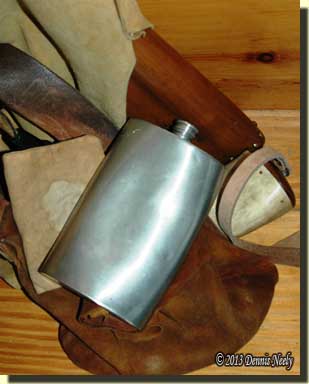
The Northwest gun, shot pouch, horn, pewter flask and walnut meats.At first I stepped under the eaves in a vain attempt to avoid the fury. In my folly, I told myself the storm would pass in but a few minutes. Soaked and frustrated, I retreated into the house and watched through the window as the rain thundered on the roof. The Northwest gun leaned in the corner, still in its leather cover. The shot pouch and horn lay beside the butt stock. The pewter flask, filled with cool water, and a small sack of walnut meats rested on the pouch.

Time travels are few and far between this summer. Life’s other necessities demand the fore, much to my displeasure. What can an 18th-century child do?

From the start, I knew I only had two, maybe three hours at best. Other than chasing woodchucks, nothing was in season. Sitting in wet grass with “Old Turkey Feathers’” muzzle pointed at an empty hole offered no appeal to me. In those times, I tend to seek alternate scenarios, and on that morning the intention was a good go at “spies and scouts.”

“Spies and Scouts”

Spies and scouts started quite by accident. In my early years as a traditional black powder hunter, Holstein heifers grazed on the North-Forty. The farm fences needed constant checking and repair, and the job of “walking fences” fell on my shoulders, because I was the one who spent the most time “in the woods,” as father used to say. Not recognizing the history-based opportunity fence checking offered, I would cover as much ground as I could, which left more time to devote to hunting.

In the mid-1980s, I started reading Mark Baker’s “A Pilgrim’s Journey” in MUZZLELOADER, and my perspective on my traditional hunts began to change. Over time, Baker’s writings helped me realize that it wasn’t good enough to just change clothes and romp through the woods with a muzzleloader—one had to develop an 18th-century mindset to guide each jaunt in the glade.

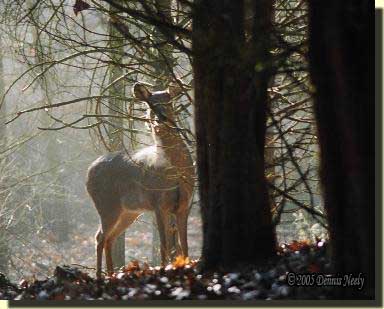
A doe questions a traditional woodsman's shape.Not long after the herd was sold I began adding a healthy dose of stealth to the fence checking, except the need to stay close to the fences was gone, too. There weren’t many turkeys on the farm at that time, so the whitetails took on the role of British spies and scouts. For me, spies and scouts became a learning exercise in the wilderness classroom, a sort of forest game where you “lived” or “died” on your “own hook,” as Baker so often wrote.

The point was to traverse ground from one point to another without being “caught.” If a deer scented this traditional woodsman or in any way showed knowledge of my presence, I was caught and presumed killed. In later years, the same held true for the wild turkeys. Because of their keen eyesight, quick “putts” and hasty retreats, I often thought of them as Native American scouts accompanying a less aware British patrol.

On the surface, the game seems silly, but skirting the big swamp or the nasty thicket in an attempt to deliver an important message usually produces a number of heart-pounding encounters with cautious old does or wily mother hens. Survival is harder than one might think, even when one sits in hopes of avoiding detection from an approaching English spy.

Using the Time Wisely

At any rate, my hoped for spies and scouts never happened. To say the least, I was disappointed, not only from the standpoint of not making it to the woods, but also because that outing was supposed include another “get acquainted” sojourn with my new persona: a native captive returned to white society.

During the winter, I had grand designs on completing the basic regalia for this new persona by spring turkey season. That never happened, and deep down, I knew it wouldn’t. The alternative path was to repurpose some of my existing clothing and accoutrements for the time being while I worked on replacements.

By necessity, I had to use the old buckskin moccasins, because my elk moccasins are worn out. I decided to use my hunt-stained leather leggins, a not-so-period-correct wool breechclout, a hand sewn osnaburg trade shirt, a loom-woven wool sash and a head scarf worn turban style. My current shot pouch would have to do, along with the powder horn, too. A part of choosing this new persona was the fact that the Northwest gun fit.

In going through my hunting clothing, I set a medium-weight linen trade shirt aside. I think it’s about 14 years old, but doesn’t show much wear. I use it, or did, on winter hunts as a second shirt. It is machine sewn, which I am trying to get away from, but I thought it would work as an over shirt for my new persona.

So on that rainy morning, I slipped out of my wet clothes and dug out the linen shirt. The time was set aside for living history, and I intended to use it. The collar and cuffs are a tad wider than was common in the 1790s, but I can live with that, for now. As I examined the shirt closer, I saw that it had some pulled seams and a frayed neck line. I went about repairing the damage with a back stitch.

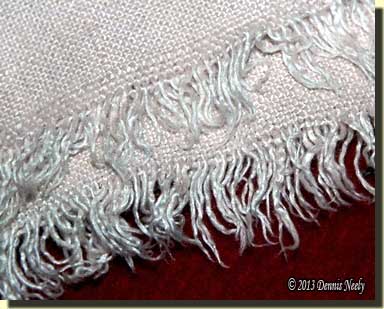
The frayed hem's fringe was once considered period-correct, but now represented poor research.

The frayed hem’s fringe was once considered period-correct, but now represented reliance on poor research.

The most glaring defect was the unraveled hem. When the shirt was first sewn, frayed hems were common and accepted. That has changed, and a sewn hem is now considered period-correct for this garment. It didn’t take much to trim off the threads and square up the hem. Even though the shirt shows machine sewing, I used a hem stitch, if for no other reason than practice. The stitching consumed more than the allotted time. I found it relaxing and enjoyable. Thankfully the rain continued, reinforcing my alternate choice.

As I worked, I noticed the fabric had yellowed a bit. From experience, I know my character would prefer an over shirt that is darker in color. I envision the shirt well stained, and perhaps that will come when it is used as an outer garment. I rolled the shirt about in my hands, wanting to keep going. I started to consider what to dye it with, and I longed to make a trip to the forest to begin gathering natural dye stuff, but that will have to wait for another drier day…

Give traditional black powder hunting a try, be safe and may God bless you.
Posted in Clothing & Accoutrements, Scenarios | Tagged , , , , , , , , | Comments Off on An Alternate Choice

Exhausting All Possibilities

The search resumed at dawn. Frost-tipped cedar boughs dotted the steep hillside. Night’s cold, clear sky turned azure, and in a short while, yellow streaks of sunlight crept over the little valley. On that crisp November morn, I made no attempt to cross time’s threshold.

The rule on the North-Forty is that all hunting stops when we have an unrecovered deer, or any game, for that matter. All hunters put forth their best effort to be certain the deer is either not hit, or if blood is drawn or hair found, that the wound is not mortal and the animal will survive. No one takes a stand or begins a still-hunt until that task is completed.

No matter how careful we are as hunters, these situations occur. We work to minimize them, of course, but whether modern or traditional, all hunters bear a responsibility to the game to make sure and not waste a valuable resource.

There can be too many people in a chase, which actually hampers progress and destroys sign, but in this case, there were just Andrew and myself. Four of us searched with the living historian who took the errant shot until after dark, but he had to return home. To say the least, he was pretty upset, to say nothing of reluctant to leave.

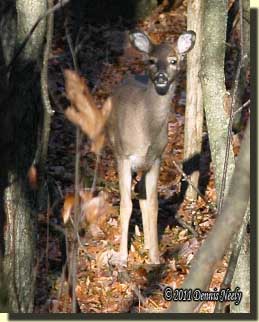
The young deer walked on the trail.The doe wandered by the traditional woodsman’s stand an hour before dark. He said at first she was at the outer limit of his effective distance, but as he waited, she angled closer. After the fact, he paced the distance at 38 steps. Being a veteran hunter, he chastised himself unmercifully for flinching as he pulled the trigger. He said he thought he was calm when he cocked the firelock’s hammer. He was sure he saw leaves fly up behind the doe, but we could not find the musket ball’s skid mark.

The doe loped off, and the woodsman made a mental note of his last sighting of the waving white tail. Unfortunately, that location was at the juncture of a half dozen trails that crossed into the valley or followed the hill’s rough contours. As we scoured the area where she stood when he took the shot, he scowled and said, “I think she stopped and looked back where I last saw her.” Evening slid into stumbling blackness as we finished looking for evidence in that area, too. We found nothing and were forced to withdraw.

About an hour after we started, Andrew stood in the uphill trail with his hands on his hips. As I peered up from the lower trail, the sun turned him into a dark silhouette. From his demeanor, I knew what was on his mind. “Can you tell me how many deer walked on this hill last night?” I asked.

“No, can you?” he answered with a clear frustration in his voice.

“No, and that is the point,” I said. “We have no way of knowing if that doe took your trail, or mine, or one of the others, so we keep looking until we find something or nothing. We’ll quit when we’re satisfied we’ve exhausted all possibilities.”

A Woodland Learning Experience

My son-in-laws are quick to pitch in when we track deer, regardless of the circumstance. Their eyes are better than mine, plus, for me, it affords an opportunity to pass on years of hunting experience. Most deer don’t make it very far. After a game animal is tagged and dressed, I always backtrack to learn all I can from the trail. I stand and try to see what the whitetail saw and understand why it took that particular course of flight. As impatient as he sometimes gets, Andrew has picked up on this practice.

As we unravel a deer’s final journey, our discussions often cover basic woodcraft skills. While Andrew straddled the upper trail, I told him about Josiah Hunt, and how he would leave the fort in the dead of night to feed the garrisoned troops and how he was revered among the warriors for his great stealth.

Andrew relaxed a bit with that story and started asking questions. We talked about clearing the ground both for releasing the forest’s natural scents and so a hunter can reposition without making noise. I spoke about hunters who clear a nest on the ground, then leave it open when they depart the area, rather than returning the nest to its original state. I offered an 18th-century perspective, then told of the doe that stood for almost an hour, hidden in the edge of the thicket as it concentrated on the hollowed-out mess where a modern hunter once sat.

“Take Nothing But Memories…”

For some reason, the old sign that once hung on the main gate at the National Muzzle Loading Rifle Association’s Walter M. Cline Range at Friendship, Indiana, came to mind. It read: “Take nothing but memories, leave nothing but footprints.”

The quote is attributed to various authors, and often listed as “unknown.” Setting that issue aside, the point that I made with Andrew was that this is how the land and its inhabitants should be treated. The only exception is the taking of game or the harvesting of natural resources consistent with a sound property management plan and state and federal game regulations.

Following a buck's trail across the big swamp.I went on to tell Andrew I was walking beside the trail I was on, intentionally keeping my moccasin prints in the short, soft grass, rather than on the churned up earth. Like Josiah Hunt, I was endeavoring to minimize my presence in the wilderness. In effect, I strive to not leave any footprints or physical evidence of being in that spot, whether as a 1790s time traveler, or a modern hunter searching for a lost deer.

As we walked the last two trails, I emphasized the importance to me of the phrase, “Take nothing but memories.” This is one of many driving forces behind my passion for traditional black powder hunting. The reality of fair chase is that we succeed only now and then, but that most times the game we pursue holds the upper hand and thus escapes unharmed and unfettered.

At the various outdoor shows we attend, we are hearing more and more hunters, mostly the thirty-somethings and under, complain about not stacking up game on every outing. This is not what hunting is all about, but rather the end result of the “gadgeteers,” as Aldo Leopold called them, hawking their wares. Please don’t misunderstand, there is no faulting the providing of products to meet the modern hunter’s needs and marketing them in a responsible manner. But in my opinion, the pendulum has swung too far to one side, and thus the gadgeteer’s salesmanship is creating unreasonable expectations, expectations that tend to drive young hunters from the sport.

In sharp contrast, the traditional hunting philosophy emphasizes enjoying every second of the hunt, and if game is taken, well, that is just an added bonus. In addition, the methodology also focuses on constant woodland learning and skill development, which provides a lifetime of enjoyable opportunities.

Our separate trails merged. I noticed he was walking to the side of his earthen path. Andrew looked at me and said there was no way the doe was hit. We had exhausted all possibilities and arrived at a common mind. We didn’t recover a deer, because there was no deer to recover. Yet even though some folks might think the morning was a bust, we both came away with a wonderful memory.

“Take nothing but memories, leave nothing but footprints,” be safe and may God bless you.

Posted in Deer Hunts, Skills | Tagged , , , , , , , , | 1 Comment

My Mouth Grew Dry

The soft cluck left little doubt. The faint “arrkk,” uttered in the forest’s somber stillness, fixed my attention on the crest of the ridge to the east. A yellow maple leaf whipsawed side to side. Others followed. The morning’s wispy breeze carried the smell of rain.

Like a spider overpowering its prey, the fingers of my right hand gathered the orange scarf from atop my head, crumpled it in a ball, then stashed it away, inside the lap of the linen hunting shirt. I feared the movement betrayed my deathly presence. Another cluck assuaged a humble woodsman’s anxious heart. Thoughts of fresh game shifted from squirrels to a wild turkey.

Sunlight bathes the wooded ridge.Gray clouds came and went. Light rays raced across the forest floor, whisked away by fast-moving shadows. A fox squirrel teased, high up in a distant red oak on that ridge. As the sunlight changed, I longed to garner a glimpse of a turkey’s bronze feathers or gray head. Minutes dragged by.

The two clucks charged the cool morning air with a common dilemma: advance or remain hidden. My eyes hacked away at the underbrush, but to no avail. Prudence dictated the later choice, so I remained within the confines of my woodland fort, a tangled oak tree top downed in a blustery rainstorm.

On two prior occasions I witnessed from afar as morning turkeys crossed over the ridge, disappeared in the valley and reappeared, following a doe trail that eventually passed within range of the tree top. I sat tight, content to watch the leaves fall. Another twenty minutes or so ticked away before I spied the first bird, a large hen that spent more time pecking and scratching than looking for danger.

As I rested the Northwest gun on the limb in front of me and snuggled the butt under my right arm, I played through the most likely scenarios for the hoped-for shot. Before sitting, I paced off 28 steps, the effective distance of “Old Turkey Feathers,” and noted a crooked cherry sapling as the first location for the unsuspecting hen’s demise.

When the last of the six birds disappeared, the firelock’s brass butt plate settled against my shoulder. The old hen was the first over the rise, zigzagging beside the doe trail. I could taste the gravy flowing over a slab of white meat and smell the cornbread stuffing. I almost smirked as my mouth watered.

The lead hen stopped in the middle of a long, thigh-sized rotted log, just off the trail. Leaves and dirt flew about. The other five closed ranks, then spread out, rustling leaves with great abandon. The turtle sight lingered close to the big hen. I squinted and prayed in silence. “A clean kill, or a clean miss. Your will, O Lord.”

“Jay! Jay! Jay! Jay!” A blue jay screamed from a lower branch, maybe 30 paces to the south of the birds. The blue jay was the first I had heard in two mornings, and it startled me a bit, but not enough to cause me to wince or move.

The forest sentinel upset the two smaller turkeys, the ones digging at the far end of the log. Both raised straight up and leered to the south. One uttered a crisp “putt” as the other turned away. It took three deliberate steps, then putted, too. The old hen took notice. In a few heartbeats, all six stared to the south, as two more jays joined the fracas. The bird that first turned away was the first to run. My mouth grew dry as the little flock retreated with long, quick strides and sunlit bronze backs.

Taking Unnecessary Risks

There is no certainty in the 18th-century forest. Traditional black powder hunters are painfully aware of this universal truth. For me, the uncertainty is a big part of what draws me to this joyous pastime. And if we look, this uncertainty fills many of the old hunting tales, either addressed outright or alluded to.

Perhaps no other hunter exemplifies this more than Meshach Browning. That may be because he wrote down the whole story, the good and the bad, the successes and the failures, the triumph of the hunter’s spirit and its frailties, as well. There doesn’t seem to be a chapter where he doesn’t find himself in some sort of predicament, and his usual response is to draw his “large knife” and finish what he started.

Early on in their marriage, Browning’s wife, Mary, spoke of these uncertainties and the dangers that lurked in the forest.

“About the first of October, as I thought it was high time to take my dogs and gun a little, I asked Mary if she would stay at home by herself, or would go to my mother’s and stay, while I went hunting…I promised to return home before dark; and was about to start, when Mary said to me: ‘I feel afraid on your account, for I know you have neither fear nor care of yourself when among the wild beasts; and some day you will be crippled, if not killed. What would you do if you got in the claws of such a bear or panther as you killed last fall, or in the trap this spring? Meshach, they could tear you as easily as a cat would a mouse; and I beg you to take care and not get into their clutches.’

“I assured her that I had plenty of powder and balls; and that, if they attempted to run on me, they must take care of themselves; or, as they raised up to take hold of me, I would be sure to let out a part, at any rate, of what they had inside their black wallets. She said: ‘May God protect you!’ and I started.” (Browning, 90)

Browning came to a swamp and let his oldest dog take wind of the thicket.

“In he went; but he was scarcely out of my sight, when I heard the fight begin…” (Ibid, 91)

In the course of the pursuit, Browning came upon the treed bear. Upon seeing him, the bear dropped to the ground, choosing to take his chances with the dogs.

“I ran the muzzle of my gun against him, and sent a ball whizzing though the middle of his body, but too far back to save a hard fight…” (Ibid)

The bear and the dogs got in a mighty tussle, and then the uncertainty kicked in.

“I had lost my gun in the weeds, and I had no means of defending my dogs, except with a large knife in my belt, which I drew, but not till I vainly tried to find a club. My dogs were getting the worst of the battle; and while he had one of them on the ground, and was biting him badly, I ran up and made a lunge at him, but, like my shot, it struck him too far back, and only entered the liver…” (Ibid)

The bear released the dog and attempted to hide under a log. The dogs kept fighting the bear and the bear the dogs. When an opportunity presented itself:

“…I ran upon him with my knife, and dealt him two or three severe blows, which finished him…” (Ibid)

A traditonial woodsman enthralled with forest.So many aspects of this encounter of Browning’s beg attention, but the overall point I wish to draw from the passage is the uncertainty that exists in the glade and how we, as traditional woodsmen, tend to get caught up in the moment. In my case, I had that hen shot, dressed and cooked before it ever was within range. The folly of such thoughts is obvious, and we all succumb to them, now and again.

But the uncertainty also comes into play with regards to our own personal safety in the woods. While reading Browning’s exploits, I shudder at the unnecessary risks he took. His actions are simply not safe. He would be a fine candidate for having “Don’t try this at home” tattooed on his forehead; at the very least, Mary should have embroidered those words on his hunting shirt. And, I think, from her statements and constant concern, Mary was very much aware of the dangerous situations her husband put himself in, too. Wives know us better than we know ourselves.

Wisdom sometimes accompanies age, or so I’m told. At any rate, as traditional woodsmen, we all need to be ever vigilant with each detail and circumstance of our historical simulations. We are human, and we make mistakes, and with that in mind, I think it is important for every living historian, every traditional hunter, to keep safety first and foremost, at all times, not just when we are immersed in  a wondrous 18th-century adventure.

Perhaps age brought Browning to the error of his youthful ways when he wrote:

“I know now, and I knew then, that there was great danger in doing so, but if I undertook anything, I thought it must be accomplished; and if I got into a dangerous scrape, the greater the danger appeared, the more anxious I was to win the fight.” (Ibid, 180)

Think before you act, be safe and may God bless you.

Posted in Turkey Hunts, Worth thinking about... | Tagged , , , , , , , | 1 Comment

Mind if I Look?

“Do you mind if I take a look?” a traditional woodsman asked, lifting the leather strap of my shot pouch from “Old Turkey Feathers’” muzzle as it rested against a white oak tree. “I’d like to see what you carry.”

“Sure,” I replied, “but there are some extra patches and cards in there. I used that bag for a woodswalk a few weekends ago and I haven’t had a chance to clean it out,” I said.

“Mine’s a mess, too,” Fred said with a laugh as he lifted the buckskin bag’s flap and started examining each treasure as if it had just been unearthed from the sands at Fort Michilimackinac.  As Fred held the single wing-bone call in his fingers a funny look came across his face. “You aren’t going to write about this, are you? You won’t use my name?”

“Well, Fred, I can’t say that I won’t write about it sometime in the future.” And Fred, I guess I never answered your second question.

The Trade Gun Shooting Box

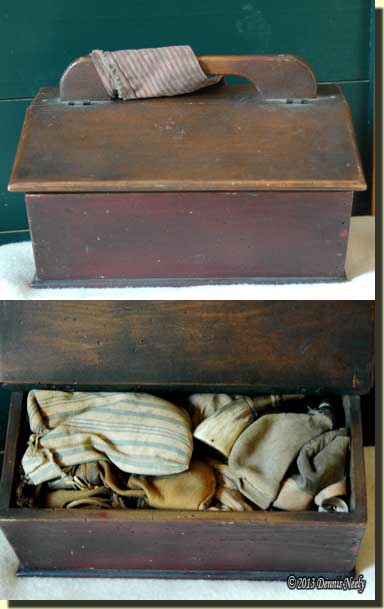
The closed shooting box on top and open below.As I lifted the shooting box’s lid, I thought of Fred and broke out laughing. If he thought my shot pouch was a mess, he should’ve been standing next to me at that moment. The box was so full that the lid wouldn’t close tight, and it hadn’t for some time. To the unknowing eye, the hodge-podge of cloth sacks, leather bags, tarnished tins and other necessities would certainly seem unorganized and confusing, but I knew each artifact by sight and most by feel.

In my mind, at least, I separate traditional black powder hunting from competitive shooting. Thus, the shooting box is supposed to be dedicated to shooting and the shot pouch to hunting, but somehow that just doesn’t seem to work out. Because I prefer the primitive side of the black powder shooting sports, my shot pouch often becomes a liaison between the two endeavors, never giving true justice to either activity. I tried to rectify the situation by dedicating my old beaded voyageur shot bag to competition.  That worked for a shoot or two, then I left it home, grabbing the hunting pouch out of habit.

I had hoped to make it to the range the other day, but life got in the way. That’s happened a lot in the last few years, and I know I’m not alone in that respect. When the time just isn’t there, a few minutes devoted to traditional hunting or shooting is better than nothing at all. I was feeling pretty down so on a whim I grabbed the box and hefted it up on the bench. At the very least, I reasoned, I can get it cleaned out and ready to go.

I built the shooting box after my first trip to the National Muzzle Loading Rifle Association’s National Championship in September of 1985. I camped in the primitive area, and even though everyone shot from the pouch, they always returned to camp and refilled their shot bags from a shooting box. At Friendship, the boxes I saw varied from a simple plastic tackle box to an ornate, hand-dovetailed oak beauty. I mulled my choices on the long drive home.

Growing up, we had a tool box grandpa Neely had made. We kept it in the farm shop. That box had a wood handle, two sloping sides and was open for easy access. It always held plumbing tools and fittings, plus a lifetime of dust equally dispersed in the bottom. I modified his design a bit and added a hinged lid. Grandpa Neely’s toolbox was well-worn. The outside had been painted at one time and was nicked and stained from a multitude of mishaps—displaying a “fine patina” as the antique collectors say.

I stained the inside of my shooting box a light brown and painted the outside burgundy. Much to my oldest daughter’s chagrin, I beat the daylights out of it with two old muskrat traps, a small chain and a few drops on the scrap steel pile. After staining the entire box dark brown, I added twenty years of wear with a judicious scrubbing using coarse steel wool soaked in mineral spirits, then coated it with a hand-rubbed application of varnish.

From the beginning, the shooting box was devoted to the trade gun. I wanted its contents to look old and well-used, so I sewed a sack to hold the pillow-ticking cleaning patches, a buckskin bag for the .610 round balls and bought a shiny tin for shooting patches. When Roger Rickabaugh and Max Vickery introduced me to Shaw’s Quail Walk, I added cloth sacks for fiber wads, .125 cards and over-the-shot cards, a kidney-shaped shot bag made of leather with a hand-carved basswood spout, and a half-pint Mason jar for wad lube. Cleaning tools got their own bag, and when the wad sacks didn’t work out so good, I bought three additional tins to set on the loading bench to keep the wads separated.

I won a small brass powder flask, filled it with 4Fg priming and tossed it in the box. A few pairs of earplugs followed, a pair of reproduction scissors and one or two short starters made it, too, along with a spare knapping hammer and a hand forged screwdriver. Tooth picks to plug the touch hole are in the bottom right corner and in the back left I keep a bag of flints. When I started priming from my regular powder horn, I relegated the old priming horn to the box so I knew right where it was.

What’s in the Box?

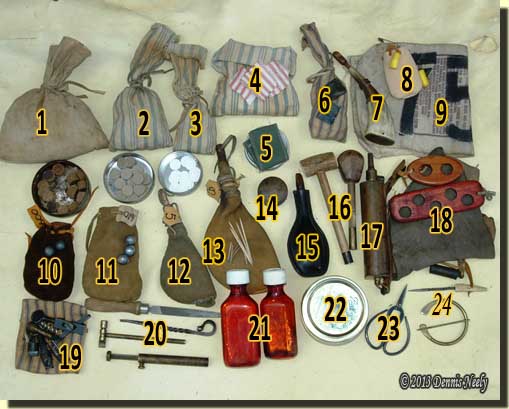
The first step in cleaning the shooting box was to pull everything out of it, and as I did, I decided to include a listing of what it currently contains. I thought this might satisfy Fred’s curiosity. Did I mention that he was concerned I might use his name?

Shooting_Box_Contents

  1. Sack containing fiber wads, with a tin of wads below
  2. Ditto for .125 over-the-powder cards
  3. Ditto for the over-the shot cards
  4. Sack of pre-cut cleaning patches
  5. Tin with pre-lubed, .007 cotton patch material
  6. Bag of trade gun flints
  7. The flat priming horn
  8. A buckskin bag with assorted ear plugs
  9. An old shot bag with my trap-range competitor’s number
  10. A leather bag holding about 50 of Tami’s .600 round balls
  11. Ditto for my .610 round balls
  12. A kidney-shaped shot pouch that holds about 15 charges
  13. Ditto that holds 30 charges, plus assorted tooth picks
  14. A brass container filled with bear grease lube
  15. A cowhide shot pouch made by Darrel Lang that holds about 10 charges
  16. Short starters
  17. A brass flask filled with 4Fg priming powder
  18. A cow’s knee (no longer carried in the shot pouch) with two loading blocks
  19. A sack of cleaning tools: worm, breech plug scraper, spare jag, bore brush, ball puller and mainspring vice
  20. Assorted tools: small file, turn screw, knapping hammer and adjustable powder measure
  21. Cleaning solvent and oil in ugly modern bottles
  22. Mason jar with lube solution for fiber wads
  23. Scissors
  24. Powder measure, vent pick and blanket pin

The mix of shooting necessities changes with experience, but that is the nature of the hobby. With the exception of the competitor’s number, bore solvent, oil and Mason jar, everything is close to period-correct and adds to the overall primitive impression of the box and its contents. I’ve tried period glassware, but the corks came out and I had a mess to clean up. But there is always room for improvement and a reason to go shopping.

Give traditional black powder hunting a try, be safe and may God bless you.
Posted in Clothing & Accoutrements | Tagged , , , , , , , , | Comments Off on Mind if I Look?